Fractions and Time Worksheets
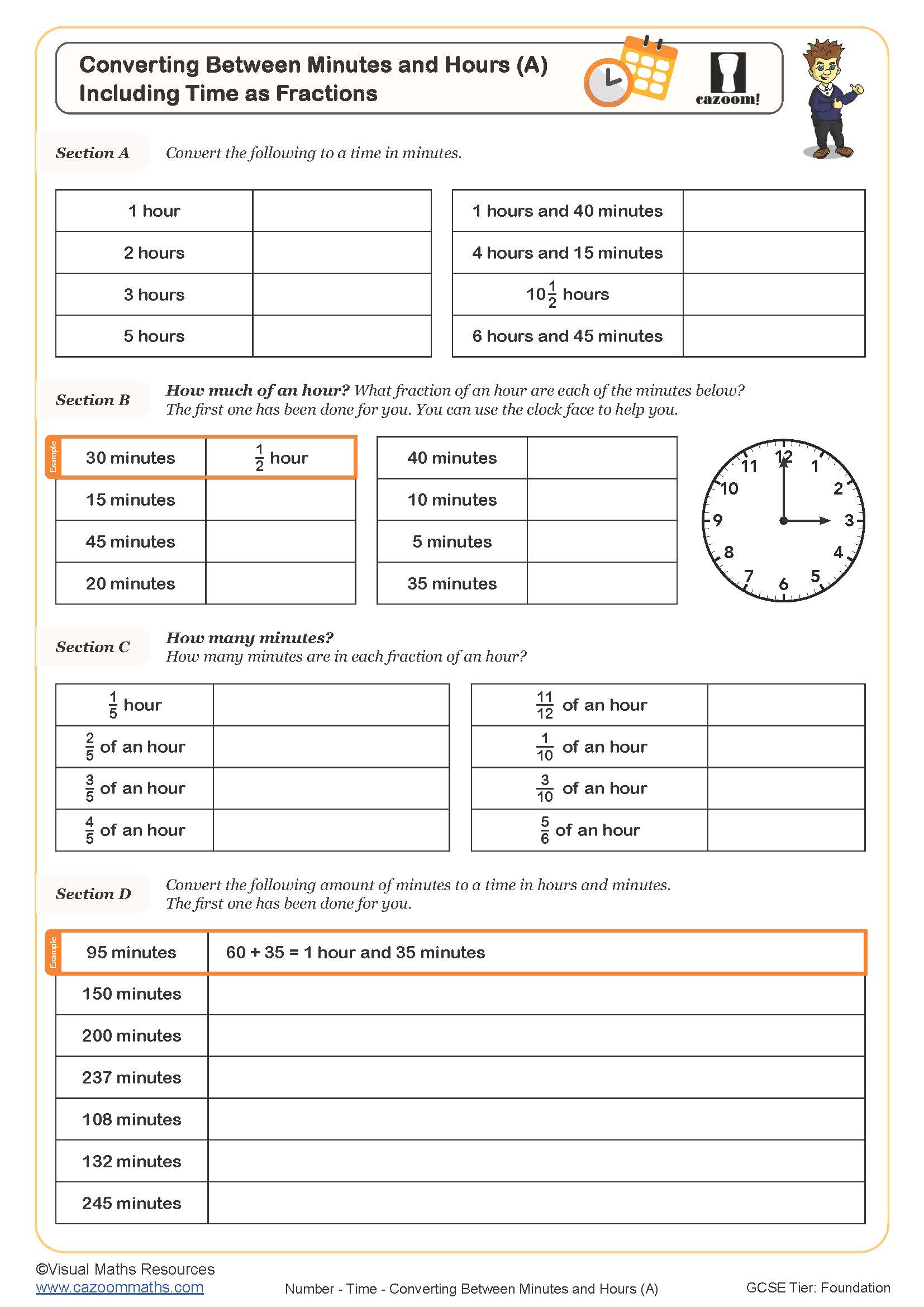
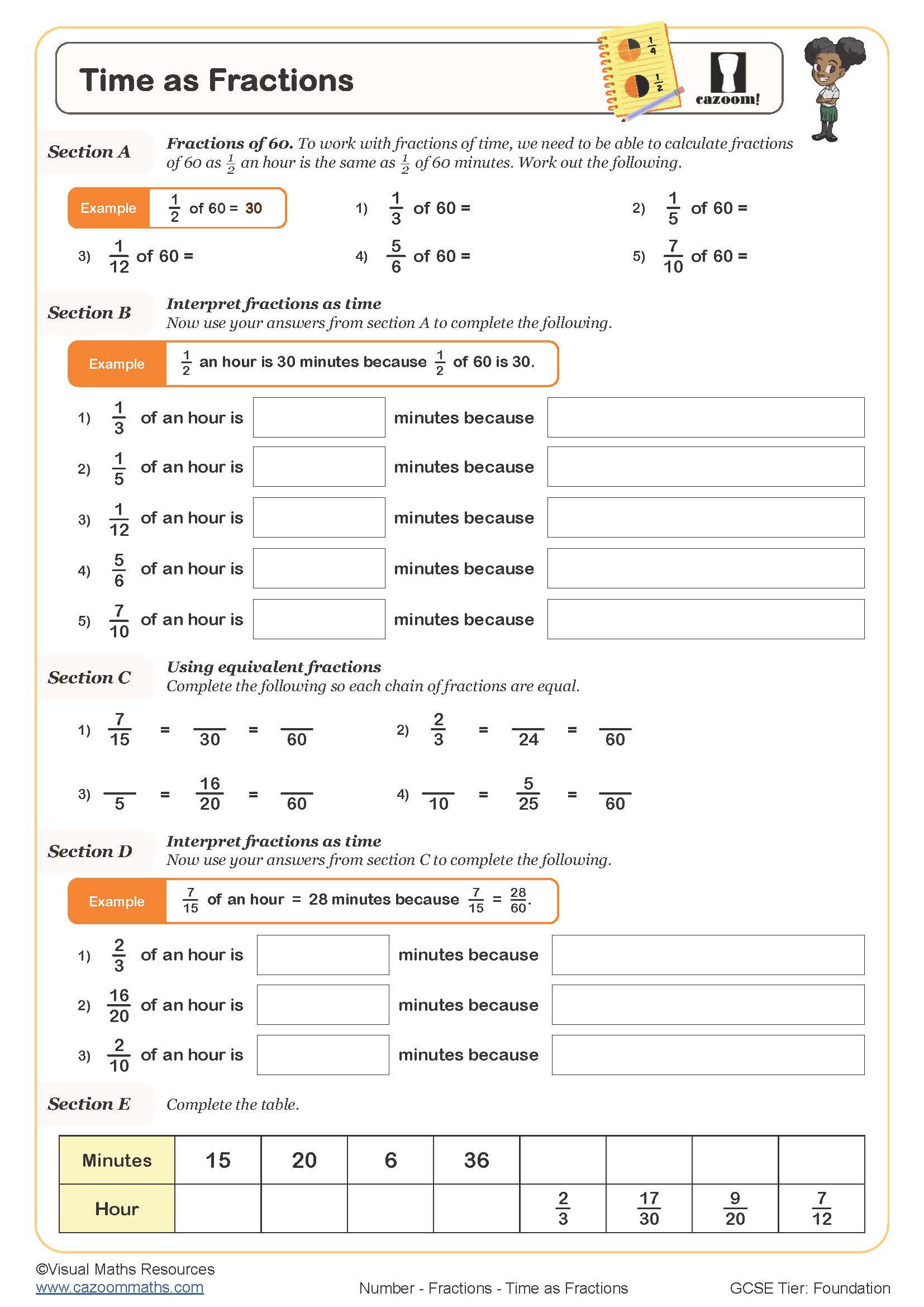
All worksheets are created by the team of experienced teachers at Cazoom Maths.
What are fractions of time and why do students find them challenging?
Fractions of time involve calculating portions of time intervals, such as finding three-quarters of an hour or two-fifths of 90 minutes. This skill requires students to combine their understanding of fractions with the non-decimal nature of time measurement, where 60 minutes equals one hour rather than the base-10 system they use elsewhere in maths. The topic appears throughout KS3 and becomes increasingly important for ratio problems and rate calculations at GCSE.
A common error occurs when students treat time as if it operates in base 10, calculating half an hour as 50 minutes because they halve 100. Another typical mistake happens when students correctly calculate a fraction of minutes but forget to convert answers back into hours and minutes format, writing 90 minutes instead of 1 hour 30 minutes. Exam mark schemes specifically penalise students who leave time answers in improper formats without appropriate conversions.
Which year groups cover fractions and time?
These worksheets target Year 7 and Year 8 students within Key Stage 3, where the National Curriculum expects students to apply fraction knowledge to measurement contexts including time. Year 7 typically introduces fractions of simple time periods such as hours and straightforward minute intervals, whilst building on upper KS2 foundations. The focus remains on unit fractions and common fractions with smaller denominators.
By Year 8, the complexity increases as students tackle fractions of mixed time periods, work with a wider range of denominators, and solve multi-step problems requiring both fraction manipulation and time conversions. Teachers notice progression when students move from calculating fractions of single units (like one hour) to more complex intervals such as finding five-eighths of 2 hours 40 minutes, which demands fluent conversion between hours and minutes alongside fraction operations.
How do you calculate fractions of time intervals?
Calculating fractions of time requires converting the time period into a single unit (usually minutes), performing the fraction calculation, then converting back to appropriate time format. For example, to find two-thirds of 1 hour 30 minutes, students first convert to 90 minutes, then calculate 90 ÷ 3 × 2 = 60 minutes, which equals 1 hour. The key skill involves recognising when to convert and maintaining accuracy throughout multi-step processes.
This skill connects directly to workplace time management and shift planning across numerous careers. Healthcare professionals calculate medication administration times using fractions of hourly intervals, whilst project managers in engineering and construction determine task durations as fractions of working days or weeks. Understanding fractions of time also underpins rate calculations in STEM fields, such as computing distances when objects travel for fractional time periods at constant speeds, linking fraction manipulation to kinematics and real-world problem solving.
How can these worksheets support classroom teaching?
The worksheets provide structured practice that builds from straightforward fraction of an hour problems towards more complex multi-step time calculations. Questions are sequenced to develop fluency with time conversions before introducing fraction manipulation, allowing students to consolidate each element before combining skills. The inclusion of answer sheets enables students to check their working independently, helping them identify exactly where errors occur in their calculation process.
Teachers regularly use these resources for targeted intervention with students who need additional practice beyond textbook exercises, particularly when preparing for assessments where time problems frequently appear. The worksheets work effectively as homework tasks that parents can support using the answer sheets, or as starter activities to diagnose whether students have retained previous learning. Many teachers find them valuable for paired work, where students can discuss their methods for converting time units before applying fractions, encouraging mathematical reasoning and peer explanation.