Mixed Rounding Worksheets
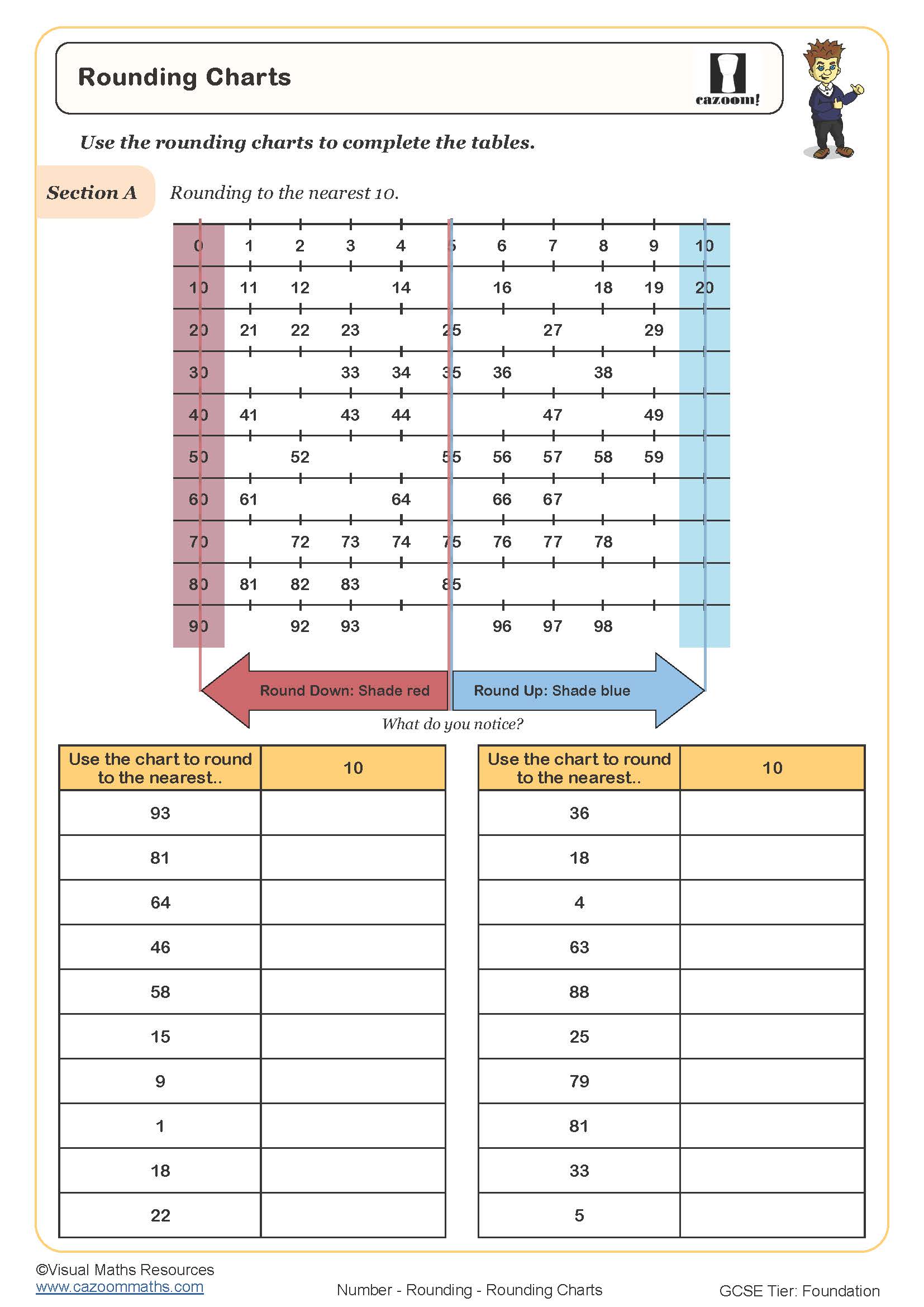
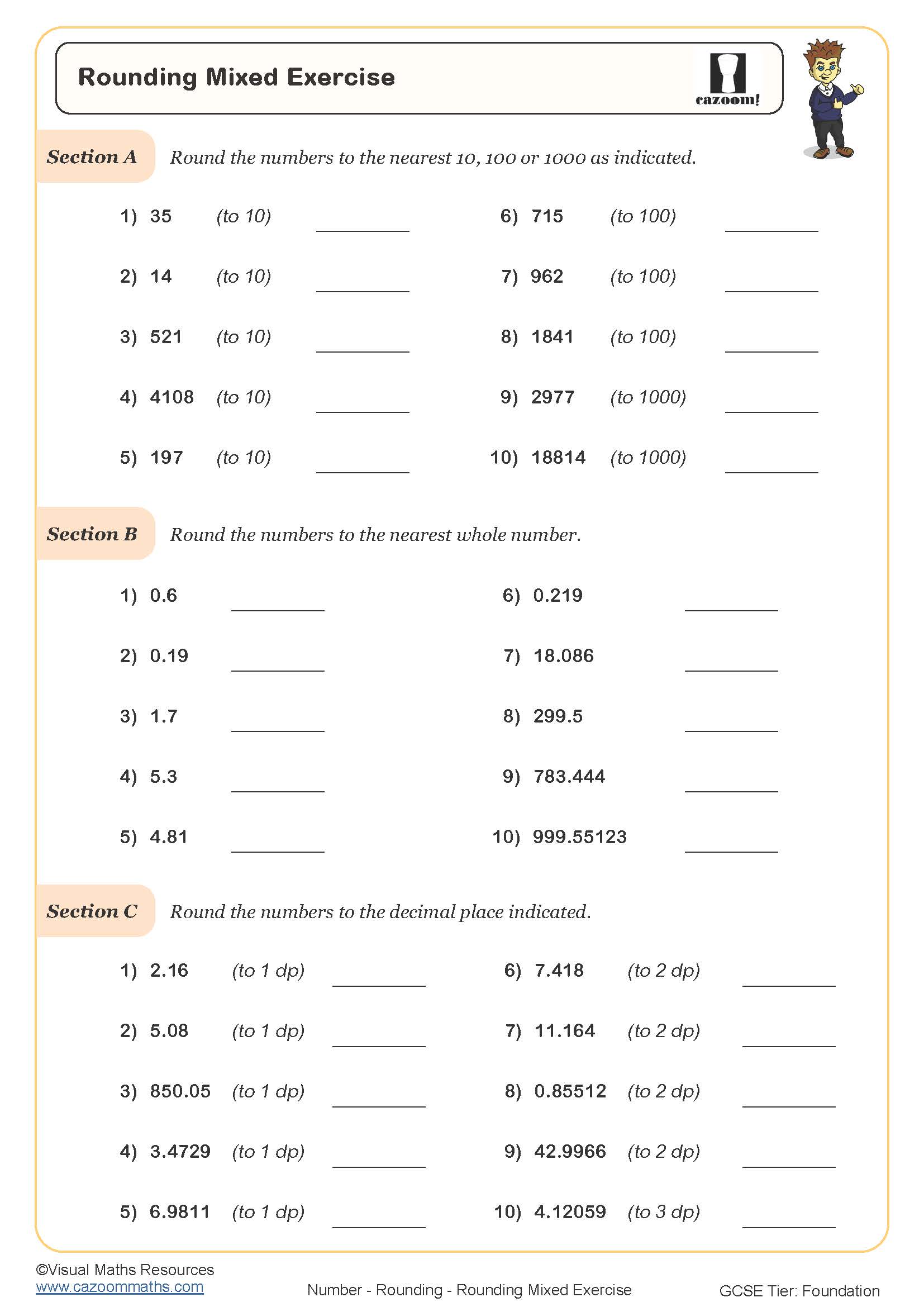
All worksheets are created by the team of experienced teachers at Cazoom Maths.
What Is Mixed Rounding in Maths?
Mixed rounding requires students to round numbers using different methods within a single exercise, such as rounding to the nearest 10, nearest whole number, one decimal place, or one significant figure. Rather than practising one rounding rule repeatedly, students must read each question carefully to identify which degree of accuracy is required. This approach reflects how rounding appears in Key Stage 3 assessments and GCSE exams, where questions rarely group identical rounding tasks together.
A common error occurs when students apply the previous question's rounding rule without reading the new instruction, particularly when moving from decimal places to significant figures. Teachers often see students correctly round 3.476 to one decimal place (3.5), then incorrectly apply the same thinking to significant figures. Mark schemes consistently penalise this lack of precision, making mixed practice crucial for exam success.
Which Year Groups Study Mixed Rounding?
These worksheets target Year 7 and Year 8 students in Key Stage 3, where the National Curriculum expects fluency in rounding integers and decimals to specified degrees of accuracy. Year 7 students typically consolidate rounding to the nearest 10, 100, and 1000, then extend to decimal places, whilst also being introduced to the concept of significant figures. By Year 8, students work confidently across all rounding methods and tackle more challenging numbers including those with multiple decimal places or leading zeros.
The progression across KS3 builds towards GCSE requirements, where mixed rounding appears in both calculator and non-calculator papers, often within multi-step problems. Year 8 worksheets introduce more complex scenarios, such as rounding numbers less than one to significant figures (where 0.00456 to 2 s.f. becomes 0.0046, not 0.0045), preparing students for Higher tier demands.
Why Do Students Confuse Decimal Places and Significant Figures?
Decimal places count positions after the decimal point regardless of value, whilst significant figures count meaningful digits from the first non-zero number. Students often confuse these methods because both involve identifying a specific digit then applying the rounding rule. The confusion intensifies with numbers like 0.00728, where rounding to two decimal places (0.01) produces a vastly different answer from rounding to two significant figures (0.0073). Teachers observe this error most frequently when students rush through mixed exercises without identifying which method applies.
This skill connects directly to scientific notation and measurement accuracy in STEM subjects. Scientists recording experimental data to three significant figures (such as measuring a reaction time as 2.47 seconds rather than 2.473 seconds) use rounding conventions to communicate the precision of their instruments. Understanding when and how to round appropriately ensures students can interpret scientific data accurately and communicate their own findings with appropriate precision across all science disciplines.
How Can Teachers Use These Worksheets Effectively?
The worksheets provide structured practice where students must actively identify the rounding method required for each question before calculating their answer. This deliberate variation prevents autopilot working and encourages careful reading of mathematical instructions. The included answer sheets allow students to self-check their work immediately, identifying whether errors stem from misreading the instruction or applying the rounding rule incorrectly, which supports metacognitive development.
Many teachers use these resources during intervention sessions with students who perform inconsistently on rounding questions in assessments, as the mixed format quickly reveals whether difficulties lie with specific methods or with switching between them. The worksheets work equally well as homework to reinforce classroom teaching, or as starter activities where students complete three or four questions to activate prior knowledge before tackling applied problems. Paired work proves particularly effective, with students explaining to each other which method they selected and why, building mathematical reasoning alongside procedural fluency.