Multiply and Divide by Powers of 10 Worksheets
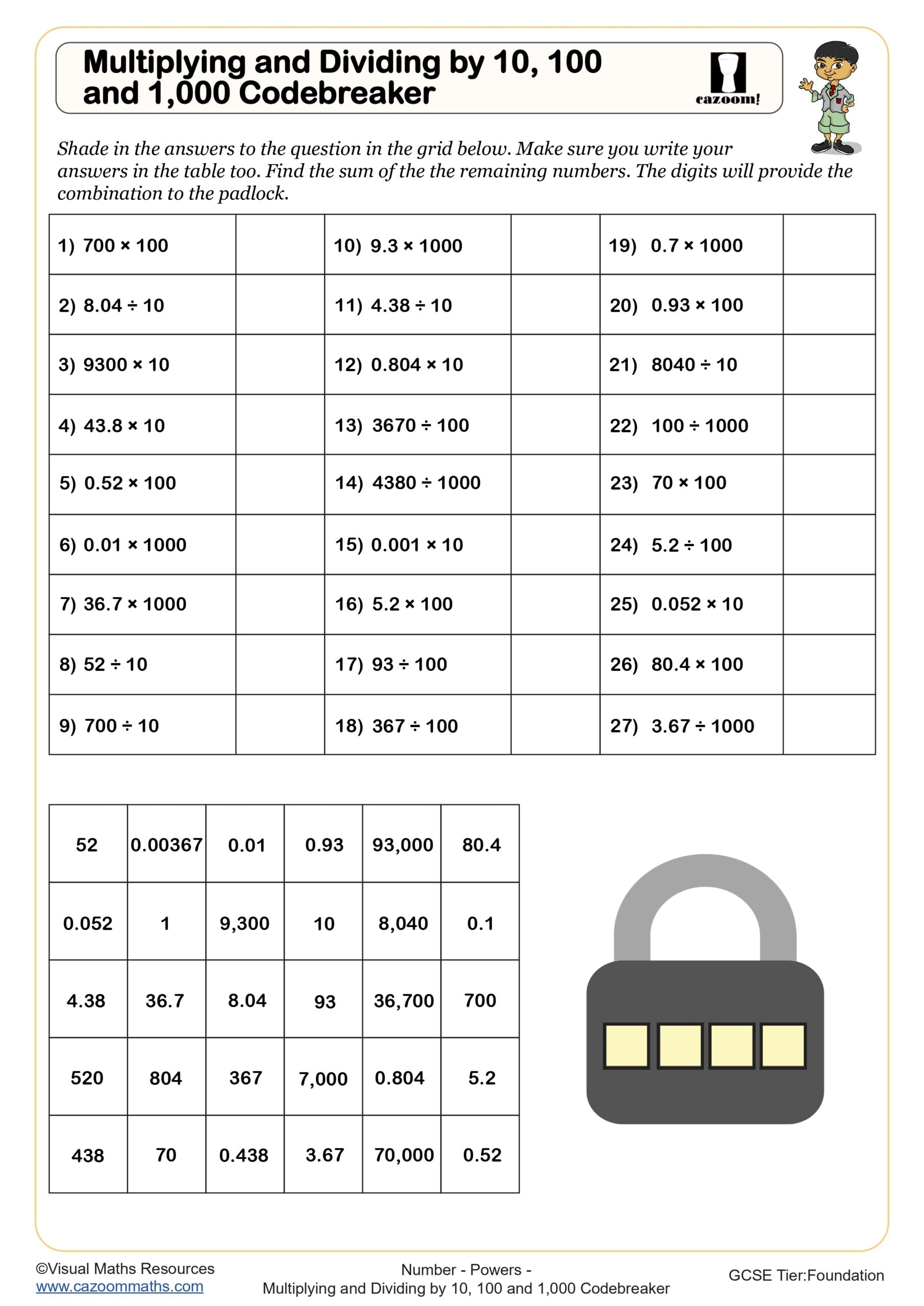
Multiplying and Dividing by 10, 100 and 1,000 Codebreaker
Year groups: 7, 8
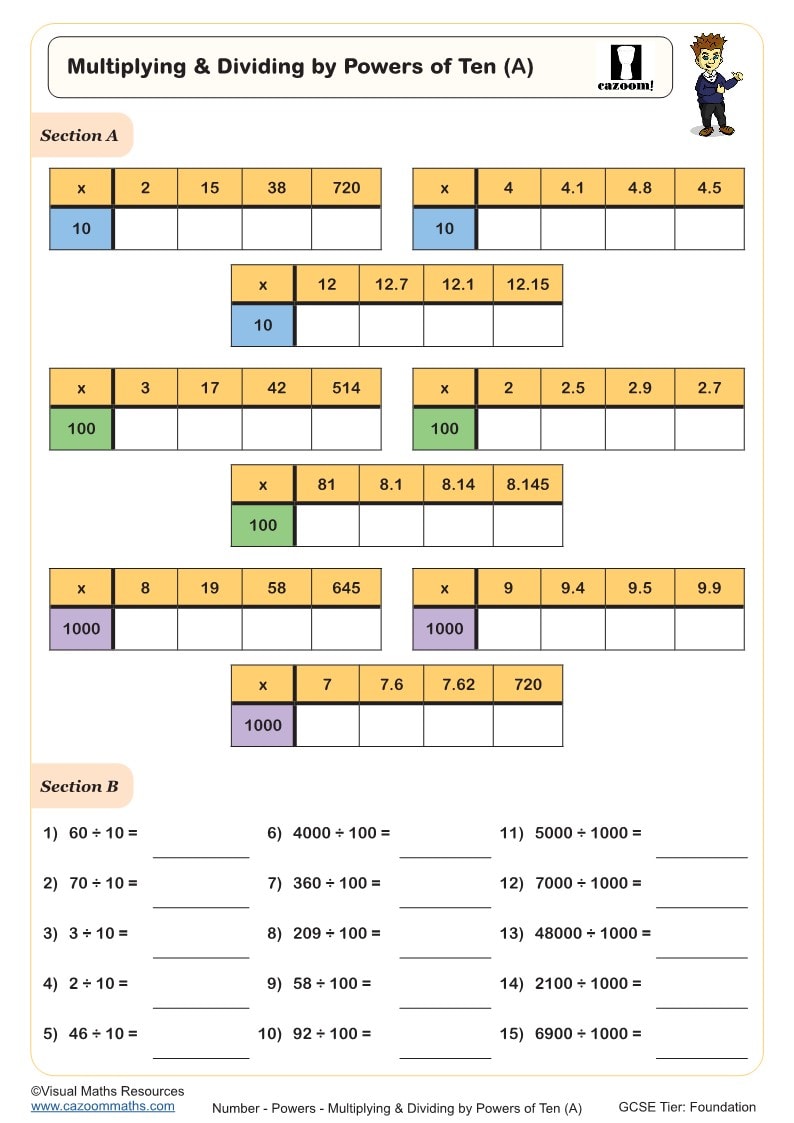
Multiplying and Dividing by Powers of Ten (A)
Year groups: 7, 8
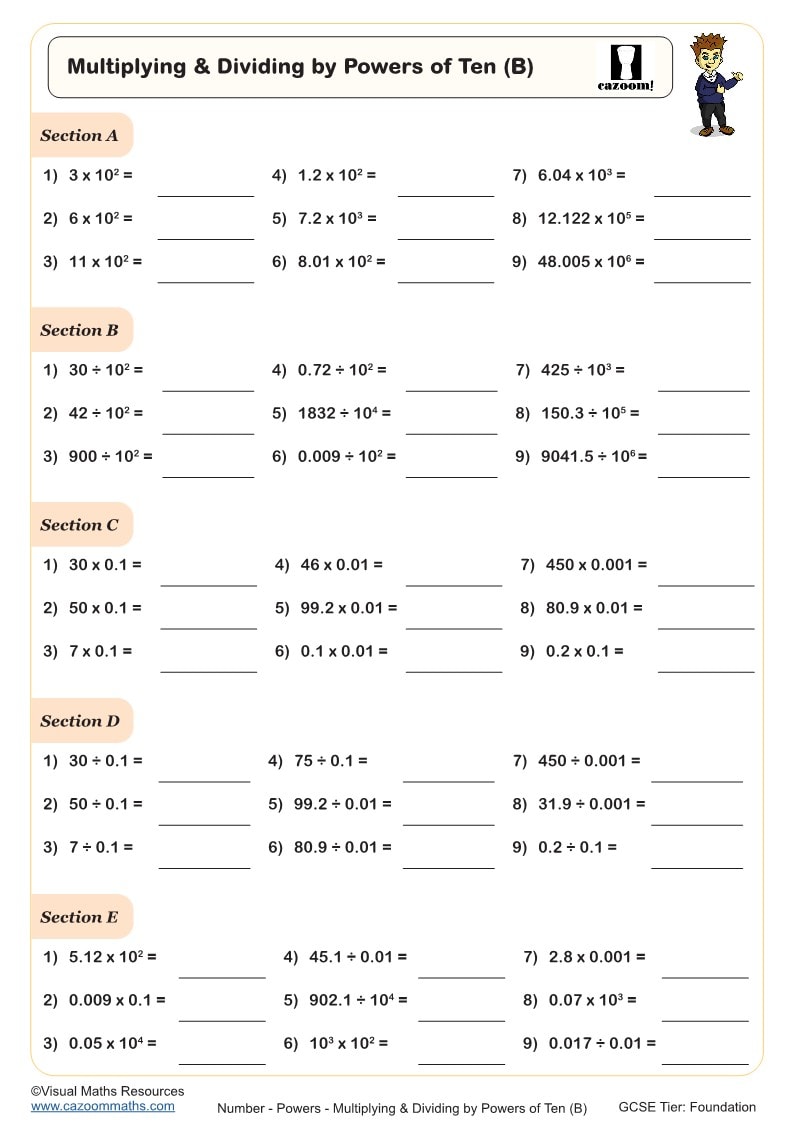
Multiplying and Dividing by Powers of Ten (B)
Year groups: 7, 8
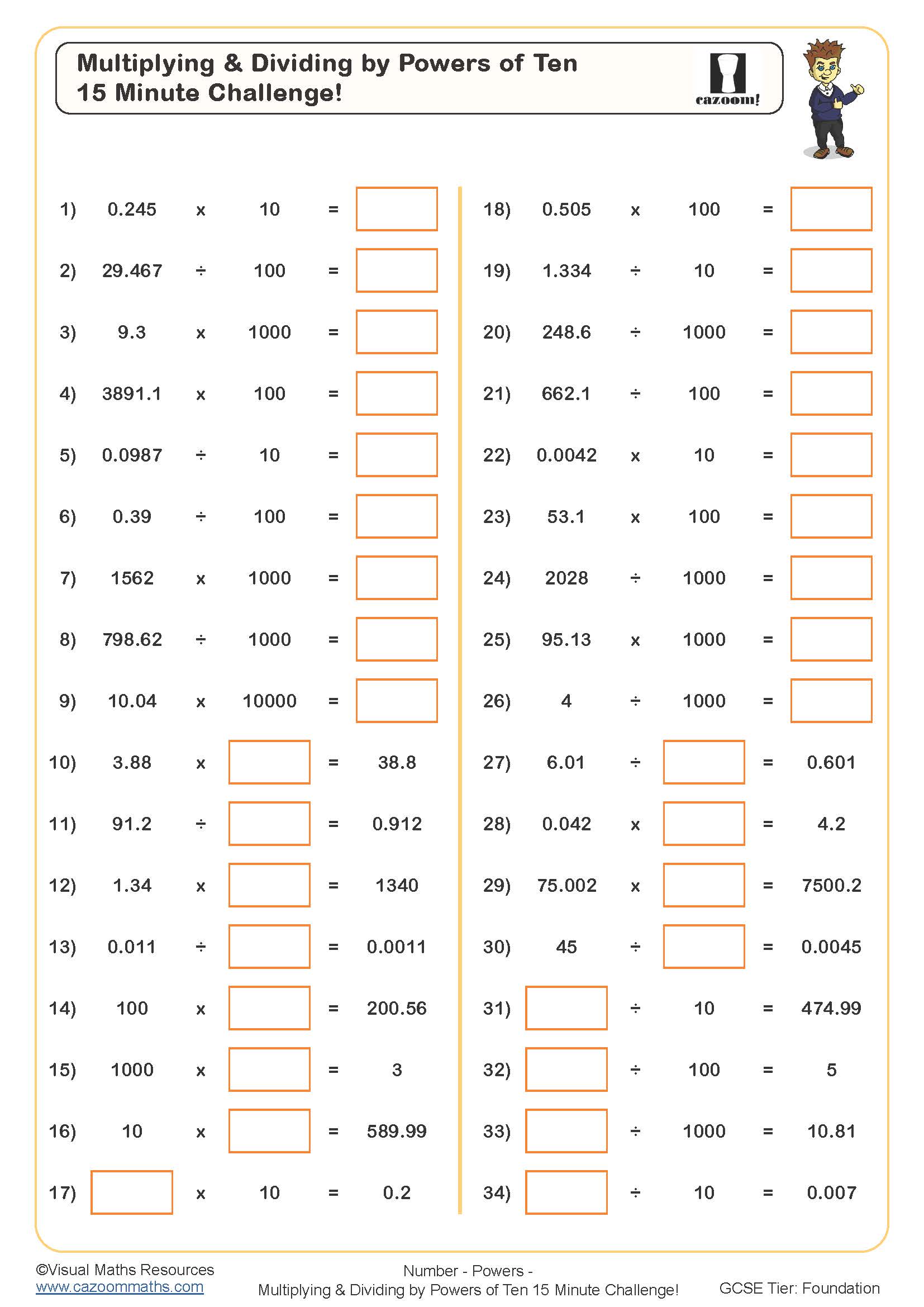
Multiplying and Dividing by Powers of Ten 15 Minute Challenge
Year groups: 7, 8
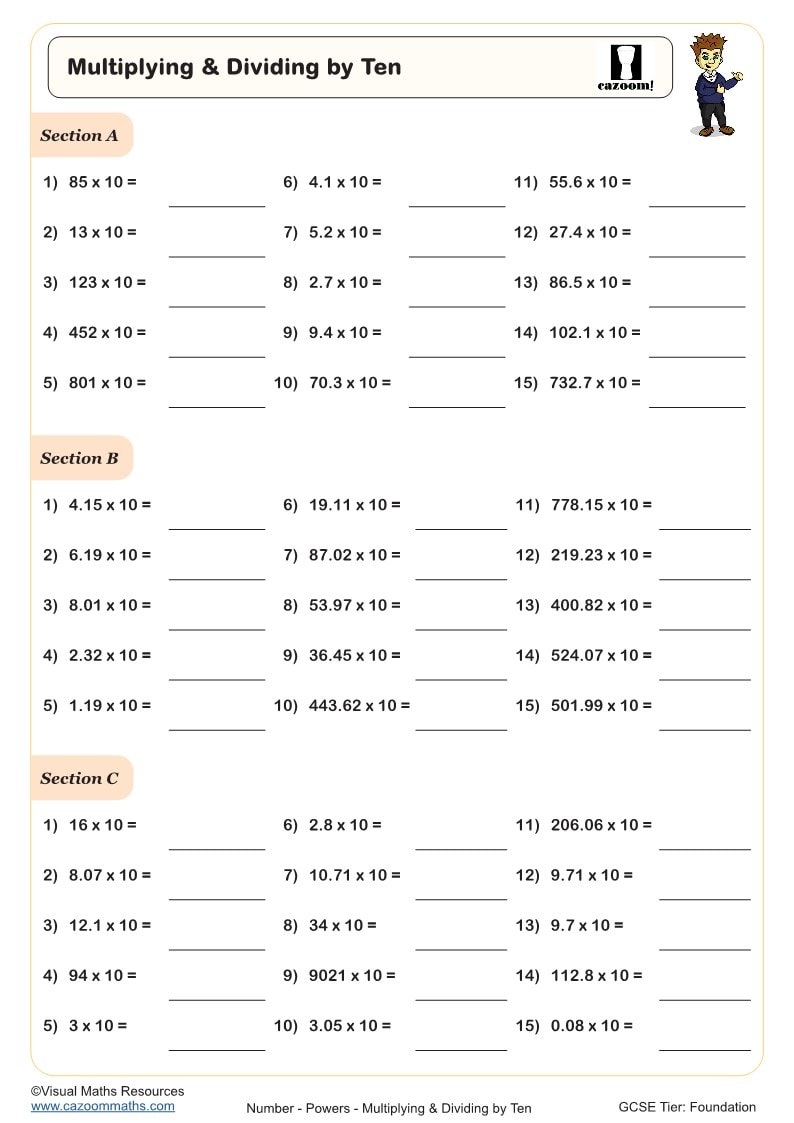
Multiplying and Dividing by Ten
Year groups: 7, 8
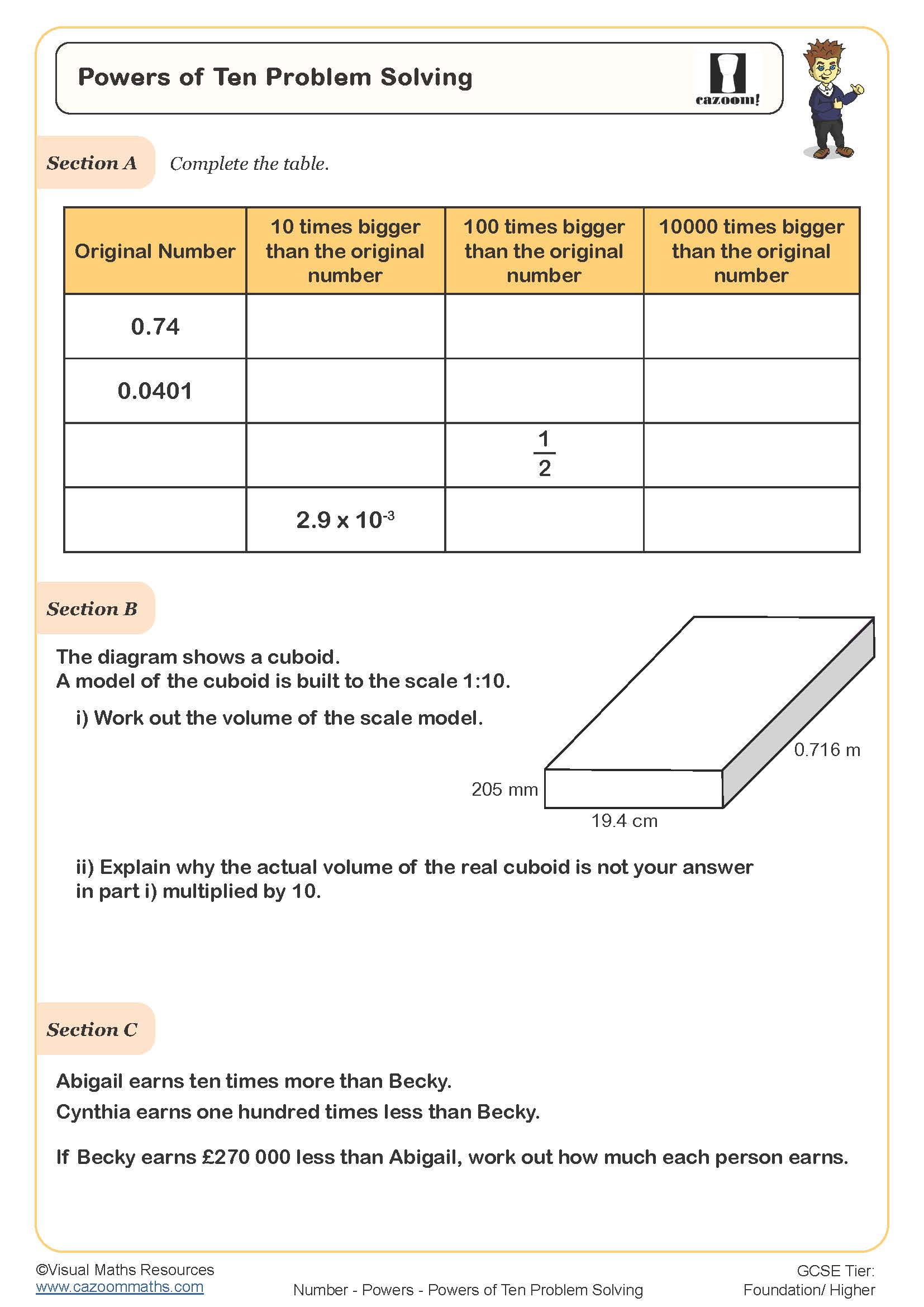
Powers of Ten Problem Solving
Year groups: 7, 8
All worksheets are created by the team of experienced teachers at Cazoom Maths.
What are the rules for multiplying and dividing by powers of 10?
When multiplying by powers of 10, digits move left on the place value grid: multiply by 10 moves each digit one place left, by 100 moves two places left, and by 1000 moves three places left. When dividing by powers of 10, digits move right by the corresponding number of places. The decimal point appears to move, but it's actually the digits shifting position whilst the decimal point remains fixed in the number system.
Students often misapply the 'add a zero' rule when decimals are involved, writing 0.6 × 10 = 0.60 rather than 6. Teachers find that explicitly using place value grids or counters helps students visualise digit movement. Exam questions regularly test this with decimal multipliers like 0.07 × 100, where students must recognise the answer is 7, not 0.7 or 0.007.
Which year groups learn to multiply and divide by powers of 10?
These worksheets cover KS3 content for Year 7 and Year 8 students, building on place value knowledge from primary school. The National Curriculum expects students to multiply and divide integers and decimals by powers of 10 with confidence, as this skill connects directly to standard form, metric conversions, and scientific notation required for GCSE.
Year 7 worksheets typically focus on whole numbers and simple decimals with powers like 10, 100, and 1000, whilst Year 8 resources introduce higher powers, more complex decimals, and mixed operations. The progression includes working backwards from an answer to find the original value, and recognising powers of 10 in index form (10², 10³), preparing students for standard form in Year 9.
How do you multiply decimals by powers of 10?
Multiplying decimals by powers of 10 requires understanding that each multiplication by 10 moves digits one place to the left on the place value chart. For example, 0.47 × 100 means moving each digit two places left: the 4 moves from tenths to tens, and the 7 moves from hundredths to units, giving 47. If there aren't enough digits, zeros fill the gaps, so 0.03 × 1000 becomes 30.
This skill has direct applications in currency exchange and unit conversions. Scientists and engineers multiply by powers of 10 constantly when converting between units: changing 3.5 kilograms to grams means multiplying by 1000 to get 3500 grams. Understanding this pattern helps students work confidently with measurements in physics, chemistry, and real-world contexts like calculating material costs or scaling recipes in food technology.
How can teachers use these multiply and divide by powers of 10 worksheets?
The worksheets provide scaffolded practise starting with straightforward integer calculations before progressing to decimals and mixed operations. Each resource includes varied question types that prevent students from simply applying a memorised trick without understanding. The answer sheets allow students to self-check their work, making these resources suitable for independent learning or immediate feedback during lessons.
Teachers use these worksheets for targeted intervention with students who struggle with place value concepts, as starter activities to refresh prior knowledge before teaching standard form, or as homework to consolidate classwork. They work well for paired work where students complete alternate questions then check each other's answers, encouraging mathematical discussion about why digits move in particular directions. The resources also support retrieval practise, helping students maintain fluency with this fundamental skill throughout KS3.