Ordering Fractions, Decimals and Percentages Worksheets
All worksheets are created by the team of experienced teachers at Cazoom Maths.
How do you order fractions, decimals and percentages?
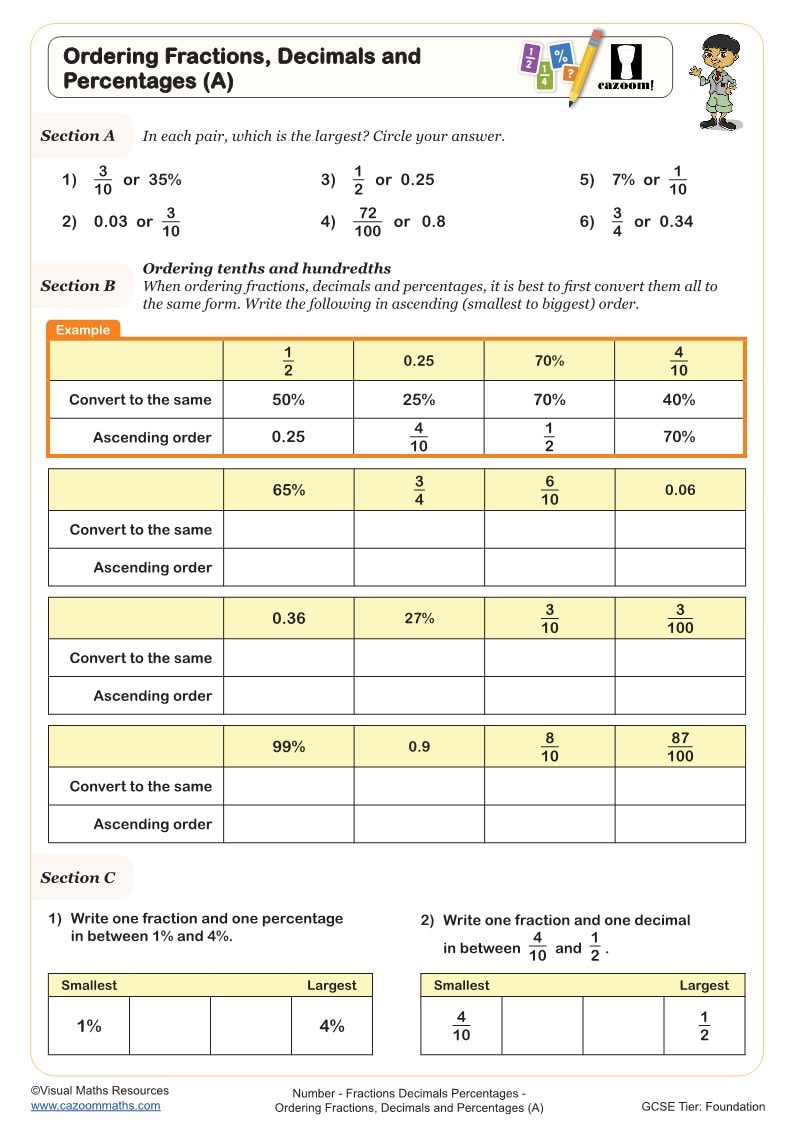
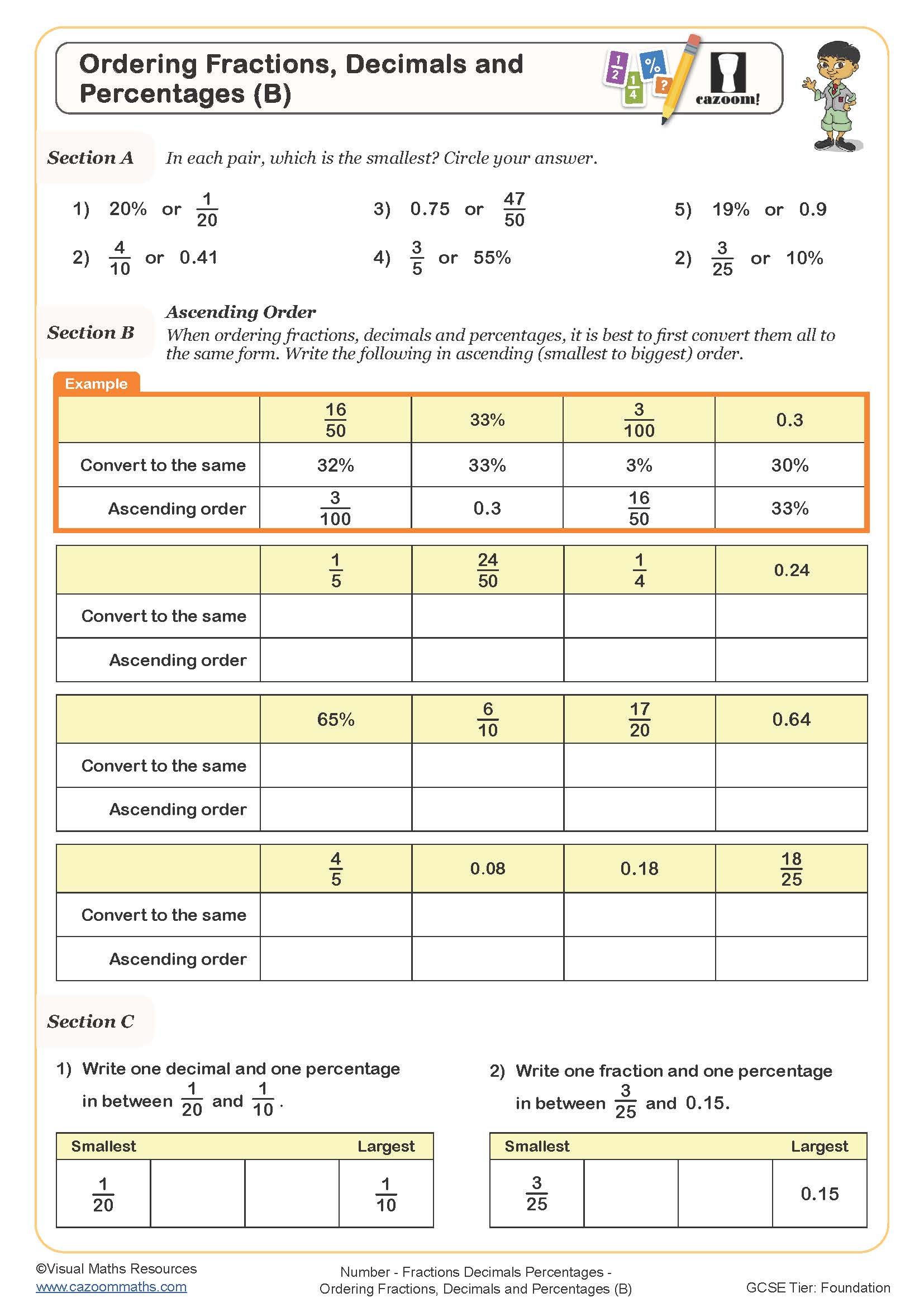
The most reliable method is to convert all values to the same form before ordering. Most students find converting to decimals the clearest approach: divide the numerator by denominator for fractions, and divide by 100 for percentages. Once all values share the same form, students can compare place values systematically from left to right, just as they would with any decimal numbers.
A common error occurs when students misread equivalent values, such as writing 0.3 as smaller than 25% because they focus on the digits rather than the actual value. Mark schemes regularly penalise students who don't show their conversion working, particularly when answers are incorrect. Teachers find that requiring students to write out all conversions explicitly reduces careless mistakes and helps identify whether errors stem from conversion or ordering.
Which year groups study ordering fractions, decimals and percentages?
This topic appears in Year 7, Year 8 and Year 9 within KS3 of the National Curriculum. Students first encounter it in Year 7 after securing conversion skills between each form, then revisit it with increasingly complex values throughout Key Stage 3. The skill supports preparatory work for GCSE ratio, percentage calculations and probability comparisons.
Progression across these year groups involves larger sets of numbers, more awkward fractions requiring division skills, and mixed negative values. Year 7 worksheets typically use simpler benchmark fractions like halves, quarters and fifths alongside familiar percentages. By Year 9, students tackle recurring decimals, improper fractions and percentages beyond 100%, requiring confident calculator use and stronger number sense to check answers for reasonableness.
What is the best way to convert fractions to decimals for ordering?
Students should divide the numerator by the denominator using either short division or a calculator, depending on the numbers involved. For example, 3/8 becomes 3 ÷ 8 = 0.375. When using calculators, students need to record sufficient decimal places to distinguish between similar values, particularly with sevenths or elevenths that produce recurring decimals. Teachers notice students often round too early, making 1/3 and 33% appear identical when they're actually different.
This skill applies directly in STEM contexts where measurements appear in different units. Engineers might compare 0.45 metres, 47 centimetres (47%) and 3/7 of a metre when cutting materials to length. Financial literacy also relies on this skill when comparing interest rates expressed as percentages, decimal multipliers and fractional increases, helping students make informed decisions about savings and borrowing in adult life.
How do these worksheets help students practise ordering mixed forms?
The worksheets provide structured practice moving from smaller sets of three or four values to longer sequences requiring sustained accuracy. Questions typically mix all three representations within each problem, preventing students from relying on pattern recognition rather than genuine understanding. The progression allows students to build confidence with straightforward values before attempting questions with recurring decimals or improper fractions.
Teachers use these worksheets effectively for targeted intervention with students who struggle during mixed topic assessments, as ordering often reveals gaps in conversion knowledge. The answer sheets make them suitable for homework where students can self-check, or for paired work where students compare methods and discuss different conversion strategies. Many teachers set these during GCSE revision when students need to sharpen foundational skills that appear across multiple paper topics, from probability trees to compound percentage problems.