Percentages of Amounts Worksheets
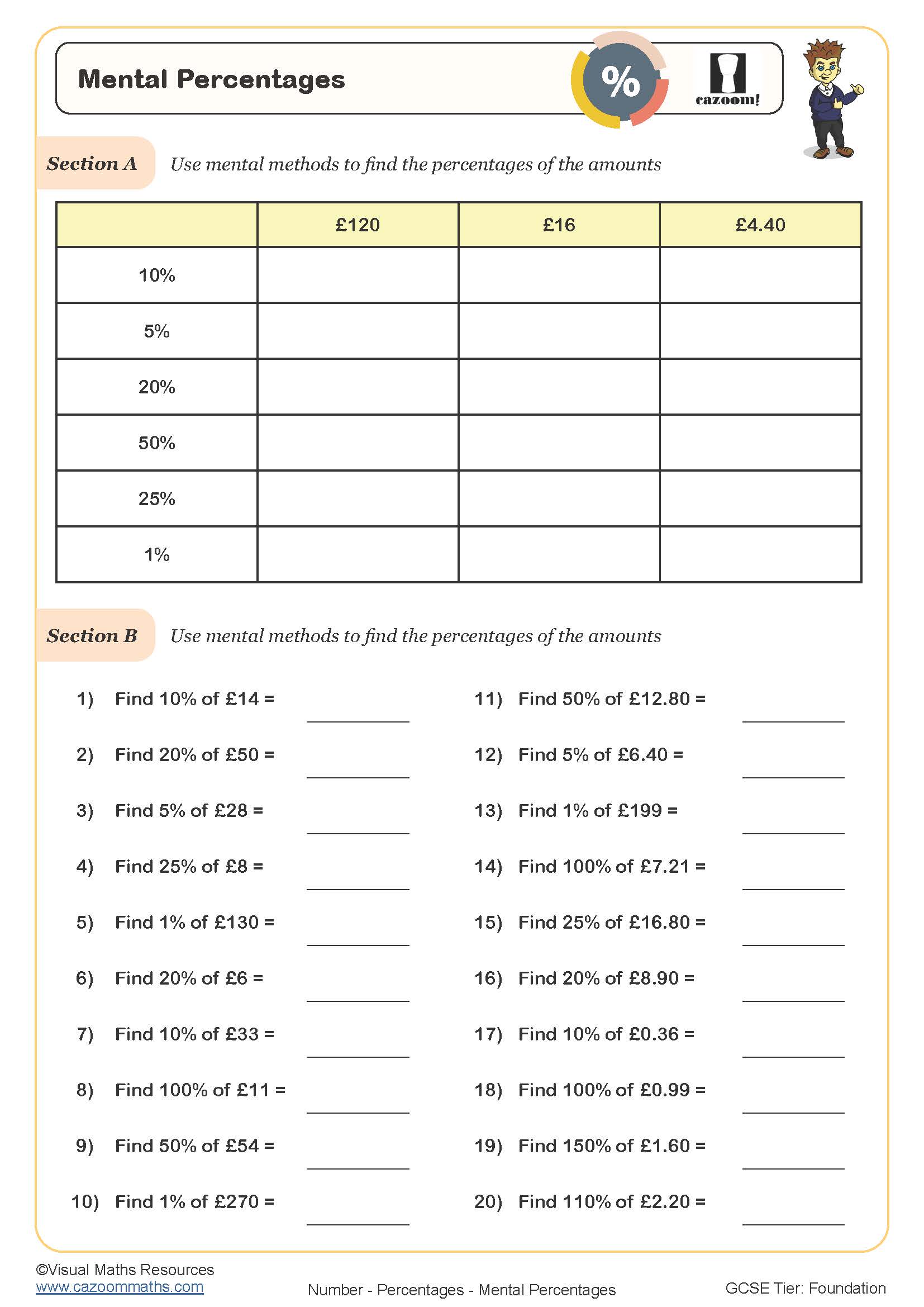
Mental Percentages
Year groups: 7, 8
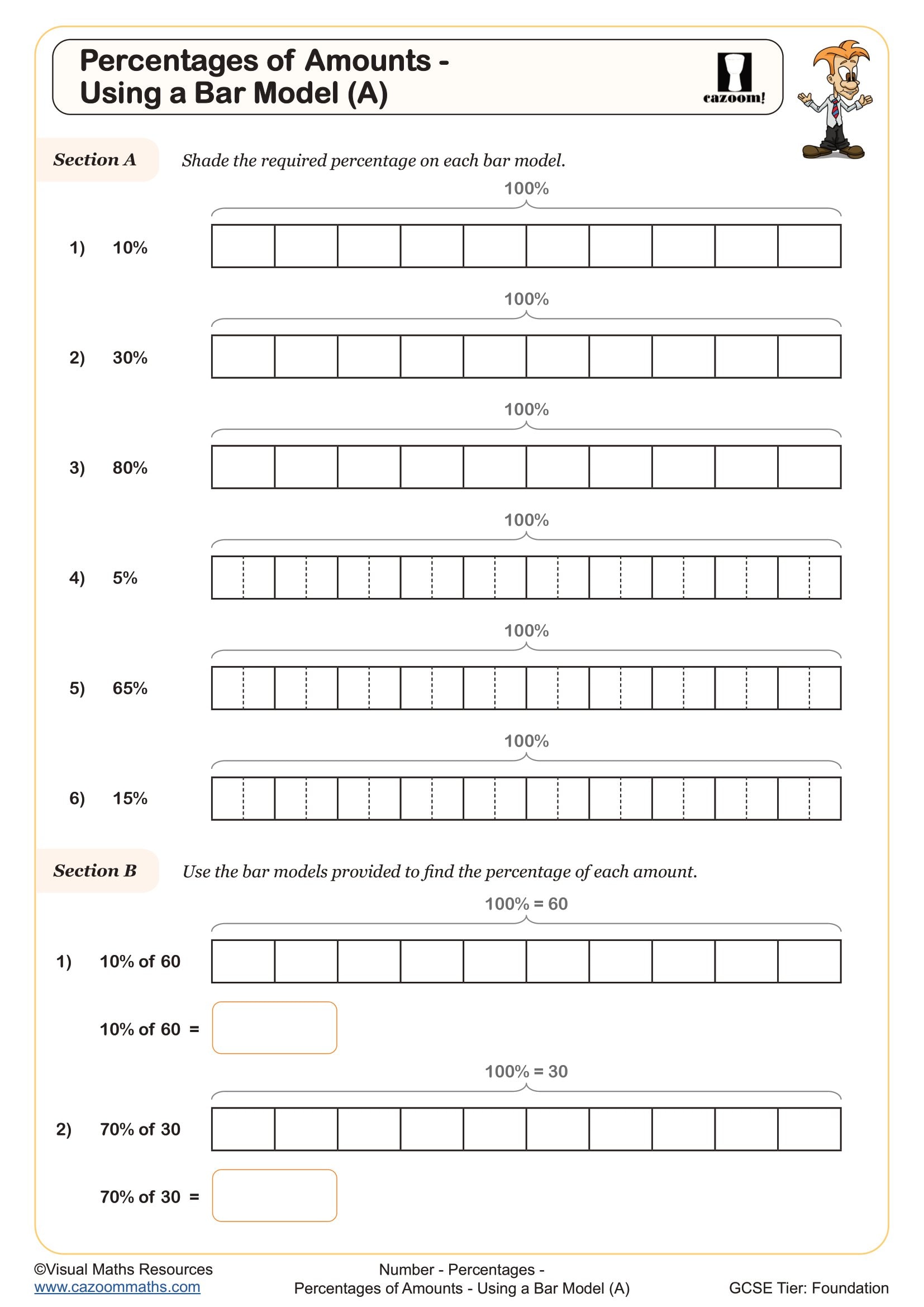
Percentages of Amounts - Using a Bar Model (A)
Year groups: 7, 8
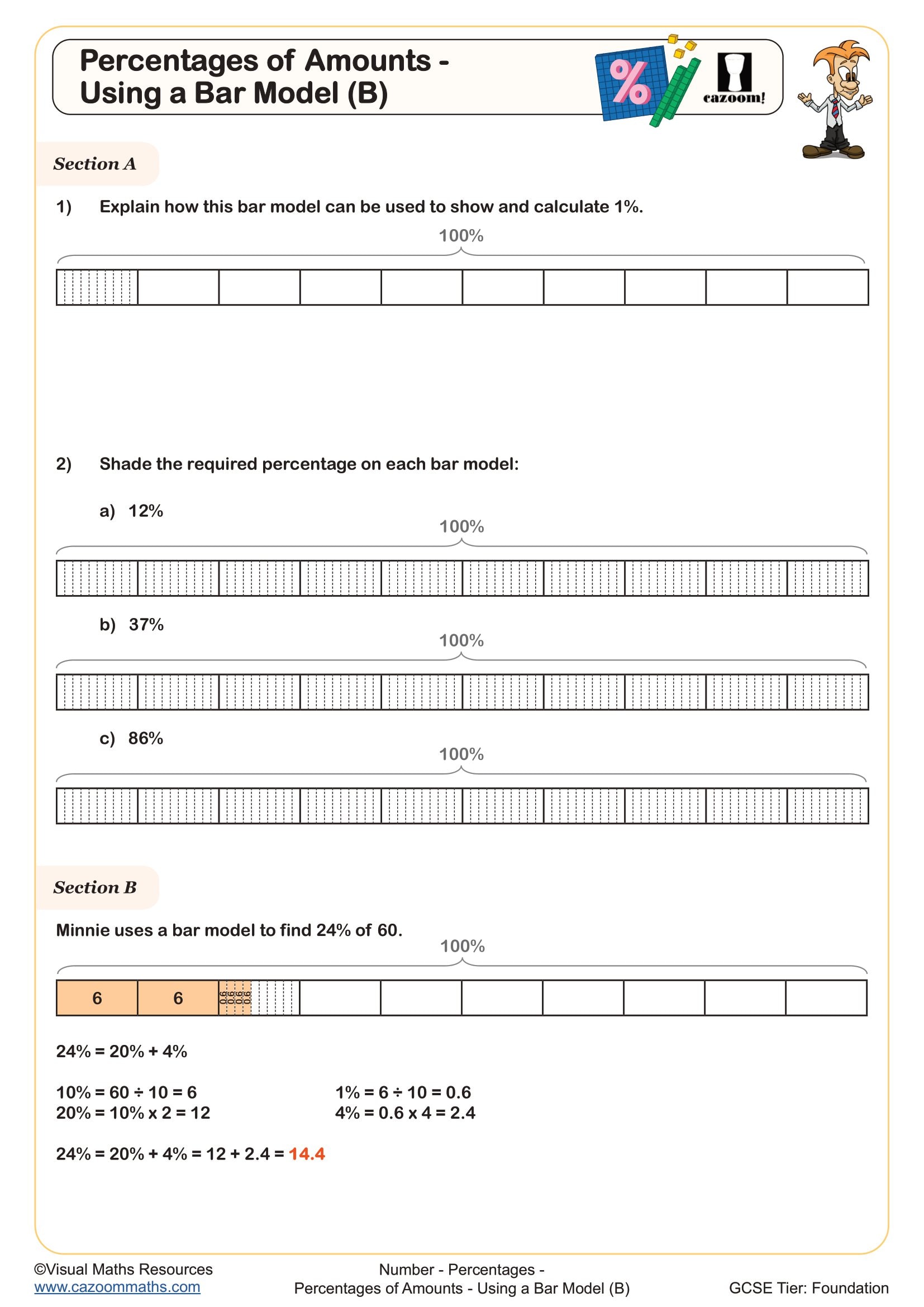
Percentages of Amounts - Using a Bar Model (B)
Year groups: 7, 8, 9
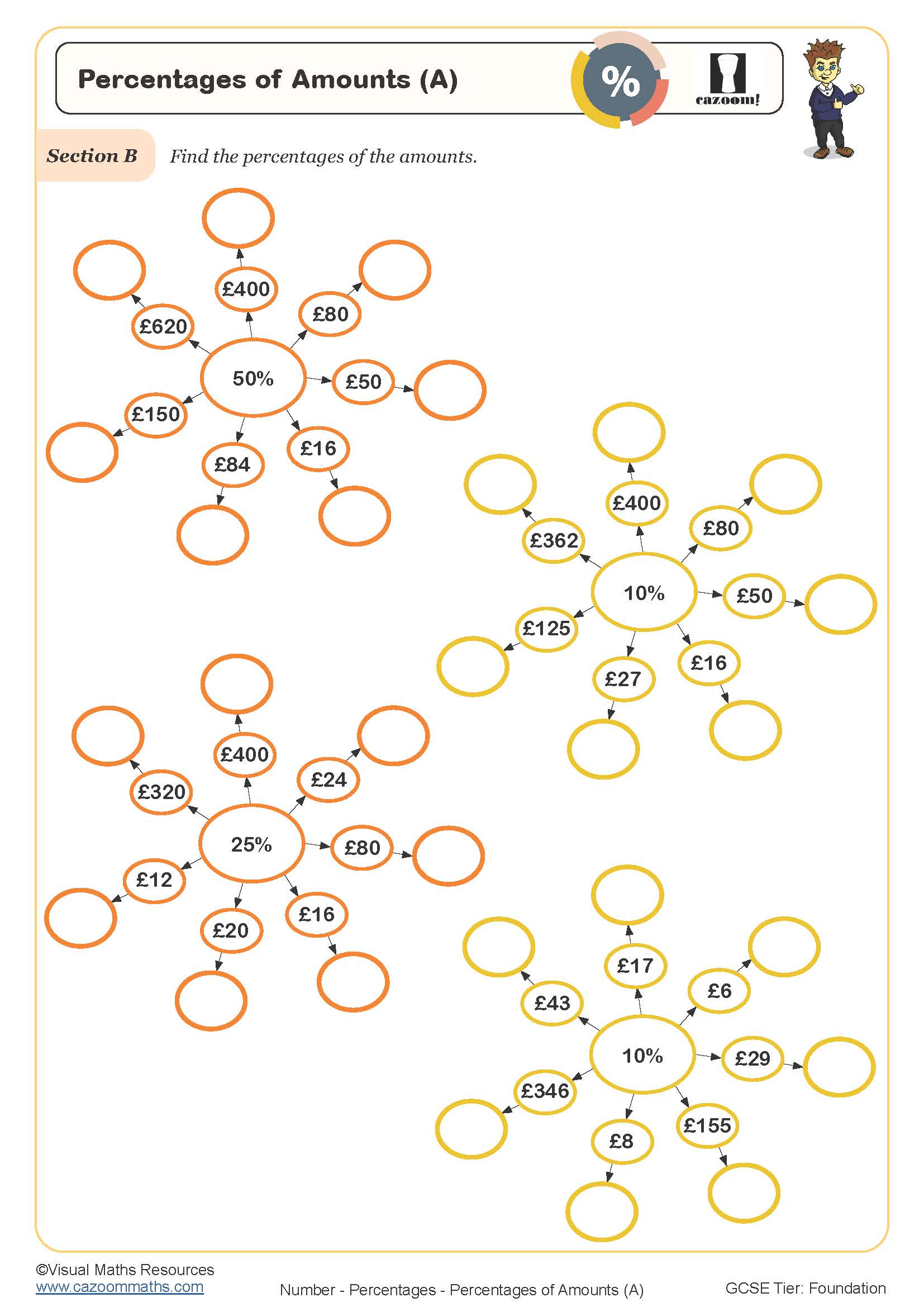
Percentages of Amounts (A)
Year groups: 7, 8
Percentages of Amounts (B)
Year groups: 7, 8
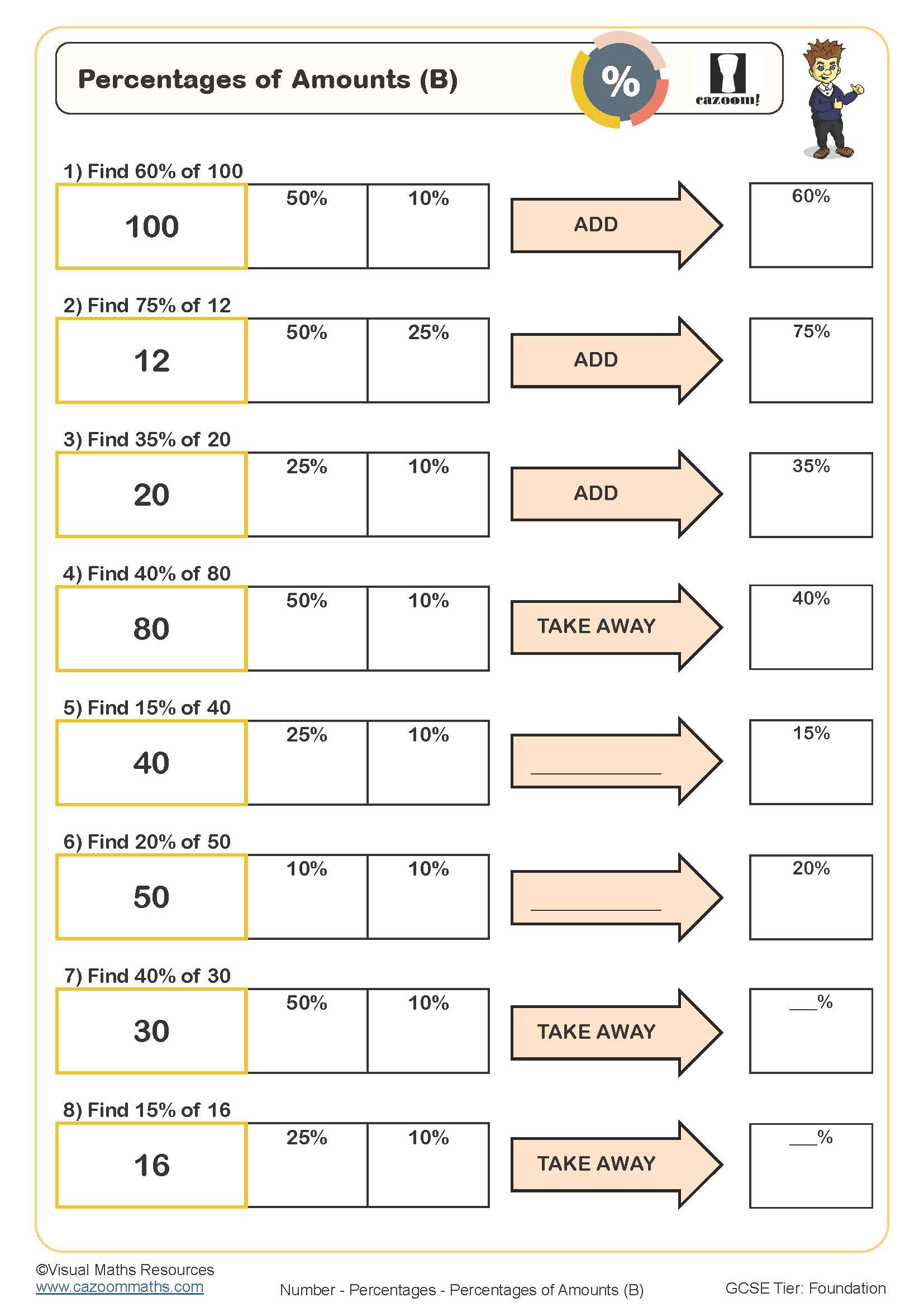
Percentages of Amounts (C)
Year groups: 7, 8
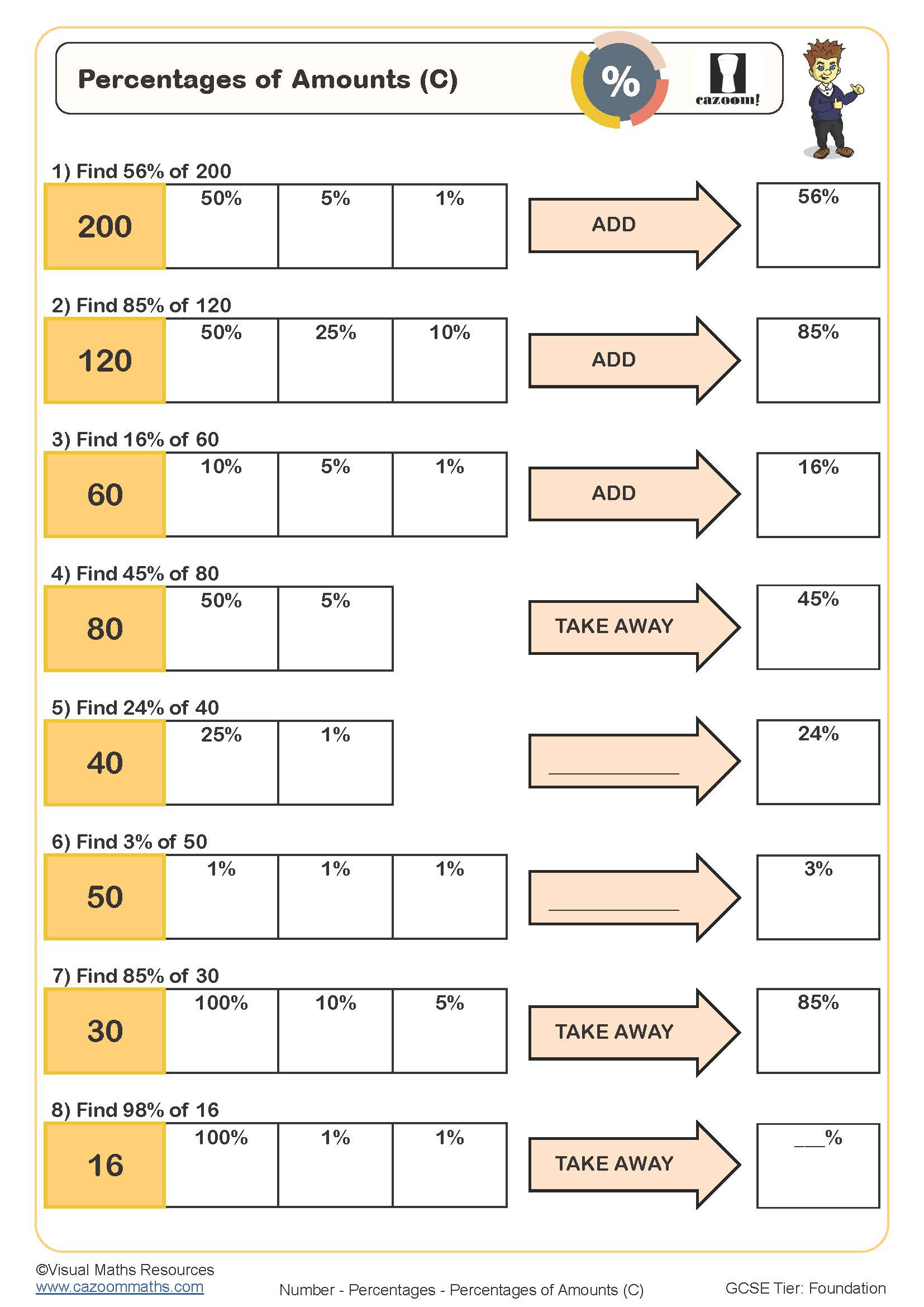
Percentages of Amounts 10 Minute Challenge
Year groups: 7, 8
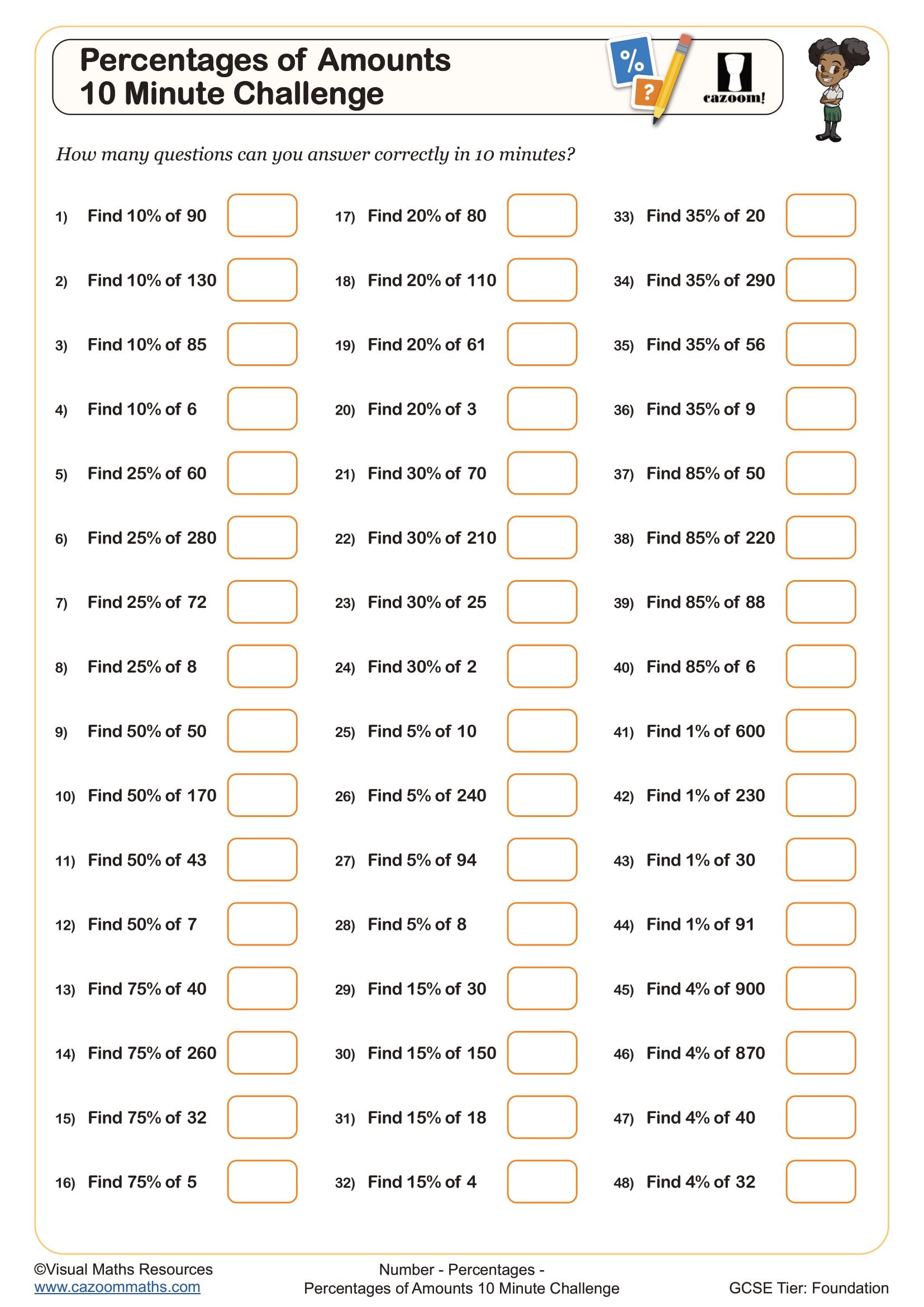
Spider Percentages (A)
Year groups: 7, 8
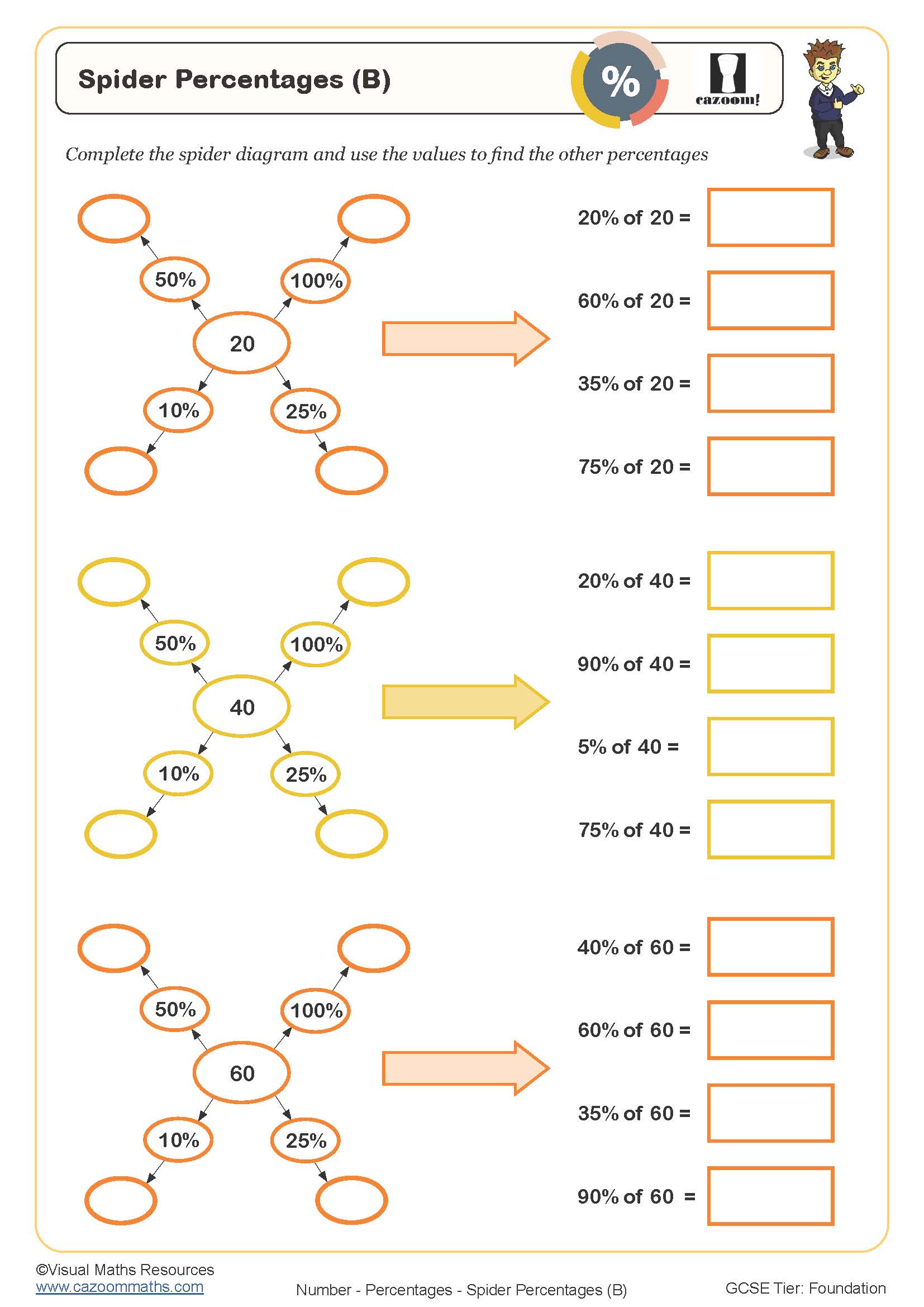
Spider Percentages (B)
Year groups: 7, 8
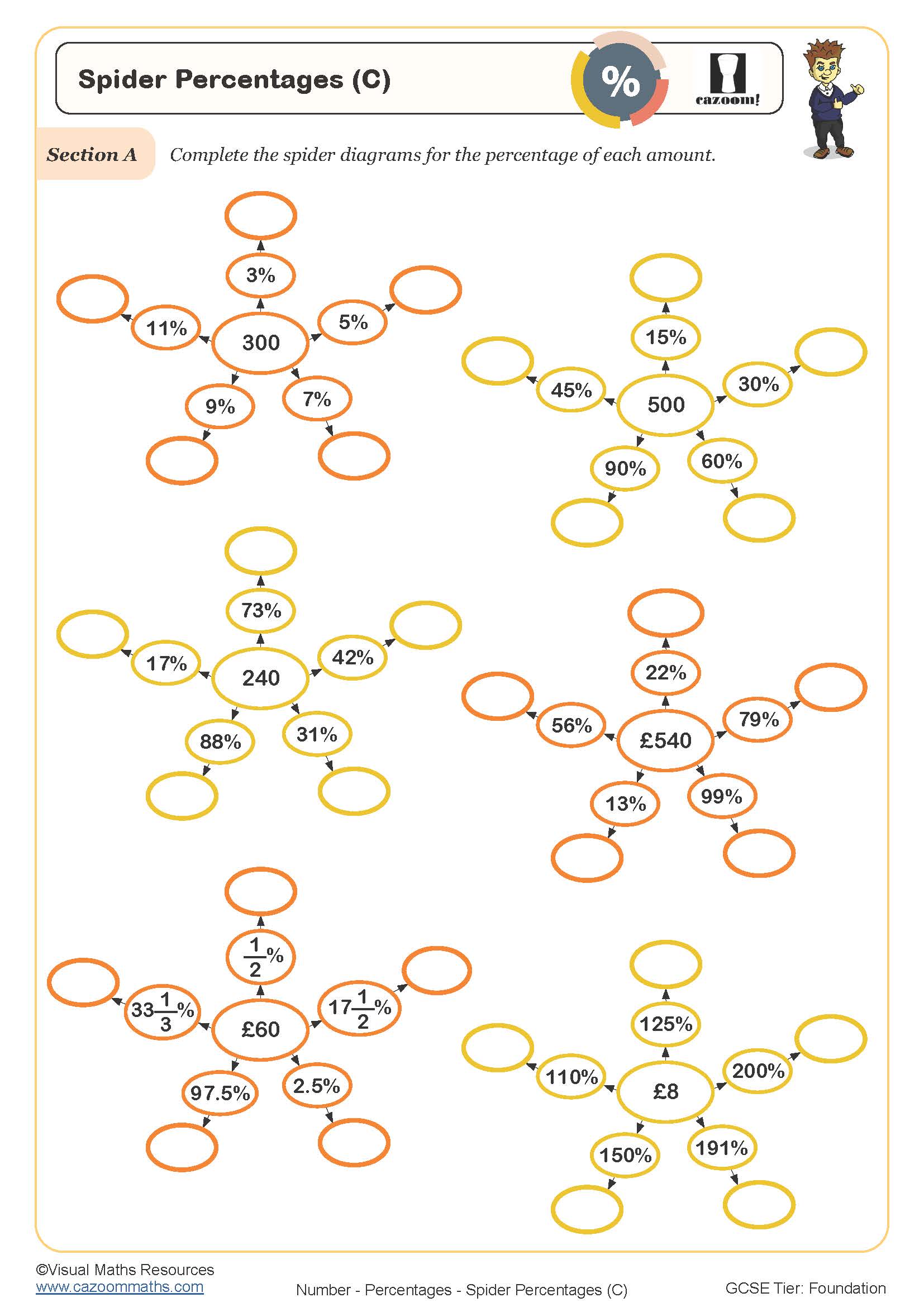
Spider Percentages (C)
Year groups: 8, 9
All worksheets are created by the team of experienced teachers at Cazoom Maths.
How do you work out percentages of amounts using a calculator?
The most reliable calculator method is converting the percentage to a decimal first, then multiplying by the amount. To find 24% of 350, students enter 0.24 × 350 = 84. This method works consistently across all calculator types and avoids confusion about order of operations that arises when students try to calculate 350 ÷ 100 × 24 in one go.
A common error occurs when students write 24% as 0.024 instead of 0.24, particularly when working under exam pressure. Teachers frequently see this in assessments where students correctly set up the calculation but lose marks through decimal misplacement. Practising the conversion step separately before moving to full calculations helps students recognise this mistake before it becomes embedded.
What year group learns percentages of amounts?
Percentages of amounts appear in the National Curriculum from Year 7 onwards as part of KS3 Number work. Students meet the topic early in secondary school, building on their understanding of percentages as parts of 100 from primary. These worksheets cover Year 7, Year 8, and Year 9, matching where the topic sits in most schemes of work.
The progression across KS3 moves from straightforward percentages of whole numbers in Year 7 (like 30% of 200) to more complex decimal amounts and multi-step problems in Years 8 and 9. By Year 9, students tackle reverse percentage problems and percentage change, which require confident calculation of percentages of amounts as a foundation skill. GCSE questions assume this fluency is secure.
What is the multiplier method for finding percentages?
The multiplier method treats the percentage as a single decimal multiplication rather than separate steps. To find 18% of 450, students recognise that 18% means 0.18 and calculate 0.18 × 450 directly. This approach becomes particularly powerful when dealing with percentage increases or decreases, where students use multipliers like 1.15 for a 15% increase or 0.92 for an 8% decrease.
This method connects directly to proportional reasoning in science, particularly when calculating concentrations in chemistry or population changes in biology. Retail and finance contexts use multiplier thinking constantly: applying a 20% VAT rate means multiplying by 1.2, whilst a 30% discount uses a 0.7 multiplier. Understanding the underlying mathematics helps students recognise these patterns across STEM subjects and real-world applications.
How can these worksheets help students master percentage calculations?
The worksheets provide structured practice that moves students from basic calculations to more complex applications, with each question type appearing multiple times so students can identify and correct their own calculation errors. Answer sheets let students check their working immediately rather than waiting for teacher feedback, which helps them spot patterns in their mistakes, whether that's decimal placement, order of operations, or misreading the question.
Teachers use these sheets effectively for starters to maintain fluency, for intervention with students who struggle during broader percentage units, or as homework to consolidate classwork. The progressive difficulty makes them suitable for differentiation: giving Year 7 students the foundational sheets whilst Year 9 students work on more demanding problems within the same topic. Many teachers set them as paired work where students compare methods and check each other's answers using the provided solutions.