Powers and Roots Worksheets
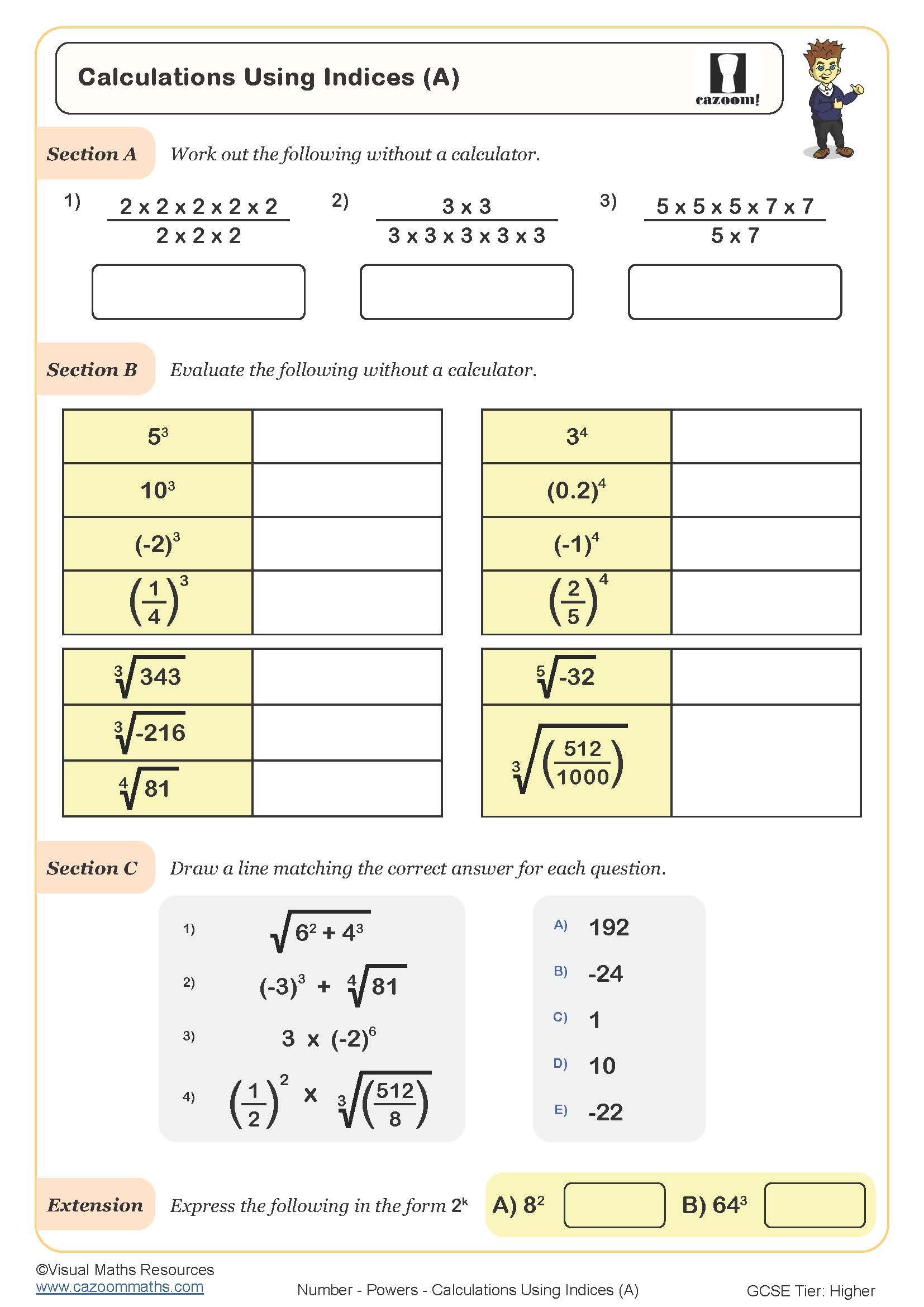
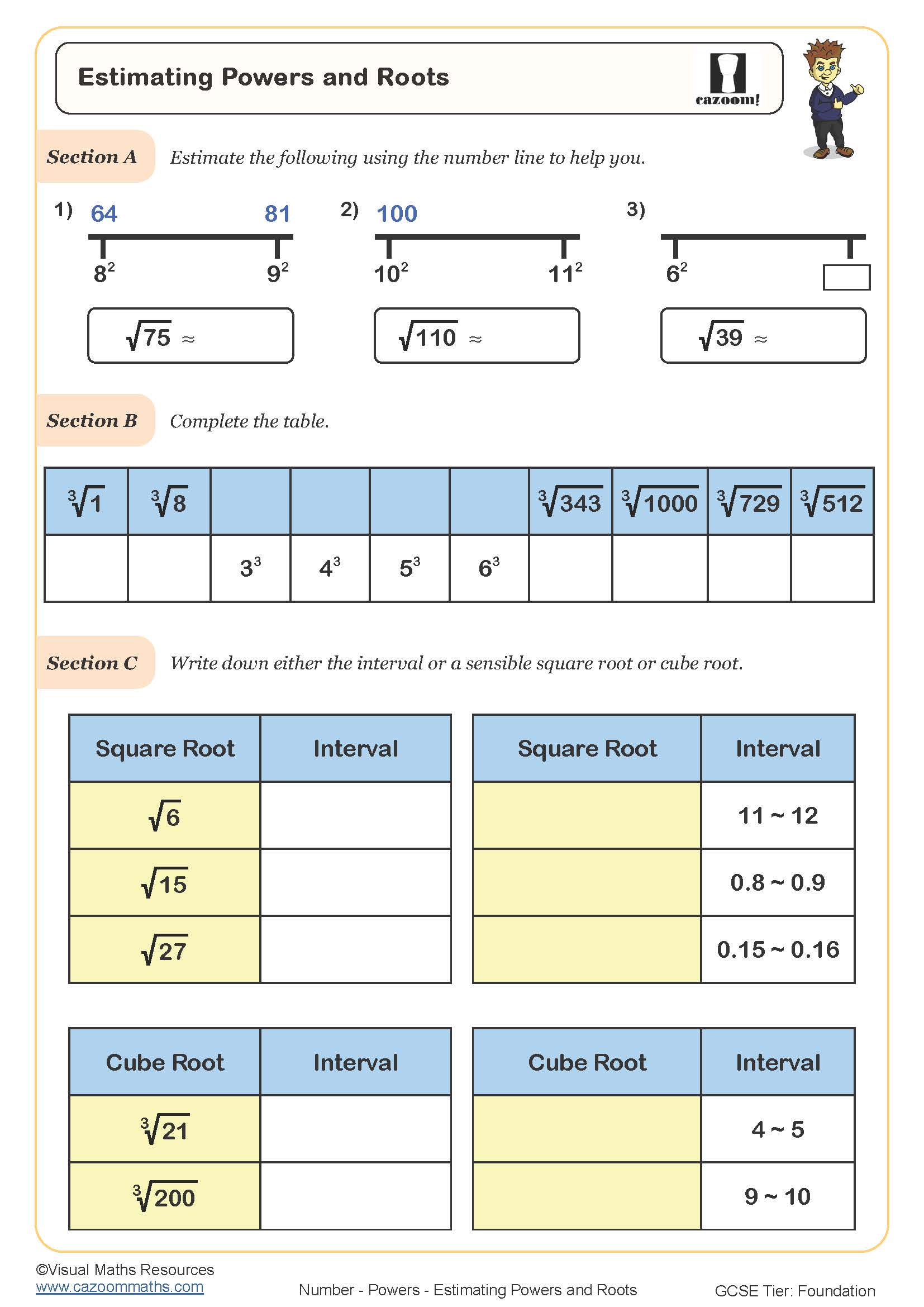
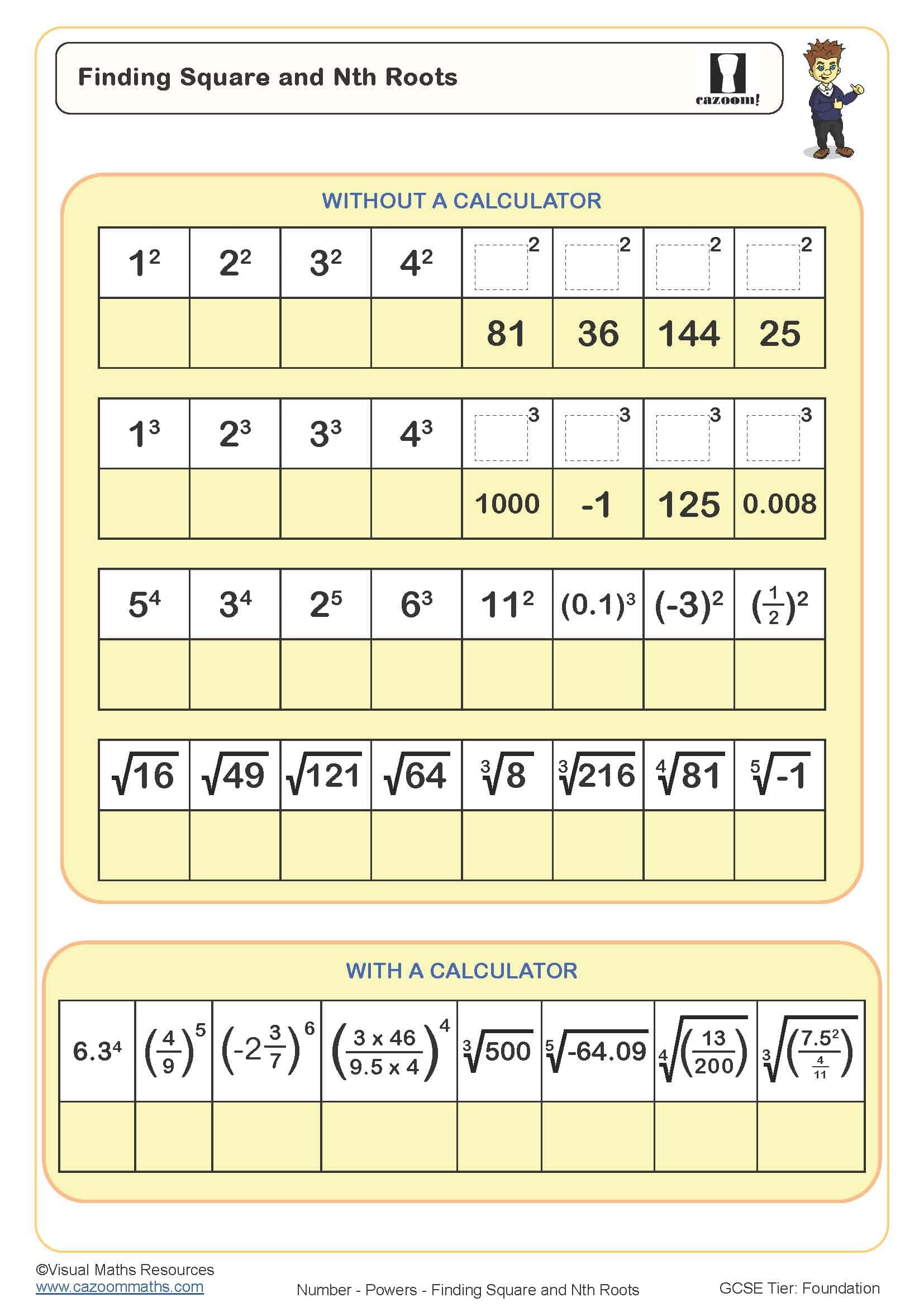
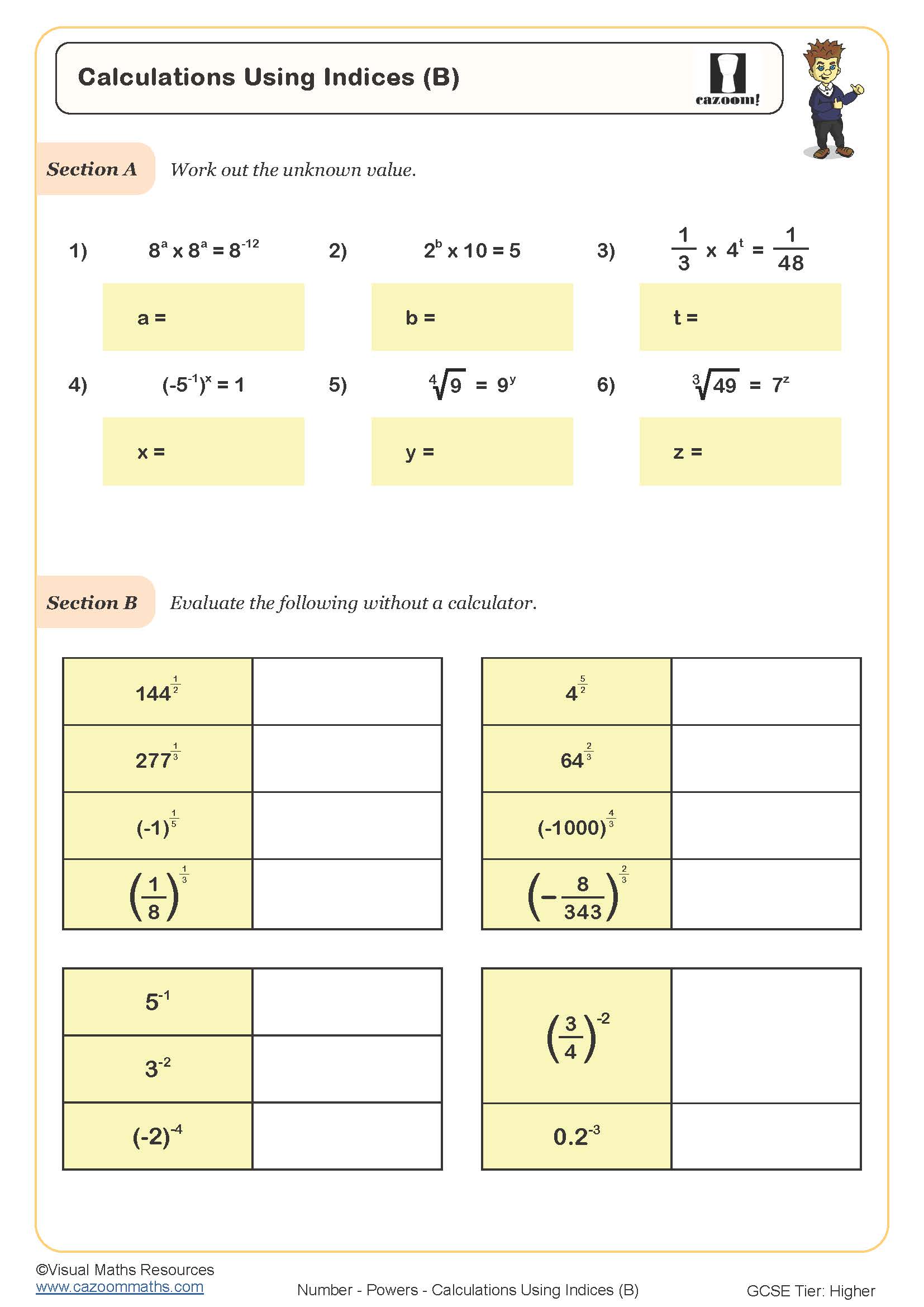
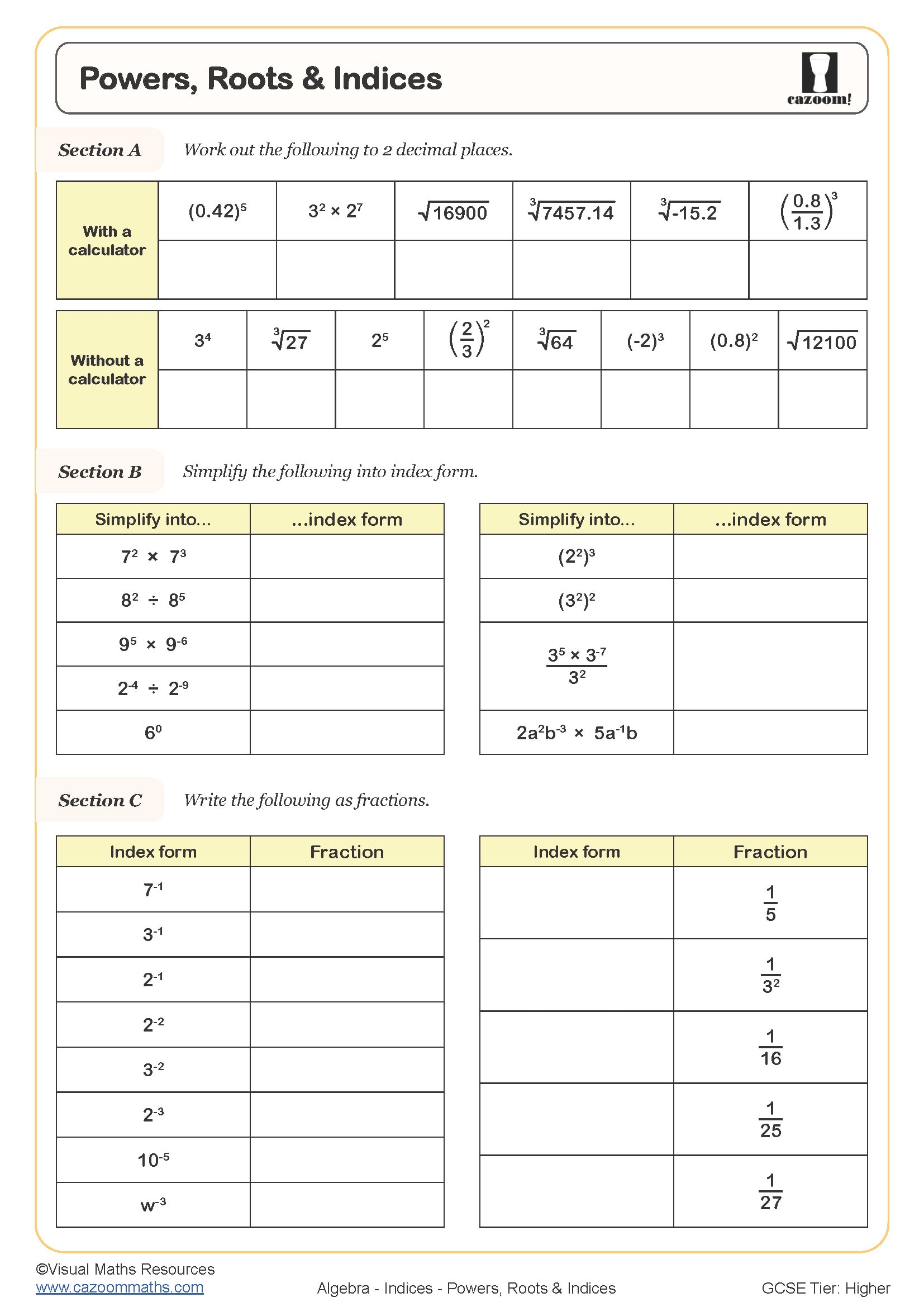
All worksheets are created by the team of experienced teachers at Cazoom Maths.
What are powers and roots in maths?
Powers (also called indices or exponents) show how many times a number is multiplied by itself, whilst roots are the inverse operation that finds the base number. For example, 2⁴ means 2 × 2 × 2 × 2 = 16, and the fourth root of 16 is 2. The National Curriculum introduces square numbers and square roots in upper Key Stage 2, extending to cube numbers, higher powers, and index laws through Key Stage 3.
Students often struggle with the notation for roots, particularly distinguishing between √64 (which equals 8) and ∛64 (which equals 4). Another common misconception involves negative bases: many students incorrectly assume that (-3)² and -3² give the same result, when in fact (-3)² = 9 but -3² = -9 due to order of operations. Mark schemes at GCSE consistently penalise students who omit brackets when working with negative numbers raised to powers.
Which year groups study powers and roots?
This collection covers Year 7, Year 8, Year 9, Year 10, and Year 11, spanning both Key Stage 3 and Key Stage 4. At Key Stage 3, students consolidate understanding of square and cube numbers before moving to index notation, basic index laws (multiplication and division), and the zero and negative index rules. By Year 9, most students work confidently with fractional indices as an alternative notation for roots.
The progression intensifies at GCSE, where Year 10 and Year 11 students apply index laws to algebraic expressions, solve equations involving powers and roots, and work with surds (irrational roots that cannot be simplified to whole numbers). Higher tier students must manipulate expressions like (2x³)⁴ or simplify √48 into surd form. Teachers often find that revisiting the concrete examples from Year 7 helps students grasp these more abstract applications, particularly when dealing with fractional and negative indices.
How do you calculate cube roots?
A cube root finds the number that, when multiplied by itself three times, gives the original value. The cube root of 27 is 3 because 3 × 3 × 3 = 27, written as ∛27 = 3. Unlike square roots, cube roots can be negative: ∛(-8) = -2 because (-2) × (-2) × (-2) = -8. Students need to recognise perfect cubes (1, 8, 27, 64, 125, 216, etc.) and understand that cube roots undo the cubing operation, just as square roots undo squaring.
Cube roots appear frequently in real-world volume calculations, particularly in engineering and design. If a storage container has a volume of 125 cubic metres and needs to be a perfect cube shape, calculating ∛125 = 5 tells designers that each edge must measure 5 metres. This connection to three-dimensional space helps students visualise why cube roots differ from square roots, and why the concept extends beyond abstract number work into practical STEM applications.
How do these worksheets help students learn powers and roots?
The worksheets build confidence through carefully structured question sets that progress from evaluating simple powers and roots to applying index laws and solving problems in context. Each sheet typically begins with recognising perfect squares and cubes, then moves to expressing repeated multiplication using index notation, before challenging students with mixed operations or worded problems. This scaffolding allows students to consolidate basic skills before attempting more complex calculations that appear in GCSE papers.
Teachers use these resources flexibly: as starter activities to assess prior knowledge at the beginning of a unit, as targeted intervention for students who struggle with index notation, or as revision materials before assessments. The complete answer sheets make them particularly valuable for homework tasks where students need to self-check their methods, or for paired work where students can verify each other's calculations. Many teachers also use individual questions as worked examples on the board, demonstrating the step-by-step process before students attempt similar problems independently.