Problem Solving with Fractions Worksheets
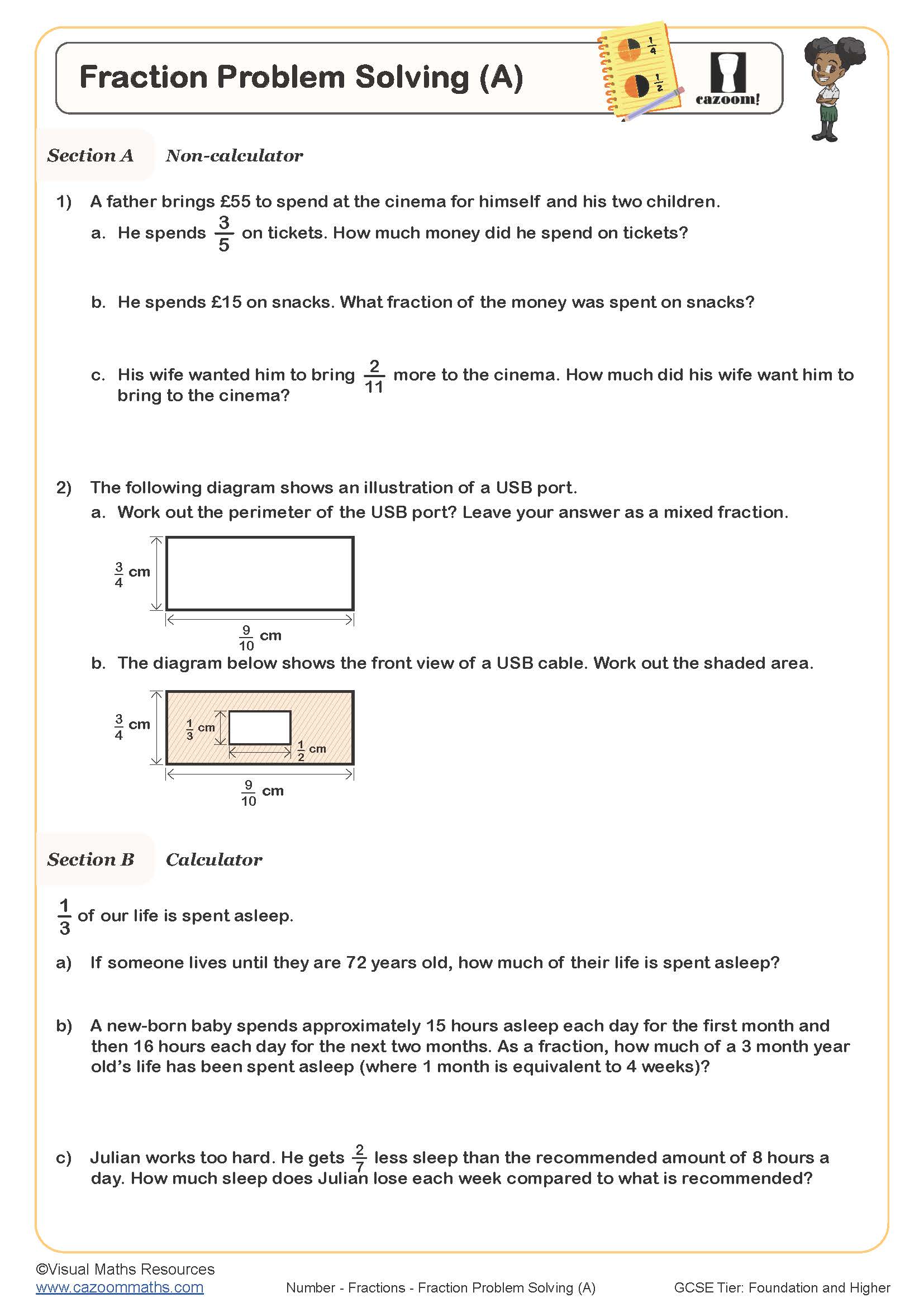
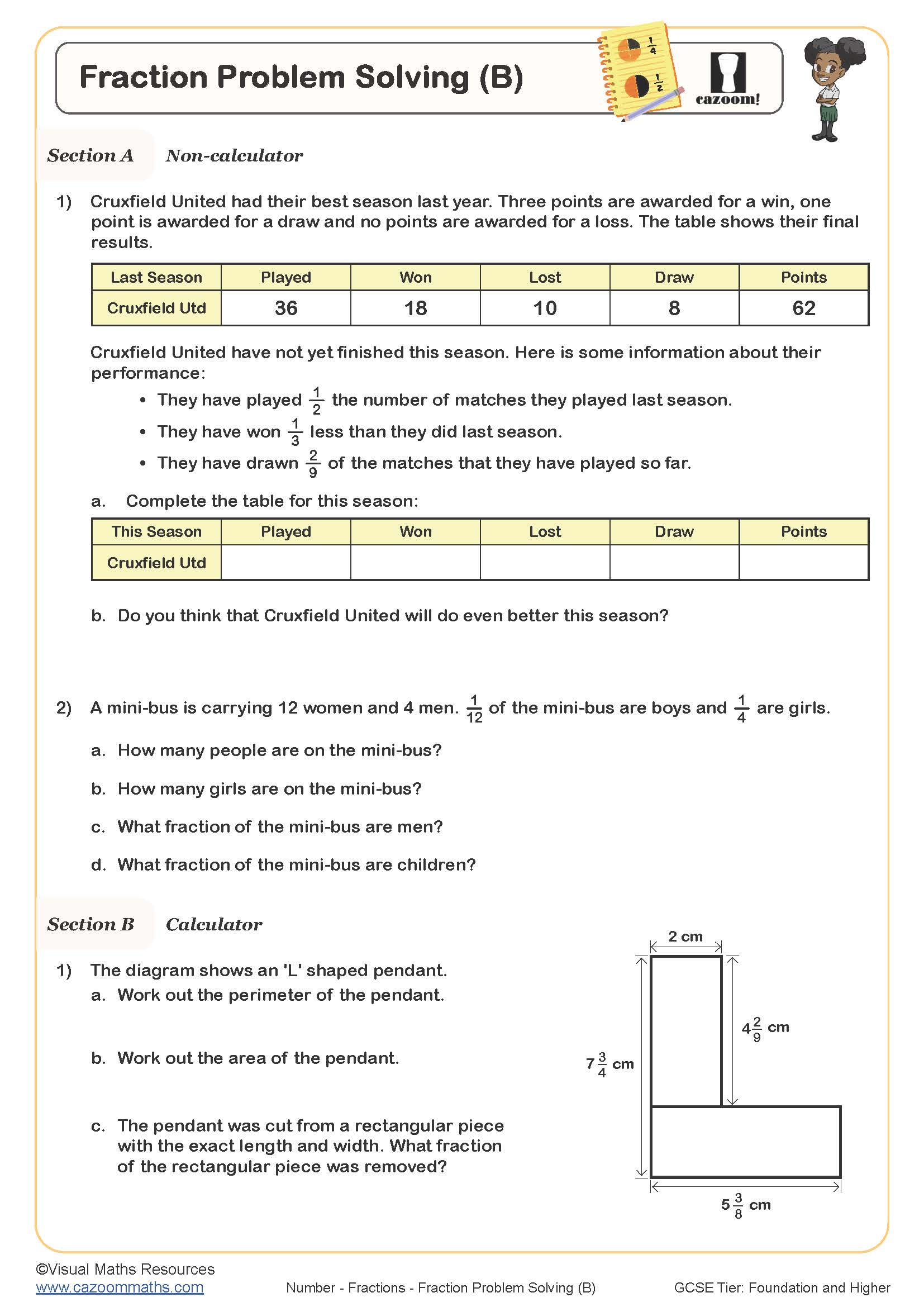
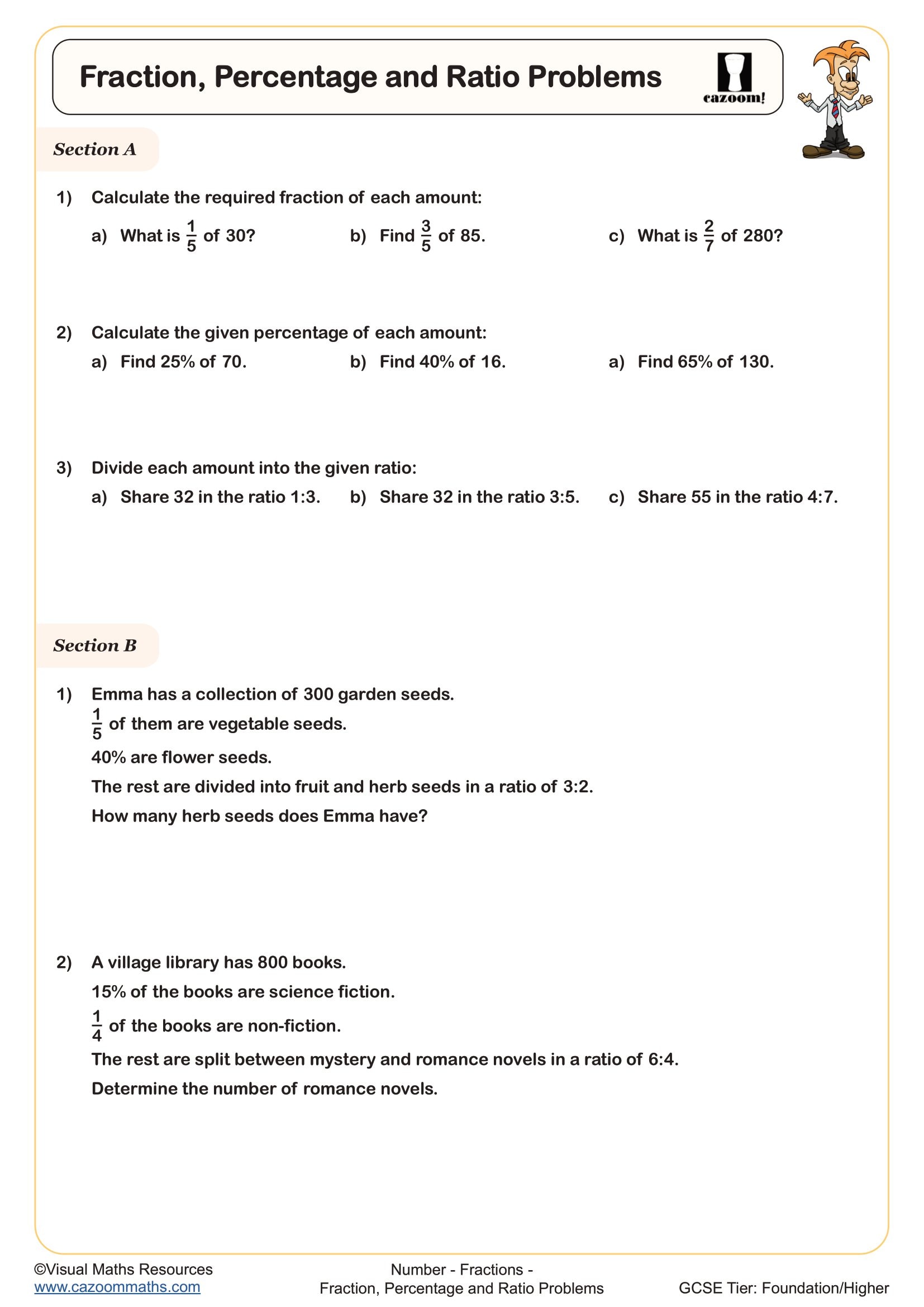
All worksheets are created by the team of experienced teachers at Cazoom Maths.
What types of questions appear on problem solving with fractions worksheets?
Problem solving with fractions worksheet questions typically involve real-world contexts such as sharing quantities, calculating proportions in recipes, working with measurements, and determining fractional parts of amounts. Students encounter multi-step problems requiring them to add, subtract, multiply, or divide fractions within a narrative framework, often needing to convert between mixed numbers and improper fractions as part of the solution process.
A common error pattern emerges when students rush to calculate without identifying what the question actually asks. For instance, when a problem states 'Sarah uses 2/3 of 450g flour', many students multiply correctly but then subtract their answer from 450g even when the question asks how much she used, not how much remained. Mark schemes consistently penalise this lack of attention to context, making these worksheets valuable for developing reading comprehension alongside calculation skills.
Which year groups use problem solving with fractions worksheets?
These fractions problem solving worksheets cover Year 9, Year 10, and Year 11, spanning both KS3 consolidation and KS4 GCSE preparation. At KS3, the National Curriculum expects students to apply their fraction skills to increasingly complex problems, whilst KS4 work incorporates problem solving with fractions into broader topics like ratio, proportion, and algebraic reasoning. The worksheets align with both Foundation and Higher tier expectations.
Progression across these year groups moves from clearly structured problems with obvious fractional language in Year 9 towards more disguised applications in Years 10 and 11. Later worksheets embed fractions within percentage problems, reverse calculations, and best buy scenarios where students must recognise that fractional reasoning applies even when fractions aren't explicitly mentioned. This mirrors the way GCSE papers test fractional understanding across multiple contexts rather than in isolated fraction sections.
How do problem solving worksheets develop reasoning with fractions?
Problem solving worksheets develop reasoning by requiring students to select and sequence operations rather than simply follow instructions. Students must interpret whether a situation requires finding a fraction of an amount, comparing fractional quantities, or working backwards from a fractional result. This demands understanding of what fraction operations actually represent, not just procedural recall of calculation methods.
Engineering, construction, and healthcare contexts regularly demand this level of fractional reasoning. A pharmacy technician calculating 3/4 of a 120ml prescription or a carpenter determining how many 2 2/3 metre lengths can be cut from 20 metres of timber must interpret the situation, select appropriate calculations, and verify results make practical sense. These worksheets prepare students for such applied mathematical thinking, where choosing the wrong operation creates real consequences beyond lost examination marks.
How can teachers use these problem solving fractions worksheets effectively?
The worksheets work effectively when teachers model the problem-solving process before independent practice. Demonstrating how to underline key information, identify what the question asks, and estimate a sensible answer range helps students develop systematic approaches. The answer sheets support this by allowing students to check their working at each stage, identifying precisely where their reasoning diverged from the correct solution path.
Many teachers use these resources for differentiated revision sessions, paired work where students explain their reasoning to each other, or as low-stakes assessments to identify which students need targeted intervention. They also serve well as homework that bridges classwork and examination preparation, particularly in Year 11 when students need repeated exposure to problem solving under timed conditions. The consistent format across worksheets allows students to build confidence through recognisable structures whilst encountering varied contexts.