Problem Solving with Fractions, Decimals, and Percentages Worksheets
All worksheets are created by the team of experienced teachers at Cazoom Maths.
What types of problems appear in fractions, decimals and percentages worksheets?
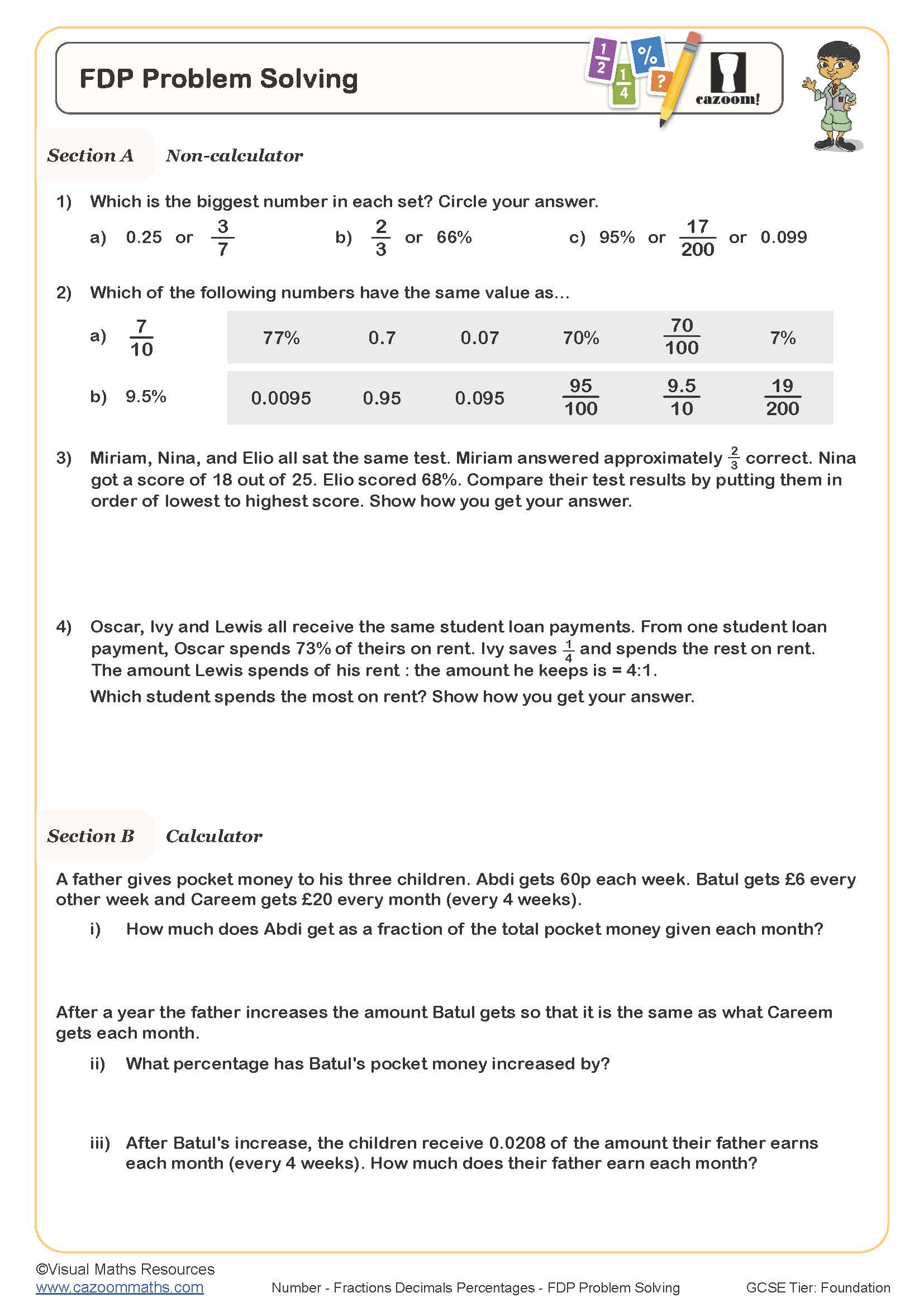
These worksheets typically present problems requiring students to convert between fractions, decimals and percentages fluently whilst deciding which form best suits the context. Questions often involve comparing quantities expressed in different forms, calculating percentage increases and decreases, working with fractions of amounts, and solving problems involving ratio and proportion where conversions between forms streamline the solution.
A common error occurs when students convert unnecessarily, adding complexity and potential for calculation mistakes. For example, when comparing 0.35 and 3/10, many students convert both to percentages rather than recognising that 3/10 equals 0.3, making the decimal comparison straightforward. Teachers observe that explicit practice in identifying which form minimises calculation steps significantly improves both accuracy and efficiency in problem-solving contexts.
Which year groups study problem solving with fractions, decimals and percentages?
These problem-solving resources target Year 8 and Year 9 students within KS3, building on the foundational conversion skills established in upper primary. At this stage, the National Curriculum expects students to solve problems involving increasingly complex contexts, working with multiple operations and determining the most efficient calculation strategy rather than following prescribed methods.
Progression across these year groups involves greater complexity in problem structure and context. Year 8 problems typically involve two-step reasoning, such as finding a percentage of an amount then applying a subsequent calculation. By Year 9, students encounter problems requiring them to work backwards from a result, handle percentage changes compounded over multiple steps, or navigate scenarios where information is presented in mixed forms, demanding strategic thinking about which conversions will simplify the mathematics involved.
How do fractions, decimals and percentages connect to financial literacy?
Understanding the equivalence and conversion between fractions, decimals and percentages underpins much of practical financial mathematics. Interest rates, tax calculations, discounts, commission structures, and investment returns all require fluent movement between these representations. Students need to recognise that a 0.05 interest rate, 5% return, and 1/20 share of profit represent identical proportional relationships expressed differently.
This skill becomes particularly relevant when comparing financial products or evaluating offers. Comparison websites display information in various formats: credit cards might show APR as percentages, savings accounts quote interest as decimals, and mobile phone contracts express data allowances as fractions of total usage. The ability to convert fluently between forms allows informed decision-making, whilst understanding that 33.3% recurrent equals exactly 1/3 prevents rounding errors that compound significantly in long-term financial planning and STEM calculations involving precision.
How can teachers use these worksheets effectively in lessons?
The worksheets support structured problem-solving practice by presenting questions that gradually increase in complexity, encouraging students to develop systematic approaches to multi-step reasoning. The inclusion of complete answer sheets enables students to verify not just their final answer but to trace through the solution method, identifying where their chosen conversion strategy may have differed from the model solution and evaluating whether their approach was equally valid but perhaps less efficient.
Many teachers find these resources particularly valuable for intervention work with students who perform adequately in procedural calculations but struggle when context demands strategic thinking. The worksheets work well as paired activities where students compare their solution methods, discussing which conversions they chose and why. They also serve effectively as homework following lessons on problem-solving strategies, or as targeted revision before assessments where multi-step reasoning with different numerical forms typically appears and often differentiates student performance across grade boundaries.