Problem Solving with Percentages Worksheets
All worksheets are created by the team of experienced teachers at Cazoom Maths.
What types of problems appear on solving percentage problems worksheets?
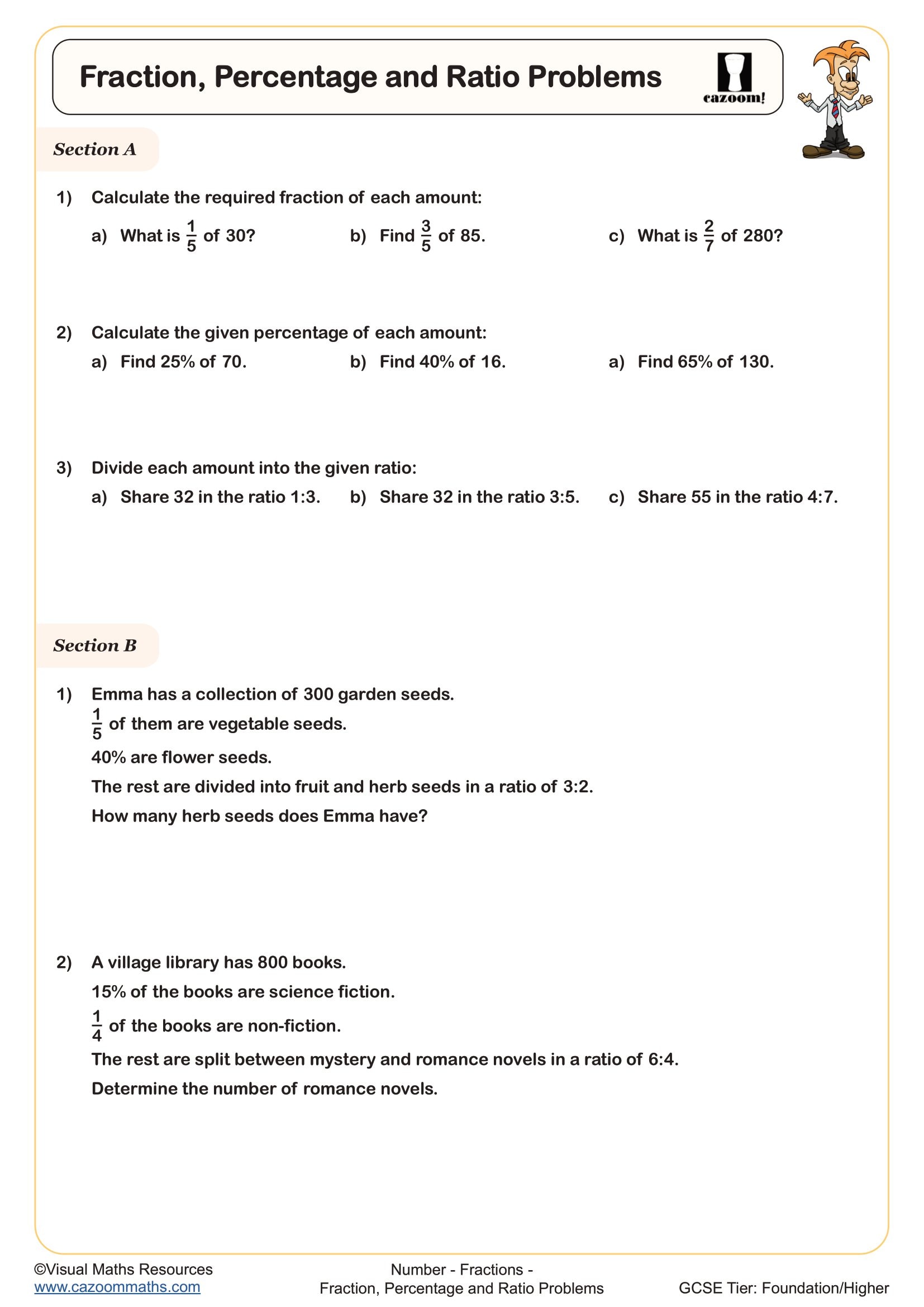
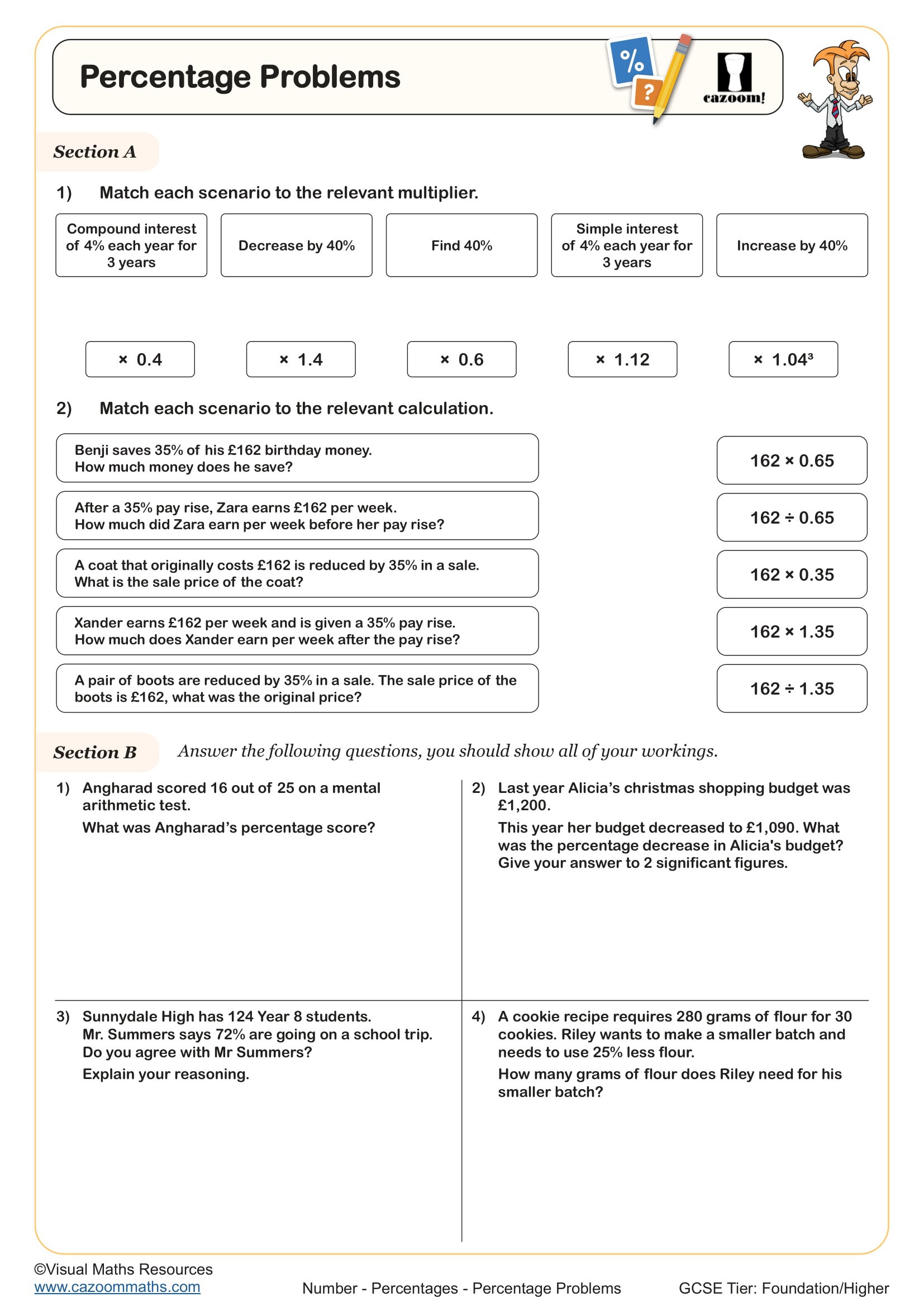
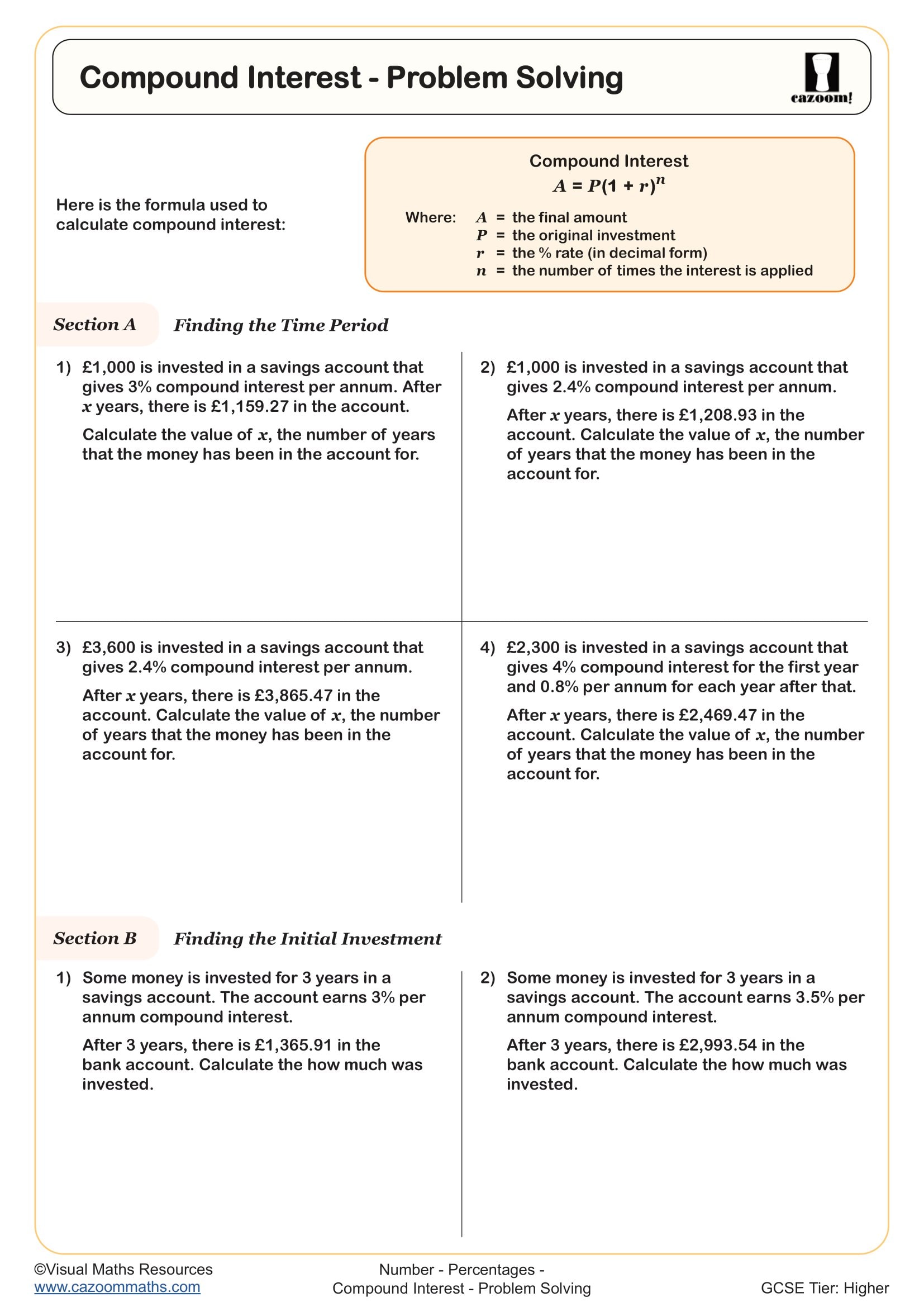
Solving percentage problems worksheets typically include real-world scenarios such as calculating sale prices after discounts, determining profit margins, working out compound interest on savings, finding percentage increases in population or prices, and reverse percentage problems where students must find the original amount before a percentage change. These worksheets progress from single-step problems to multi-stage questions that require students to chain calculations together.
Students often lose marks by applying percentage changes in the wrong order or failing to work with the correct base amount. For instance, when an item is reduced by 20% and then by a further 10%, many students incorrectly assume this equals a 30% reduction rather than calculating 90% of 80% of the original price. This misconception appears regularly in GCSE papers and requires explicit teaching of multiplicative versus additive thinking.
Which year groups study problem solving with percentages?
Problem solving with percentages appears in the National Curriculum from Year 9 through Year 11, spanning both KS3 and KS4. At Year 9, students typically work with straightforward applications such as calculating discounts and simple interest. By Year 10, problems incorporate reverse percentages and compound changes, whilst Year 11 worksheets include the most demanding scenarios combining multiple percentage operations within financial contexts.
The progression focuses on increasing the number of steps required and the mathematical reasoning involved. Year 9 problems might ask students to find 15% of £240, whilst Year 11 questions require them to determine what percentage one quantity is of another after both have undergone percentage changes. GCSE Foundation tier expects competence with straightforward applications, whilst Higher tier includes complex reverse percentages and compound scenarios worth significant marks.
How do reverse percentage problems work?
Reverse percentage problems require students to work backwards from a result to find the original amount before a percentage change was applied. For example, if a jacket costs £68 after a 15% discount, students must recognise that £68 represents 85% of the original price, then divide by 0.85 to find the starting value. This demands understanding that the reduced price isn't the whole but rather a proportion of the whole.
This skill connects directly to financial literacy and consumer awareness. When comparing mobile phone contracts or store cards offering percentage-based cashback, consumers need to calculate true costs and savings by working backwards from advertised prices. In retail management, businesses use reverse percentages to determine what price to mark items before applying promotional discounts that still yield desired profit margins. These real-world applications make reverse percentages particularly relevant beyond the classroom.
How do these worksheets support problem solving with percentages?
The worksheets provide structured progression through percentage applications, starting with problems that clearly state what operation is needed before moving to scenarios where students must interpret the context and select their own approach. Many include worked examples showing the complete solution process, which helps students understand not just which calculations to perform but why that method works. The answer sheets include final answers and, where appropriate, intermediate steps that help students identify exactly where their reasoning diverged from the correct approach.
Teachers find these percentage problem solving worksheets particularly useful for intervention sessions with students who can perform mechanical percentage calculations but struggle with application questions. The worksheets work well for homework following initial teaching, as paired activities where students compare solution methods, or as timed practice for exam preparation. Because percentage problems appear across GCSE papers in various contexts, regular exposure to these problem types builds the flexibility students need to recognise percentage questions regardless of how they're presented.