Problem Solving with Ratio Worksheets
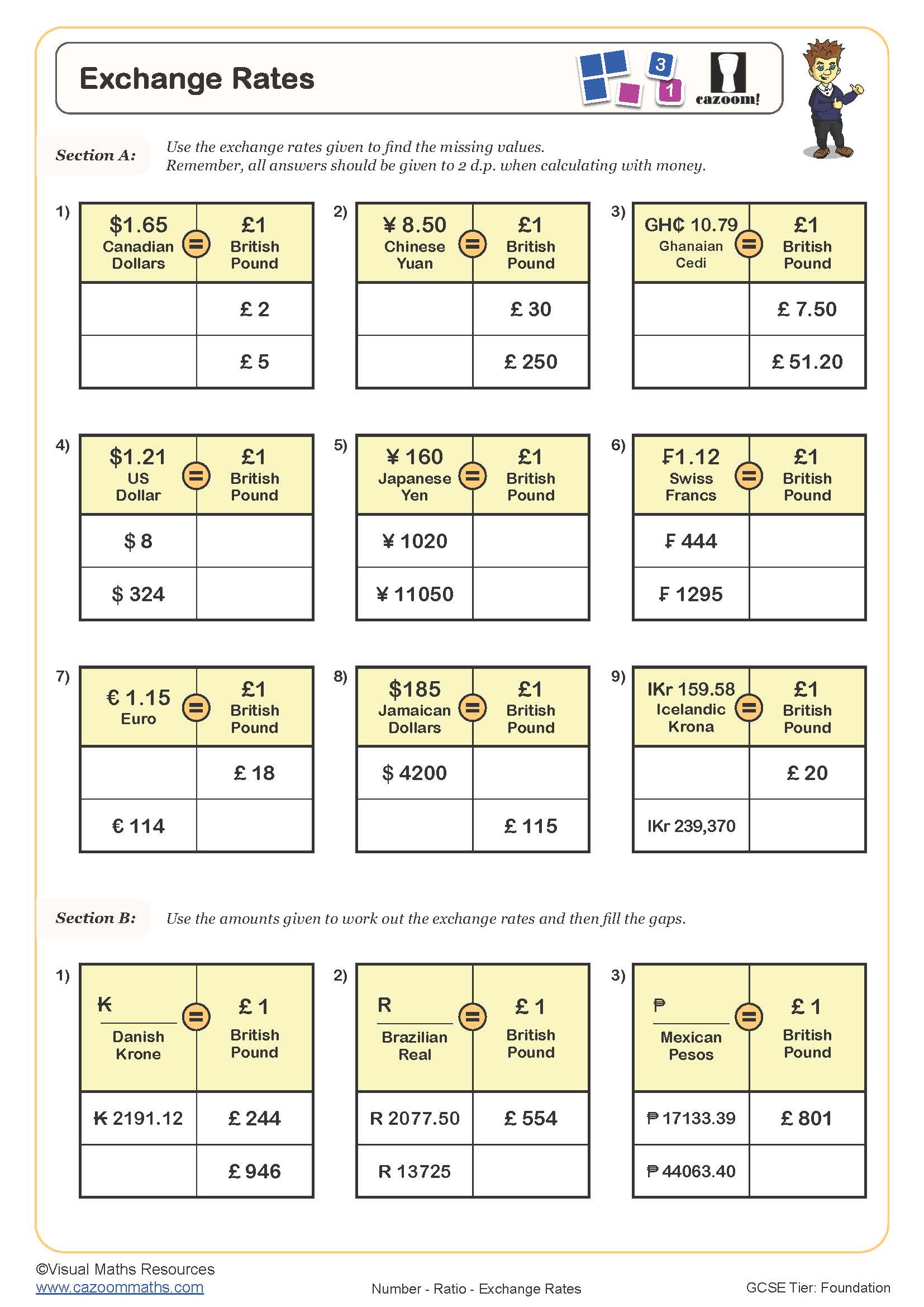
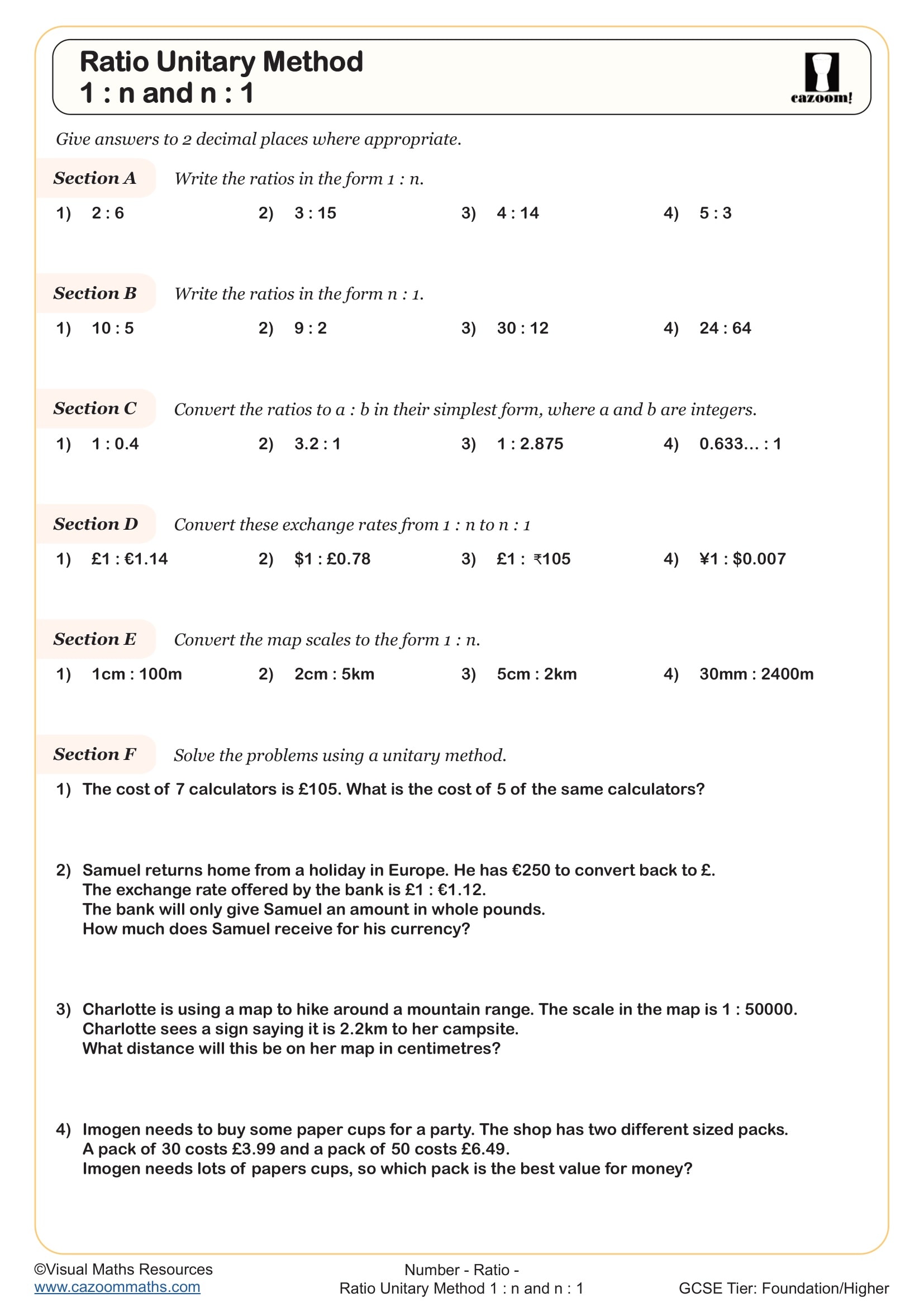
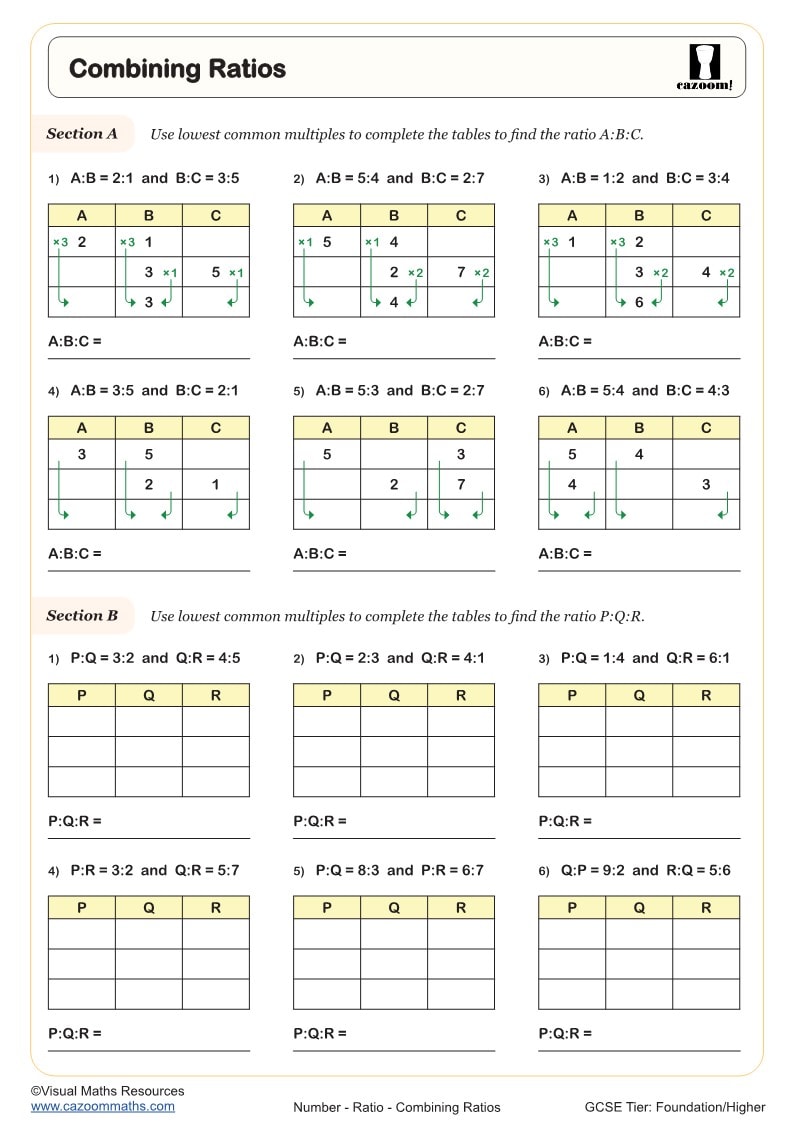
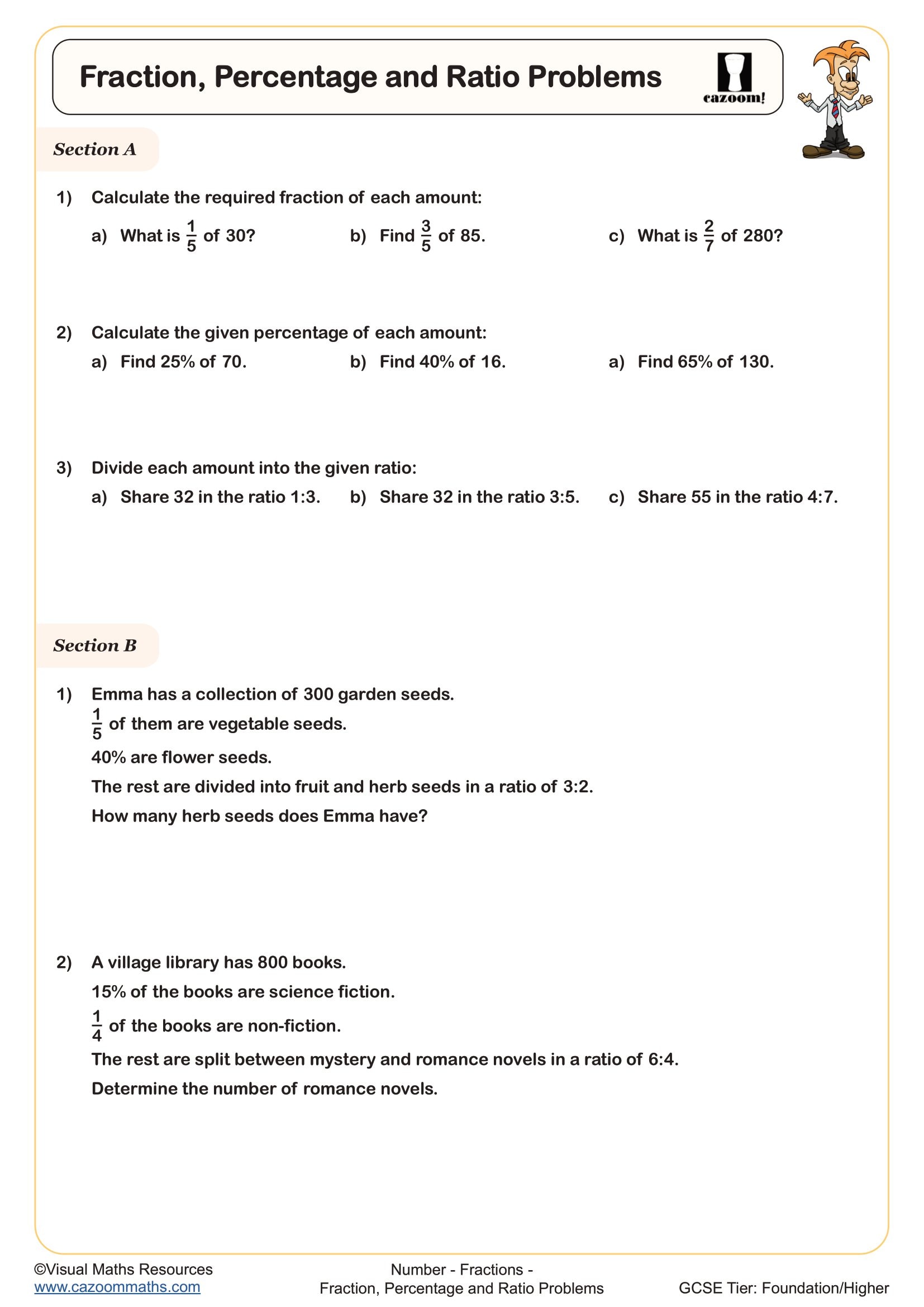
All worksheets are created by the team of experienced teachers at Cazoom Maths.
How do you approach solving ratio problems effectively?
Successful ratios problem solving requires students to identify what the question asks for before rushing into calculations. The key steps involve reading carefully to spot whether they need to find individual shares, totals, or scale factors, then setting up the ratio in a form that matches the question. Many teachers structure this as: identify the ratio, find the value of one part, then calculate what's required.
Students typically lose marks by misinterpreting which quantity corresponds to which part of the ratio. For example, in a question stating "the ratio of boys to girls is 3:5 and there are 24 boys", some students incorrectly divide 24 by 8 rather than recognising that 3 parts equals 24. Encouraging students to label their working clearly prevents this confusion and helps examiners award method marks even when final answers contain arithmetic errors.
Which year groups study problem solving with ratio?
These worksheets span Year 8 through Year 11, covering both KS3 and KS4 curricula. Students first encounter ratio sharing in Year 7, but problem solving with ratio becomes a distinct focus from Year 8 onwards when questions involve multiple operations and require selecting appropriate strategies. The topic appears regularly on both Foundation and Higher GCSE papers.
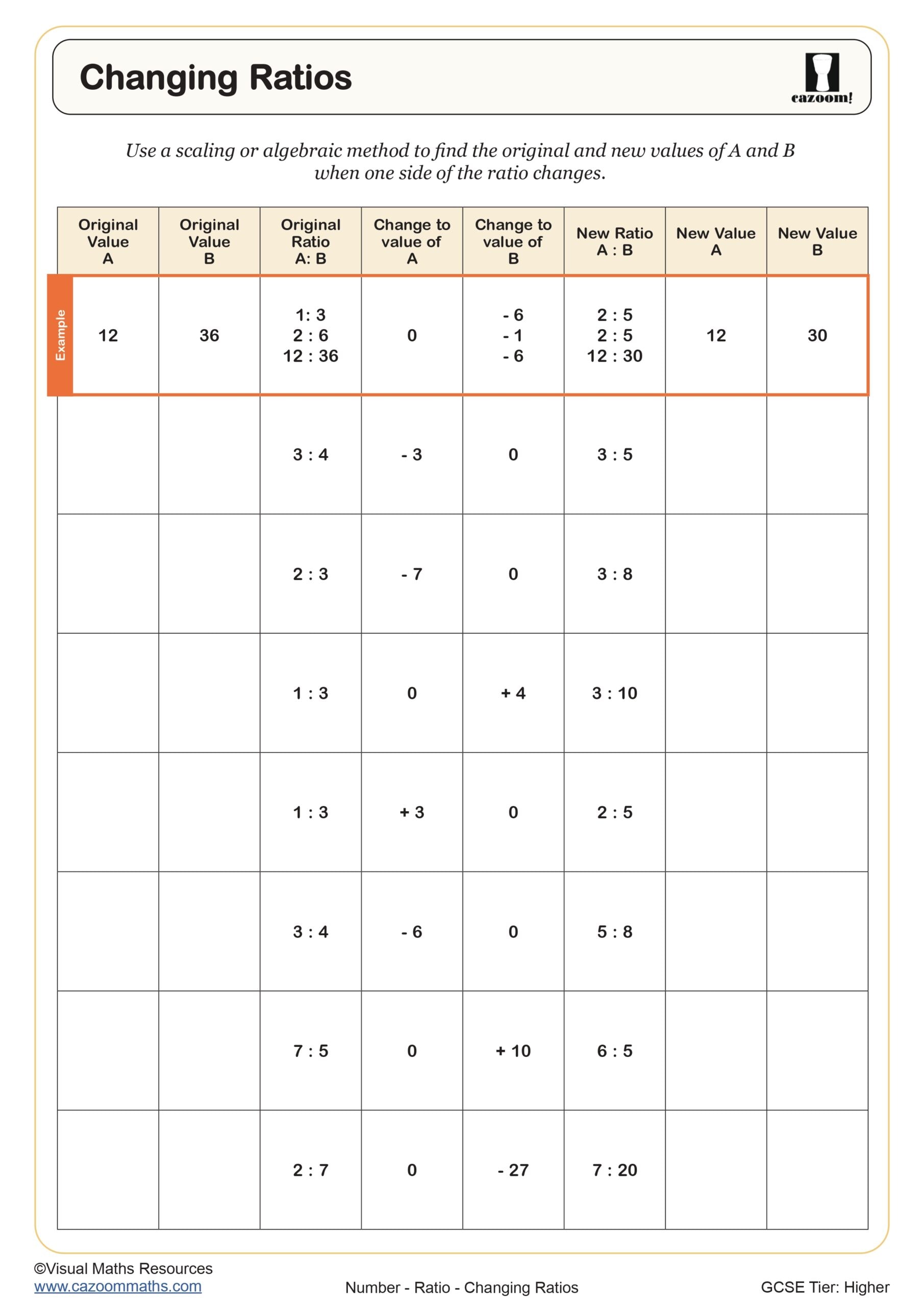
Progression across year groups involves increasing complexity in context and calculation. Year 8 students work with straightforward two-part ratios in familiar contexts, whilst Year 9 introduces three-part ratios and problems requiring conversion between forms. By Year 10 and 11, students face questions combining ratios with percentages or algebra, and changing ratios where quantities shift between different proportional relationships. This layered approach builds the resilience needed for unpredictable exam questions.
What are combining ratios and why do they challenge students?
Combining ratios occurs when students must merge two separate ratios that share a common quantity, creating a single equivalent ratio across all parts. For instance, if the ratio of sand to cement is 3:1 and cement to water is 2:5, students need to find a ratio for sand:cement:water by making the cement parts match. This requires finding a common multiple and scaling both ratios accordingly, which demands strong understanding of equivalent ratios and systematic working.
This skill has direct applications in construction and manufacturing, where mixing specifications come from different sources. Concrete mixing ratios must account for aggregate:cement and cement:water proportions to achieve correct consistency and strength. Similarly, paint mixing in automotive refinishing combines base colour ratios with hardener ratios to produce the final formula. These real-world contexts help students see why accuracy in combining ratio calculations matters beyond the classroom, particularly in technical and engineering fields where incorrect proportions affect product quality and safety.
How do these worksheets support ratio problem solving skills?
The worksheets provide structured practice that builds from accessible entry points to more demanding multi-step questions, allowing students to develop confidence with method selection before tackling unfamiliar contexts. Questions include sufficient variety that students must think about strategy rather than simply repeating the same procedure. The complete answer sheets show full working, which proves particularly valuable when students struggle to see where their approach diverged from the correct method.
Teachers use these worksheets flexibly across different classroom situations. They work well for intervention groups where students need concentrated practice after initial teaching, and for homework that reinforces lesson content without overwhelming students with excessive repetition. Many teachers set these for paired work, where one student attempts odd questions whilst their partner tackles even questions, then they compare methods. This collaborative approach reveals different solution pathways and helps students articulate their mathematical reasoning, which strengthens understanding before assessments.