Proportional Graphs Worksheets
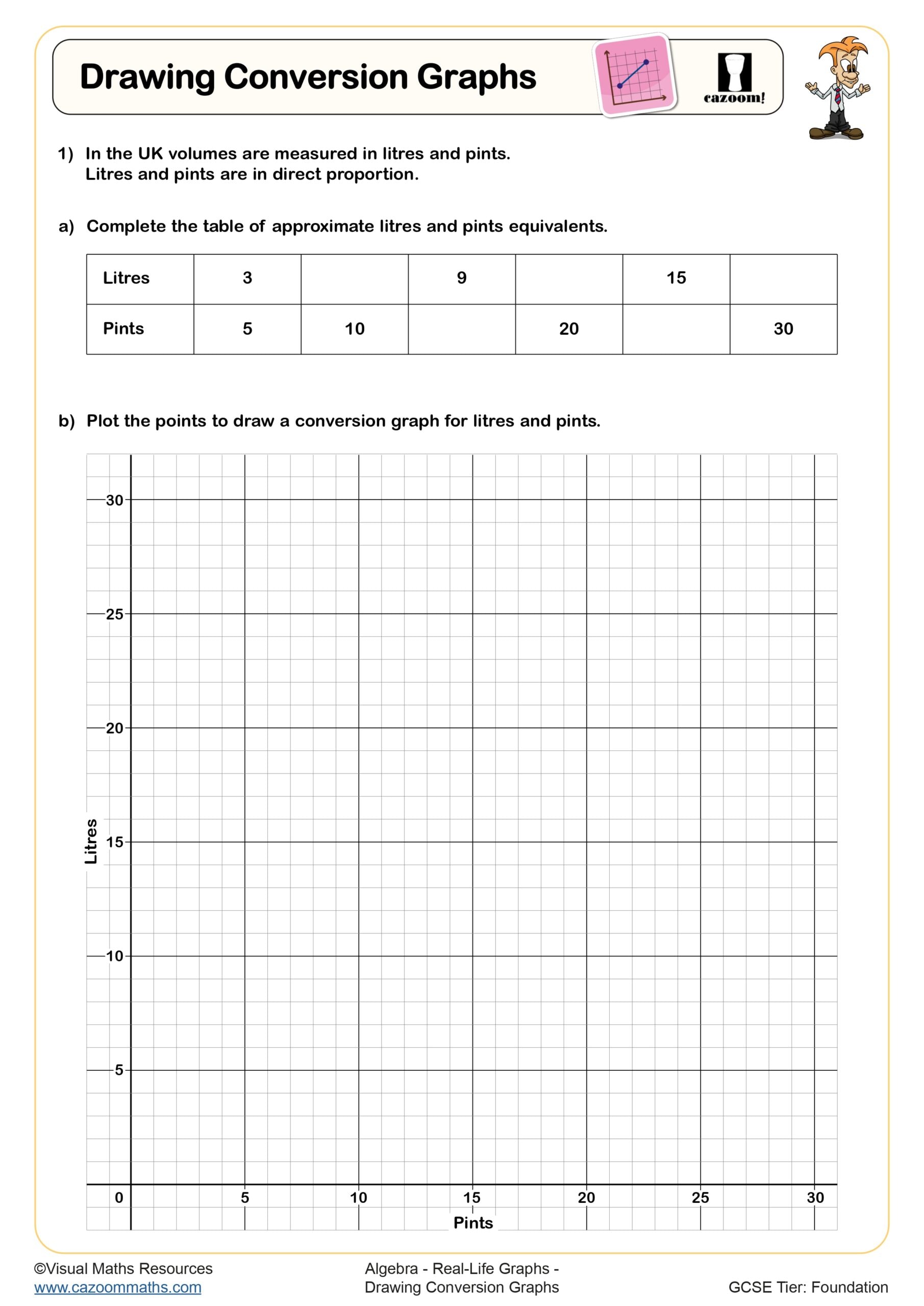
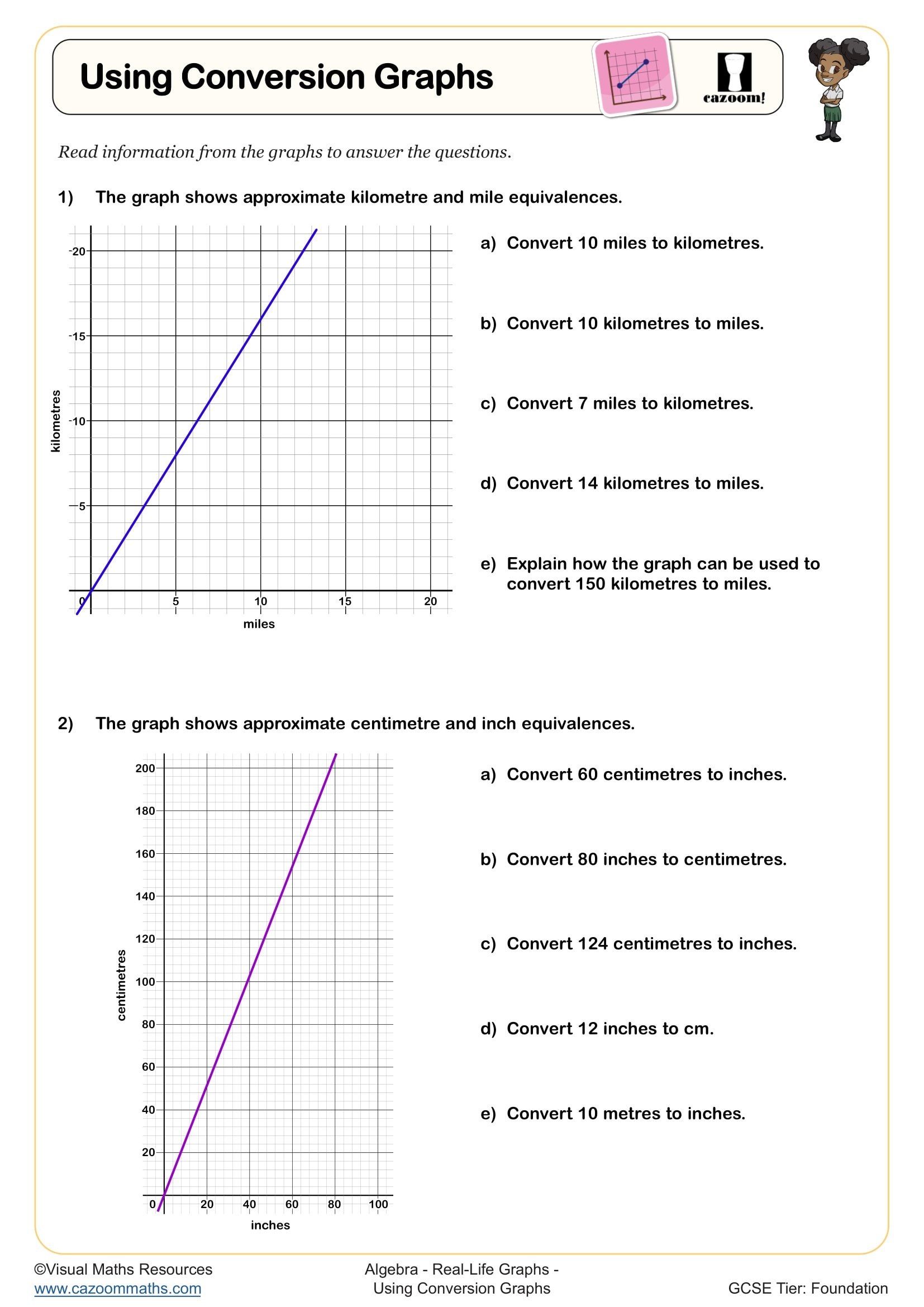
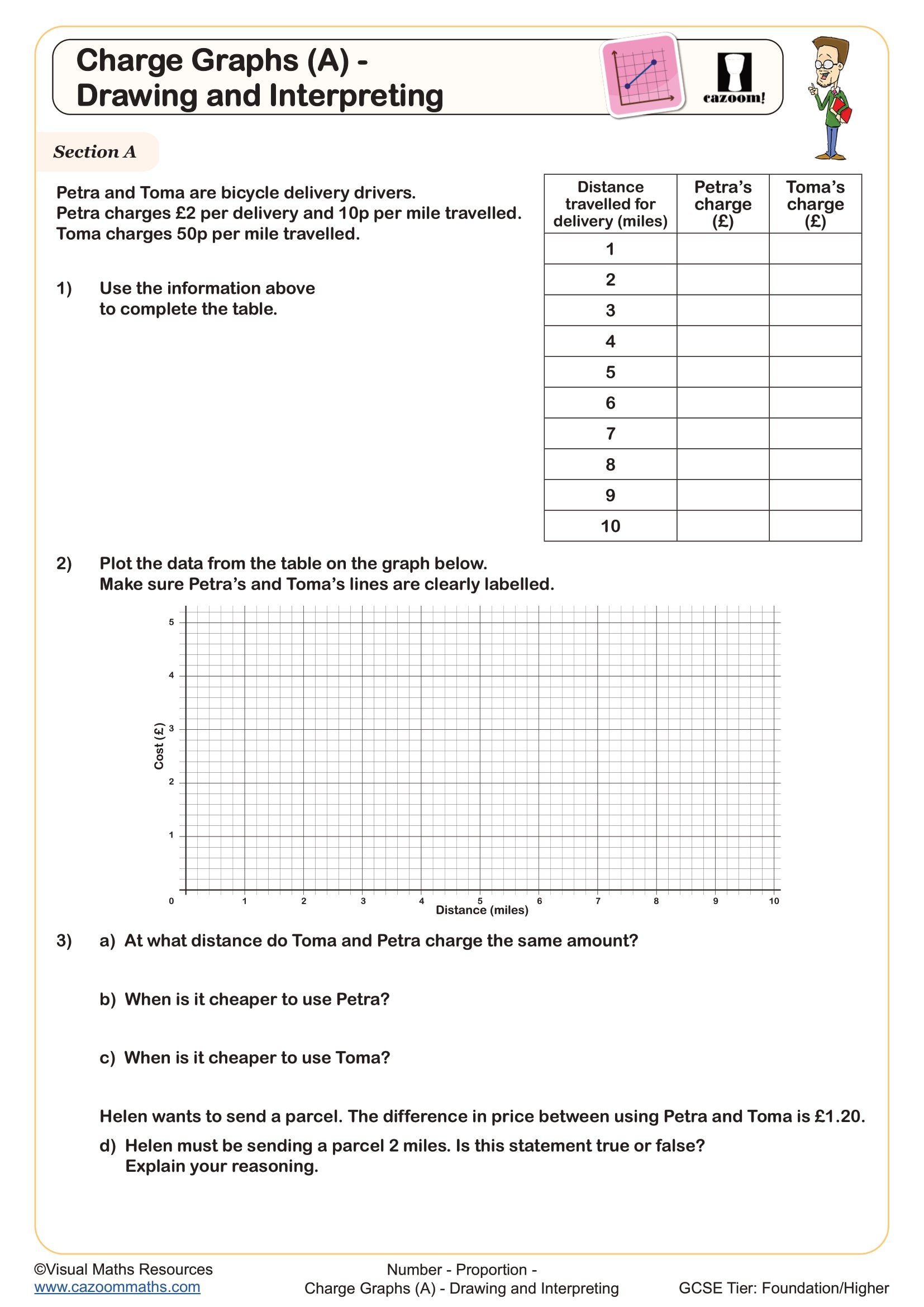
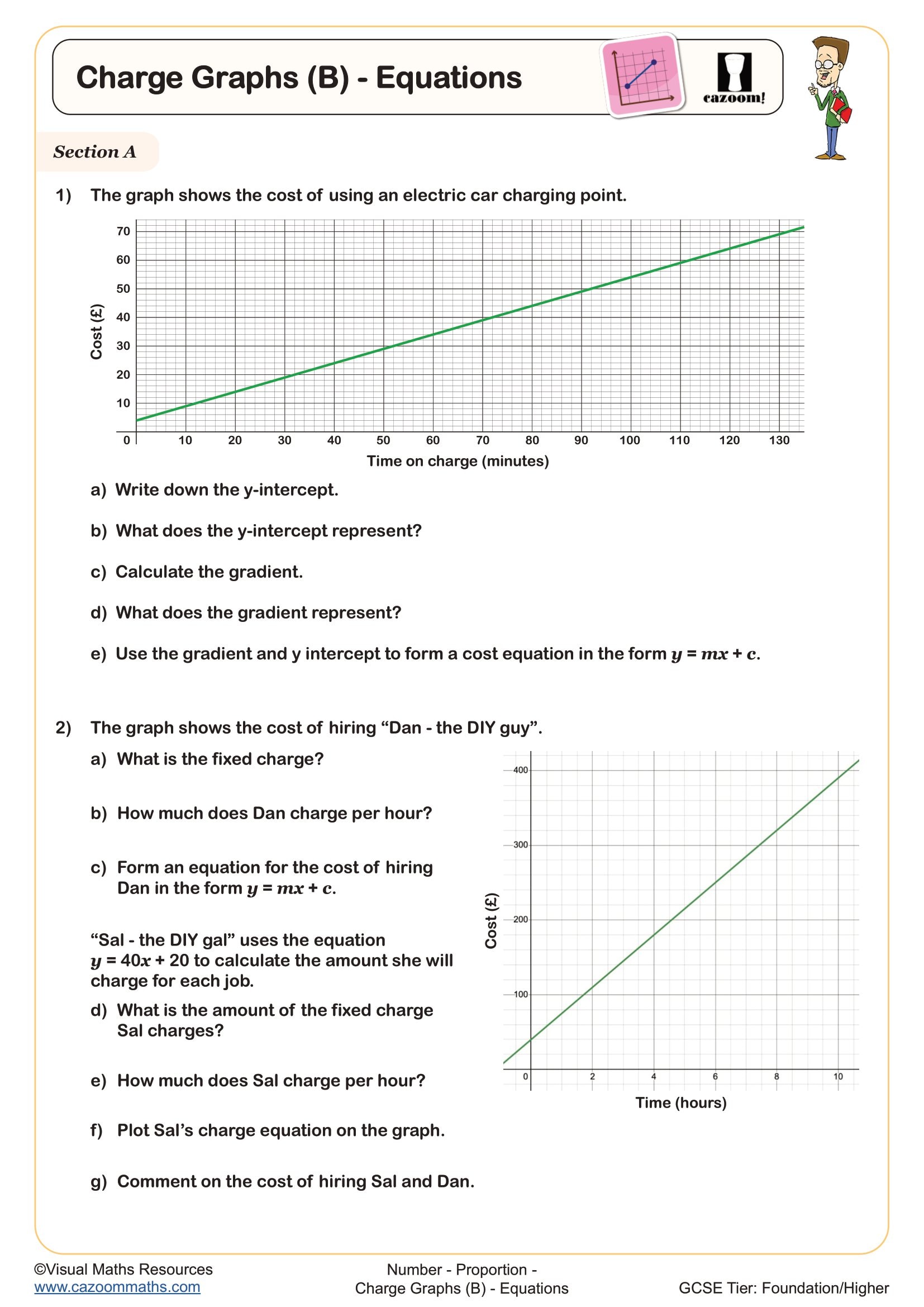
All worksheets are created by the team of experienced teachers at Cazoom Maths.
What should students know about proportional graphs worksheets?
A proportional graphs worksheet PDF typically focuses on direct proportion, where two variables maintain a constant ratio and produce a straight line through the origin when plotted. Students learn that if one quantity doubles, the other doubles too, creating the characteristic linear relationship y = kx. The gradient of a proportional graph represents the constant of proportionality, which students need to calculate and interpret across different contexts.
Teachers often notice that students lose marks by not checking whether their plotted line passes through (0,0), or by confusing proportional graphs with other linear relationships that have y-intercepts. Another common error involves reading values incorrectly from scales, particularly when graphs use non-standard intervals. Exam questions frequently ask students to demonstrate understanding by explaining why a relationship is or isn't proportional based on the graph's characteristics.
Which year groups study proportional graphs?
These worksheets cover proportional graphs for Year 8, Year 9, and Year 10 students across Key Stage 3 and Key Stage 4. The National Curriculum introduces direct proportion graphically at KS3, where students first encounter the connection between proportional relationships and straight-line graphs through the origin. This understanding builds on ratio work from earlier years and prepares students for more complex linear functions.
Progression across year groups moves from plotting simple proportional relationships with given coordinates in Year 8 to interpreting real-world contexts in Year 9, then connecting graphical, algebraic, and numerical representations in Year 10. By GCSE, students are expected to recognise proportional graphs instantly, calculate constants of proportionality from graphs, and distinguish proportional relationships from other linear models in problem-solving contexts.
How do students find the constant of proportionality from a graph?
The constant of proportionality is the gradient of a proportional graph, found by dividing any y-value by its corresponding x-value or by calculating the change in y over the change in x between two points. Since proportional graphs pass through the origin, students can select any clear point on the line and divide its coordinates. For example, on a graph showing distance against time, if a point (4, 20) lies on the line, the constant is 20 ÷ 4 = 5, representing 5 metres per second.
This skill connects directly to speed-time graphs in physics, concentration-volume relationships in chemistry, and currency conversion in economics. Students working with proportional graphs develop the foundation for understanding rates of change across STEM subjects. Teachers find that practical contexts like recipe scaling or fuel consumption help students grasp why the constant remains the same regardless of which point they choose on the line.
How can teachers use these proportional graphs worksheets effectively?
These worksheets build understanding through structured questions that progress from plotting given proportional relationships to identifying them from tables and contexts. Students practise reading and interpreting graphs before moving to more demanding questions about calculating constants and comparing different proportional relationships. The inclusion of answer sheets allows teachers to set work that students can self-mark, identifying their own misconceptions around scale reading or calculation errors.
Many teachers use these resources for targeted intervention with students who struggle to connect algebraic and graphical representations of proportion. The worksheets work well as homework following introductory lessons, allowing students to consolidate skills independently. They're also useful for revision before assessments, particularly for mixed-ability classes where some students need to revisit fundamentals whilst others extend their understanding to more complex contexts. Paired work using these sheets helps students articulate why graphs do or don't show proportion.