Rationalising the Denominator Worksheets
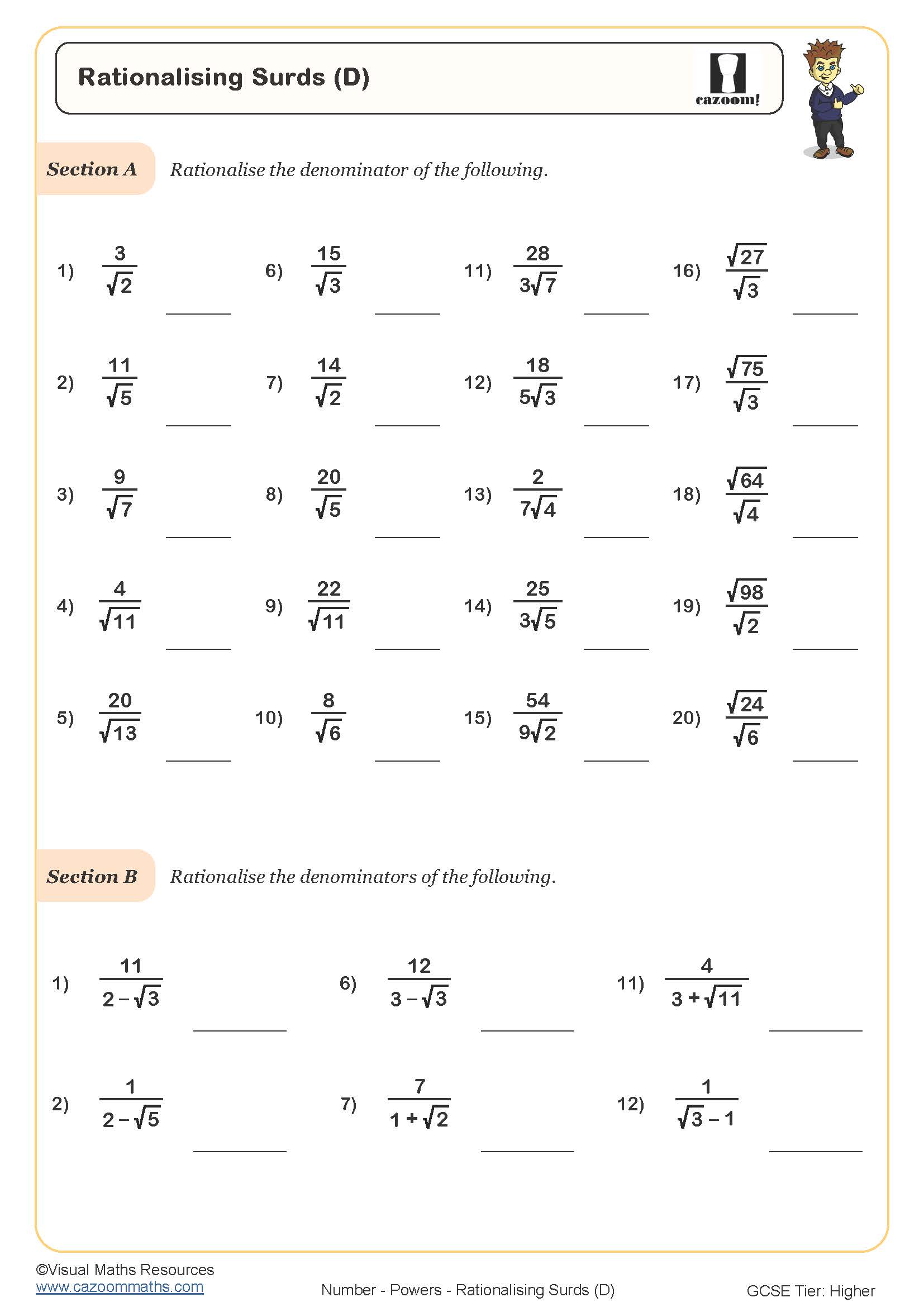
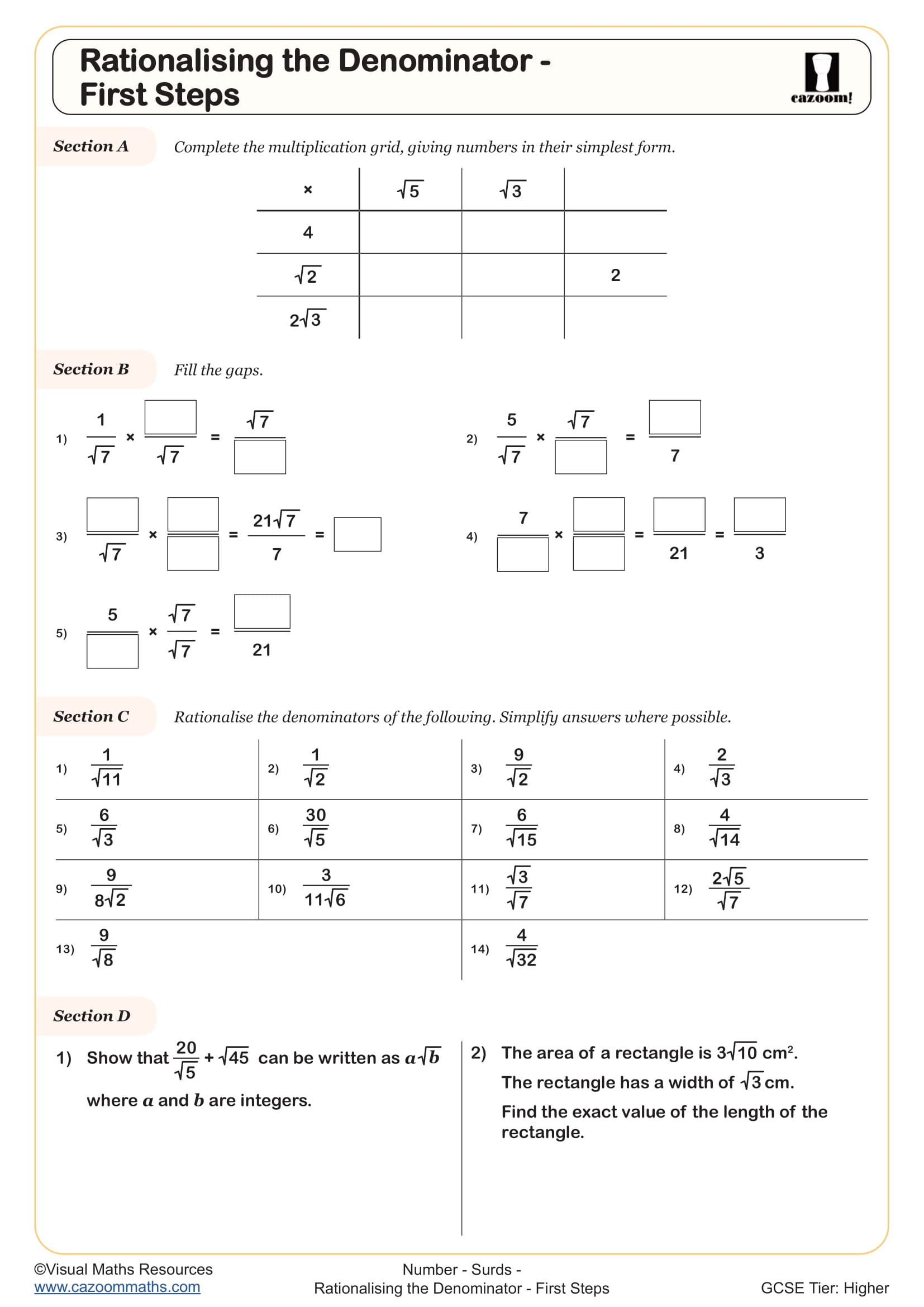
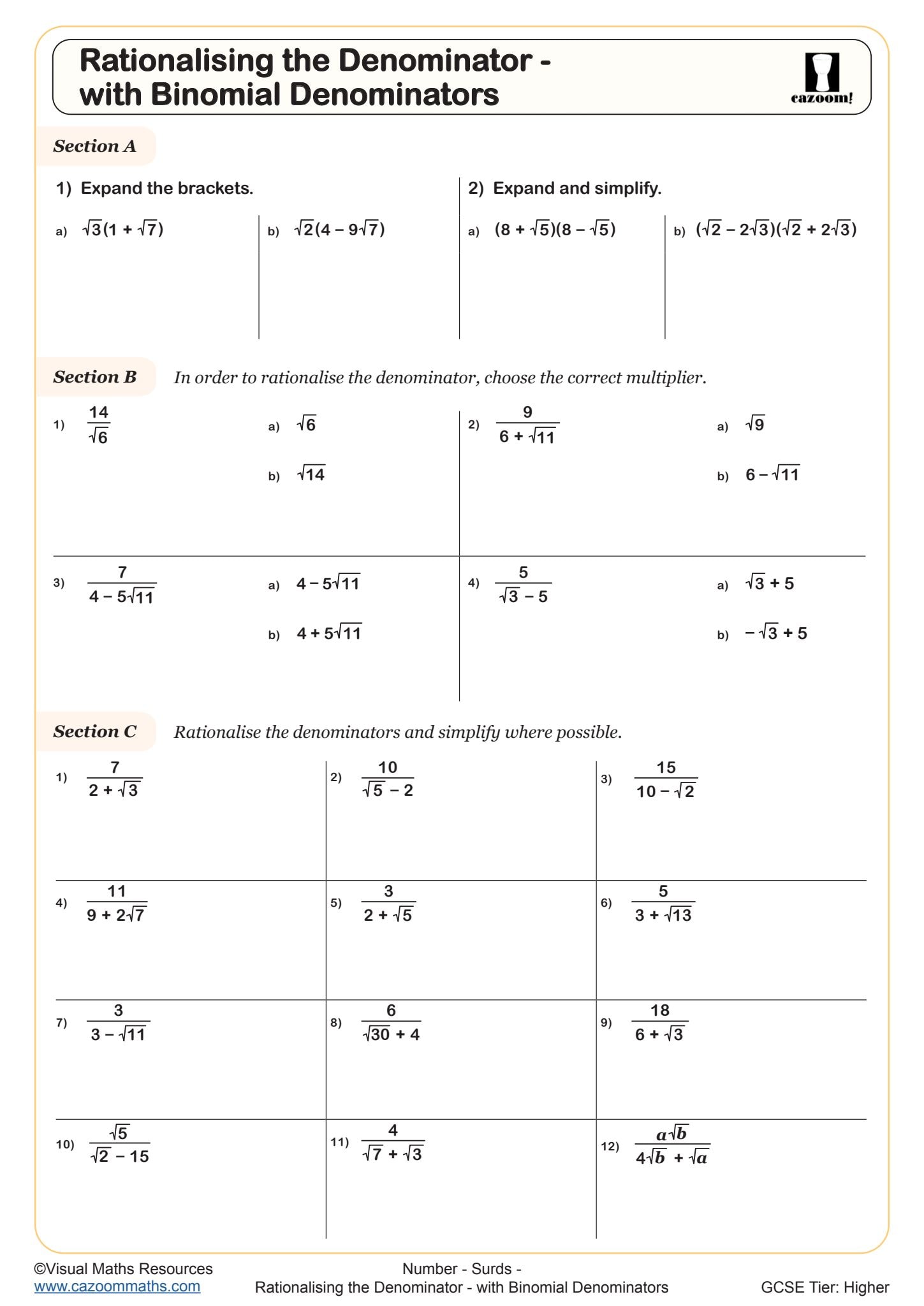
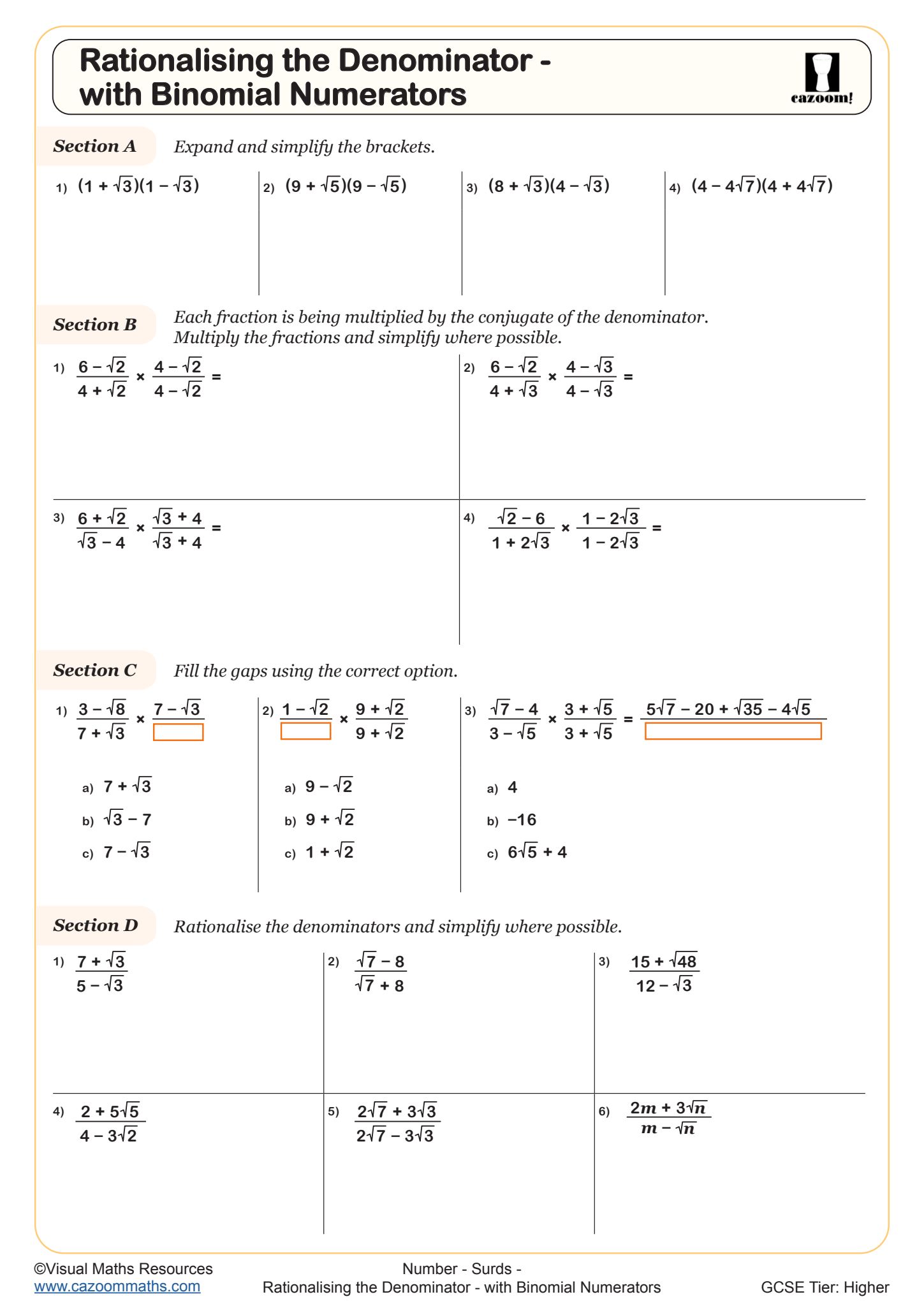
All worksheets are created by the team of experienced teachers at Cazoom Maths.
Why do we rationalise the denominator in maths?
Rationalising the denominator converts fractions with surds in the denominator into an equivalent form with a rational denominator. This convention makes expressions easier to compare, add together, and use in subsequent calculations. At GCSE level, exam mark schemes expect answers in rationalised form, and students lose marks if they leave expressions like 1/√3 unrationalised.
A common error occurs when students think they've finished after multiplying both numerator and denominator by the surd, but forget to simplify the resulting expression. For example, with 4/√2, students correctly multiply by √2/√2 to get 4√2/2, but then fail to cancel down to 2√2. Exam questions often penalise this incomplete simplification, particularly in non-calculator papers where numerical approximations aren't available to check work.
What year group learns rationalising the denominator?
Rationalising the denominator appears in Year 10 and Year 11 as part of the GCSE Higher tier curriculum. Students encounter it after developing confidence with manipulating surds, including simplifying and performing basic operations. The National Curriculum requires Higher tier students to work with irrational numbers in exact form, and rationalising is tested regularly on both calculator and non-calculator papers.
The difficulty progresses from simple cases like 1/√5 in Year 10 to binomial denominators such as (3 + √2) in Year 11, where students must use the difference of two squares. This builds on their algebraic knowledge of expanding brackets and multiplying conjugates. Many teachers find that students who struggle with rationalising binomial denominators haven't fully understood why multiplying by the conjugate eliminates the surd terms, treating it instead as a memorised procedure.
How do you rationalise binomial denominators?
To rationalise a binomial denominator containing surds, students multiply both numerator and denominator by the conjugate of the denominator. The conjugate has the same terms but the opposite sign between them, so for (a + √b), the conjugate is (a - √b). When these multiply together, the result is a² - b, eliminating the surd through the difference of two squares pattern. This requires solid understanding of bracket expansion and recognition that (√b)² = b.
This technique connects to engineering and physics contexts where exact calculations matter. In electrical engineering, rationalising complex impedances makes calculations with alternating current circuits more manageable. When designing signal processing filters, engineers work with expressions containing surds and must rationalise them to determine precise component values. Students who understand the underlying algebra rather than just following steps find these applications more accessible and can adapt the method to unfamiliar contexts.
How can these rationalising worksheets help students prepare for exams?
The worksheets build fluency through structured progression, starting with first steps questions that isolate the core skill before moving to binomial numerators and denominators where students must combine multiple techniques. Each sheet includes worked examples that model the method explicitly, showing both the algebraic manipulation and the reasoning behind each step. Answer sheets allow students to self-check and identify exactly where their working differs from the correct approach, which is particularly valuable for independent revision.
Many teachers use these worksheets for targeted intervention with students who've grasped basic surd manipulation but struggle when rationalising appears within longer exam questions. The sheets work well for homework following initial teaching, then again as focused revision closer to exams. In paired work, students can compare their methods for binomial denominators, discussing why certain approaches work more efficiently than others and identifying common algebraic errors before they become embedded habits.