Recurring and Terminating Decimals Worksheets
All worksheets are created by the team of experienced teachers at Cazoom Maths.
What is the difference between recurring and terminating decimals?
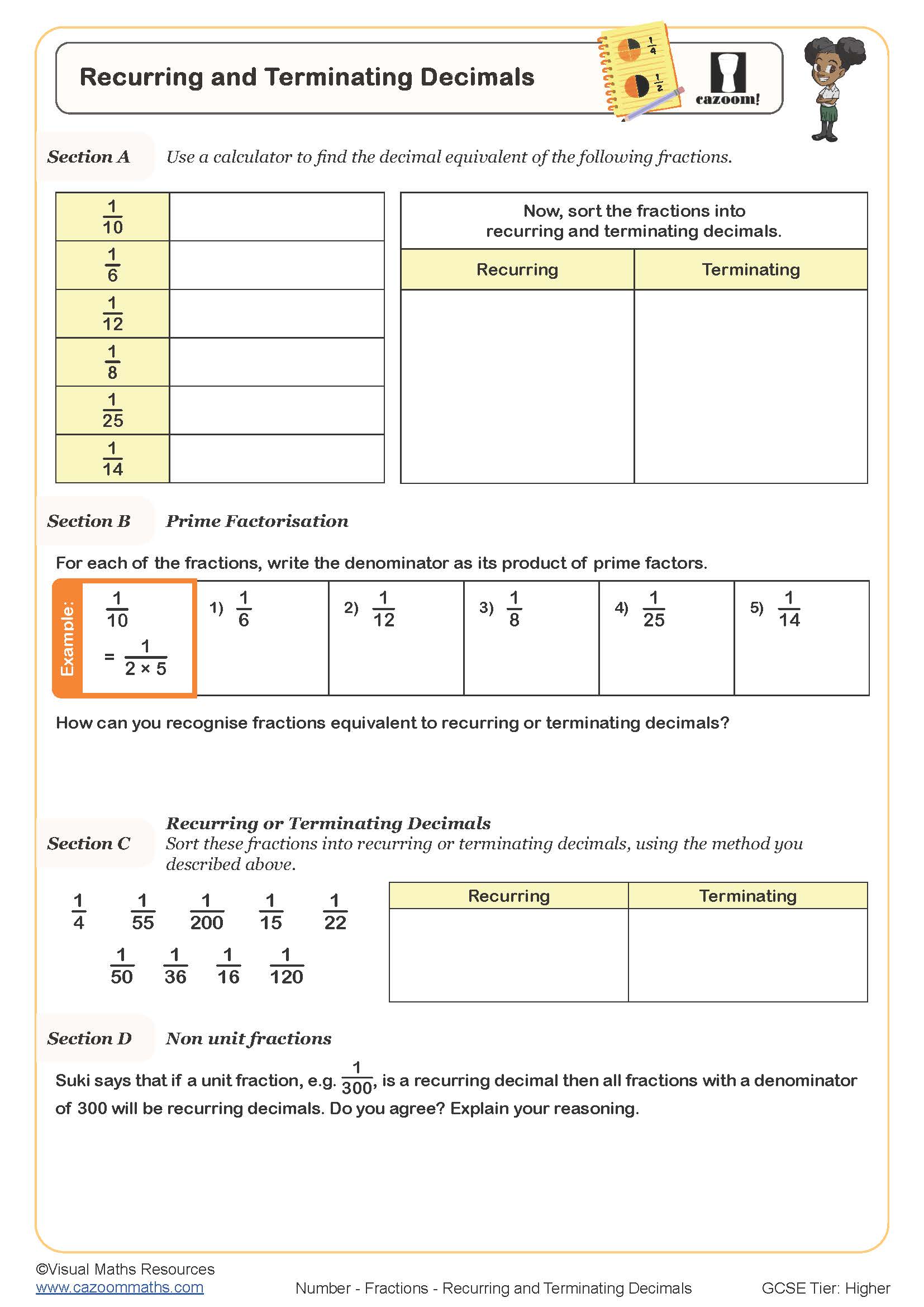
A terminating decimal is one that ends after a finite number of digits, such as 0.25 or 0.875, whilst a recurring decimal continues infinitely with a repeating pattern, like 0.333... or 0.142857142857... The key lies in the denominator of the fraction when expressed in simplest form: if it contains only factors of 2 and 5, the decimal terminates because these are the prime factors of 10.
Students often make the error of thinking a decimal is terminating simply because their calculator display ends, not realising the calculator has rounded a recurring decimal. Exam questions specifically test whether students can predict the type of decimal before performing division, expecting them to analyse the fraction's denominator rather than rely solely on calculation. This conceptual understanding distinguishes procedural knowledge from genuine mathematical reasoning.
Which year groups study recurring and terminating decimals?
These worksheets cover content taught in Year 9 and Year 10, spanning both Key Stage 3 and Key Stage 4. The National Curriculum introduces decimal conversions at upper KS3, with students expected to understand the relationship between fractions and their decimal equivalents, whilst KS4 work deepens this to include formal notation for recurring decimals using dot notation.
The progression across these year groups moves from identifying whether decimals terminate or recur, to converting between forms confidently, and finally to using algebraic methods to convert recurring decimals back to fractions at GCSE level. Year 10 students encounter exam-style questions that combine this knowledge with other rational number operations, requiring them to spot recurring decimals within multi-step problems involving percentages or ratio.
How do you know if a fraction will be a terminating decimal?
To determine whether a fraction produces a terminating decimal, simplify the fraction fully and examine the prime factors of the denominator. If the denominator contains only 2s and 5s (or a combination of both), the decimal terminates. For example, 7/40 simplifies to 7/(2³×5), so it terminates as 0.175. However, 1/6 has 2×3 in the denominator, so the factor of 3 causes it to recur as 0.1666...
This mathematical principle connects directly to how decimal currency works in financial contexts. Sterling divides pounds into hundredths (pence), where 100 = 2²×5², meaning any fraction with only these prime factors converts to an exact monetary amount. This explains why splitting £1 between three people creates an awkward 33.33...p situation, whilst dividing between four people gives exactly 25p each, a concept students encounter in everyday transactions and budgeting scenarios.
How can these worksheets support students learning about decimal types?
The worksheets provide structured practice that moves students from recognition exercises to conversion tasks, building confidence through repeated exposure to different fraction forms. Answer sheets enable students to self-assess their understanding of the underlying patterns, particularly helping them verify whether they've correctly identified prime factors in denominators before attempting conversions.
Teachers find these resources valuable for targeted intervention with students who rely too heavily on calculators without understanding why decimals behave differently. The worksheets work effectively as homework to consolidate classwork on rational numbers, or as starter activities to diagnose whether students grasp the concept before moving to more complex GCSE topics like standard form or bounds. Paired work encourages students to articulate their reasoning about why specific fractions terminate, strengthening conceptual understanding alongside procedural fluency.