Recurring Decimals Worksheets
All worksheets are created by the team of experienced teachers at Cazoom Maths.
What are recurring decimals in maths?
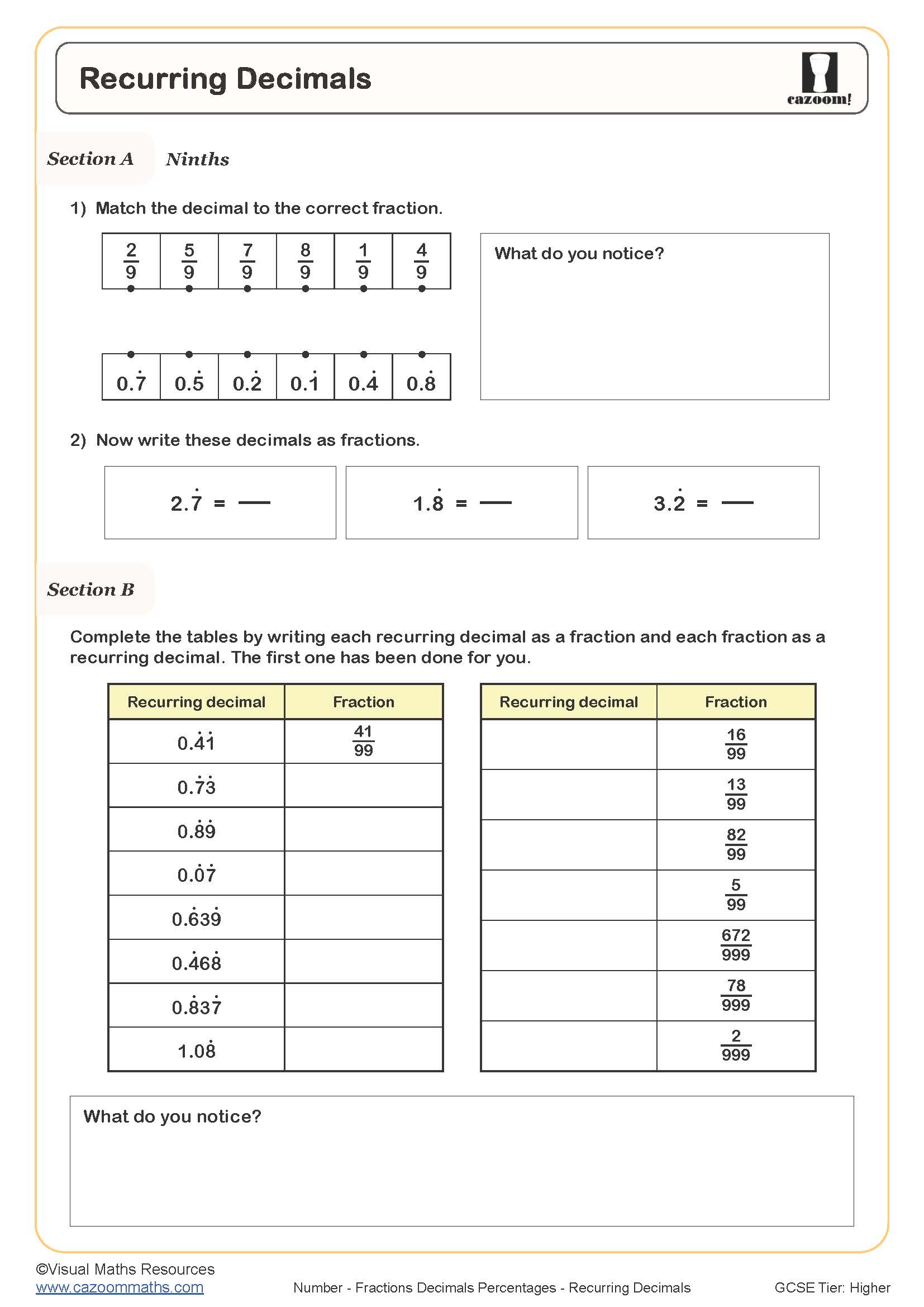
A recurring decimal is a decimal number where one or more digits repeat infinitely in a pattern. The repeating section is indicated by dots above the digits, such as 0.3̇ (which equals 1/3) or 0.14̇2̇8̇5̇7̇ where the digits 142857 repeat endlessly. At KS4, students learn to distinguish between terminating decimals, which can be written exactly, and recurring decimals, which represent exact fractions that cannot be expressed as finite decimals.
A common misconception is that students write 0.33 instead of recognising that 0.3̇ means 0.333333... continuing forever. This distinction matters significantly in GCSE questions, where students must convert between fractions and recurring decimals with complete accuracy. Exam mark schemes expect precise notation with dots correctly positioned, and students lose marks when they round recurring decimals to a few decimal places rather than expressing them algebraically.
Which year groups study recurring decimals?
Recurring decimals appear in the KS4 curriculum for Year 10 and Year 11 students, typically encountered after students have secure understanding of equivalent fractions and basic decimal conversion. This topic sits within the Number strand of the National Curriculum and features regularly on both GCSE Foundation and Higher tier papers, particularly in questions worth 3-4 marks that require algebraic working.
The progression across these year groups involves increasing complexity in the patterns students must convert. Year 10 students typically begin with simple recurring decimals like 0.7̇ or 0.6̇3̇, whilst Year 11 work extends to mixed recurring decimals such as 0.16̇7̇ where only some digits recur. Higher tier students also encounter recurring decimals within more complex problem-solving contexts, including reverse percentage problems and ratio questions where exact fraction form is required.
How does the algebraic method work for converting recurring decimals?
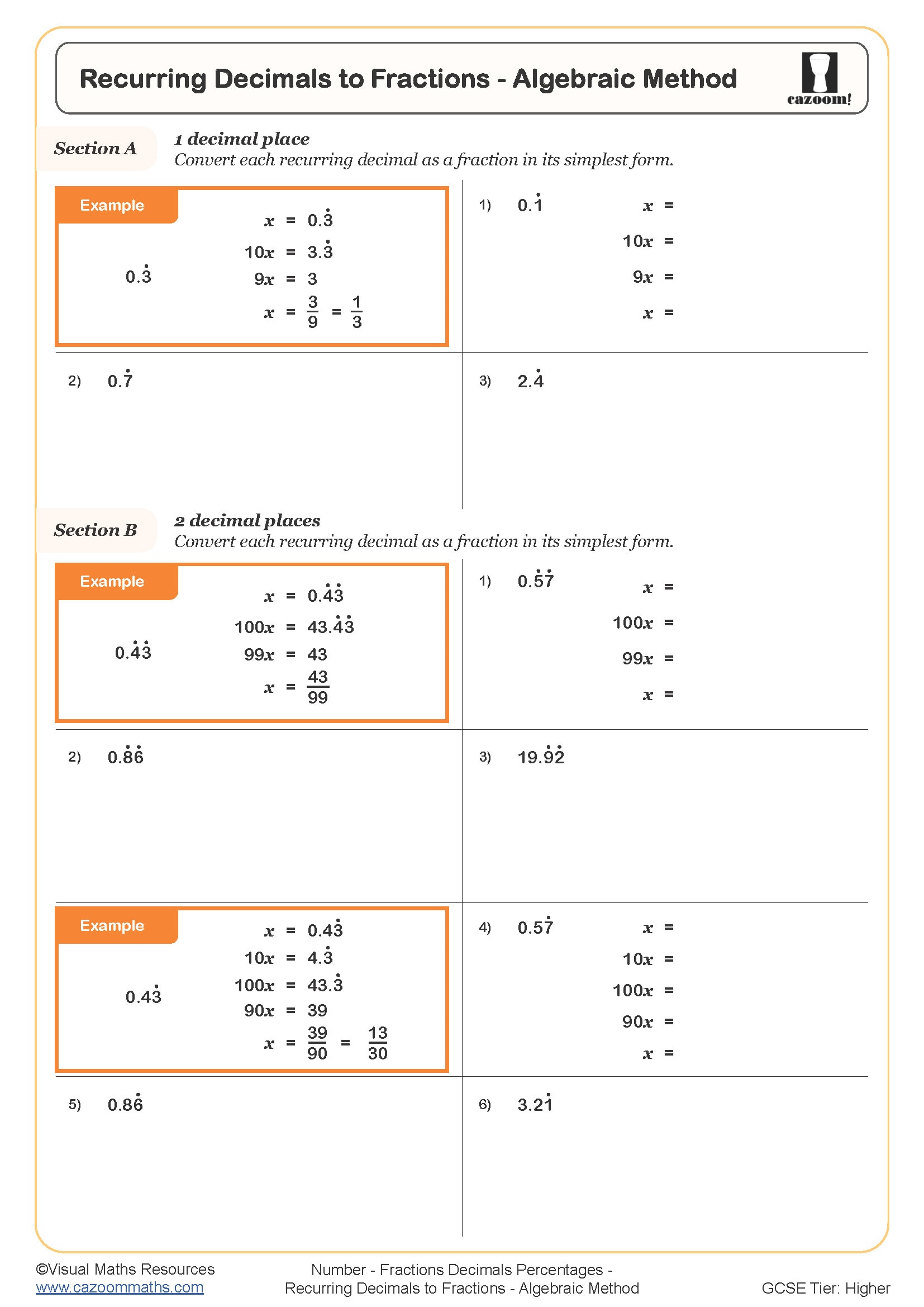
The algebraic method uses equation manipulation to eliminate the recurring part and isolate the fraction. Students set the recurring decimal equal to a variable (x), then multiply by an appropriate power of 10 to shift the decimal point so the recurring sections align. By subtracting one equation from the other, the recurring portion cancels out, leaving a simple equation to solve. For example, with x = 0.4̇, multiply by 10 to get 10x = 4.4̇, then subtract the original equation: 9x = 4, so x = 4/9.
This algebraic approach connects directly to applications in engineering and computer science, where recurring decimals appear in binary conversions and iterative calculations. Understanding that recurring decimals represent exact rational numbers rather than approximations is crucial when programming calculators or designing algorithms that require precise arithmetic. Teachers notice that students who grasp this method develop stronger algebraic manipulation skills that transfer to solving simultaneous equations and rearranging formulae.
How can these worksheets support classroom teaching?
The worksheets provide structured practise with the algebraic method, breaking down the conversion process into manageable steps that students can follow systematically. Questions progress from simple single-digit recurring patterns to more challenging examples where non-recurring digits appear before the recurrence begins. Complete answer sheets with full working enable students to identify exactly where their method diverges from the correct approach, particularly useful for self-assessment during independent study.
Many teachers use these resources for targeted intervention with students who find algebraic manipulation challenging, as the repetitive structure builds confidence with equation setup and subtraction. The worksheets work effectively as homework to consolidate lesson learning, or as timed practise sessions before mock exams where recurring decimal questions regularly appear. Paired work allows stronger students to articulate their method whilst supporting peers who struggle with determining the correct multiplication factor, addressing the most common error pattern in this topic.