Reverse Percentages Worksheets
All worksheets are created by the team of experienced teachers at Cazoom Maths.
What is a reverse percentages worksheet and when do students need it?
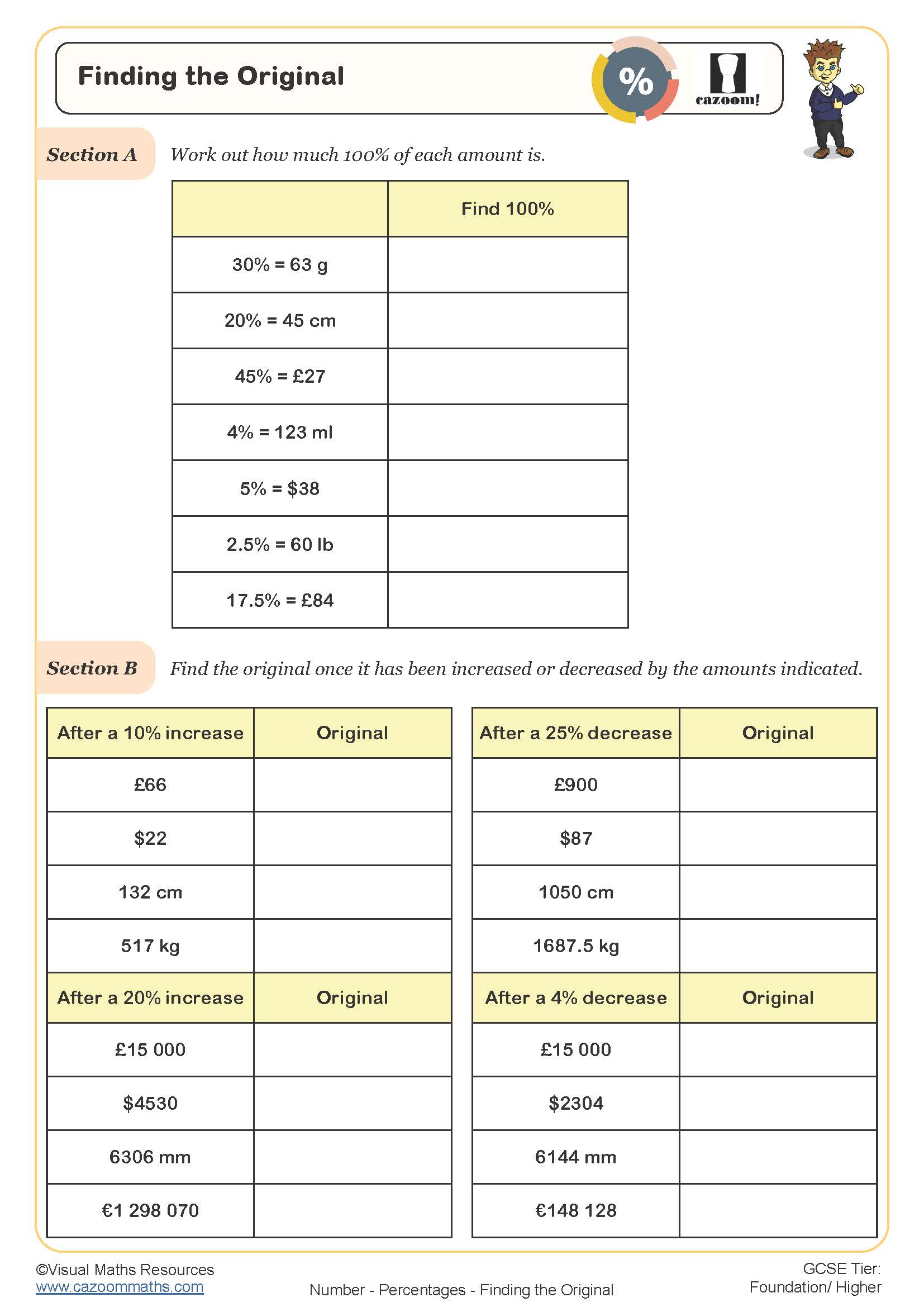
A reverse percentages worksheet focuses on finding original values when students only know the result after a percentage change has been applied. This appears across KS3 and KS4 mathematics when students encounter problems like 'a jacket costs £84 after a 30% discount – what was the original price?' rather than simply calculating what 30% of a value equals. The technique requires understanding that the final amount represents a different percentage of the original (70% in the discount example, not 100%).
Students commonly make the error of calculating the percentage of the final amount and adding or subtracting it, which produces an incorrect answer. Exam mark schemes specifically require the multiplier method (dividing by the decimal equivalent) or proportional reasoning, and students lose marks when they show incorrect methodology even if they somehow reach a correct answer through flawed working. The reverse percentages worksheet PDF format allows students to practise identifying these problem types and applying systematic approaches.
Which year groups cover reverse percentages?
Reverse percentages appears in Year 9 as students develop proportional reasoning skills, continuing through Year 10 where it becomes an expected GCSE foundation and higher tier topic. At KS3, students typically encounter simpler contexts like finding original prices after single percentage increases or decreases. The National Curriculum positions this after students have secure understanding of calculating percentages of amounts and percentage change.
By Year 10, the complexity increases with compound interest scenarios requiring reverse calculations, problems involving multiple percentage changes, and unfamiliar contexts that test whether students can recognise when reverse methods apply. Teachers often use these problems to differentiate, as they separate students who have memorised procedures from those who genuinely understand proportional relationships. GCSE questions frequently embed reverse percentages within worded problems about finance, population growth, or measurements.
How does the multiplier method work for reverse percentages?
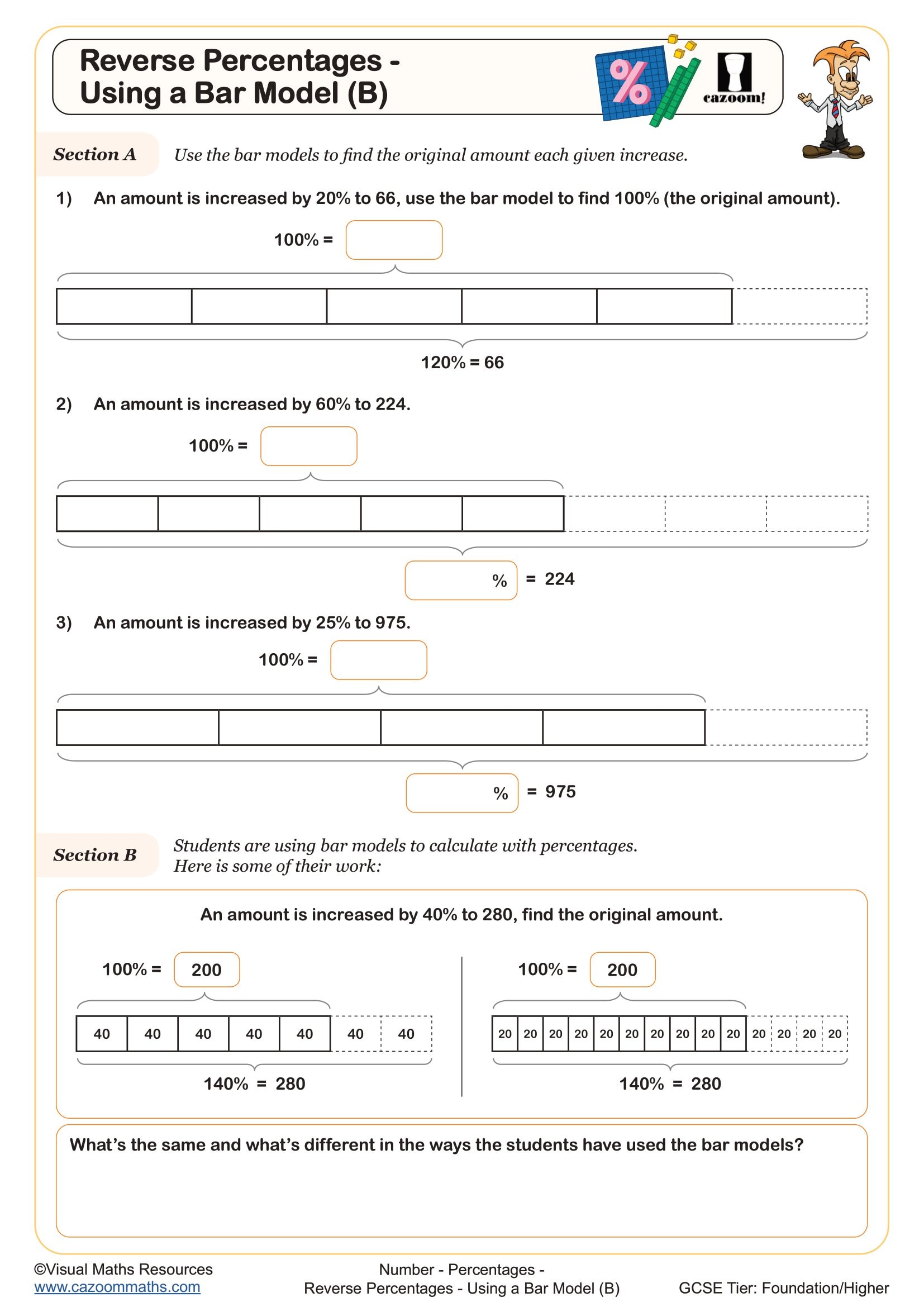
The multiplier method teaches students to identify what percentage the final value represents, convert this to a decimal, then divide the final amount by this decimal to find the original. For example, if a value increases by 15% to reach 460, students recognise that 460 represents 115% of the original, convert 115% to 1.15, then calculate 460 ÷ 1.15 = 400. This systematic approach prevents the common error of calculating 15% of 460 and subtracting it, which gives the wrong answer.
This skill connects directly to real-world financial literacy, particularly understanding VAT calculations where businesses must determine pre-VAT prices from inclusive amounts, or analysing sale pricing strategies in retail. Engineers and scientists use reverse percentage calculations when working backwards from measured results to account for losses, efficiency factors, or calibration adjustments in experimental data. The multiplier method provides a reliable framework applicable across these STEM contexts.
How do these worksheets support reverse percentage learning?
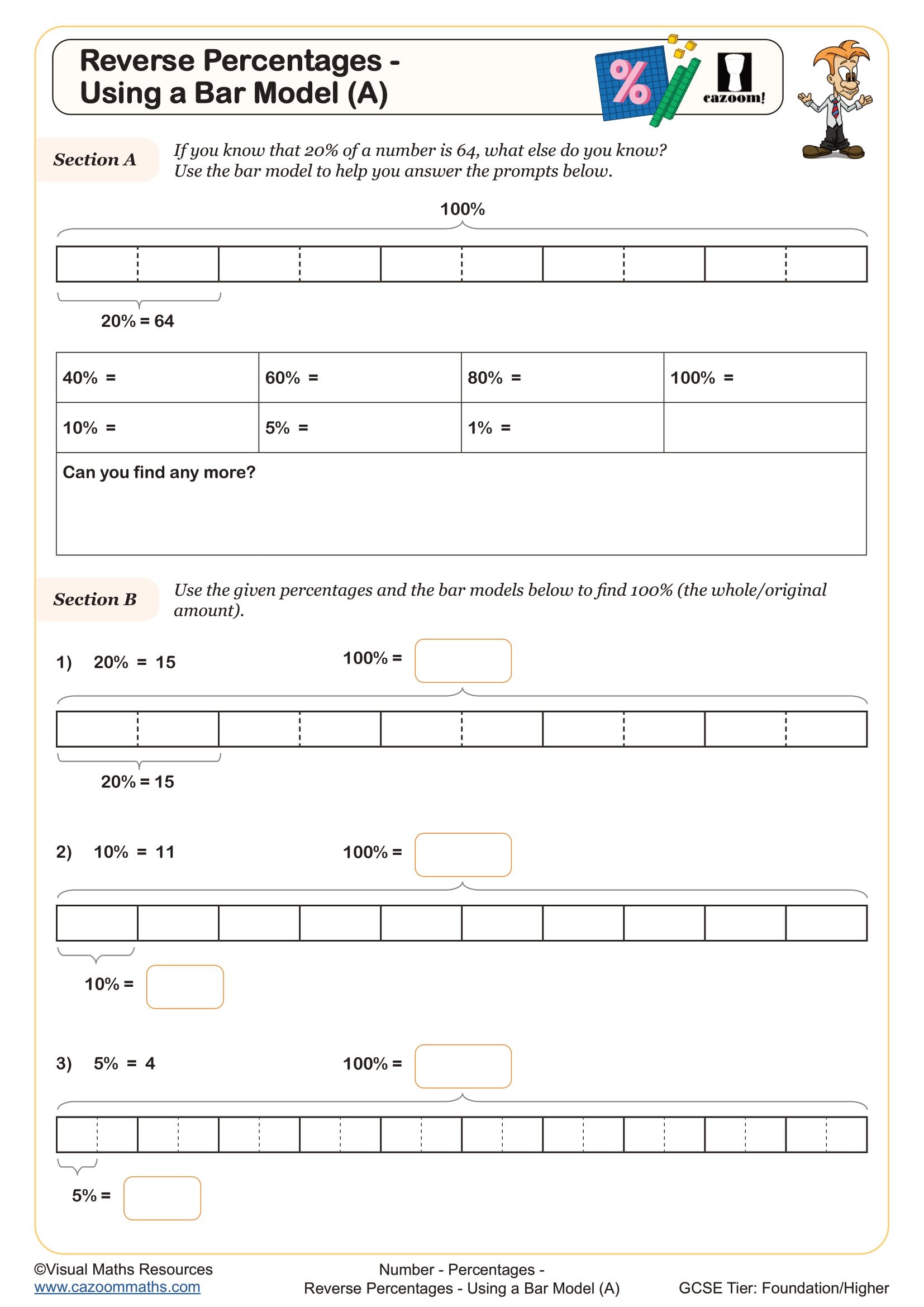
The worksheets build confidence through structured question sequences that help students recognise reverse percentage problems and select appropriate methods. Questions typically progress from clearly signposted problems to those embedded in context, developing the critical skill of identifying when reverse methods apply. Answer sheets allow students to check not just final answers but verify their method choice and calculation steps, which proves particularly valuable when common errors like working with the wrong percentage base occur.
Teachers find these resources effective for targeted intervention with students who struggle to apply percentage knowledge flexibly, and for homework following initial teaching of the multiplier method. The worksheets work well in paired activities where students compare methods and discuss why standard percentage techniques fail for reverse problems. Many teachers use selected questions as starter activities before GCSE practise papers, as reverse percentages frequently appears in problem-solving contexts worth multiple marks where method clarity determines success.