Rounding to Powers of Ten Worksheets
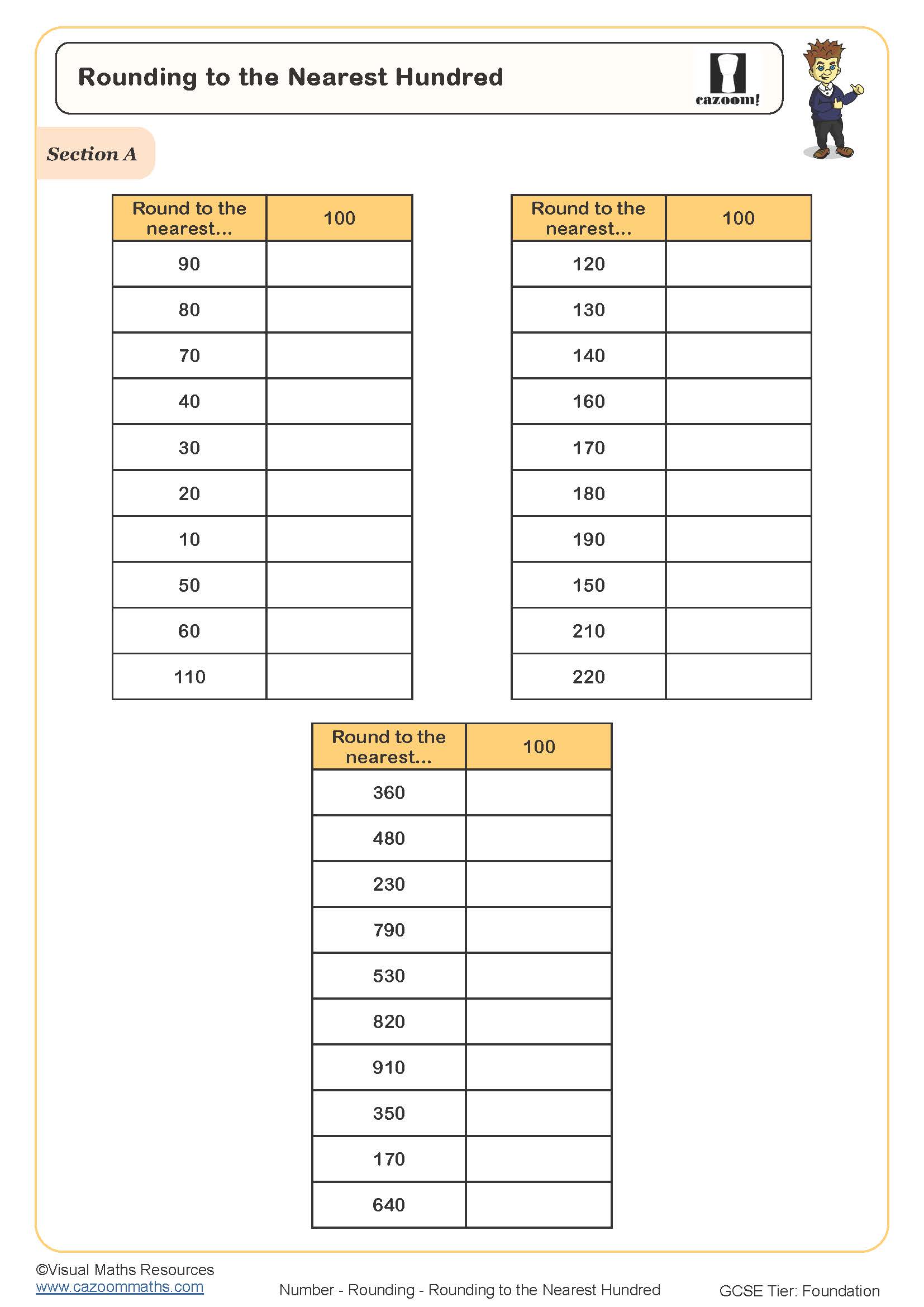
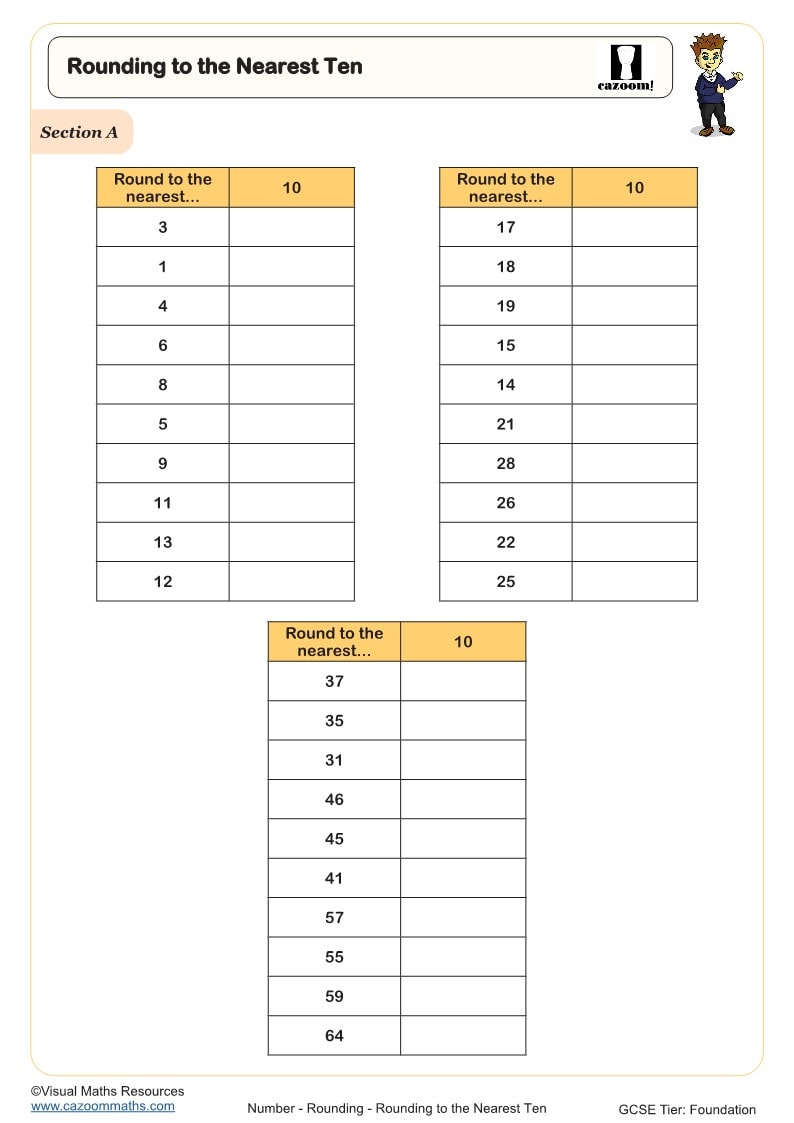
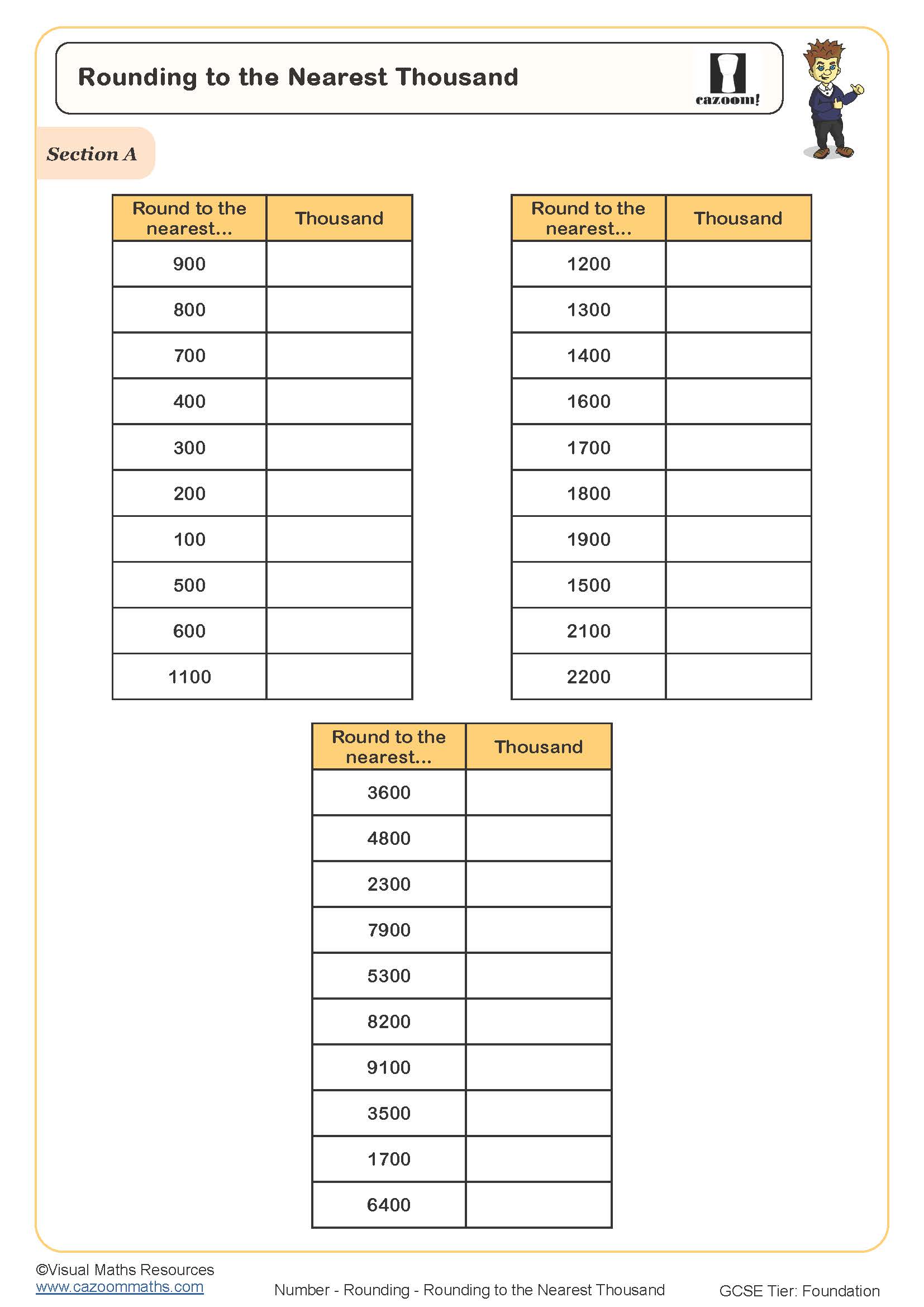
All worksheets are created by the team of experienced teachers at Cazoom Maths.
What does rounding to powers of ten mean?
Rounding to powers of ten means adjusting a number to the nearest multiple of 10, 100, 1000, or higher powers such as 10,000 or 100,000. Each power of ten represents a place value column: 10¹ = 10 (tens), 10² = 100 (hundreds), 10³ = 1000 (thousands), and so on. The process requires students to identify the relevant digit, look at the digit immediately to its right, then round up if that digit is 5 or more, or round down if it's 4 or less.
A common misconception occurs when students confuse 'rounding to the nearest hundred' with 'rounding to two significant figures'. For example, when rounding 3,478 to the nearest hundred, students should get 3,500, but some mistakenly write 3,000 because they've misidentified which digit controls the rounding. Exam mark schemes regularly penalise this error, particularly in questions involving estimation or error bounds.
Which year groups learn rounding to powers of ten?
These rounding to powers of ten worksheets target Year 7 and Year 8 students working within the KS3 National Curriculum. By this stage, students have encountered basic rounding in primary school but now work with larger numbers, negative integers, and decimals rounded to various powers of ten. The KS3 programme of study expects students to round both whole numbers and decimals with confidence, preparing them for estimation techniques required in GCSE problem-solving.
Progression across these year groups moves from straightforward whole number rounding to more complex scenarios involving decimal places and numbers in standard form. Year 7 students typically consolidate rounding whole numbers to any power of ten, whilst Year 8 students encounter hybrid questions where they must choose an appropriate degree of accuracy or round numbers expressed in different formats, building towards the precision required in scientific and financial contexts.
Why do we round to powers of ten rather than other values?
Powers of ten align directly with our base-10 number system and place value structure, making them the most logical benchmarks for estimation and approximation. Rounding to 10, 100, or 1000 simplifies mental arithmetic because these values represent clean multiples that are easy to manipulate when calculating. This consistency across place value columns also helps students recognise patterns and apply the same rounding rules regardless of the size of the number they're working with.
This skill has immediate applications in fields requiring rapid estimation: engineers round measurements when checking if calculations are reasonable, scientists round experimental data to appropriate levels of precision, and economists round financial figures when presenting forecasts or budgets. When currency exchanges quote rates or governments report census data, the figures have typically been rounded to suitable powers of ten to communicate information clearly without overwhelming audiences with unnecessary detail.
How do these worksheets help students master rounding to powers of ten?
The worksheets build skill through structured practice that progresses from identifying which digit to examine through to applying rounding in multi-step problems. Questions include visual place value grids on some sheets, helping students who still benefit from concrete representations of abstract concepts. The variety of question styles ensures students can't rely on pattern-spotting alone and must genuinely understand which place value column controls each rounding decision.
Teachers use these resources for targeted intervention with students who struggle during mixed numeracy tasks, as homework to consolidate classwork, or as starter activities to maintain fluency. The complete answer sheets enable students to self-mark during paired work or allow teaching assistants to support small groups without needing to calculate every answer independently. Many teachers set these as low-stakes assessments before moving on to significant figures or standard form, identifying exactly where misconceptions persist.