Significant Figures Worksheets
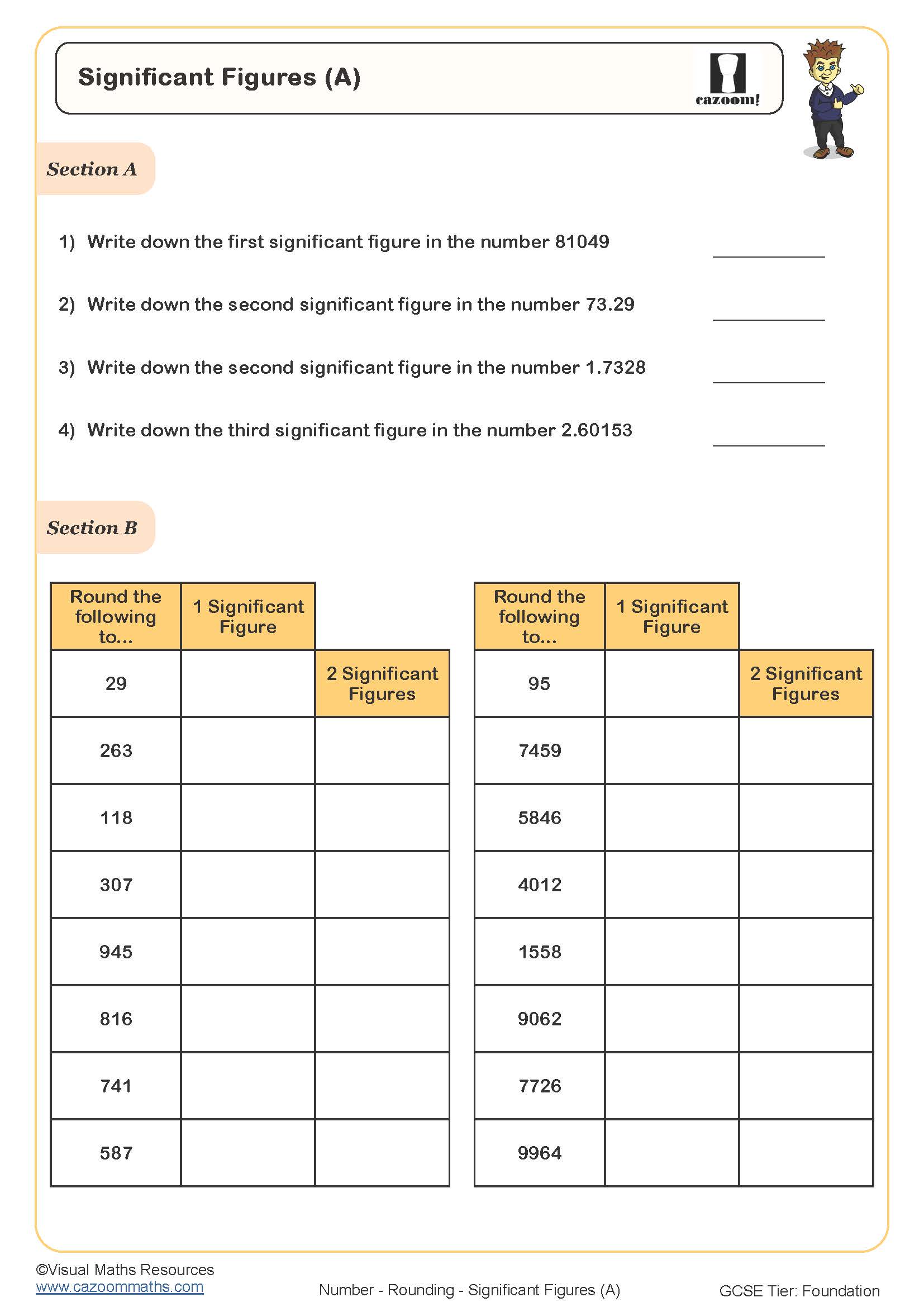
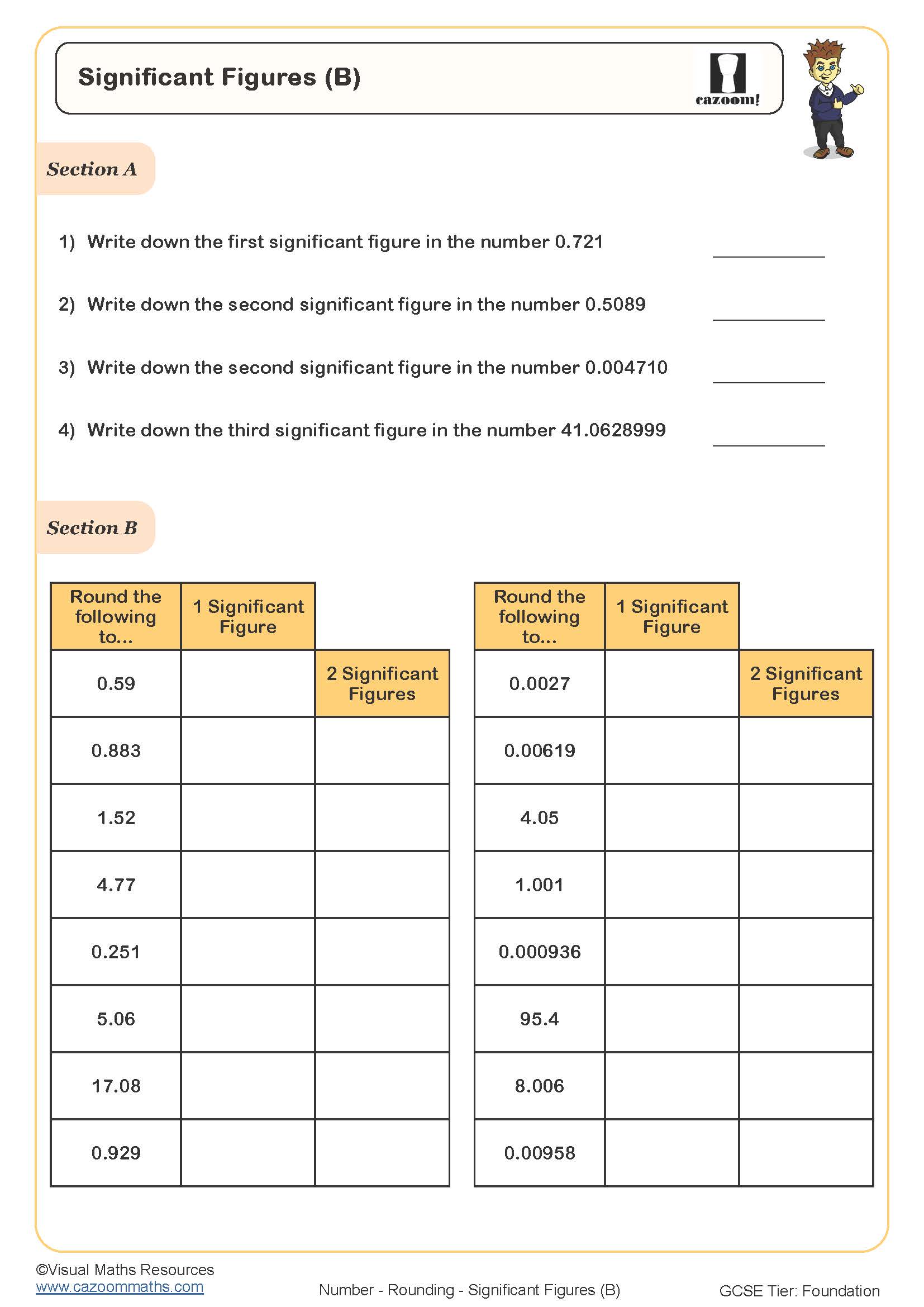
All worksheets are created by the team of experienced teachers at Cazoom Maths.
What are significant figures and why do students need to learn them?
Significant figures indicate the precision of a number by showing which digits carry meaningful information. In the number 4.502, all four digits are significant, whereas in 0.0045, only the 4 and 5 are significant because the leading zeros simply position the decimal point. The National Curriculum introduces this concept at KS3 as preparation for scientific calculations and data handling, where expressing answers to an appropriate degree of accuracy becomes essential.
Students often lose marks in assessments by counting all zeros as significant, particularly in whole numbers like 3400 where the trailing zeros may or may not be significant depending on context. Teachers notice this confusion intensifies when students transition from rounding to decimal places, as the rules differ. Understanding significant figures connects directly to scientific measurement, where recording a length as 12.0 cm versus 12 cm communicates different levels of precision in the measuring instrument used.
Which year groups cover significant figures in the curriculum?
These significant figures worksheets target Year 7 and Year 8 students within Key Stage 3, where the topic forms part of the Number strand in the National Curriculum. Students typically encounter significant figures after mastering rounding to decimal places, as it requires more sophisticated understanding of place value and number magnitude. The concept appears in both pure mathematics contexts and when handling data in science lessons.
Progression between Year 7 and Year 8 moves from identifying significant figures in straightforward numbers to applying the skill in multi-step calculations and scientific contexts. Year 7 students focus on recognising which digits count as significant and rounding numbers with clear non-zero digits. By Year 8, students tackle more complex scenarios involving zeros in various positions, rounding very large or very small numbers, and understanding when significant figures matter in real measurements versus exact values like counted quantities.
How do you handle zeros when counting significant figures?
The treatment of zeros determines whether students apply significant figure rules correctly. Leading zeros (those before the first non-zero digit) never count as significant: in 0.00741, only 7, 4, and 1 are significant. Zeros between non-zero digits always count: 5003 has four significant figures. Trailing zeros in numbers with decimal points count as significant: 45.0 has three significant figures because the zero indicates measurement precision. Trailing zeros in whole numbers create ambiguity unless written in standard form.
This skill connects directly to real-world STEM applications, particularly in chemistry and physics where measurements carry inherent uncertainty. When a chemist records a mass as 24.0 g rather than 24 g, they communicate that their balance measures to the nearest tenth of a gram. Engineers use significant figures to avoid false precision in calculations: multiplying measurements with different levels of accuracy requires rounding the final answer to match the least precise input, preventing meaningless decimal places that suggest greater accuracy than the original data supports.
How can teachers use these worksheets effectively in lessons?
The worksheets provide structured practice that builds from identifying significant figures to applying rounding rules across different number types. Complete answer sheets allow students to self-check their work during independent practice, whilst teachers can use partially completed examples to model the decision-making process for handling zeros. The progressive difficulty helps teachers differentiate, assigning earlier questions to students consolidating basic concepts whilst challenging others with ambiguous cases.
Many teachers use these resources for retrieval practice at lesson starts, particularly before science practicals where measurement accuracy matters. They work well for homework following initial teaching, allowing students to consolidate understanding before tackling more complex applications. In intervention sessions, the worksheets help identify specific misconceptions about zero handling. Paired work proves effective, with students explaining their reasoning to each other, which often reveals whether they're applying rules mechanically or genuinely understanding why certain digits carry significance whilst others merely position the decimal point.