Simplifying Fractions Worksheets
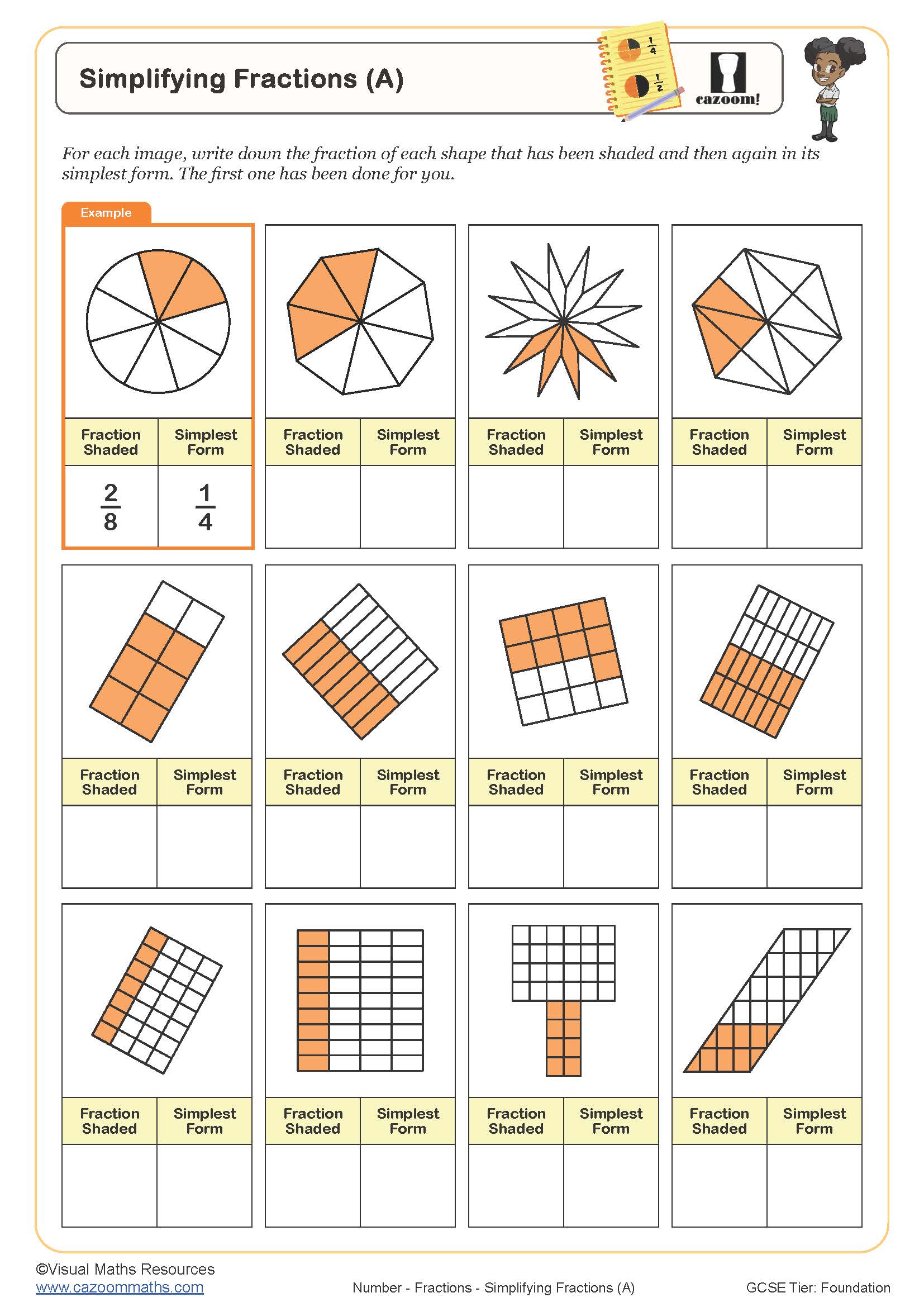
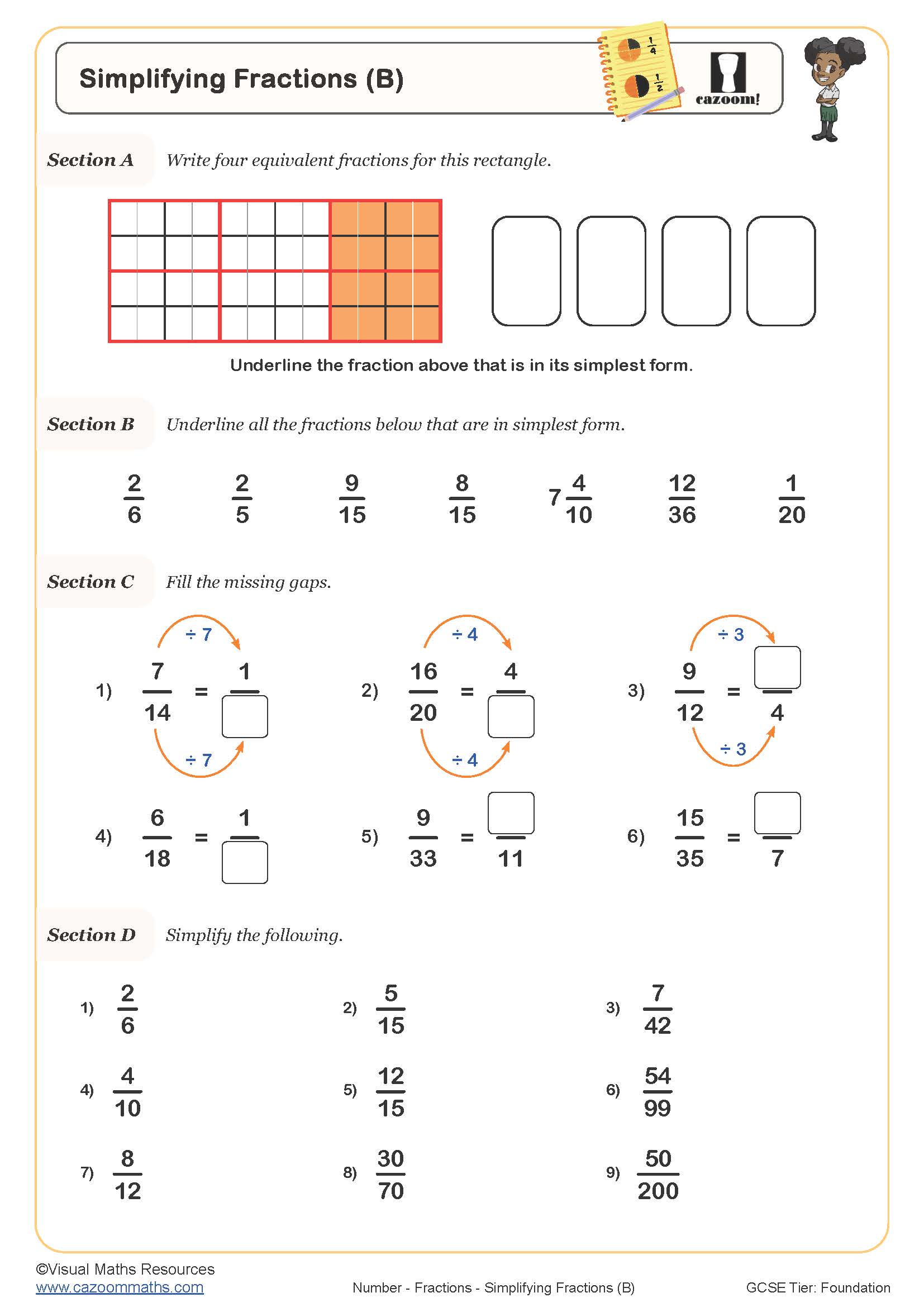
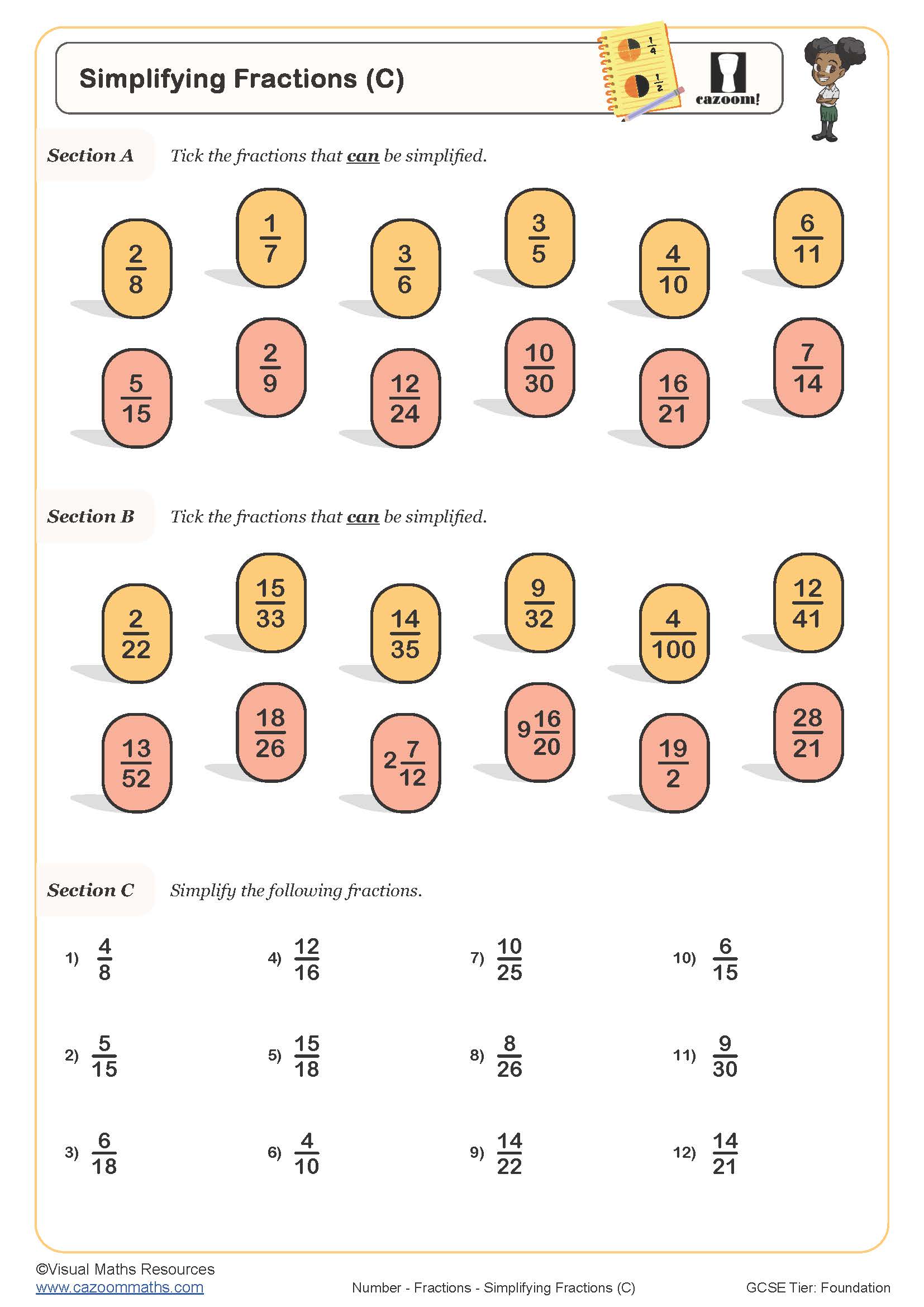
All worksheets are created by the team of experienced teachers at Cazoom Maths.
What does simplifying fractions mean in maths?
Simplifying fractions means writing a fraction in its lowest terms by dividing both the numerator and denominator by their highest common factor (HCF). For example, 12/18 simplifies to 2/3 because both 12 and 18 divide by 6. The National Curriculum introduces this skill in Key Stage 2, with systematic methods developed throughout KS3 where students encounter increasingly complex fractions in algebra, ratio, and probability contexts.
A common error occurs when students divide by a common factor but not the highest one, producing answers like 6/9 instead of 2/3. Teachers often observe students who can simplify 4/8 to 1/2 immediately but struggle with less obvious fractions like 18/24, where the HCF isn't immediately apparent. Developing fluency with factor pairs and divisibility rules helps students work more efficiently with larger numbers and builds confidence for algebraic fraction work in Year 9.
Which year groups learn simplifying fractions?
These worksheets are designed for Year 7 and Year 8 students working within Key Stage 3. At Year 7, students consolidate methods from primary school and apply systematic approaches to simplifying fractions with larger numerators and denominators. The expectation is that students can identify the HCF efficiently and recognise when a fraction is already in its simplest form, skills that support their work with fraction calculations and equivalent fractions.
The progression from Year 7 to Year 8 involves increased complexity in the numbers used and greater emphasis on efficiency. Year 8 students encounter simplification as part of broader problems involving ratio, proportion, and algebraic fractions where they must simplify expressions like 6x/9 to 2x/3. Teachers notice that students who struggle with numerical simplification in Year 7 face significant barriers when fractions appear in equations and formulae later in KS3.
Why is the highest common factor method important for simplifying fractions?
The highest common factor (HCF) method involves finding the largest number that divides exactly into both the numerator and denominator, then dividing both parts by this number in one step. For 24/36, the HCF is 12, giving 2/3 directly. This approach is more efficient than dividing repeatedly by smaller common factors, and it becomes particularly valuable when working with larger numbers or algebraic terms where multiple simplification steps increase the chance of errors.
This skill connects directly to engineering and design contexts where dimensions must be expressed in simplest ratio form. A gear ratio of 48:72 simplifies to 2:3 using the same HCF method, allowing engineers to specify the exact relationship between components without unnecessary complexity. In data science, simplifying fractions helps express probabilities and proportions clearly, making statistical findings more accessible when presenting to non-technical audiences.
How do these worksheets help students improve at simplifying fractions?
The worksheets build proficiency through carefully sequenced questions that start with fractions having obvious common factors before progressing to those requiring systematic HCF identification. Students encounter varied numerators and denominators, preventing over-reliance on memorised simplifications and developing genuine understanding of the process. Answer sheets allow students to check their work independently and identify where they might have missed the highest common factor, encouraging them to review their factor-finding strategies.
Teachers use these resources for targeted intervention with students who haven't fully grasped simplification methods, as homework to reinforce classwork, or as low-stakes retrieval practice at the start of lessons on fraction operations. The worksheets work well for paired work where students can discuss factor identification strategies and challenge each other to find the HCF efficiently. Many teachers find them valuable during revision periods before assessments, as fraction simplification appears across multiple GCSE topics including ratio, probability, and algebra.