Simplifying Ratios and Equivalence Worksheets
/Cazoom-Maths-Ratio-Simplifying-Ratios-(A)-Worksheet.jpg?w=3840)
-Worksheet.jpg?w=3840)
All worksheets are created by the team of experienced teachers at Cazoom Maths.
How do you simplify ratios like 8:16?
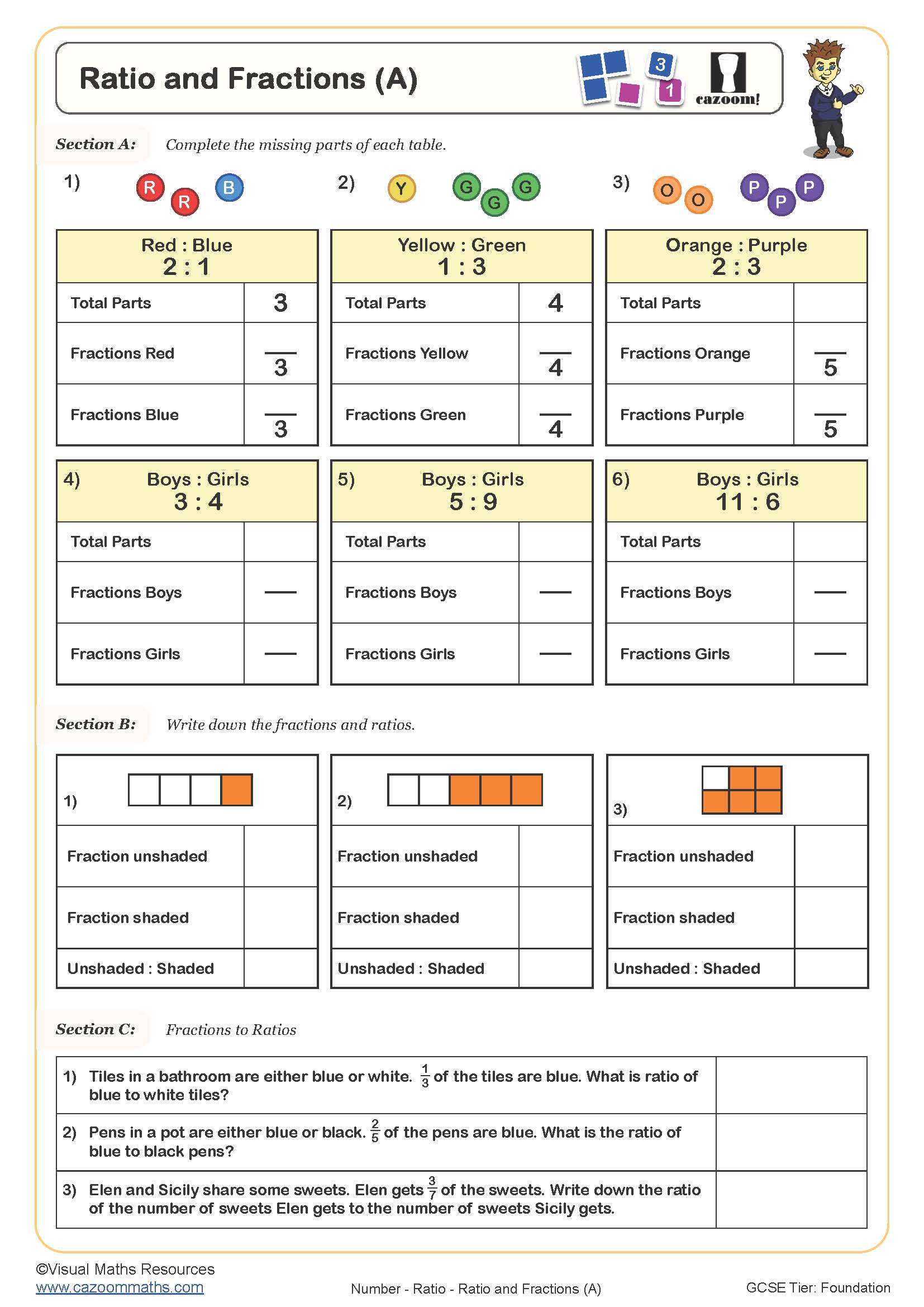
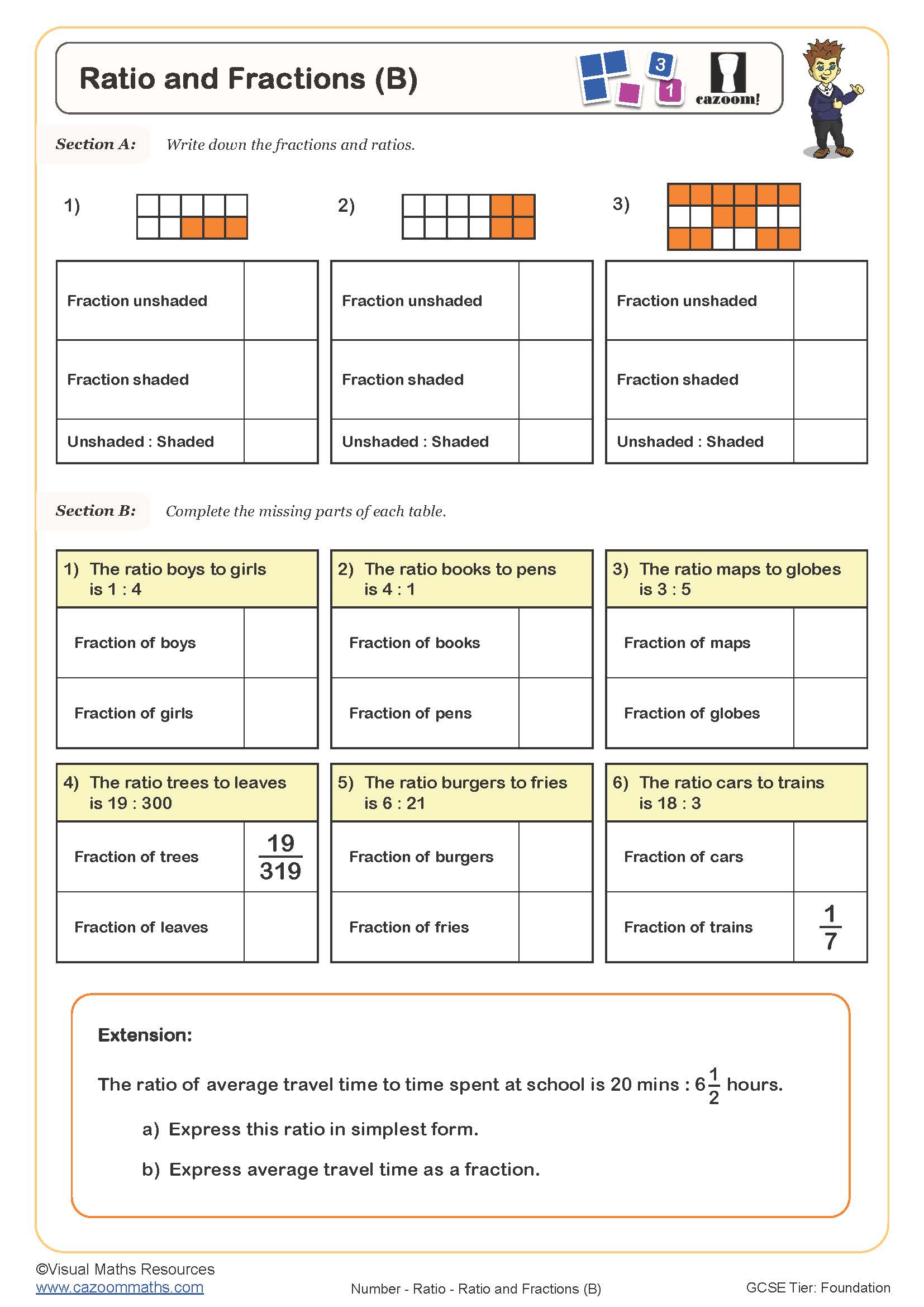
To simplify an 8:16 ratio, students find the highest common factor (HCF) of both numbers and divide each part by it. Since the HCF of 8 and 16 is 8, dividing both parts gives 1:2 as the simplified form. This follows the same principle as simplifying fractions, which helps students make connections across different areas of the curriculum.
A common mistake occurs when students spot an obvious common factor like 2 or 4 but stop there, writing 4:8 or 2:4 instead of continuing to the simplest form. Mark schemes at GCSE expect ratios in their simplest terms unless the question specifies otherwise, and students regularly lose marks by submitting partially simplified answers. Encouraging students to check whether the simplified parts share any remaining common factors helps avoid this error.
Which year groups cover simplifying ratios?
These worksheets span Year 7, Year 8, Year 9 and Year 10, covering both Key Stage 3 and Key Stage 4. The National Curriculum introduces ratio formally in Year 6, with simplification becoming a core skill from Year 7 onwards as students encounter increasingly complex ratio problems. By Key Stage 3, students should confidently reduce two-part and three-part ratios using HCF methods.
Progression across the year groups moves from simplifying straightforward numerical ratios in Year 7 to handling ratios with decimals, fractions and algebraic terms by Years 9 and 10. At KS4, GCSE questions frequently combine ratio simplification with other concepts such as proportion, scaling recipes or dividing quantities, requiring students to apply this foundational skill within multi-step problems where fluency with simplification becomes crucial for accessing higher marks.
What are equivalent ratios and why do they matter?
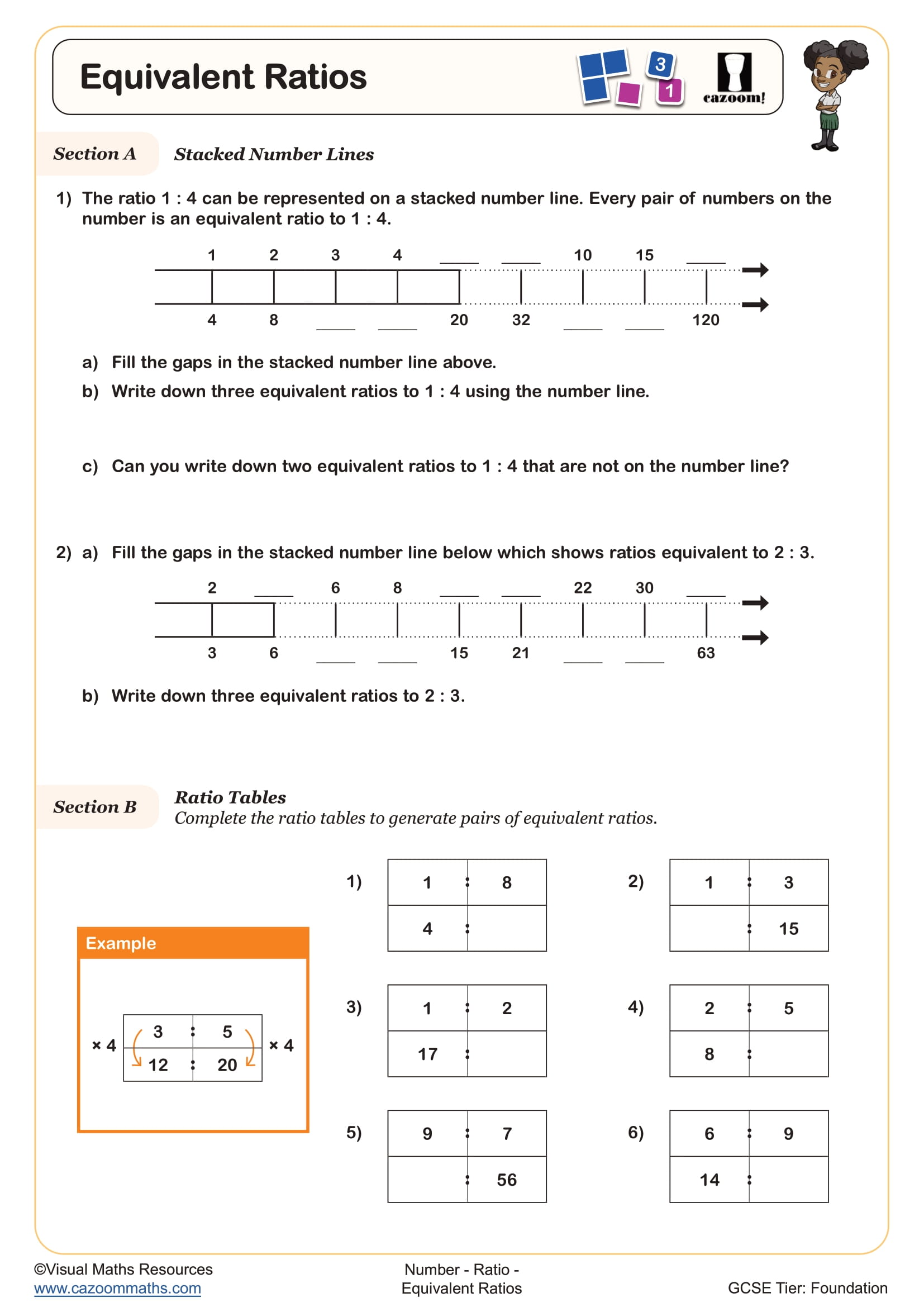
Equivalent ratios represent the same relationship between quantities, just as equivalent fractions represent the same proportion. For example, 2:3, 4:6 and 10:15 are all equivalent because each can be simplified to 2:3. Students learn to generate equivalent ratios by multiplying or dividing both parts by the same number, and to recognise when two ratios are equivalent by simplifying both to compare.
This skill connects directly to real-world applications in design and engineering, where maintaining consistent proportions matters enormously. Architects scale building plans using equivalent ratios to ensure rooms remain in proportion, whilst chemists use equivalent ratios when adjusting reaction quantities for different batch sizes. Understanding that 2:3 and 200:300 represent identical relationships helps students grasp how ratio problems translate from classroom exercises to practical STEM contexts where precision in maintaining proportional relationships determines success.
How do these worksheets build ratio simplification skills?
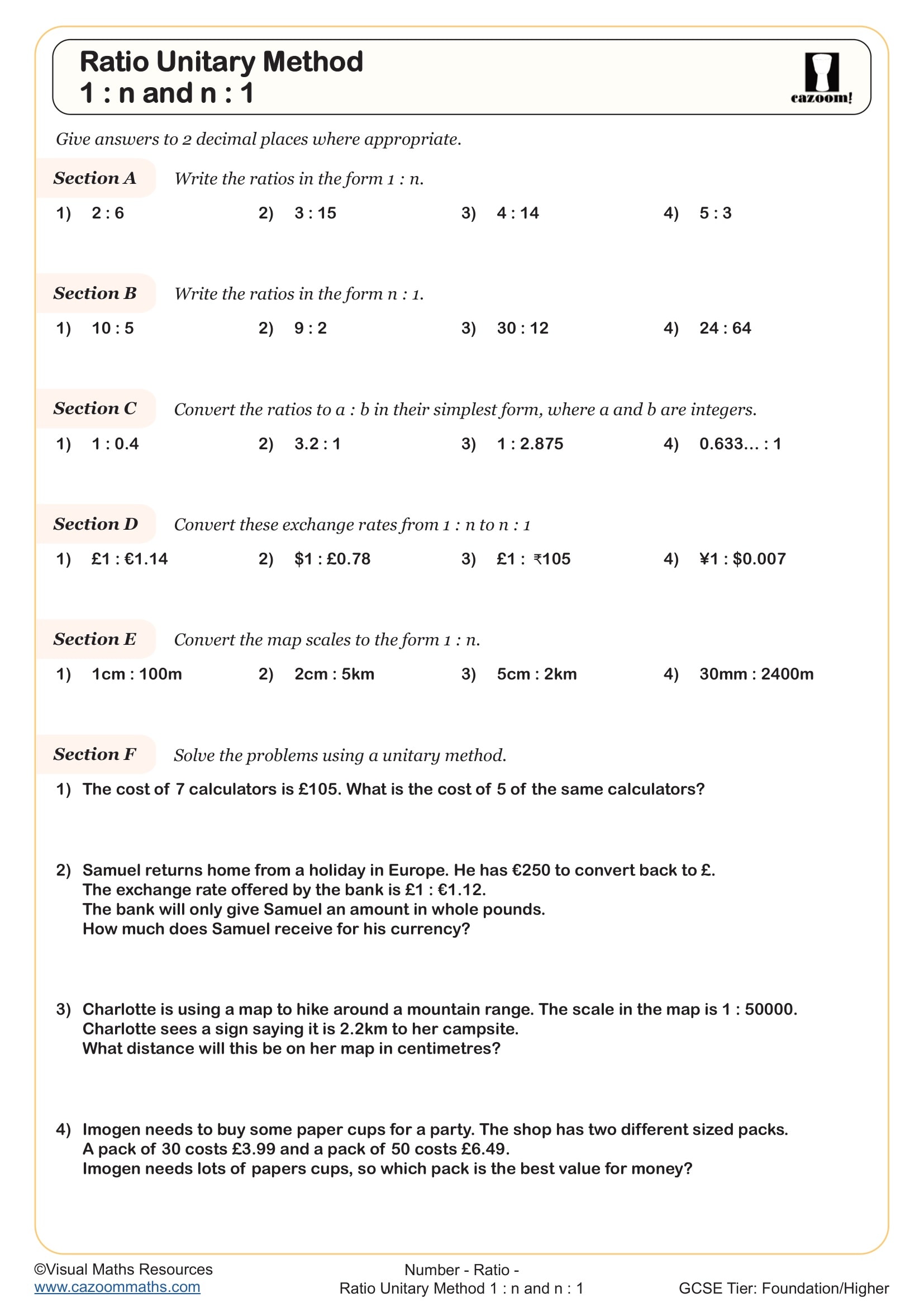
The worksheets provide structured practice that builds from straightforward simplification exercises to more demanding problems involving multiple steps or unfamiliar contexts. Questions typically progress from single ratios requiring one simplification step through to problems where students must first interpret a scenario, extract the ratio, then simplify it. This scaffolded approach helps students develop fluency before tackling application questions.
Teachers use these resources flexibly depending on classroom needs: as starter activities to refresh prior knowledge before introducing ratio division, as homework following initial teaching, or during intervention sessions with students who need targeted practice. The answer sheets allow students to self-mark during paired work, encouraging mathematical discussions about method when answers differ. Many teachers find the worksheets particularly valuable for pre-exam revision, where students can identify specific areas of weakness in ratio work before sitting GCSE papers.