Simplifying Surds Worksheets
All worksheets are created by the team of experienced teachers at Cazoom Maths.
What types of simplifying surds questions do these worksheets cover?
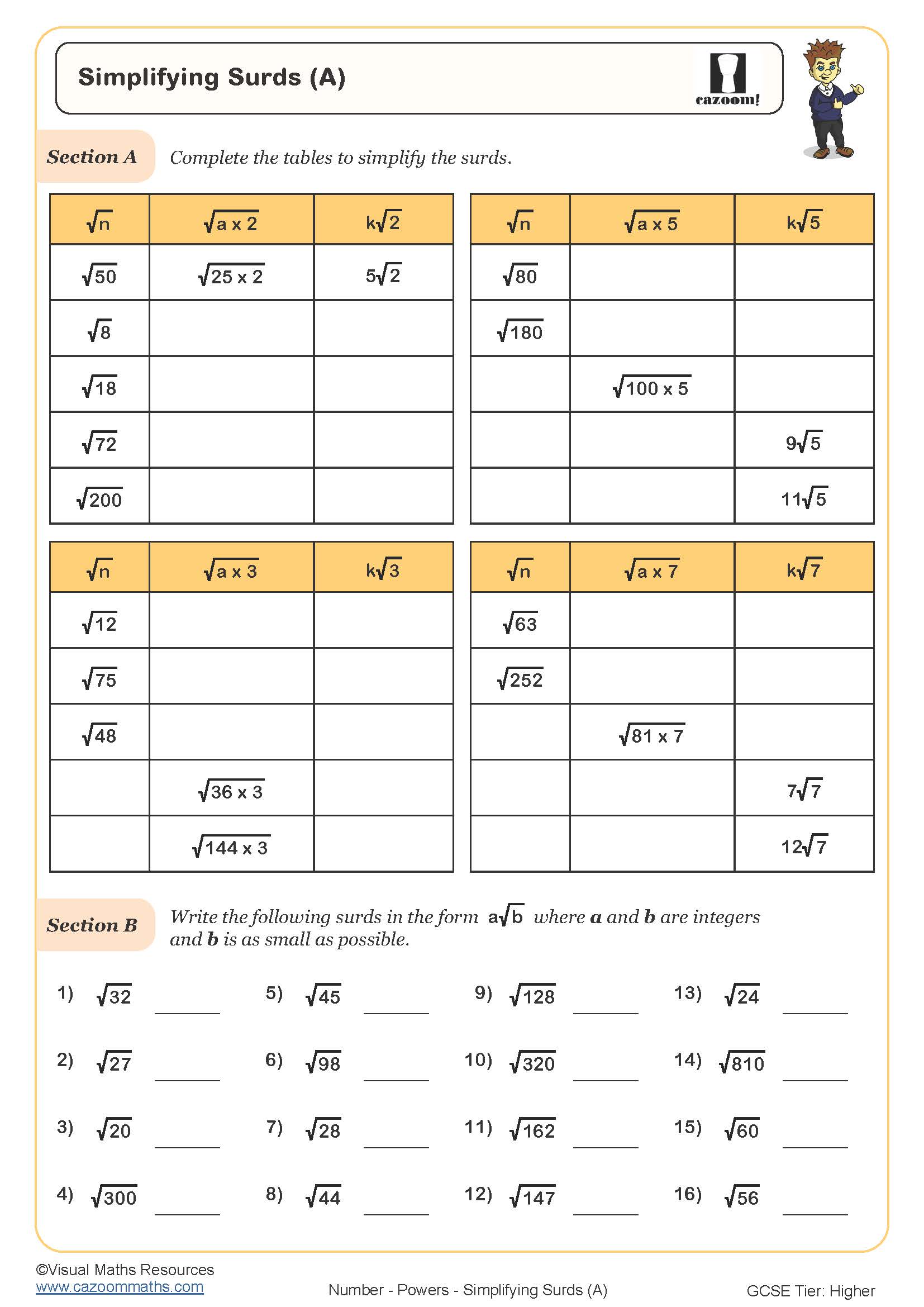
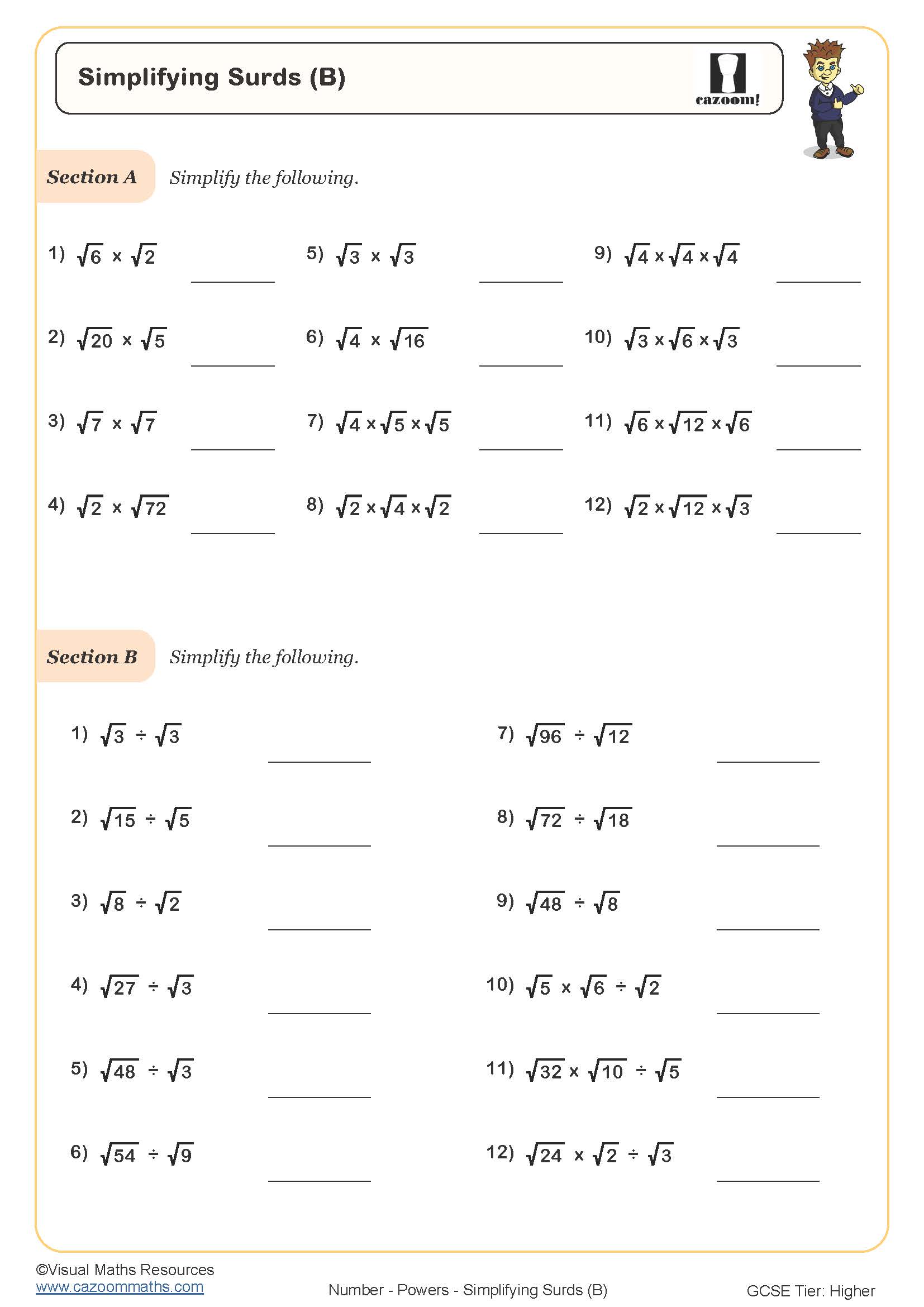
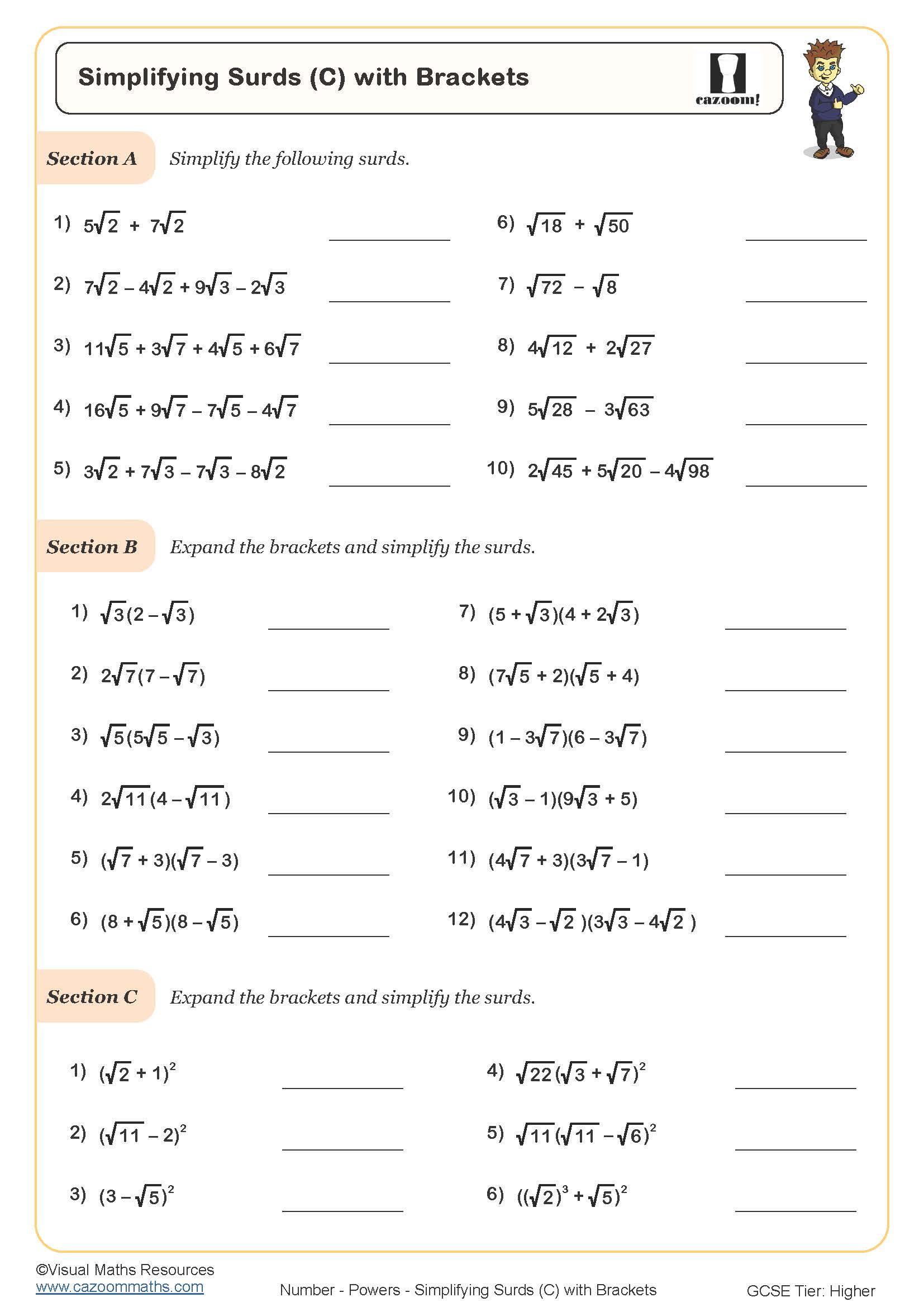
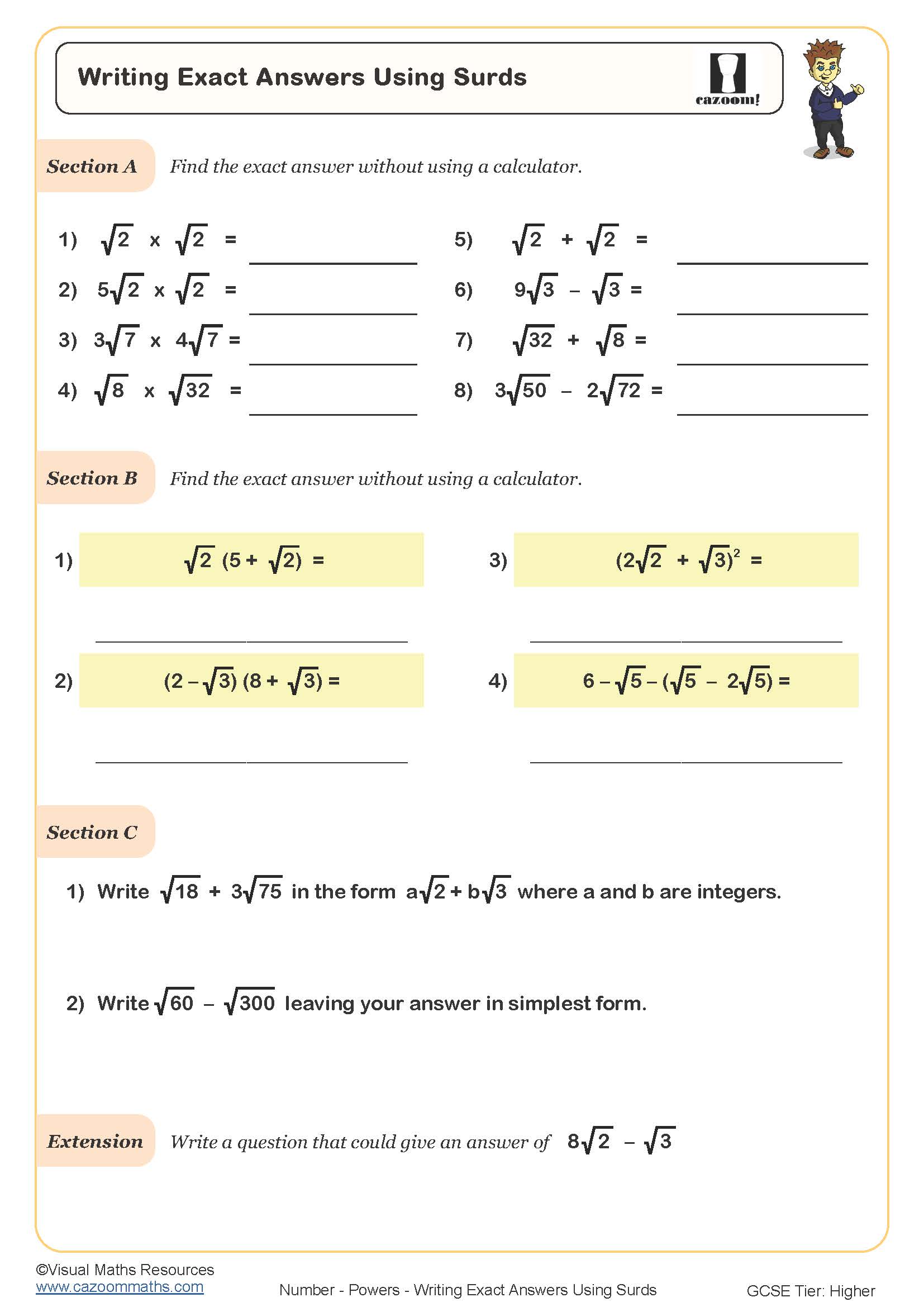
The worksheets progress through all the simplifying surds questions that appear in GCSE examinations, starting with basic expressions like √12 and √18, then advancing to more complex surds involving larger numbers and multiple terms. Students practise identifying perfect square factors, working with surds containing variables, and simplifying expressions in denominators.
Teachers report that students frequently make errors when trying to simplify surds questions involving numbers like √72 or √98, often missing factor pairs or incorrectly applying the multiplication rule. The structured progression helps students build confidence with simpler cases before tackling the more challenging simplification of surds questions that appear in higher-tier GCSE papers.
Which year groups should use these simplifying surds worksheets?
These resources are specifically designed for Year 10 and Year 11 students studying higher-tier GCSE mathematics, where surds form part of the Number and Algebra strands of the National Curriculum. Most schools introduce simplifying surds after students have developed strong foundations in indices and basic algebraic manipulation, typically during the spring term of Year 10.
Some teachers find that high-achieving Year 9 students can access these worksheets as extension work, particularly those already confident with square numbers and prime factorisation. The key prerequisite is understanding that surds are irrational numbers that cannot be expressed exactly as decimals, which connects to students' earlier work on rational and irrational numbers.
How do these worksheets help students understand rationalising denominators?
Several worksheets specifically focus on expressions with surds in denominators, teaching students the technique of multiplying by the conjugate to eliminate irrational numbers from the bottom of fractions. This connects directly to the GCSE requirement that final answers should not contain surds in denominators, a rule that often catches students off guard in examinations.
Teachers observe that students initially find it counterintuitive to make expressions 'look more complicated' by introducing additional surds during the rationalisation process. The worksheets provide step-by-step practice showing how expressions like 1/√3 become √3/3, helping students understand that this apparently complex form is actually the preferred mathematical convention.
How can teachers use these worksheets to address common misconceptions?
The answer sheets prove invaluable for identifying where students go wrong with simplifying processes, particularly the common error of trying to simplify surds by taking square roots of individual digits rather than finding perfect square factors. Teachers can use the worked solutions to demonstrate correct factorisation methods and highlight why √16×3 equals 4√3, not √1×√6.
Many teachers use these worksheets diagnostically before teaching the topic, identifying which students confuse surds with indices or attempt to add unlike surds incorrectly. The systematic progression allows teachers to pinpoint exactly where conceptual understanding breaks down, making targeted intervention much more effective than generic reteaching of the entire topic.