Standard Form Worksheets
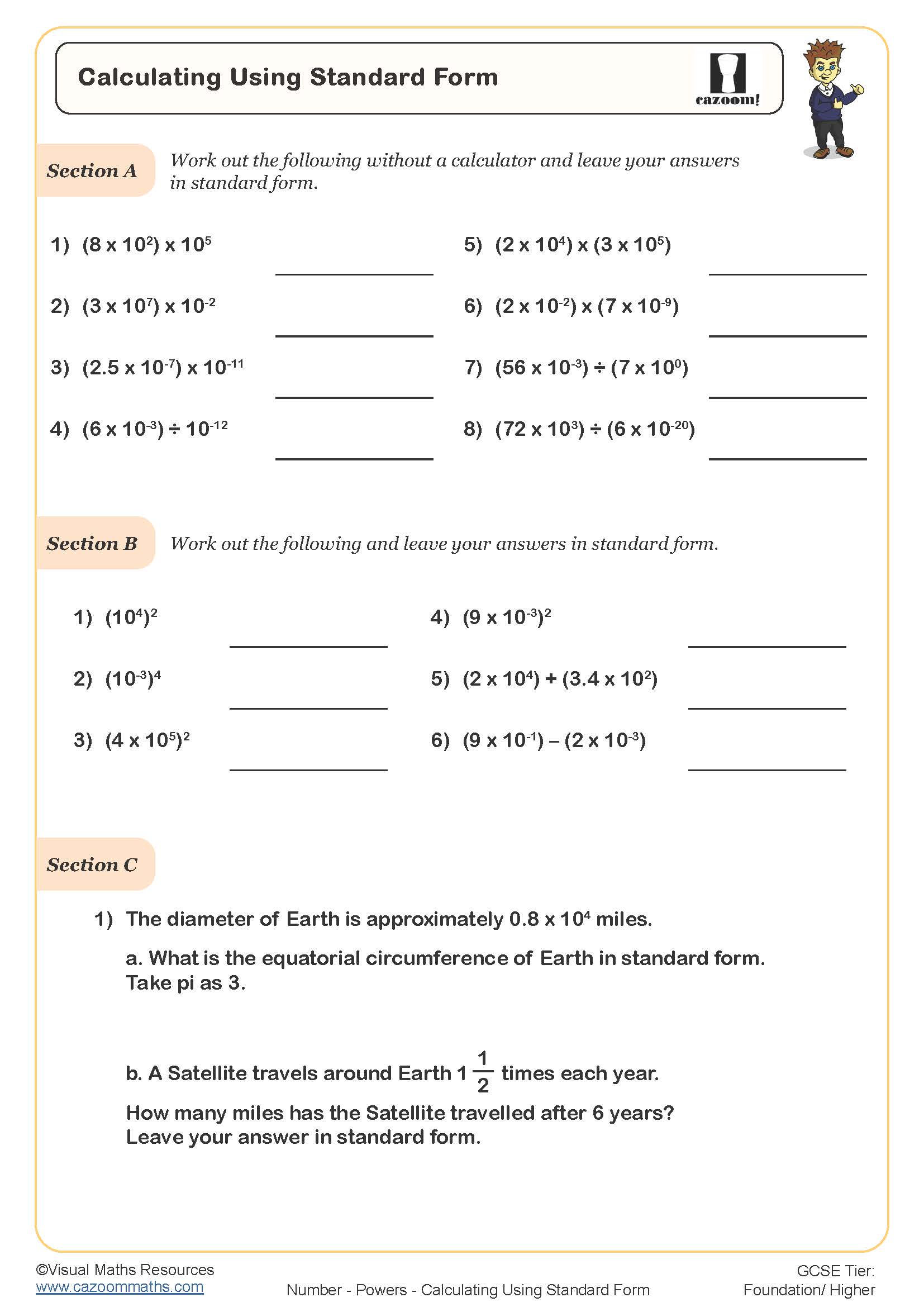
Calculating Using Standard Form
Year groups: 7, 8
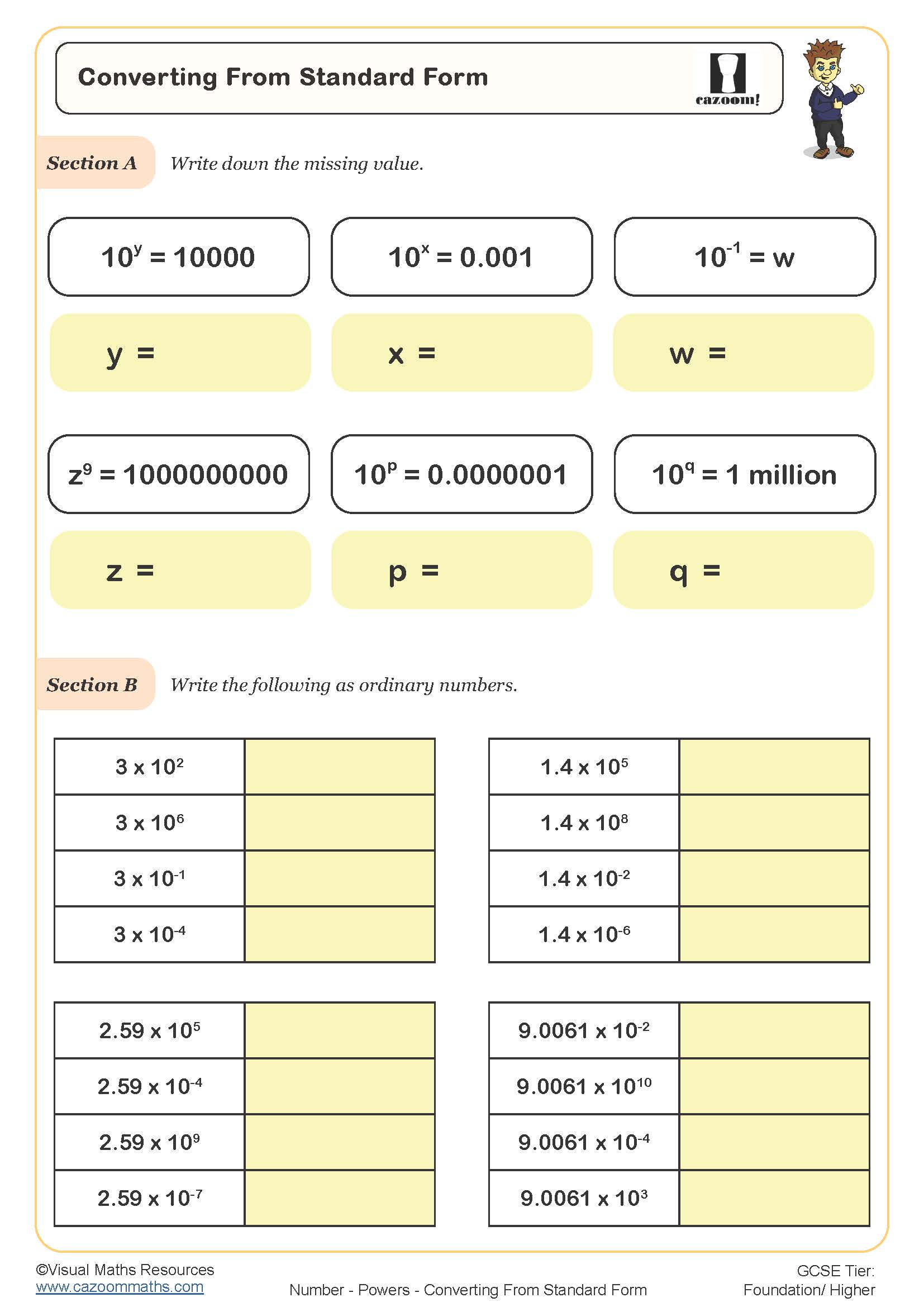
Converting from Standard Form
Year groups: 7, 8
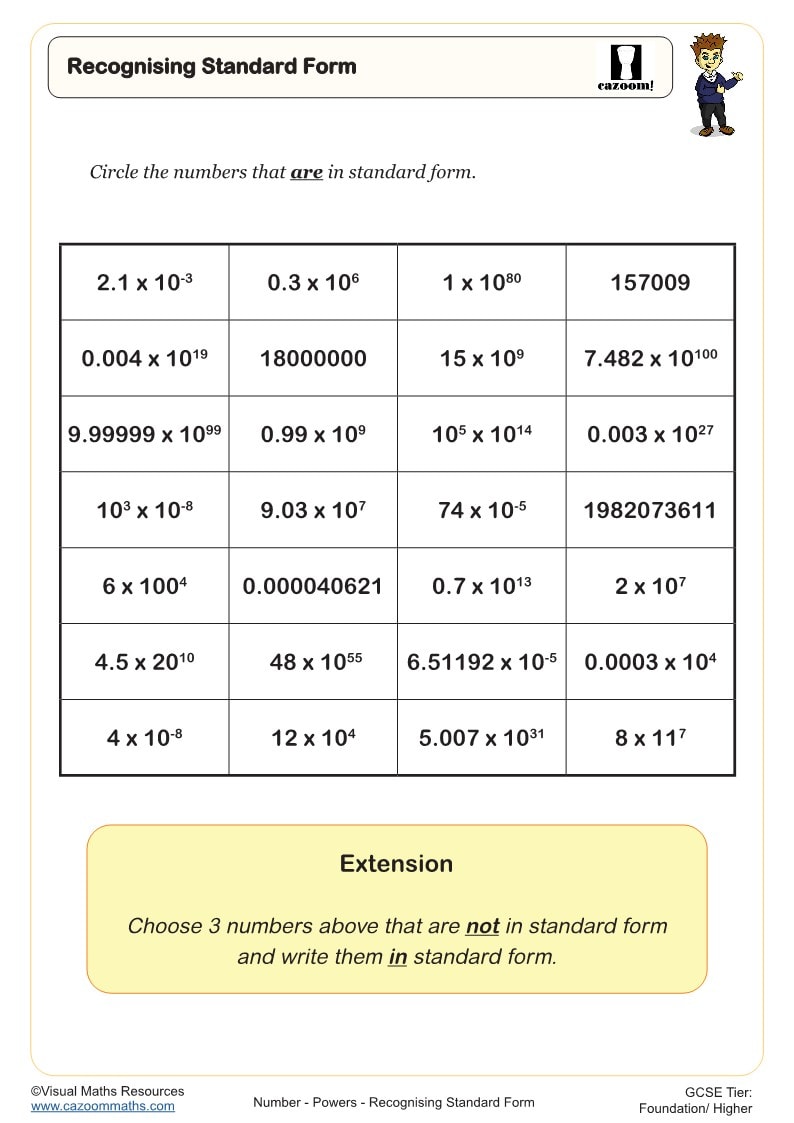
Recognising Standard Form
Year groups: 7, 8
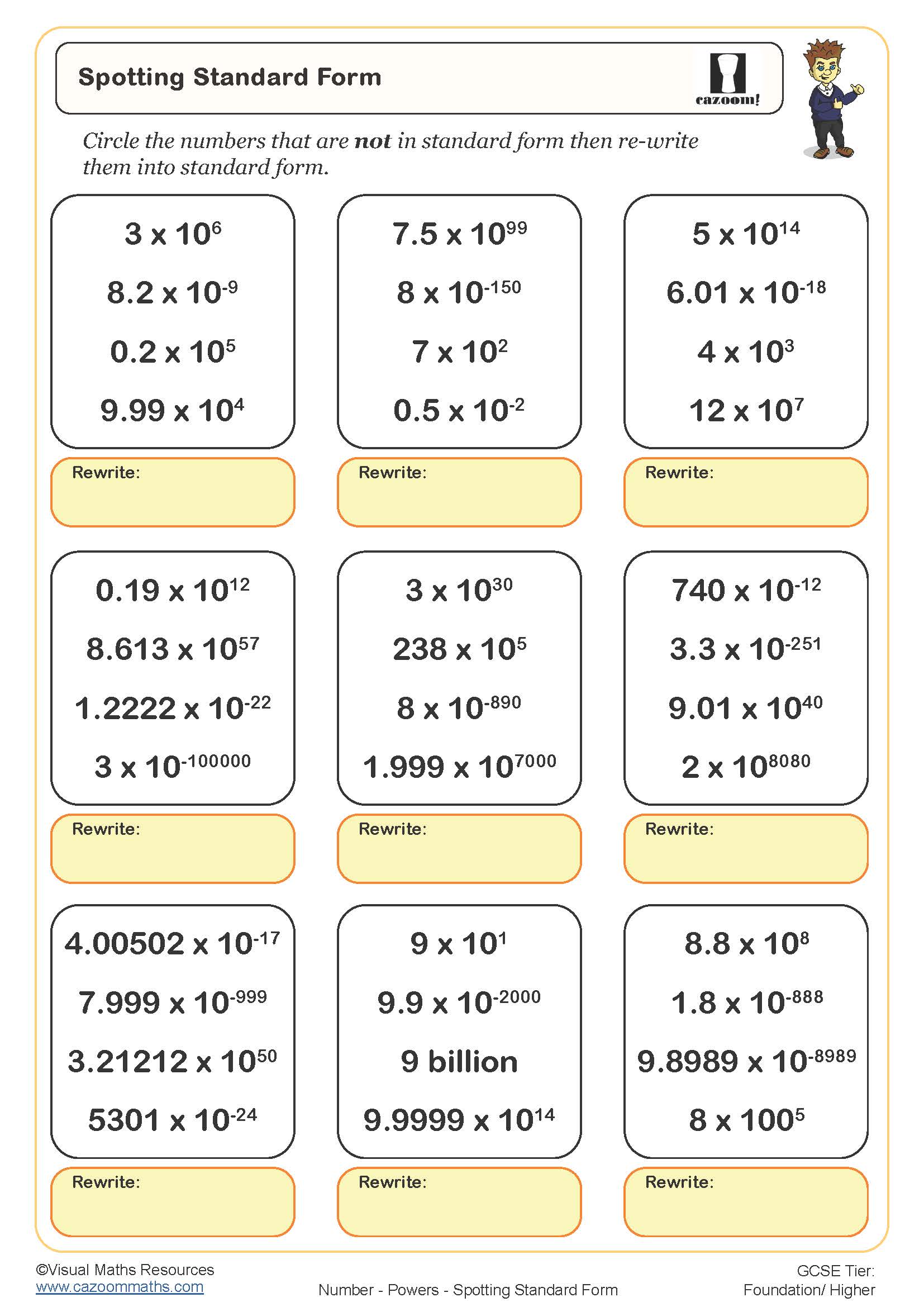
Spotting Standard Form
Year groups: 7, 8
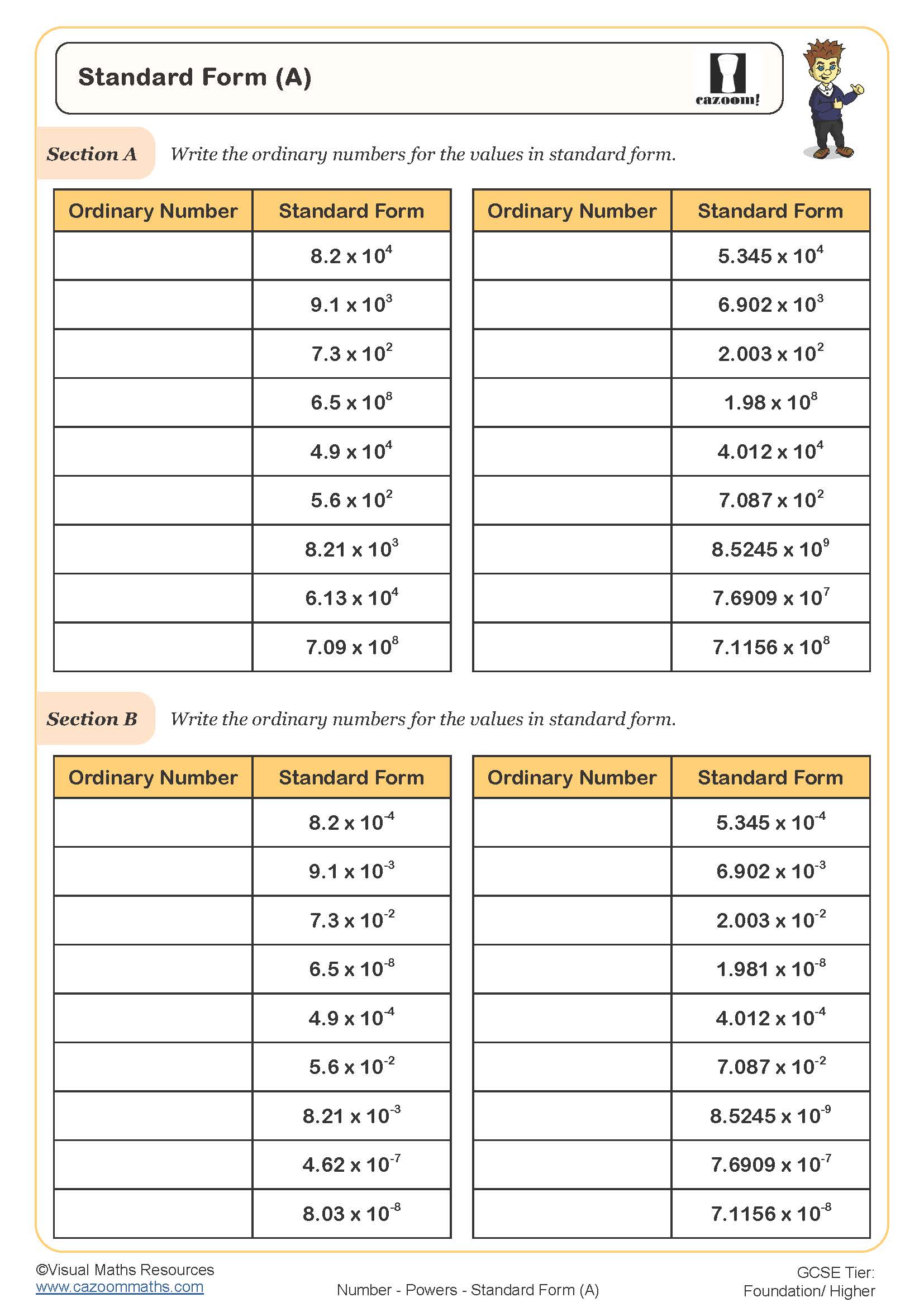
Standard Form (A)
Year groups: 7, 8
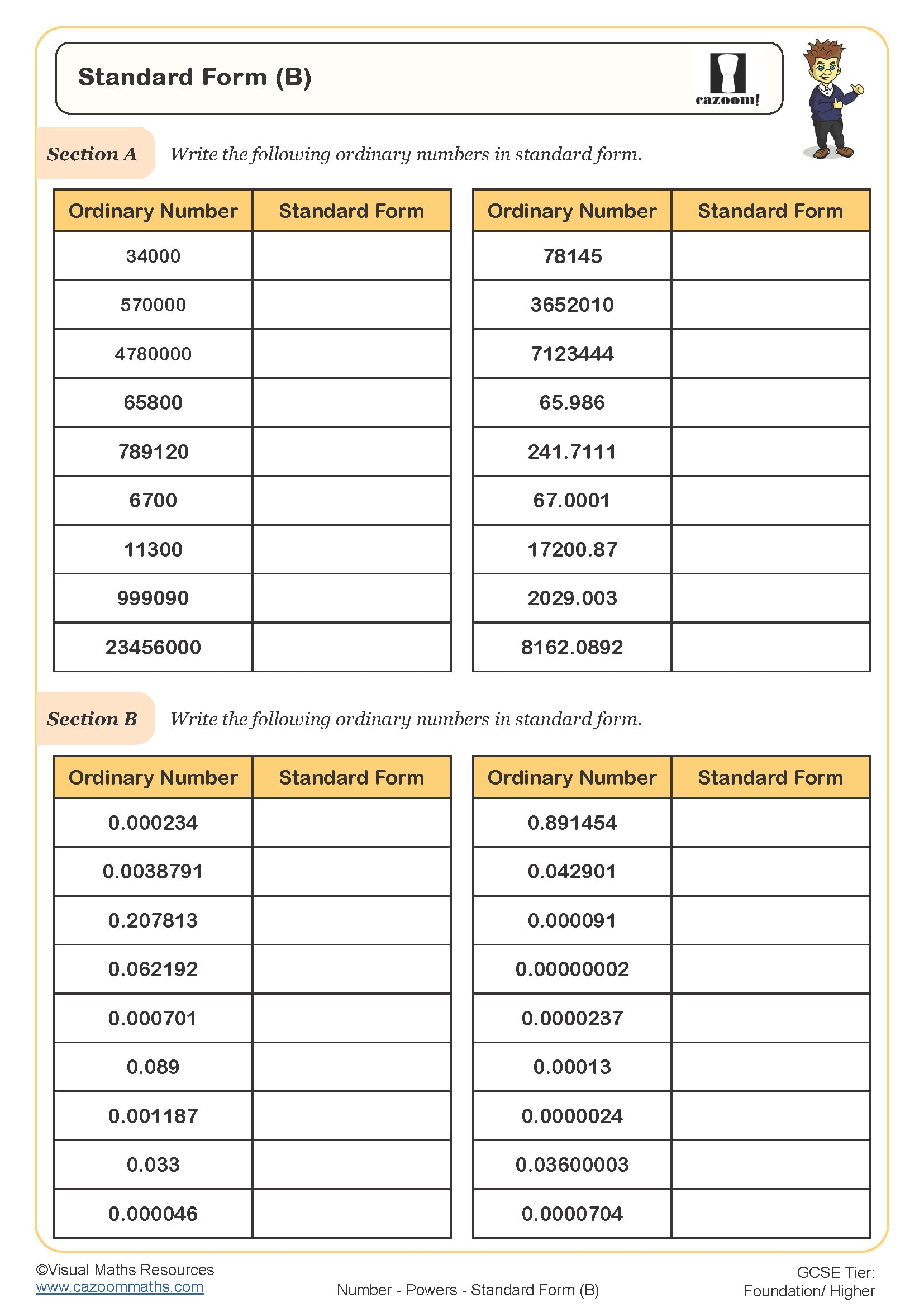
Standard Form (B)
Year groups: 7, 8
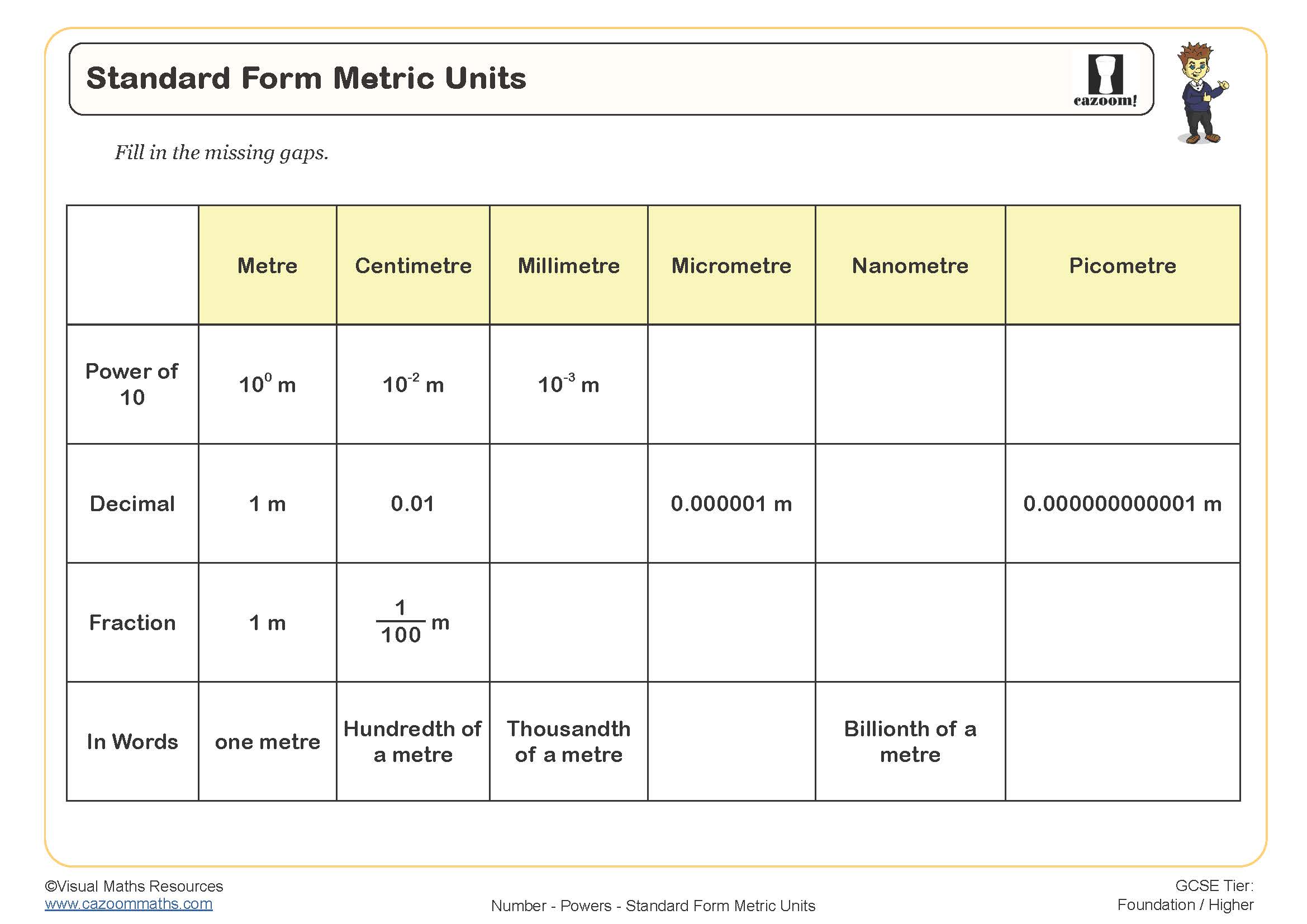
Standard Form Metric Units
Year groups: 7, 8
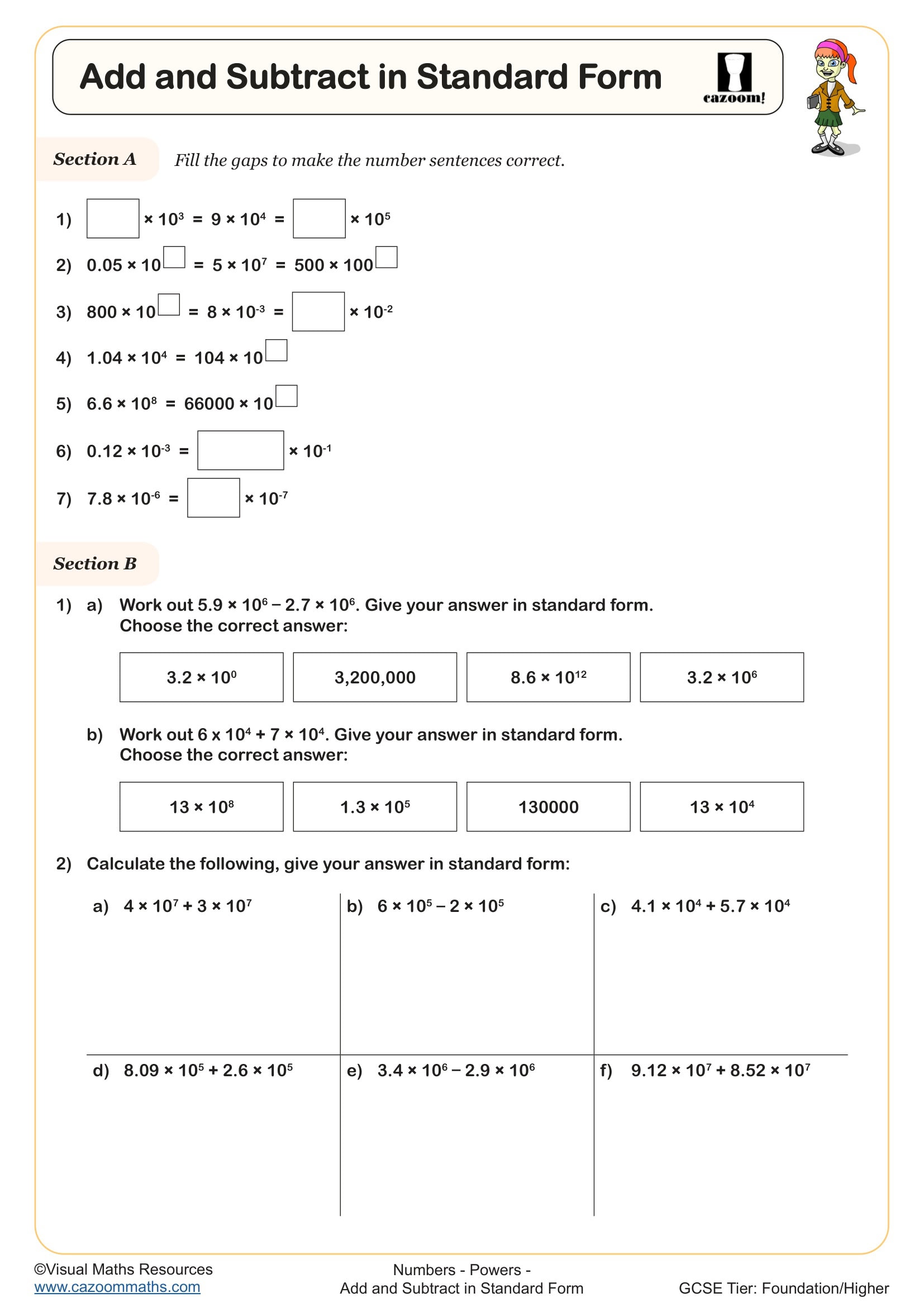
Add and Subtract in Standard Form
Year groups: 8, 9
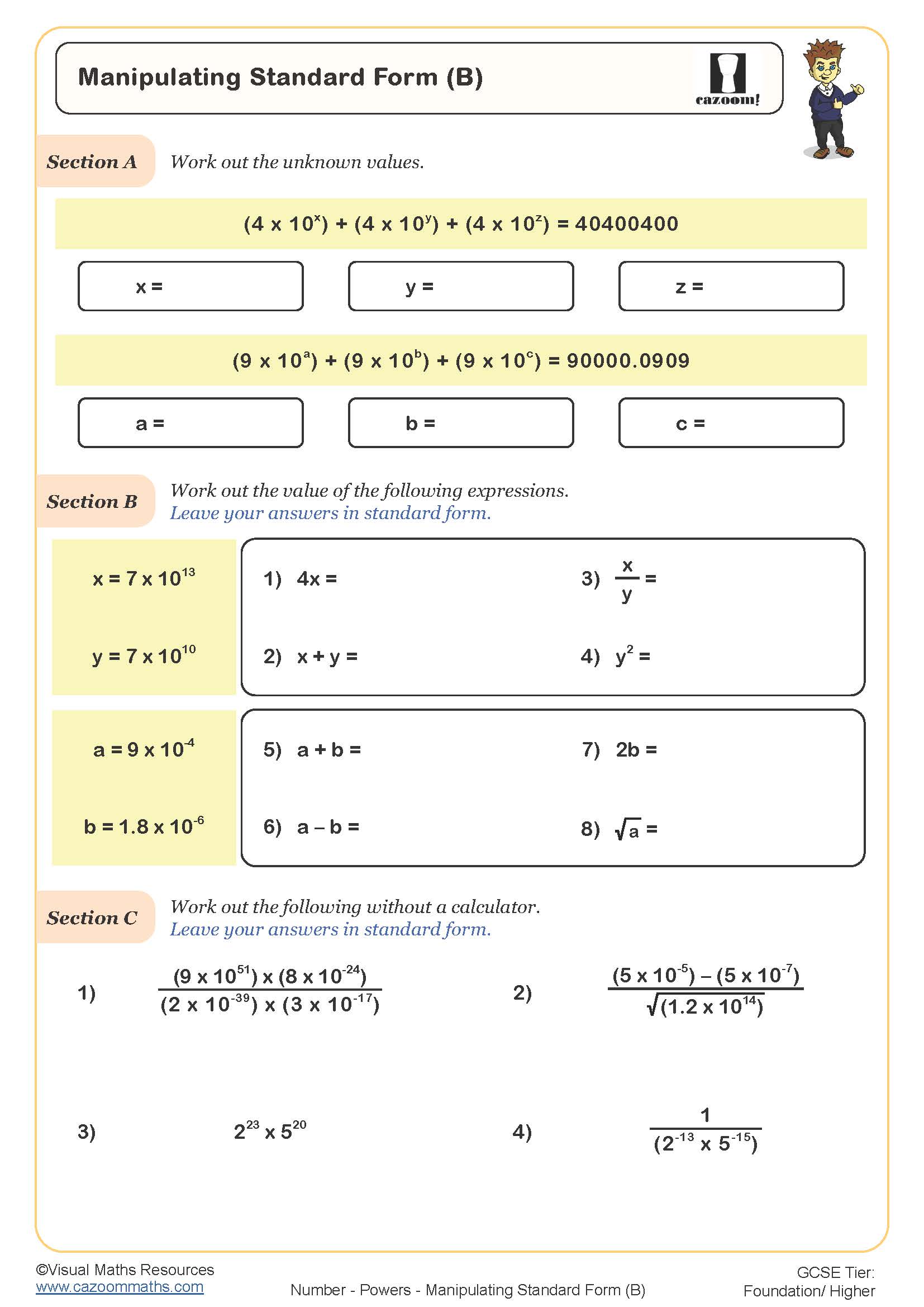
Manipulating Standard Form (B)
Year groups: 8, 9
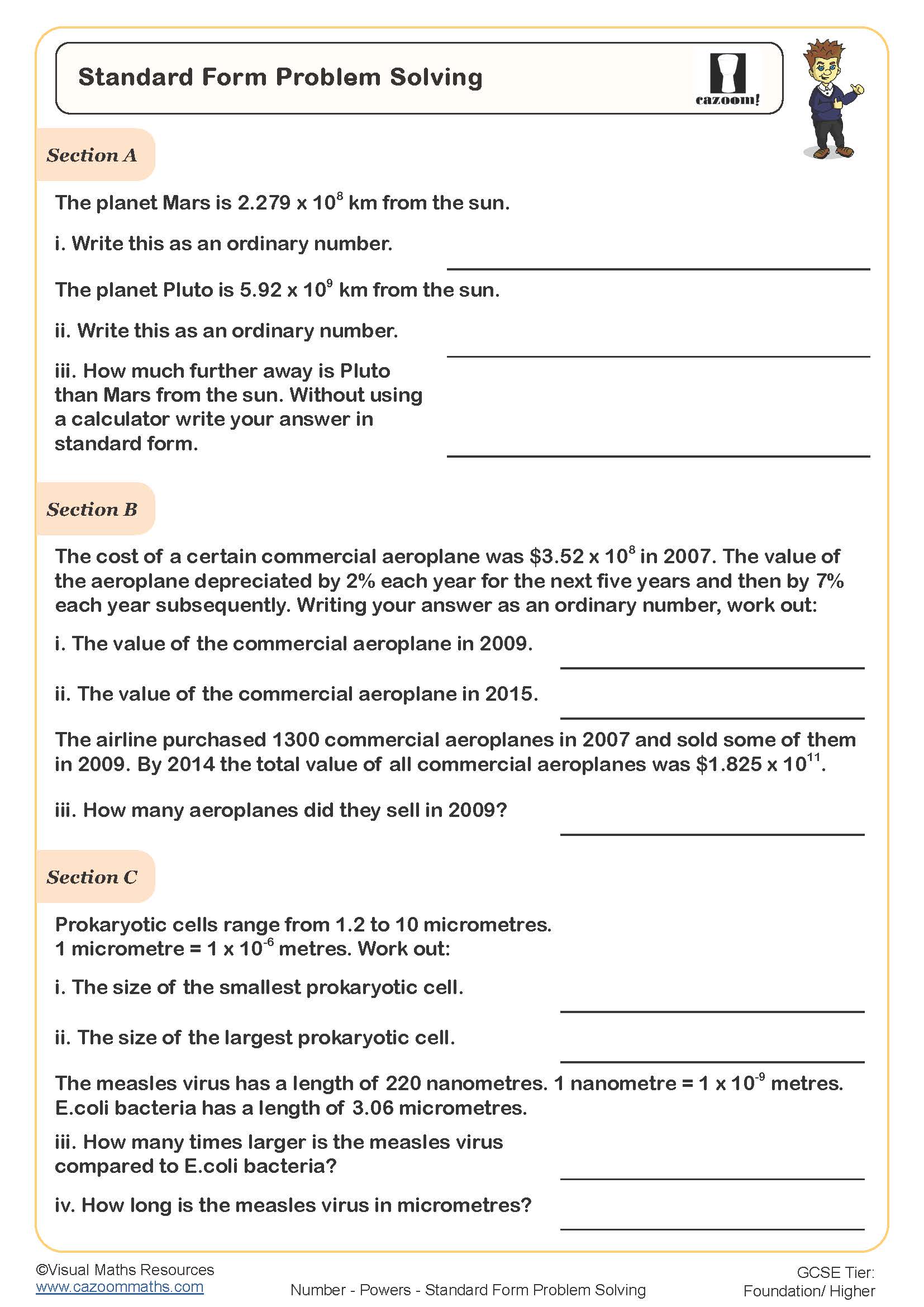
Standard Form Problem Solving
Year groups: 8, 9
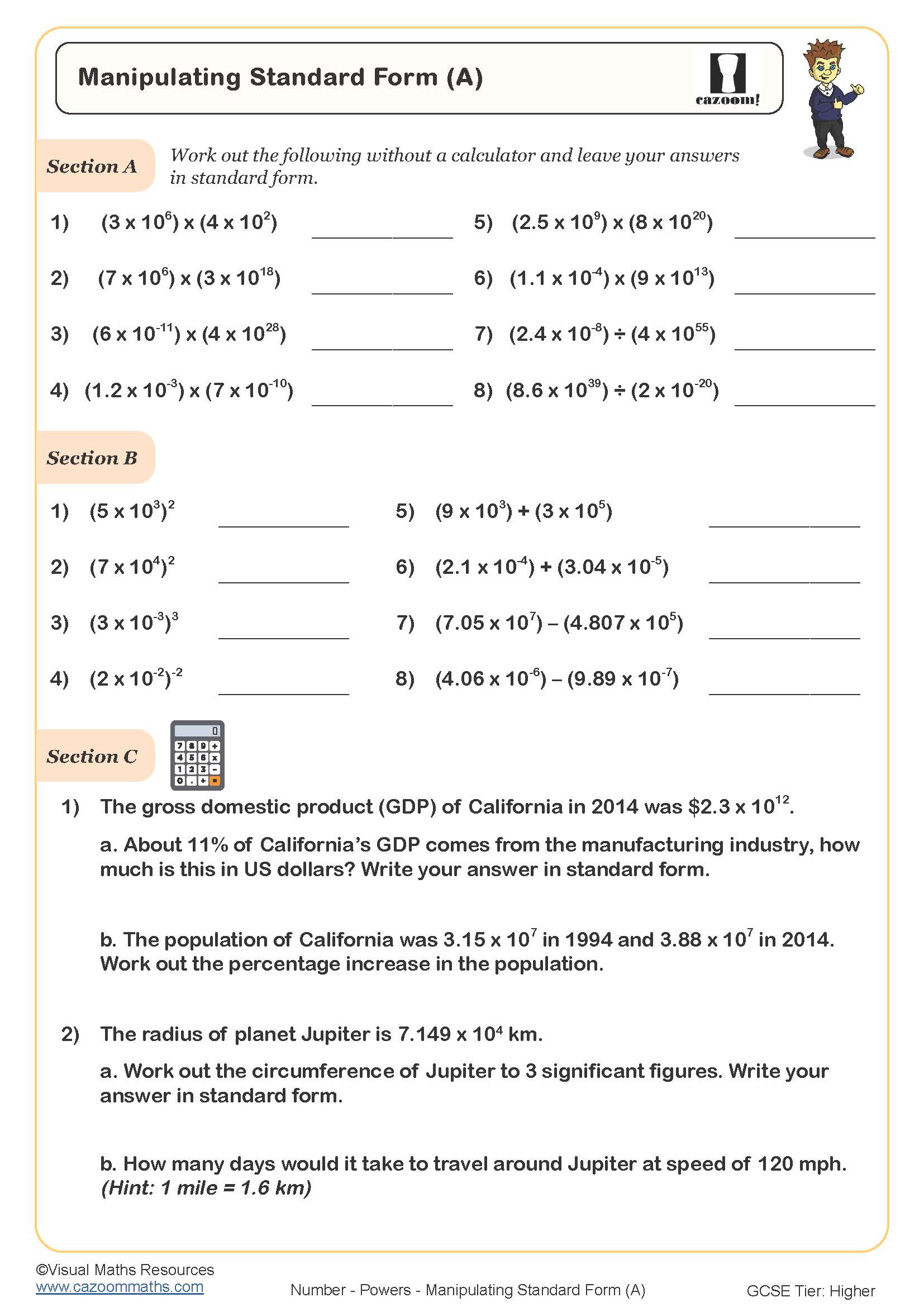
Manipulating Standard Form (A)
Year groups: 9, 10
All worksheets are created by the team of experienced teachers at Cazoom Maths.
What is standard form in maths and why do students find it challenging?
Standard form expresses numbers as A × 10ⁿ where 1 ≤ A < 10 and n is an integer. It appears throughout KS3 and becomes essential at GCSE for handling extremely large values like distances in space or tiny measurements in science contexts. Students must understand that the power of ten indicates how many places the decimal point moves, with negative powers for numbers smaller than one.
A persistent misconception occurs when converting numbers like 0.00045 to standard form. Students frequently write 4.5 × 10⁻⁴ as 4.5 × 10⁴, forgetting that moving the decimal point right requires a negative power. Exam mark schemes specifically penalise incorrect powers, and calculators displaying answers in standard form can confuse students who haven't grasped the underlying notation. Regular practice distinguishing between positive and negative indices proves crucial for accuracy.
Which year groups study standard form worksheets?
Standard form features in Year 7, Year 8, Year 9 and Year 10 across both Key Stage 3 and Key Stage 4. Initial introduction typically occurs in Year 7 or Year 8, where students learn to recognise and write numbers in standard form. The National Curriculum expects students to understand powers of 10 and express numbers in this notation before moving to calculations.
Progression increases substantially as students advance. Year 7 and Year 8 work focuses on conversion and recognition, whilst Year 9 introduces multiplying and dividing numbers in standard form. By Year 10, students tackle exam-style questions combining standard form with calculator skills, as GCSE papers regularly feature multi-step problems requiring fluency with this notation. Foundation tier expects basic conversions; Higher tier demands confident manipulation including calculations without converting back to ordinary form first.
How do you multiply numbers in standard form?
When multiplying numbers in standard form, students multiply the number parts (between 1 and 10) and add the powers of 10. For example, (3 × 10⁵) × (2 × 10³) becomes (3 × 2) × 10⁵⁺³ = 6 × 10⁸. Students must then check whether their answer remains in standard form, adjusting if the coefficient falls outside the range 1 to 10. Teachers frequently observe students multiplying the powers instead of adding them, leading to wildly incorrect magnitudes.
This skill connects directly to scientific contexts where multiplication occurs constantly. Calculating energy outputs (joules often expressed as large numbers), molecular quantities in chemistry, or processing astronomical data all require standard form multiplication. Engineers working with semiconductor sizes measured in nanometres regularly multiply values like 45 × 10⁻⁹ metres. Without standard form fluency, students entering STEM fields struggle with the scales inherent in scientific calculation, making this notation genuinely career-relevant beyond examination success.
How can teachers use these standard form worksheets effectively?
The worksheets build systematically from identifying standard form through to complex calculations, allowing teachers to select appropriate difficulty levels for different groups. Each worksheet includes worked examples that model the process step-by-step, which proves particularly valuable for students who missed initial teaching or need consolidation. The complete answer sheets enable students to self-check their work, helping them identify whether errors stem from decimal placement, powers of ten, or calculation mistakes.
Many teachers use these worksheets during intervention sessions when students return from science lessons confused about notation they've encountered. They work well as starters to refresh the skill before calculator paper practice, or as targeted homework when mock exam analysis reveals standard form as a weakness. Paired work encourages discussion about why powers are positive or negative, which often clarifies misconceptions more effectively than teacher explanation alone. The range of difficulty supports differentiation within mixed-ability classes, particularly at KS4 where Foundation and Higher tier students need different challenge levels.