Telling the Time Worksheets
All worksheets are created by the team of experienced teachers at Cazoom Maths.
What skills do telling time worksheets develop?
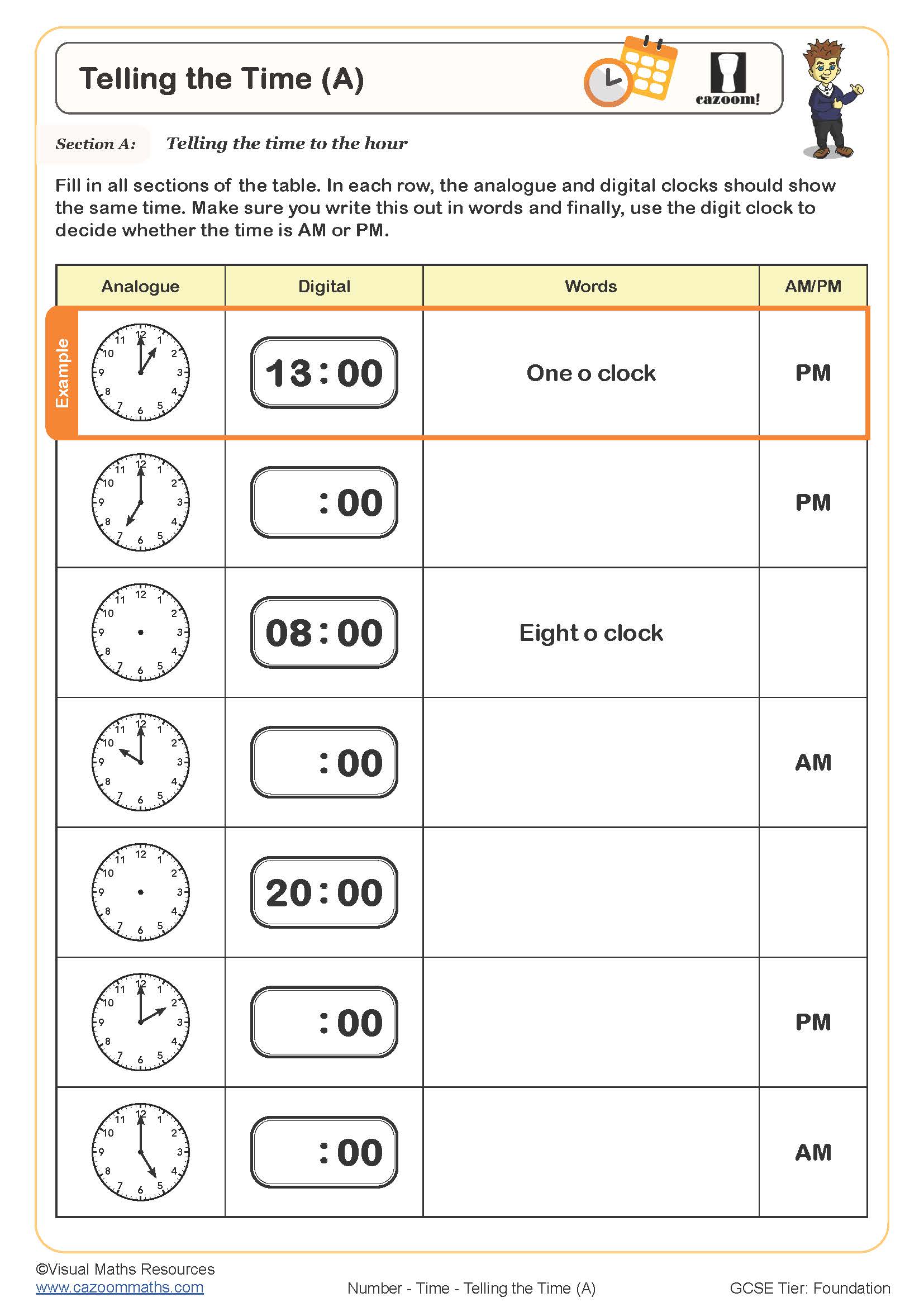
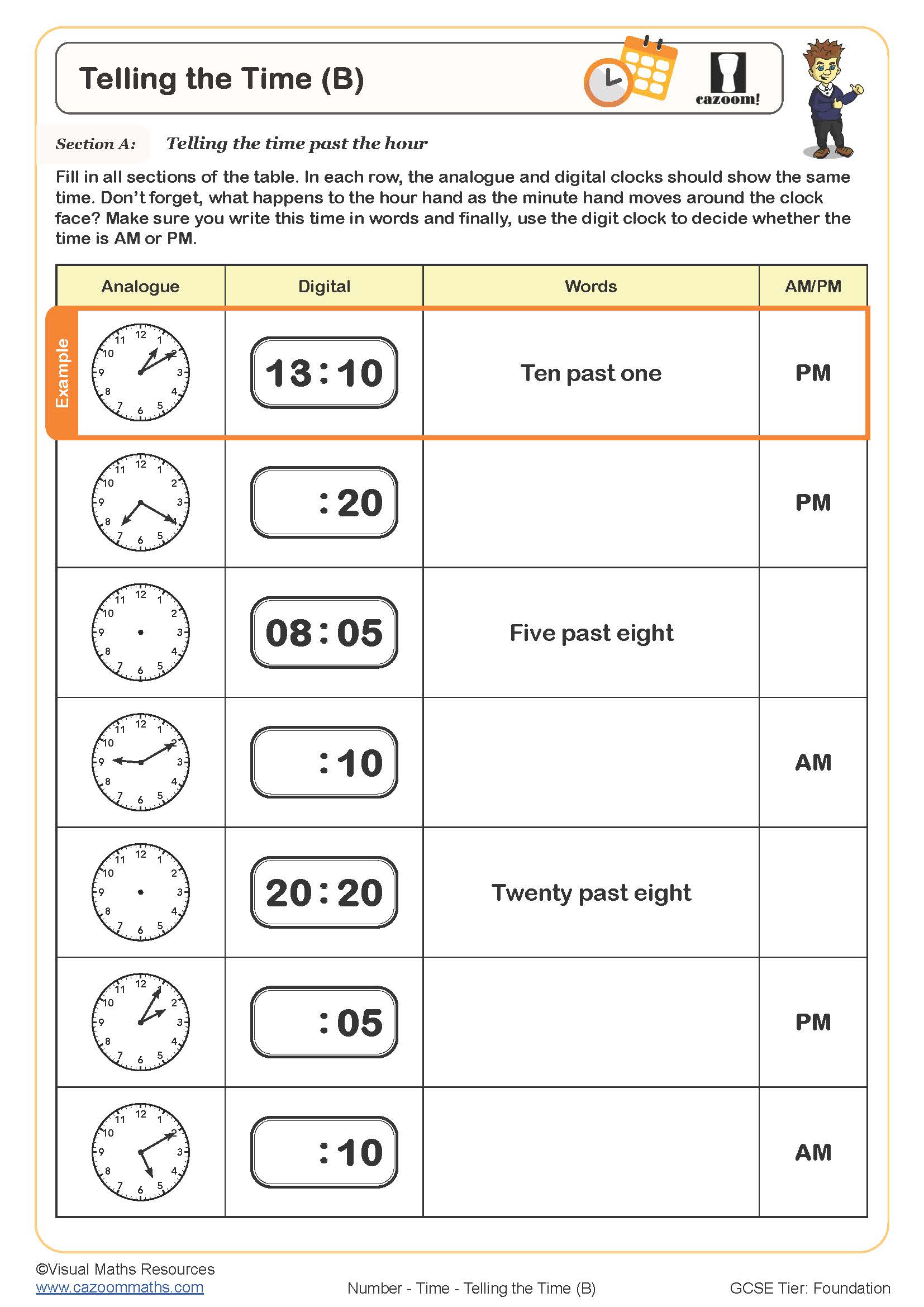
Telling time worksheets at KS3 level develop students' ability to read and interpret both analogue and digital time displays, convert confidently between 12-hour and 24-hour formats, and calculate time intervals accurately. These worksheets typically include questions on elapsed time, working backwards from given end times, and applying time concepts to real-world scenarios like timetables and schedules.
A common error teachers observe is students subtracting time incorrectly because they treat it as base-10 rather than base-60. For example, when calculating the difference between 14:45 and 16:20, students might write 1 hour 75 minutes instead of converting to 1 hour 35 minutes. Worksheets that include varied question types help students recognise when they need to regroup minutes into hours, building the procedural fluency required for GCSE problem-solving questions involving time.
Which year groups use these telling the time resources?
These telling the time worksheets are designed for Year 7 students at KS3, where the National Curriculum expects students to apply their primary-level time knowledge to more complex calculations and real-world contexts. At this stage, students move beyond simply reading clocks to working with timetables, calculating journey times, and interpreting time-based data in various formats.
While basic clock reading is introduced in KS1 and developed through KS2, Year 7 marks the transition to using time as a tool within broader mathematical problems. Students work with compound measures like speed (distance per unit time), interpret time series graphs in statistics, and tackle multi-step problems where time intervals combine with other operations. This progression ensures students can handle the functional maths questions about time that appear regularly in GCSE papers.
How do students convert between 12-hour and 24-hour time formats?
Converting between 12-hour and 24-hour time requires students to understand that morning times (midnight to noon) remain the same in both formats, whilst afternoon and evening times (noon to midnight) have 12 added to the hour component. For instance, 3:30 PM becomes 15:30 in 24-hour time because 3 + 12 = 15. The key challenge is remembering that 12:00 PM is noon (written as 12:00 in 24-hour format) whilst midnight is 00:00, not 24:00.
This skill connects directly to real-world applications students encounter daily, from reading train and bus timetables to understanding flight departure times or hospital appointment systems. In STEM careers, 24-hour time is standard across healthcare, aviation, military operations, and international business, where clarity about AM and PM is critical for safety and coordination. Teachers often use timetable scenarios to help students see why the 24-hour system eliminates ambiguity in professional contexts.
How can teachers use these worksheets in lessons?
The worksheets provide structured practice that allows students to work methodically through different aspects of time, from straightforward conversions to multi-step problems involving calculations. With answer sheets included, students can check their own work and identify patterns in their errors, which is particularly valuable when addressing misconceptions about how time calculations differ from standard arithmetic.
Teachers typically use these resources for intervention with students who still struggle with time concepts from primary school, as homework to reinforce lesson content, or as starter activities to retrieve prior knowledge before tackling compound measures like speed. The worksheets also work well for paired practice where students can discuss their methods for calculating time intervals, helping them articulate whether they counted forwards, used a number line, or converted everything to minutes first. This peer discussion often reveals calculation strategies that struggling students haven't considered.