Written Methods for Division Worksheets
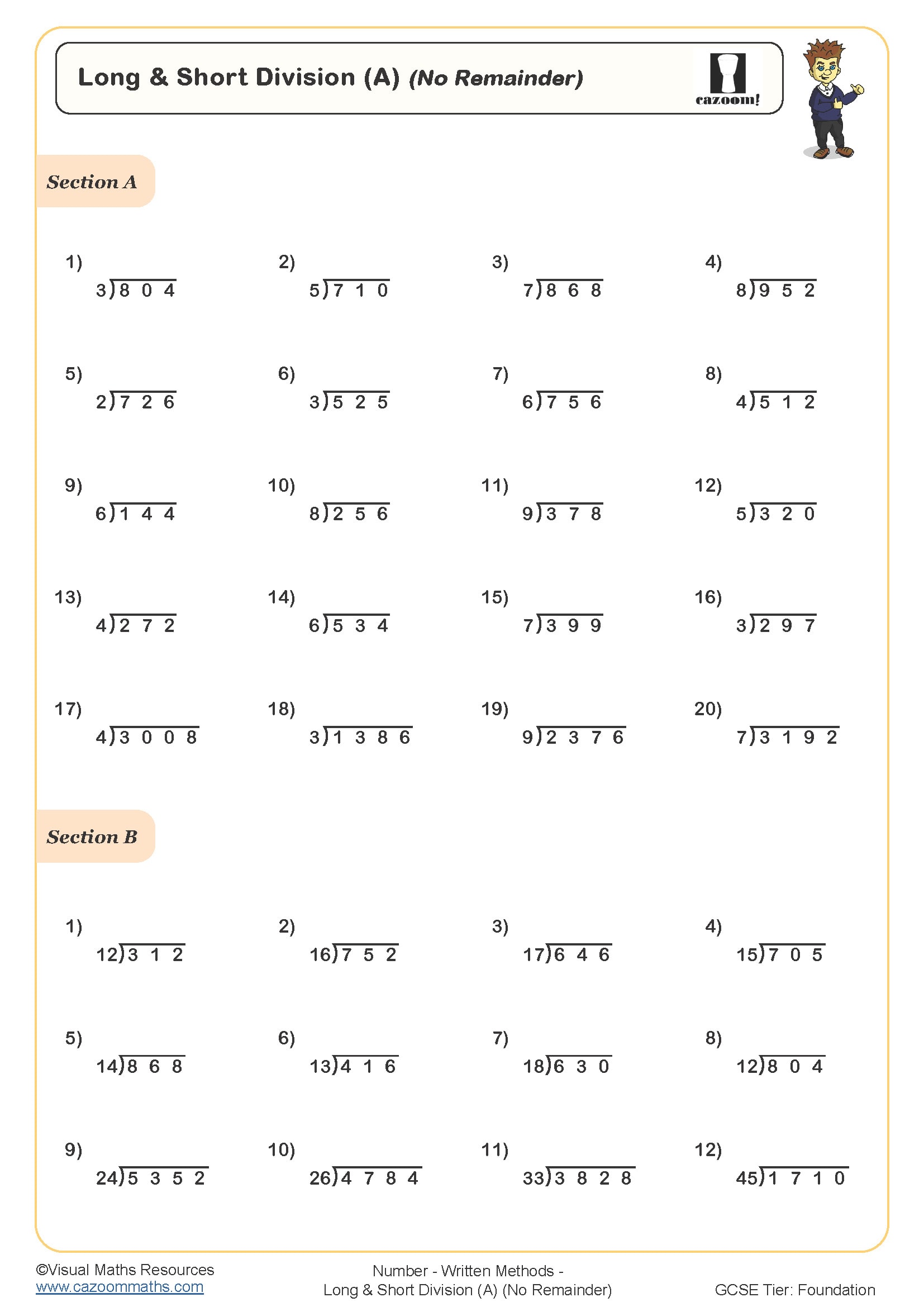
Long and Short Division (A)
Year groups: 7, 8
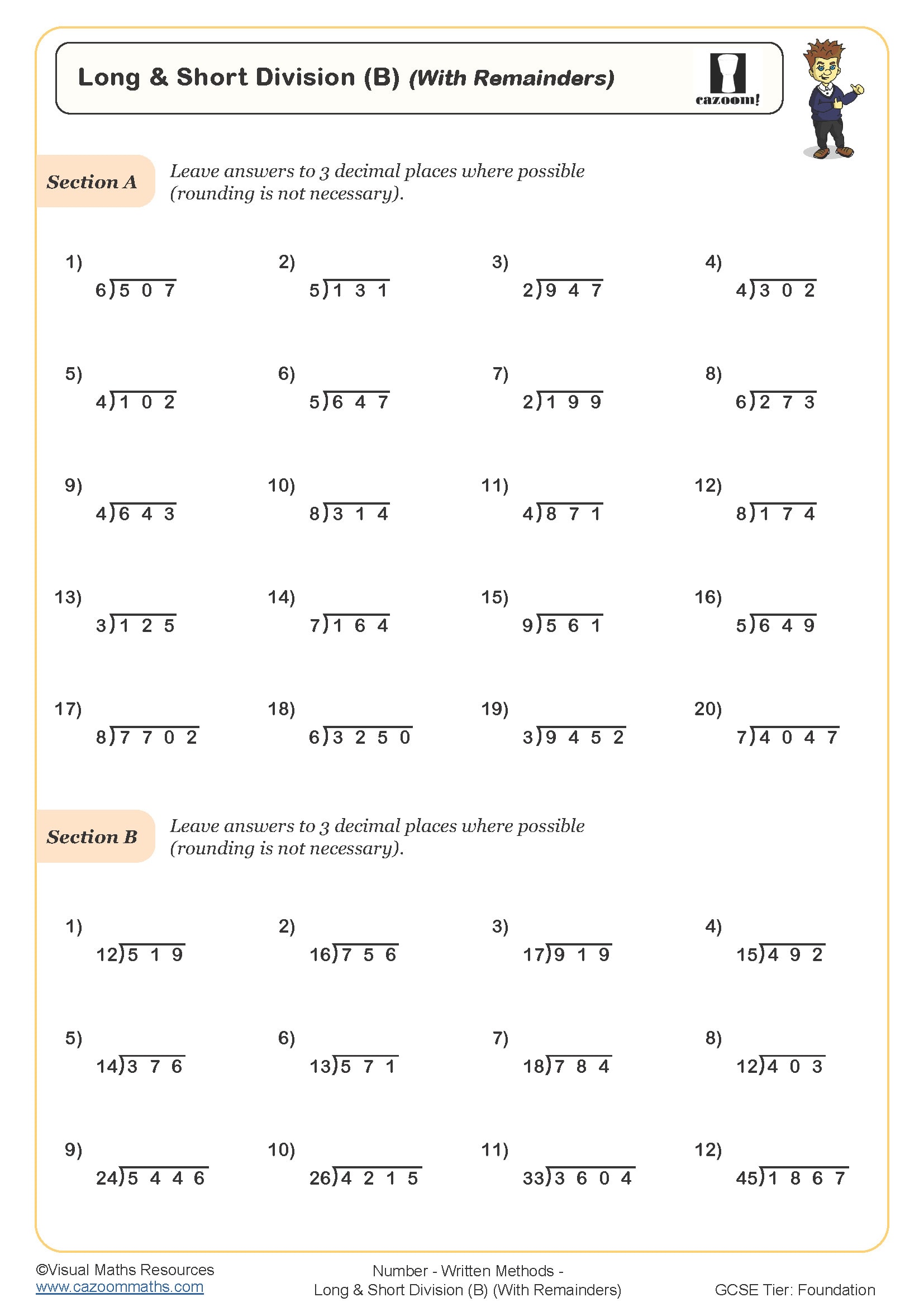
Long and Short Division (B)
Year groups: 7, 8
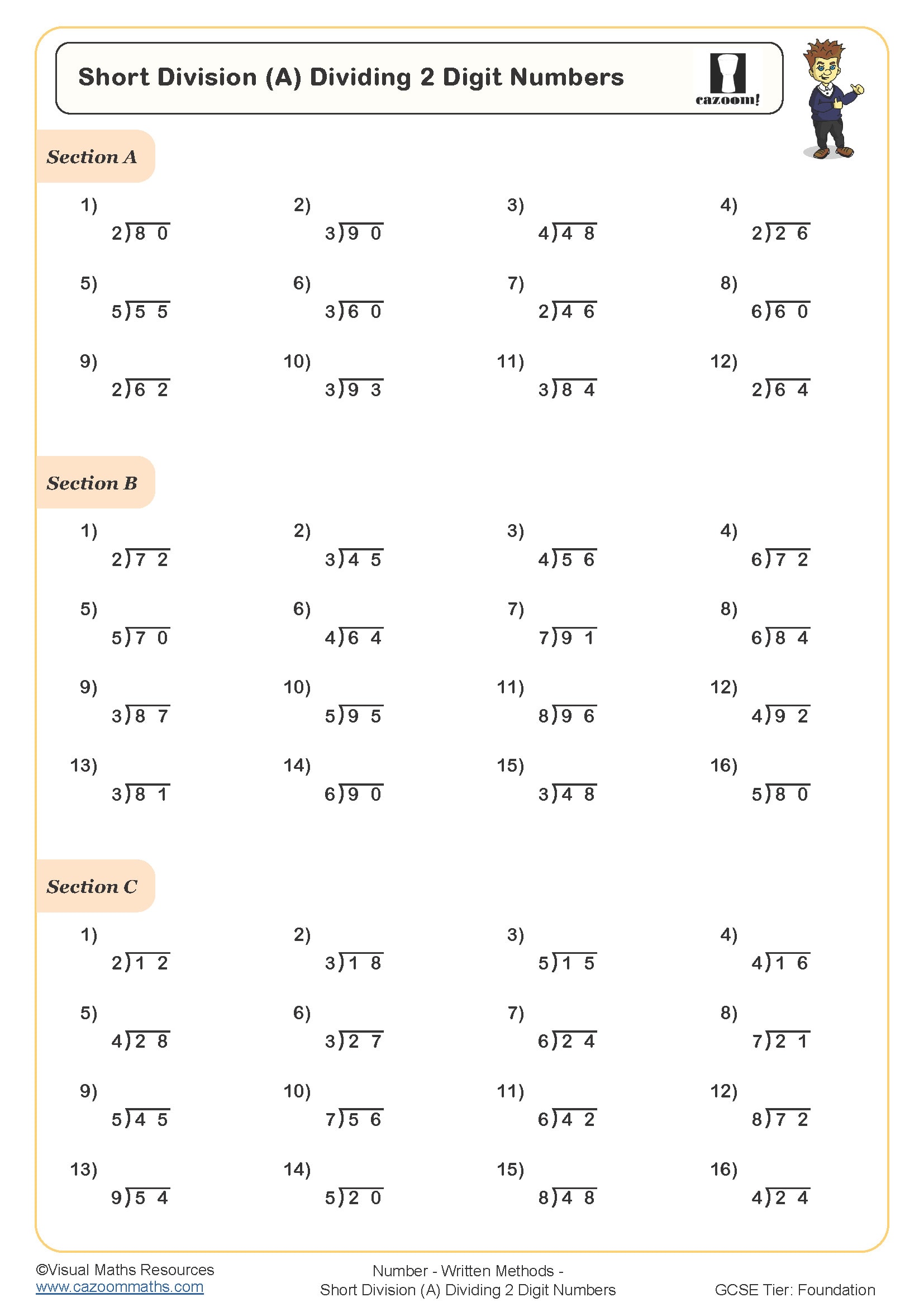
Short Division (A) Dividing 2 Digit Numbers
Year groups: 7, 8
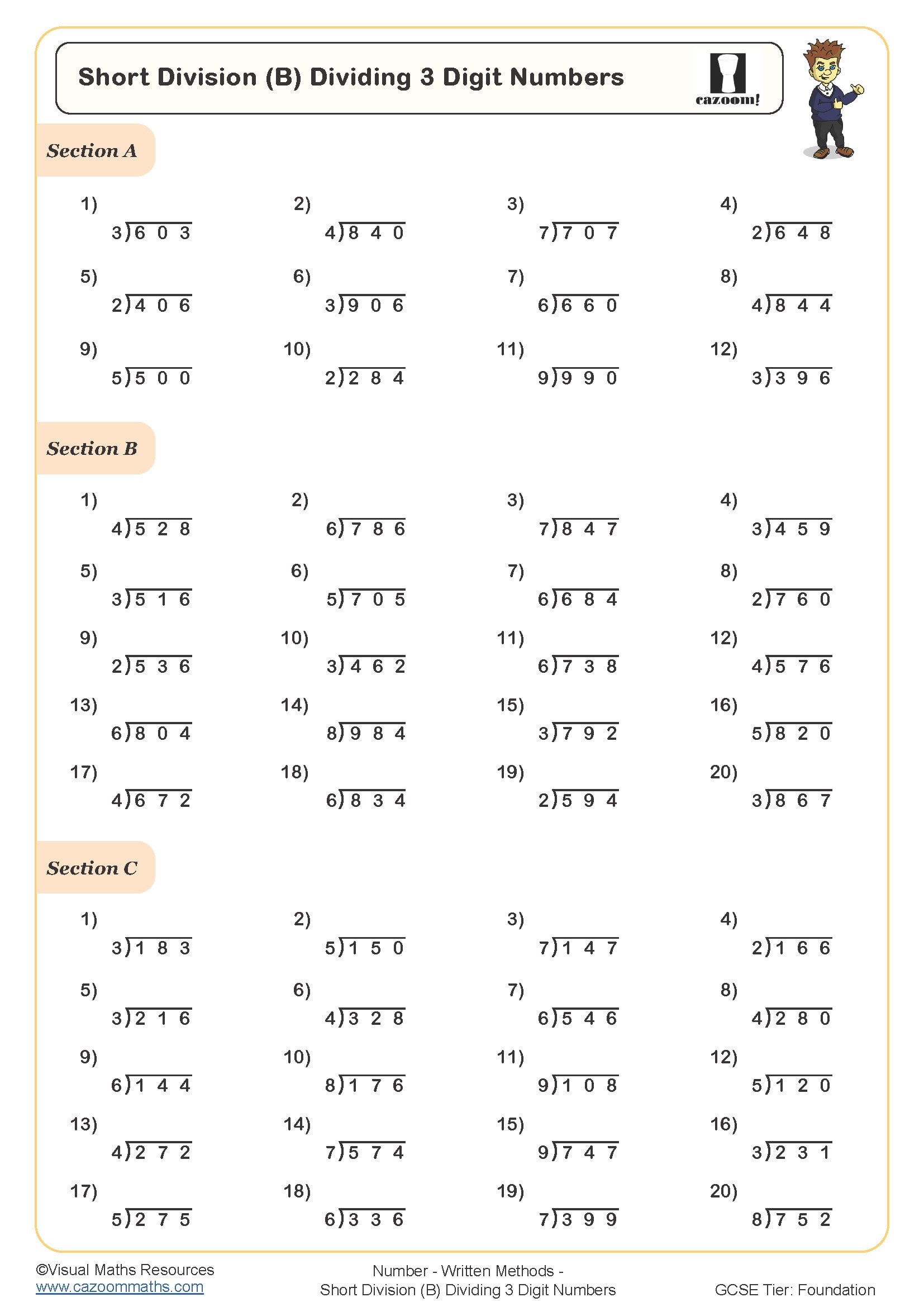
Short Division (B) Dividing 3 Digit Numbers
Year groups: 7, 8
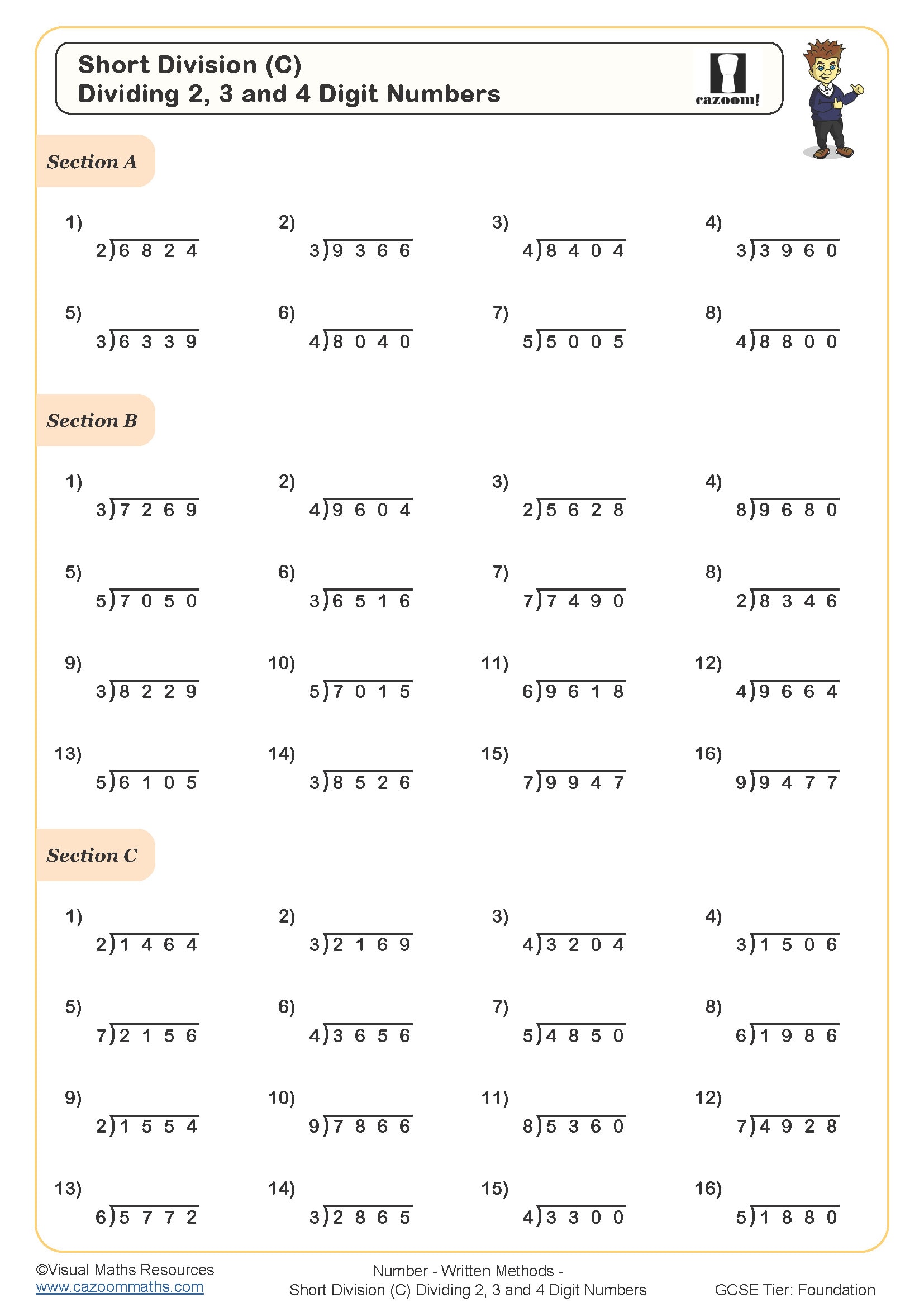
Short Division (C) Dividing 2, 3 and 4 Digit Numbers
Year groups: 7, 8
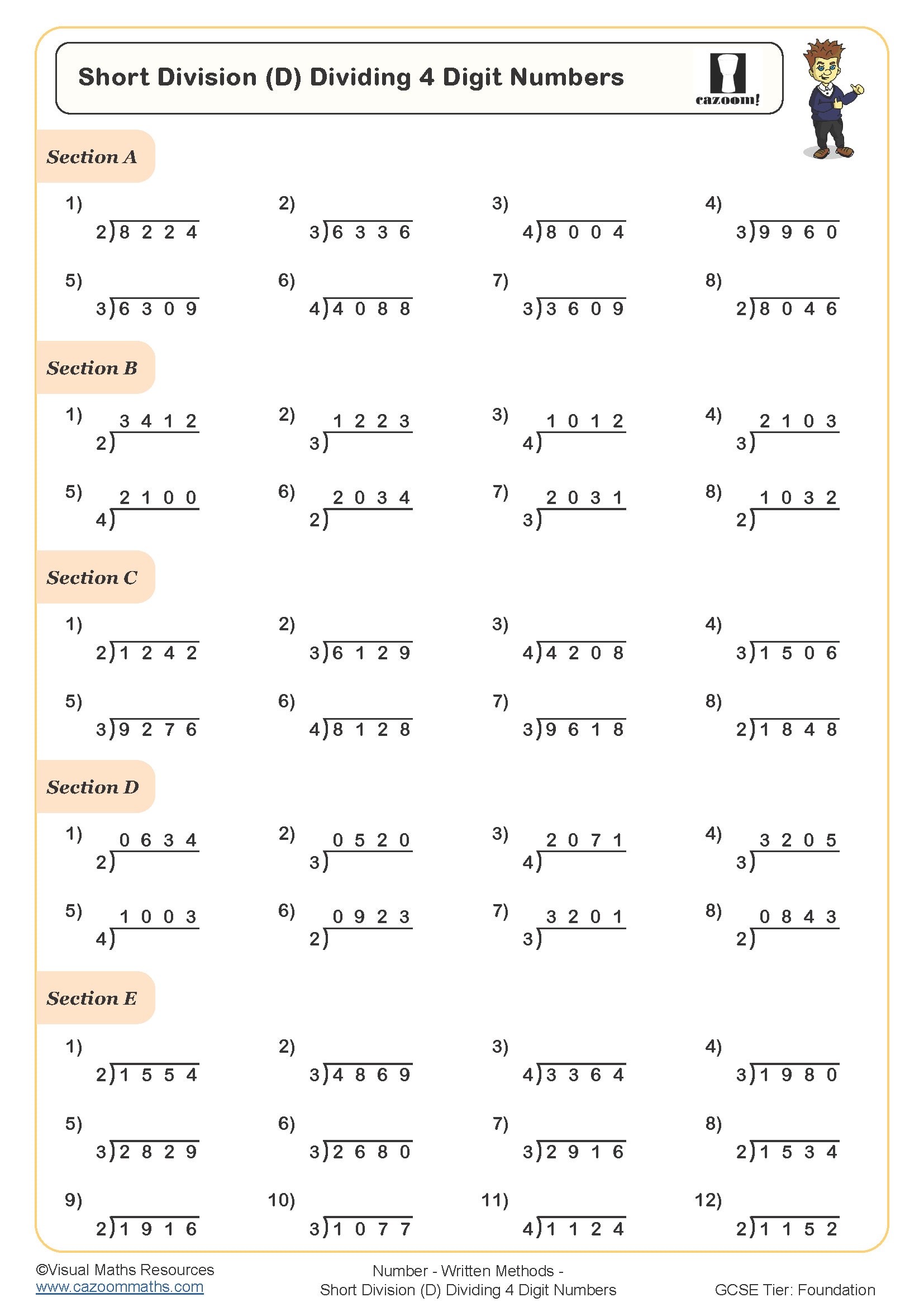
Short Division (D) Dividing 4 Digit Numbers
Year groups: 7, 8
All worksheets are created by the team of experienced teachers at Cazoom Maths.
What are the written methods for division in KS3?
Written methods for division at Key Stage 3 focus on two main algorithms: short division (also called the bus stop method) and long division. Short division works efficiently when dividing by single-digit numbers, whilst long division becomes necessary for dividing by two-digit divisors or when students need to show more detailed working. Both methods require secure understanding of times tables, place value, and how to record remainders appropriately, whether as whole numbers, fractions, or decimals.
Students frequently make errors when carrying remainders between place value columns, particularly when zeros appear in the dividend. Teachers notice that many students misalign their working in long division, leading to incorrect subtraction and cascading errors through the calculation. Systematic practice with clearly structured worksheets helps students develop the spatial organisation and checking habits that reduce these mistakes.
Which year groups learn written division methods?
These worksheets cover Year 7 and Year 8, where students consolidate and extend the division methods introduced in upper primary. In Year 7, the National Curriculum expects students to divide whole numbers confidently using formal written methods, whilst Year 8 builds towards dividing by larger numbers and expressing remainders in different forms according to context.
The progression across these year groups moves from dividing three-digit numbers by single digits, through to four-digit dividends and two-digit divisors. Year 8 worksheets typically include more complex scenarios where students must decide whether to express remainders as whole numbers, fractions, or decimals, developing the reasoning skills that underpin GCSE problem-solving questions.
What is long division and when should students use it?
Long division is a formal written method used when dividing by numbers too large for short division to handle efficiently, particularly when the divisor has two or more digits. The method involves repeated estimation, multiplication, and subtraction, recording each step clearly to track the process. Students write the divisor outside the division bracket, estimate how many times it fits into successive portions of the dividend, multiply, subtract, and bring down the next digit.
This algorithm connects directly to engineering and scientific calculations where estimating quotients and managing large numerical datasets without technology becomes necessary. Architects use similar iterative processes when calculating material quantities, whilst computer scientists recognise the algorithmic thinking that underpins efficient division. Understanding why the method works, rather than just following steps mechanically, strengthens students' proportional reasoning across STEM subjects.
How do these worksheets help students improve their division skills?
The worksheets provide structured practice that gradually increases in complexity, allowing students to build confidence with the procedural steps before tackling more demanding calculations. Clear layouts give students sufficient space to record their working methodically, whilst answer sheets enable immediate checking and self-correction. This scaffolded approach helps students identify exactly where errors occur in multi-step processes.
Teachers use these worksheets effectively for targeted intervention with students who need additional practice outside whole-class teaching, or as retrieval practice to maintain fluency with written methods. They work well for homework because the answer sheets allow parents to support without needing to know the method themselves. In paired work, students can compare their written layouts and discuss different approaches to the same calculation, developing metacognitive awareness of their own calculation strategies.