KS3 Polygons Worksheets
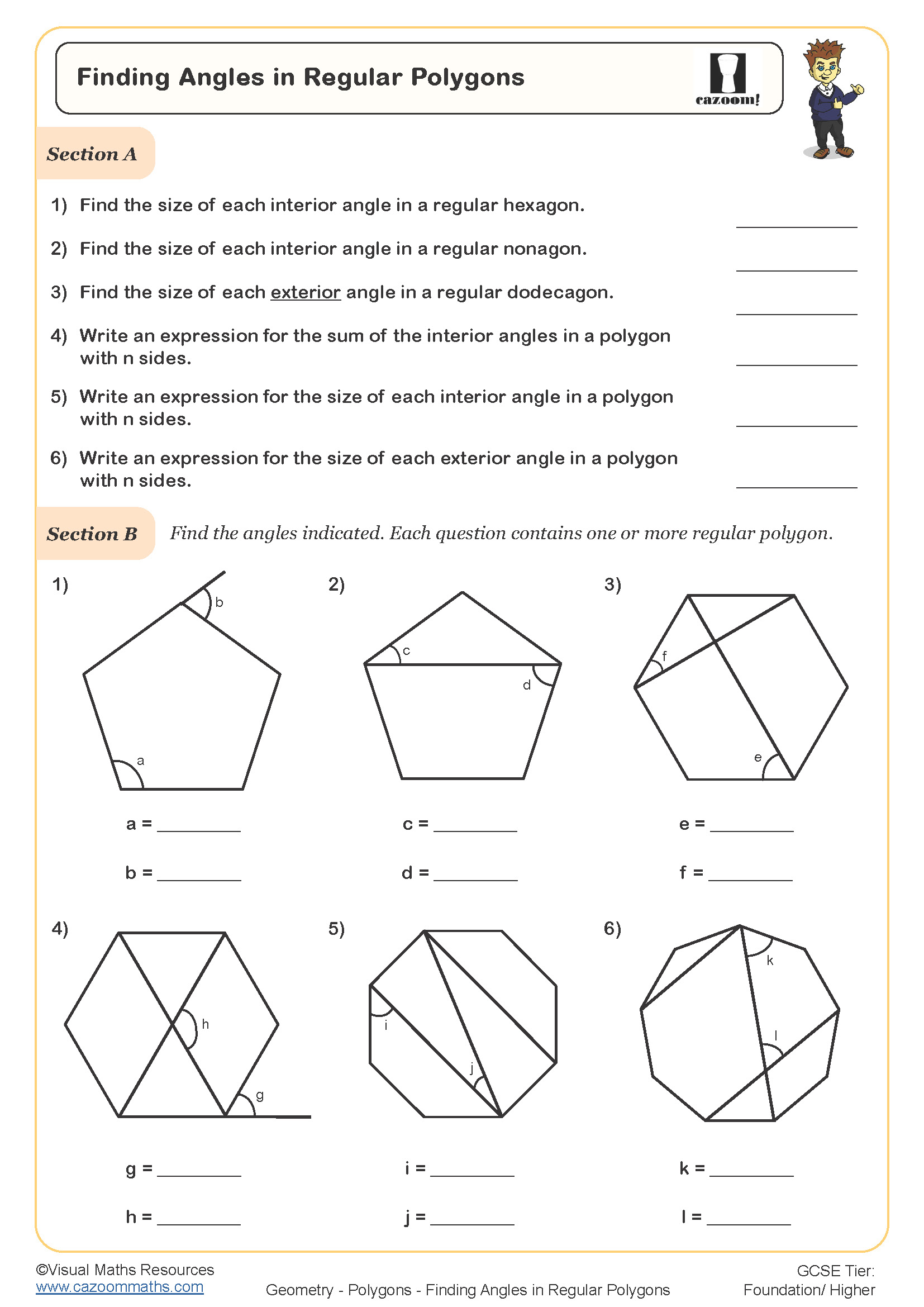
All worksheets are created by the team of experienced teachers at Cazoom Maths.
What should students practise with a polygons worksheet?
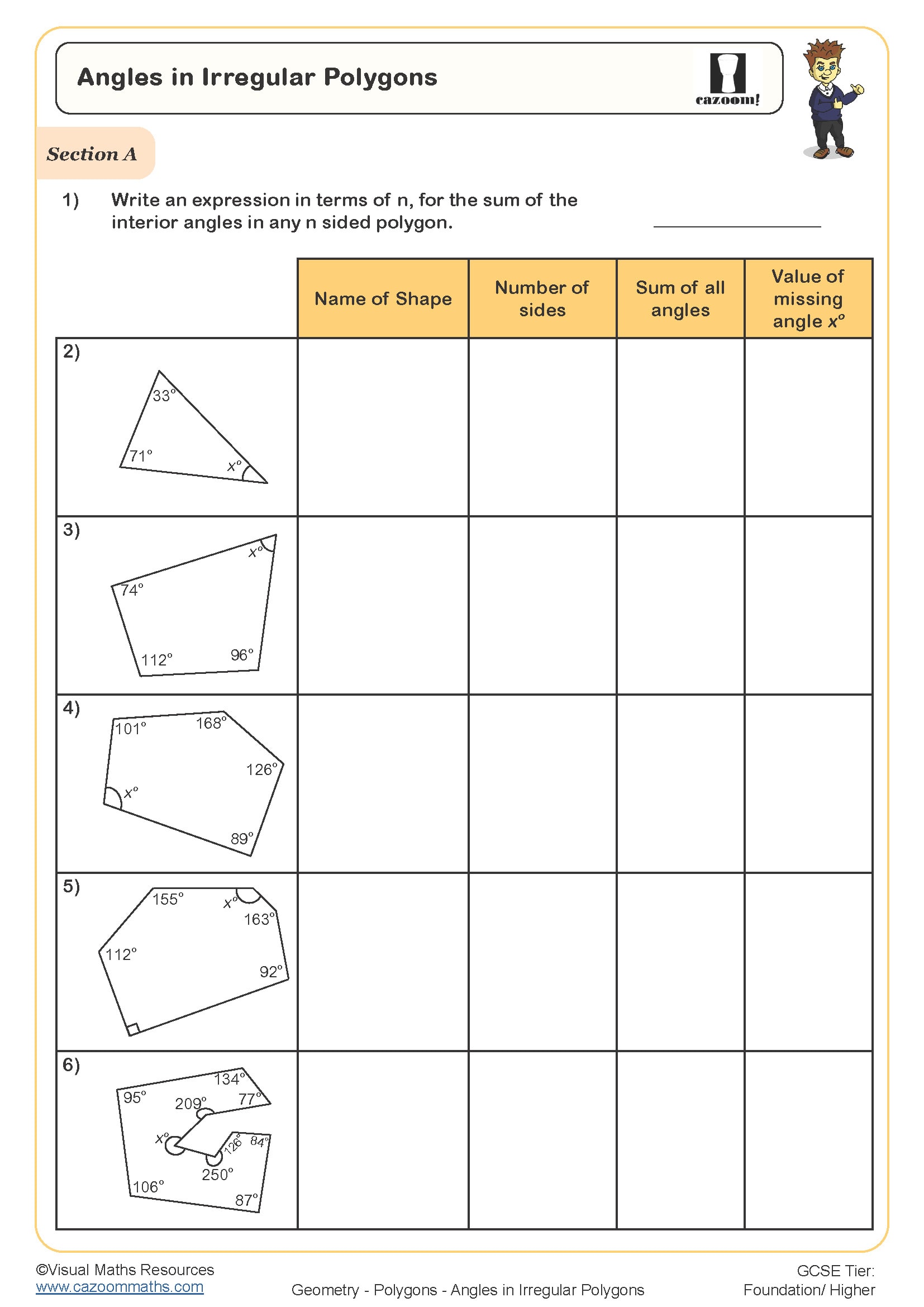
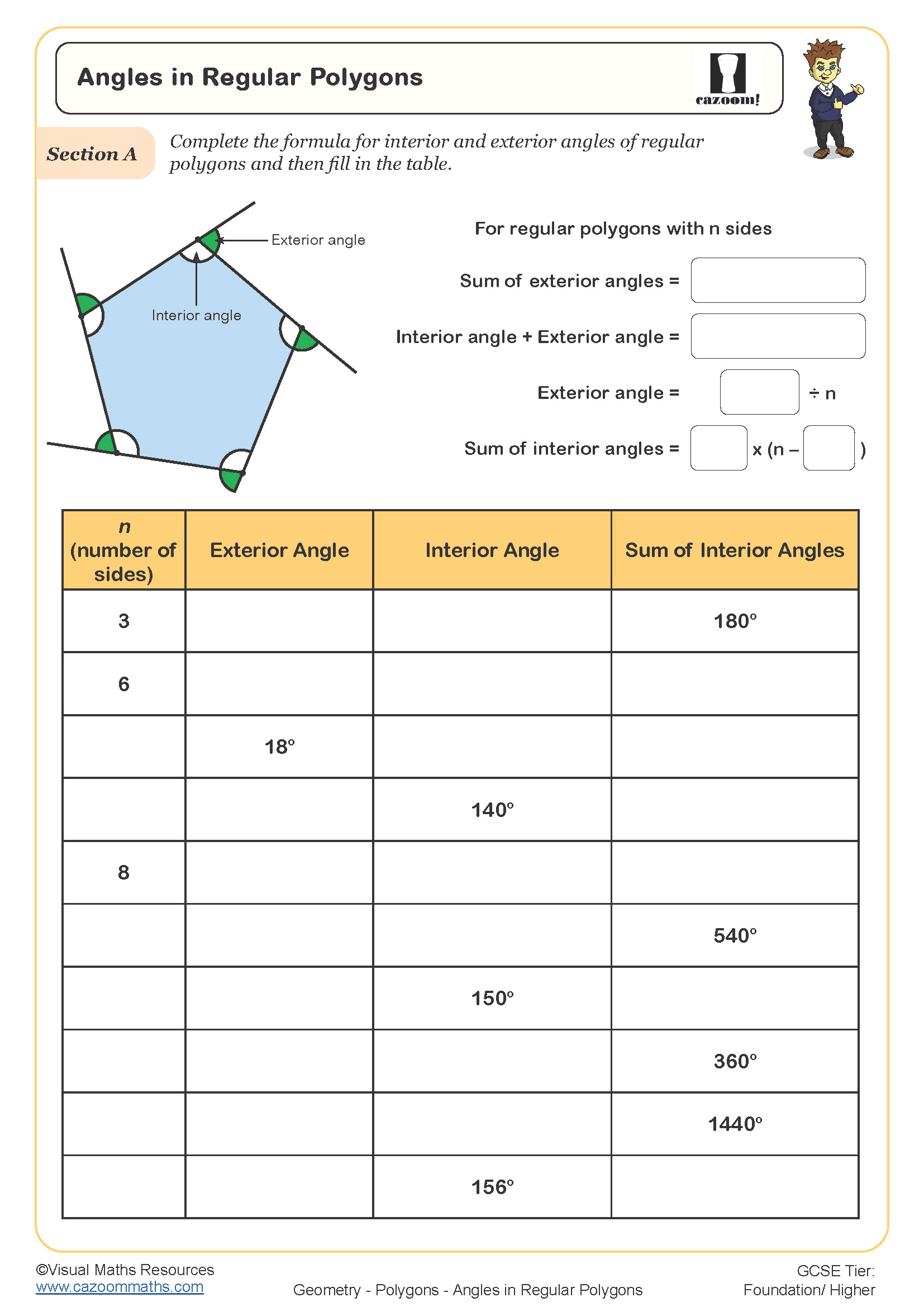
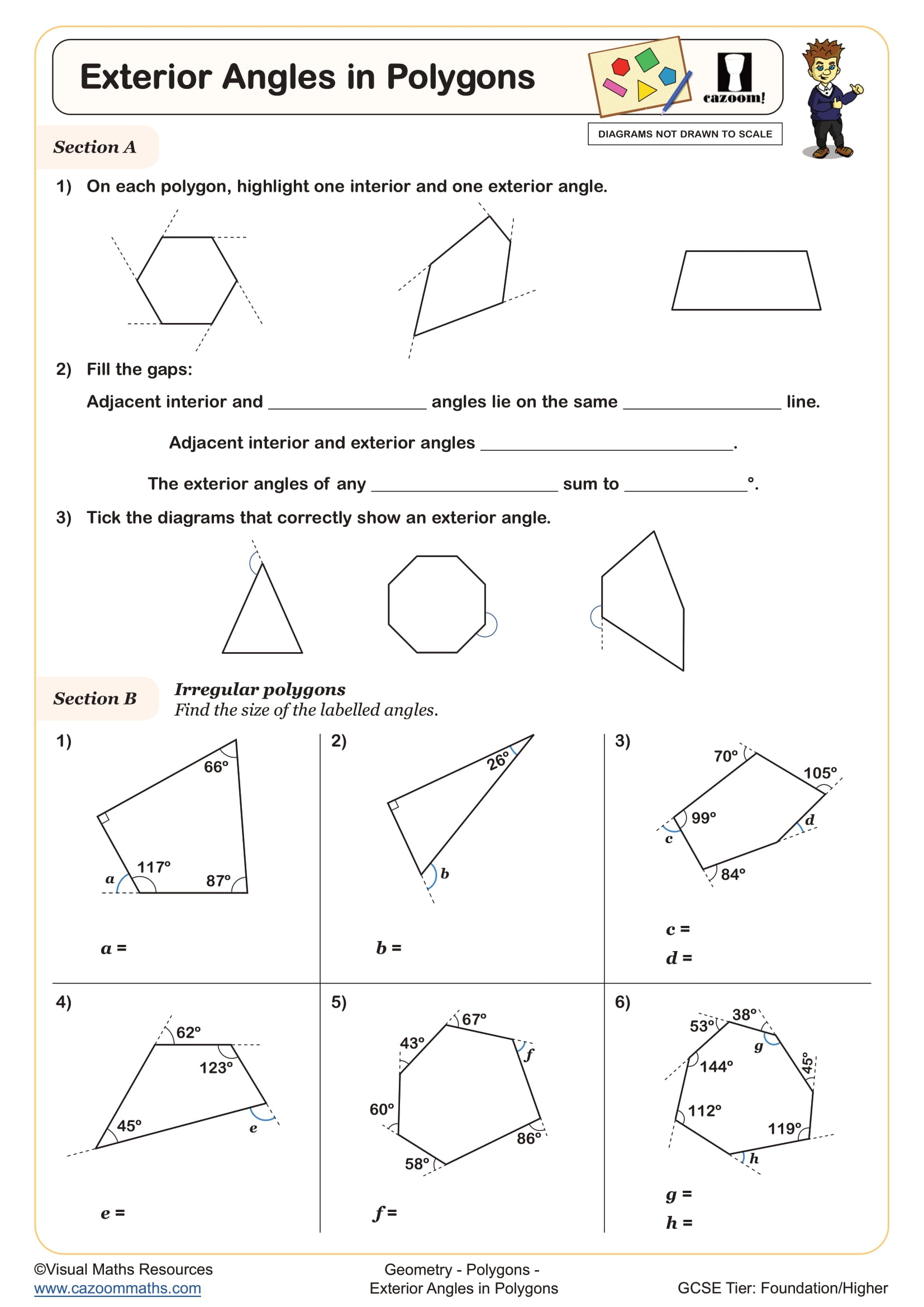
A quality polygons worksheet covers interior angle calculations, exterior angle properties, and the relationship between regular and irregular polygons. Students need practice applying the formula (n-2)×180° for interior angle sums and understanding that exterior angles always total 360° regardless of the polygon type.
Teachers frequently observe that students struggle when polygons are presented in different orientations or when they need to find individual angles in irregular polygons. Starting with regular polygons helps students spot patterns before moving to more complex irregular shapes where they must use given information strategically.
Which year groups use polygon worksheets most effectively?
Year 7 and Year 8 students typically encounter polygons as part of the KS3 geometry curriculum, building on basic angle facts learned in primary school. The National Curriculum expects students to derive and use angle sum properties by the end of Key Stage 3, preparing them for GCSE requirements.
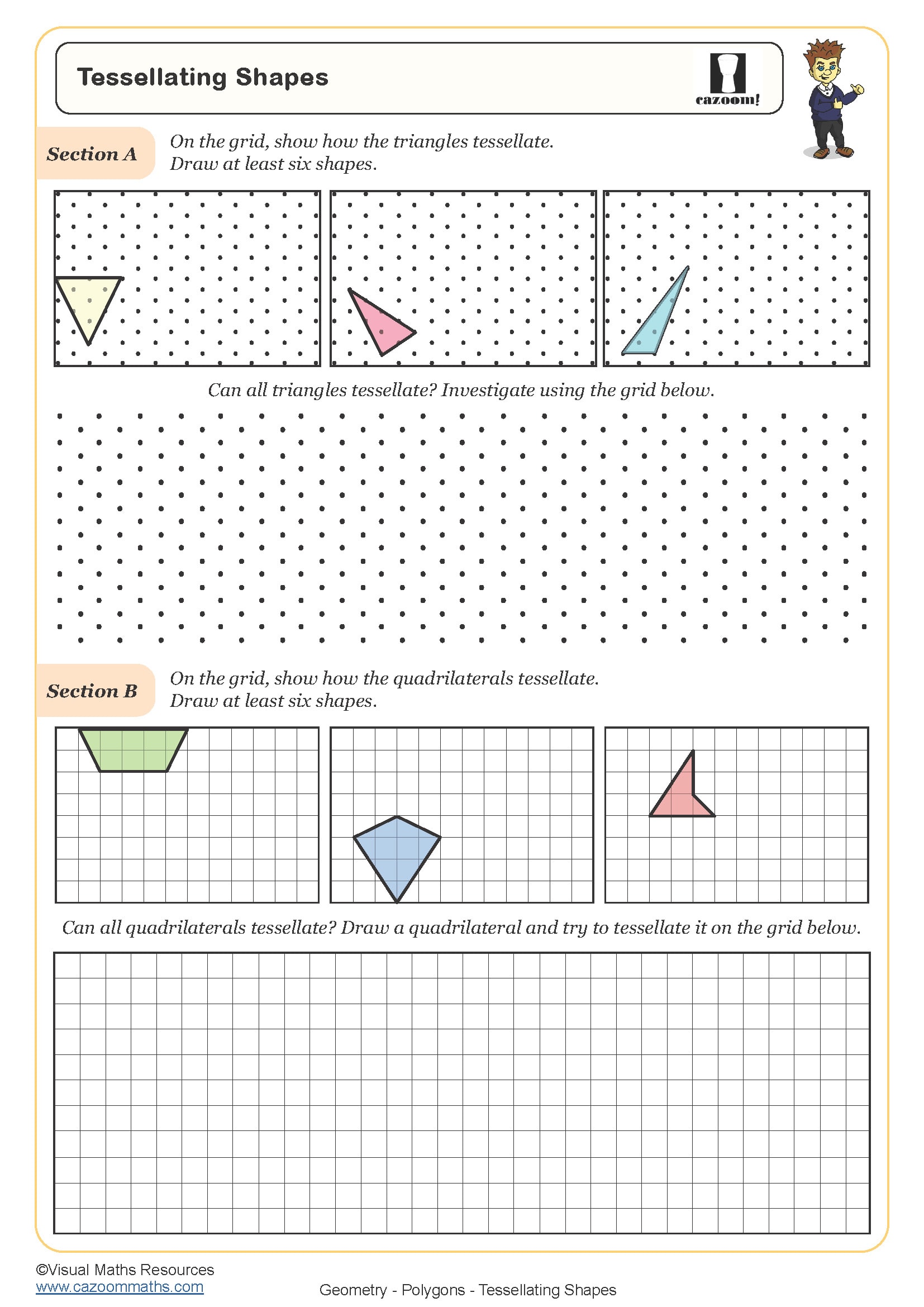
Year 9 students often revisit polygons when tackling more challenging problems involving cyclic quadrilaterals and polygon tessellations. Teachers notice that students who master basic polygon properties in Year 7 show greater confidence with similar shapes and trigonometry topics later in their mathematical journey.
Why do students find exterior angles of polygons challenging?
The concept that exterior angles always sum to 360° regardless of polygon shape often surprises students who expect this total to change. Many students initially confuse exterior angles with interior angles, particularly when polygons are drawn in unusual orientations or when the exterior angle isn't clearly marked.
Classroom experience shows that using physical polygon cut-outs helps students visualise how exterior angles work. Walking around the perimeter of a polygon and turning at each vertex demonstrates why the total turn is always 360°, making this abstract concept more concrete for visual learners.
How can teachers use polygon worksheets for effective differentiation?
Starting with regular polygons allows all students to succeed before progressing to irregular shapes that require algebraic manipulation. Teachers can assign different worksheet sections based on student confidence, with some focusing on basic angle calculations while others tackle multi-step problems involving unknown angles.
Answer sheets enable students to check their working independently, building mathematical confidence. Teachers often use polygon worksheets for homework consolidation after introducing concepts practically, then return to challenging questions as starter activities to maintain skills over time.