Grouped Frequency Tables Worksheets
All worksheets are created by the team of experienced teachers at Cazoom Maths.
What are grouped frequency tables in maths?
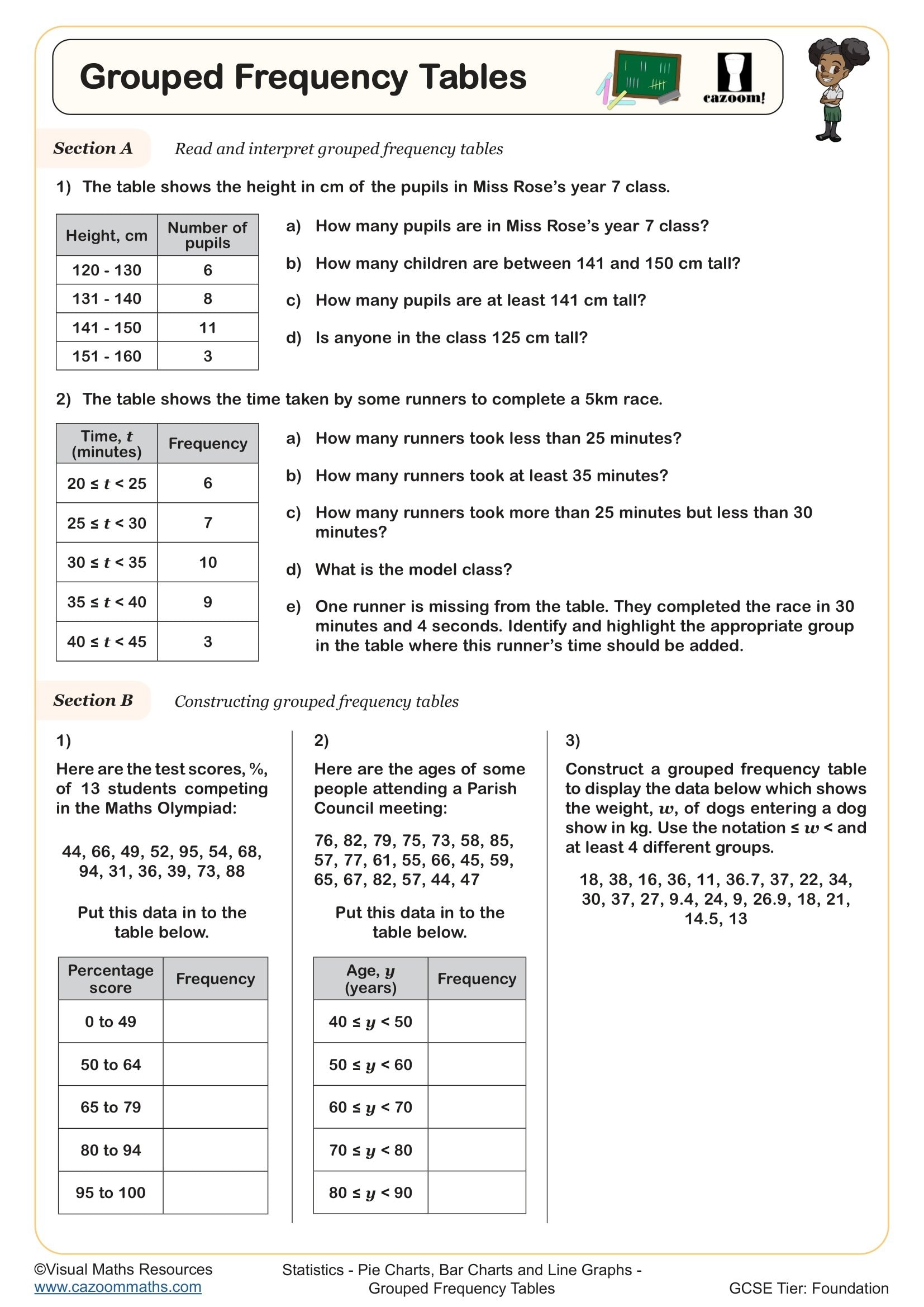
A grouped frequency table organises continuous or discrete data into class intervals with their corresponding frequencies. Instead of listing every individual value, data is categorised into ranges such as 0-10, 11-20, which makes large datasets manageable. This method appears throughout Key Stage 3 statistics and forms the foundation for calculating estimates of mean, median, and identifying modal classes at GCSE.
Students often lose marks by treating class intervals inconsistently, particularly with inequalities. When a class interval reads '10 < h ≤ 20', the value 20 belongs in that class but 10 doesn't. Teachers notice this confusion especially when students move between contexts where boundaries are written differently, such as '10-19' versus continuous intervals. Exam questions regularly test whether students can correctly place boundary values.
Which year groups study grouped frequency tables?
Grouped frequency tables appear in the Key Stage 3 curriculum, with these worksheets suitable for Year 7 and Year 8 students. At Year 7, students typically begin by constructing simple grouped frequency tables from given data and understanding why grouping helps when dealing with large datasets. The National Curriculum expects students to interpret and construct frequency tables as part of statistical problem-solving.
By Year 8, the difficulty increases as students work with more complex class intervals, including those involving decimals or awkward boundaries. They progress from simply recording data to using grouped frequency tables as a tool for calculating estimated means and comparing distributions. This groundwork becomes essential for GCSE Foundation and Higher tier statistics, where grouped data forms the basis for cumulative frequency graphs and box plots.
How do you calculate the midpoint of a class interval?
The midpoint is calculated by adding the lower and upper boundaries of a class interval and dividing by two. For the interval 20 < h ≤ 30, the midpoint is (20 + 30) ÷ 2 = 25. Midpoints become crucial when estimating the mean from grouped data, as they represent the assumed average value for all data points within that interval. Students must understand that these are estimates since the original individual values are unknown once grouped.
Midpoints have practical applications in manufacturing quality control and scientific measurements. When engineers test batches of components for diameter measurements or chemists record reaction temperatures, they group results into intervals and use midpoints to estimate average values without processing thousands of individual readings. This approach saves time while maintaining statistical accuracy, demonstrating why industries rely on grouped data analysis when handling large-scale measurements or survey responses.
How should teachers use grouped frequency table worksheets?
The worksheets provide structured practise in constructing and interpreting grouped frequency tables, with questions that build from basic table completion to more demanding analysis tasks. Teachers can use them to check whether students correctly determine class intervals, tally data accurately, and understand the purpose of grouping. The included answer sheets allow students to self-assess during independent work or enable teaching assistants to support intervention groups effectively.
Many teachers find these worksheets useful for differentiated homework, where different students complete sections appropriate to their confidence level. They work well as starter activities to refresh prior learning before introducing cumulative frequency or as consolidation after teaching estimated mean calculations. The worksheets also suit paired work, where one student constructs a grouped frequency table from raw data while their partner verifies the tallying, building collaborative checking habits that reduce careless errors in assessments.