Multiple Event Probability Worksheets
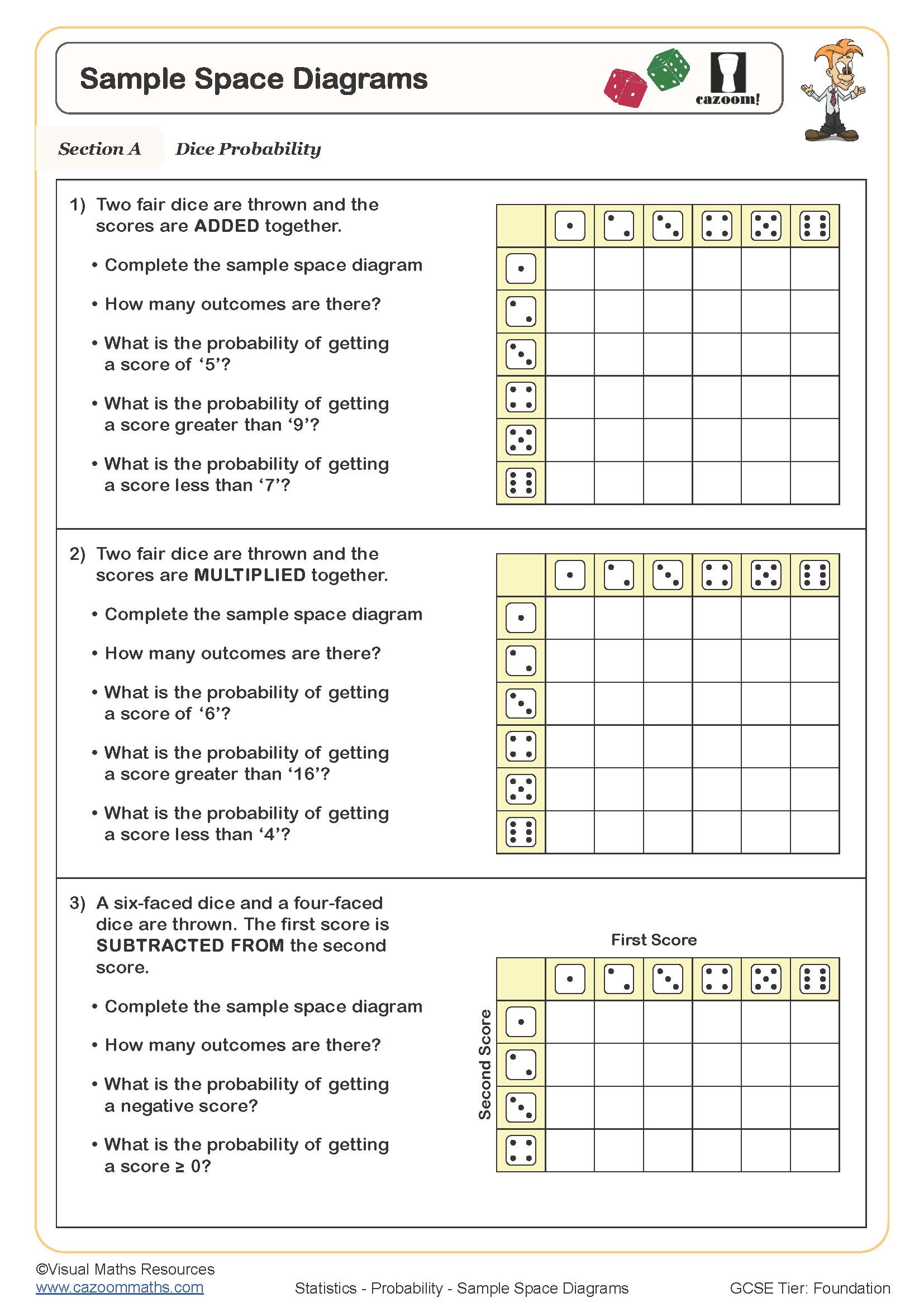
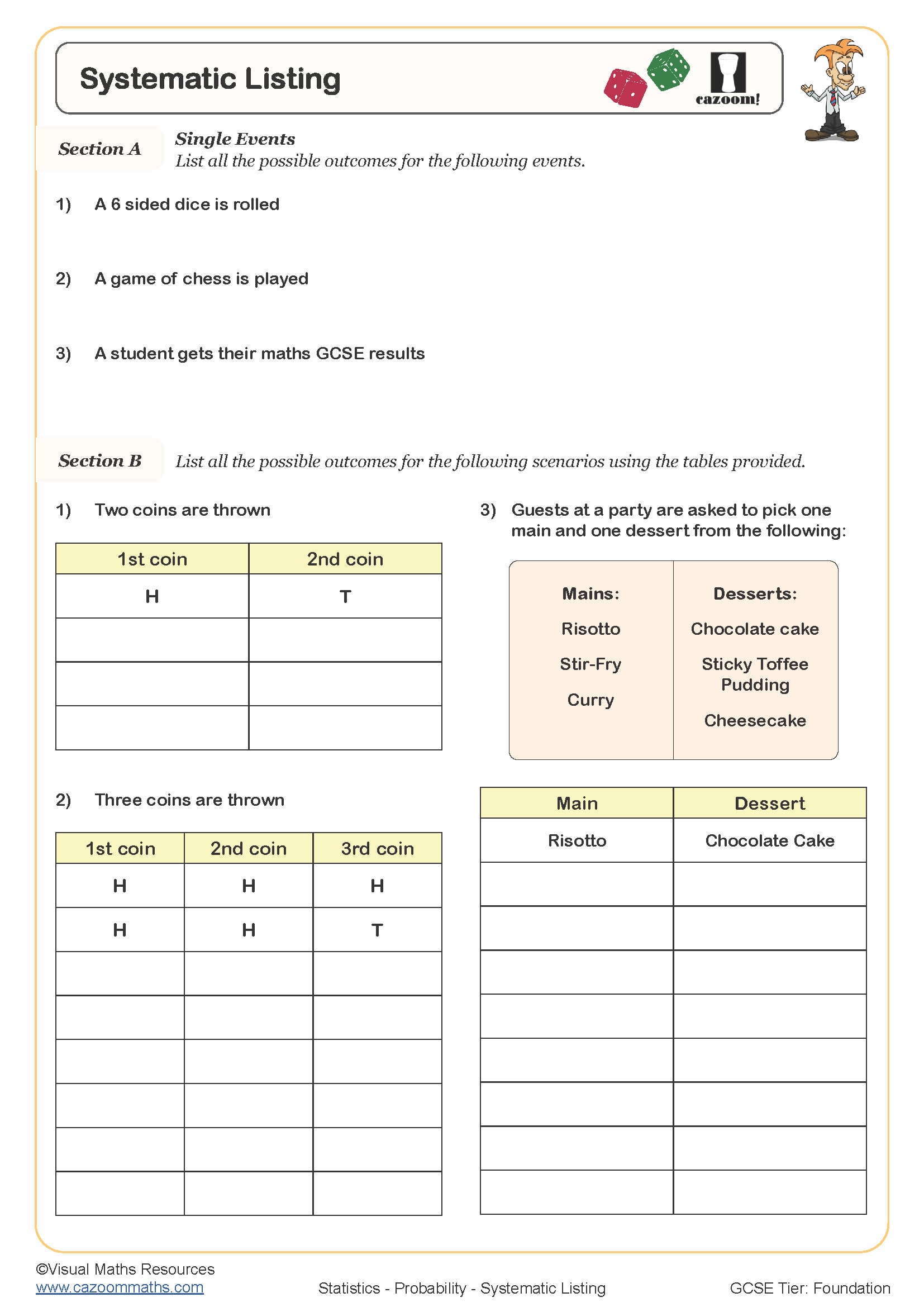
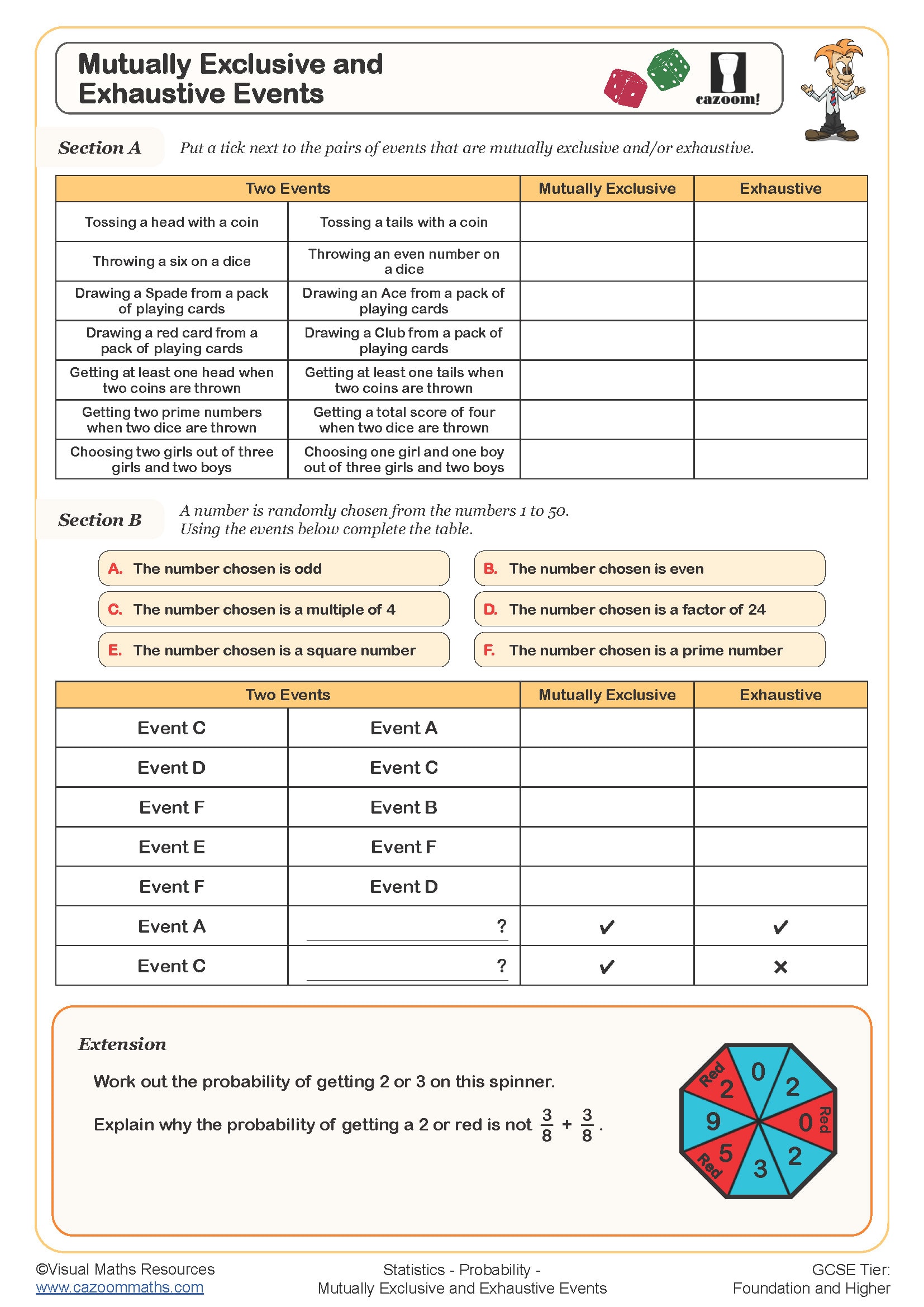
All worksheets are created by the team of experienced teachers at Cazoom Maths.
What is multiple event probability and why do students find it challenging?
Multiple event probability involves calculating the likelihood of two or more events occurring, either in sequence or simultaneously. Students must determine whether events are independent (one doesn't affect the other, like two separate coin tosses) or dependent (the first event changes the second, like drawing cards without replacement). The National Curriculum introduces this at upper KS3, with progression through to GCSE Foundation and Higher tiers.
The main difficulty arises when students treat all combined events as simple addition problems rather than recognising when to multiply probabilities. Teachers often observe students adding fractions along tree diagram branches instead of multiplying, or failing to adjust the denominator when items aren't replaced. Another common error occurs with 'at least one' questions, where students attempt to list all favourable outcomes rather than using the complement rule (1 minus the probability of none).
Which year groups study multiple event probability?
These worksheets cover Year 8, Year 9, Year 10, and Year 11, spanning both Key Stage 3 and Key Stage 4. At KS3, students begin with independent events using tree diagrams and simple probability calculations, building the foundations for more complex scenarios. By Year 9, most students work confidently with two-stage events and can distinguish between replacement and non-replacement contexts.
Progression through KS4 introduces conditional probability and more sophisticated problem-solving. Year 10 and Year 11 students encounter examination-style questions involving three or more events, Venn diagrams combined with tree diagrams, and contexts requiring interpretation before calculation. Higher tier GCSE students also work with algebraic probability, where outcomes are expressed as unknowns. The difficulty increases not just in calculation complexity but in the reasoning required to select appropriate methods.
How do tree diagrams help students organise probability calculations?
Tree diagrams provide a visual structure that shows all possible outcomes when events occur in sequence. Students draw branches for each outcome at each stage, labelling each branch with its probability and multiplying along paths to find the probability of specific combinations. This method particularly helps when dealing with dependent events, as students can clearly see where probabilities change on second or third branches based on what's already occurred.
This organisational skill has direct applications in risk assessment and decision-making across STEM fields. Epidemiologists use tree diagrams to model disease transmission probabilities when multiple factors affect spread rates. Quality control engineers apply the same principles when calculating the likelihood of multiple component failures in manufacturing systems. Understanding how sequential events compound or diminish overall probability helps students appreciate why backup systems exist in aircraft design or why medical tests often require confirmation from a second method before diagnosis.
How do these worksheets build confidence with combined probability?
The worksheets scaffold learning by starting with clearly labelled scenarios before progressing to problems requiring students to identify event types themselves. Early questions often provide partially completed tree diagrams or tables, allowing students to focus on calculation methods before managing the organisational aspects. Later questions remove this support, expecting students to choose whether a tree diagram, two-way table, or direct calculation suits the problem best.
Many teachers use these worksheets for targeted intervention with students who struggle to translate worded problems into probability structures. The answer sheets prove particularly valuable for homework, as students can identify exactly which branch of a calculation went wrong rather than just marking an answer incorrect. They also work well for paired work, where one student constructs the diagram whilst another checks probabilities sum to 1 at each stage. For GCSE revision, the collection provides focused practice on the 3-5 mark probability questions that appear consistently in Paper 2 and Paper 3.