Reading and Interpreting Bar Charts Worksheets
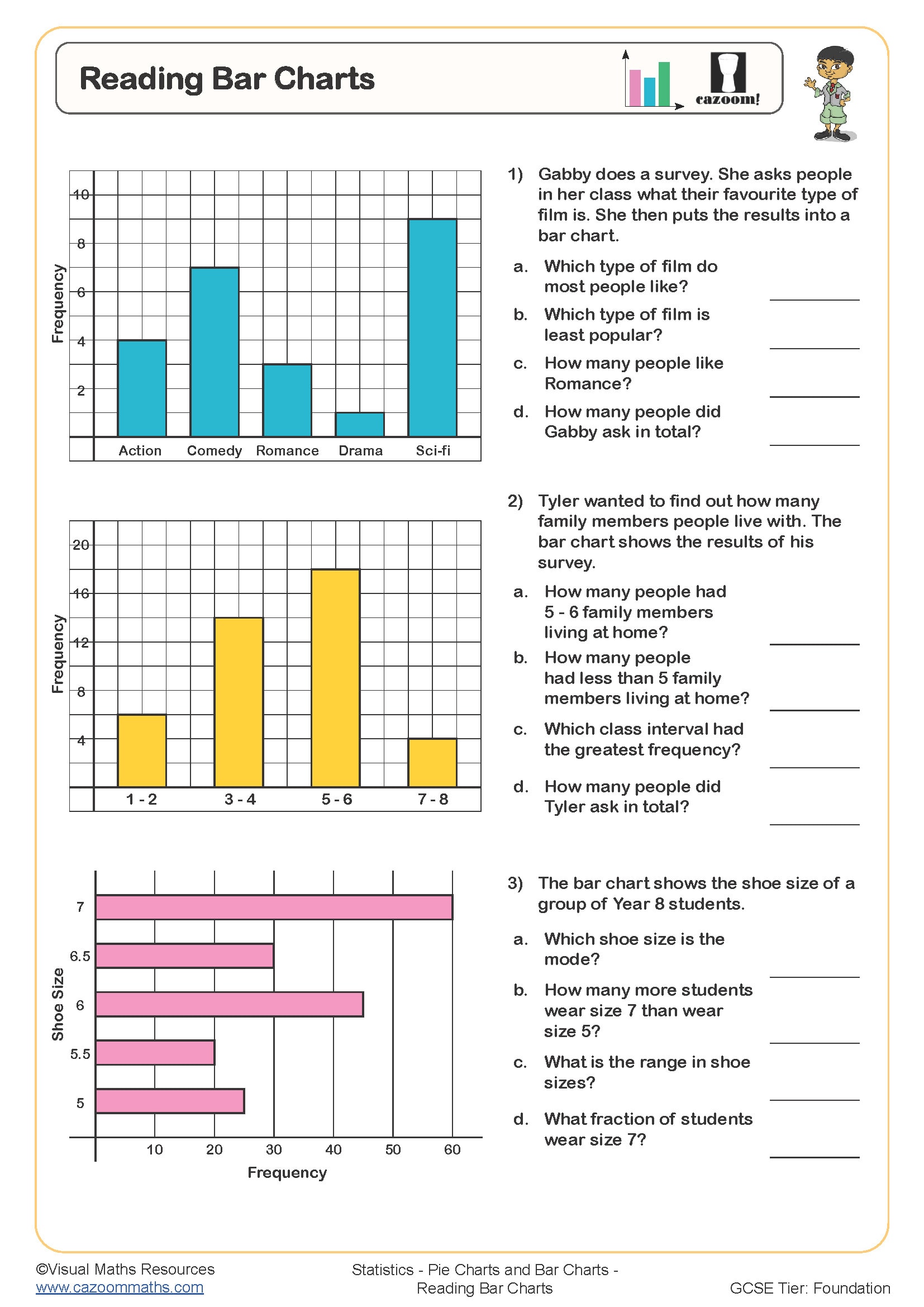
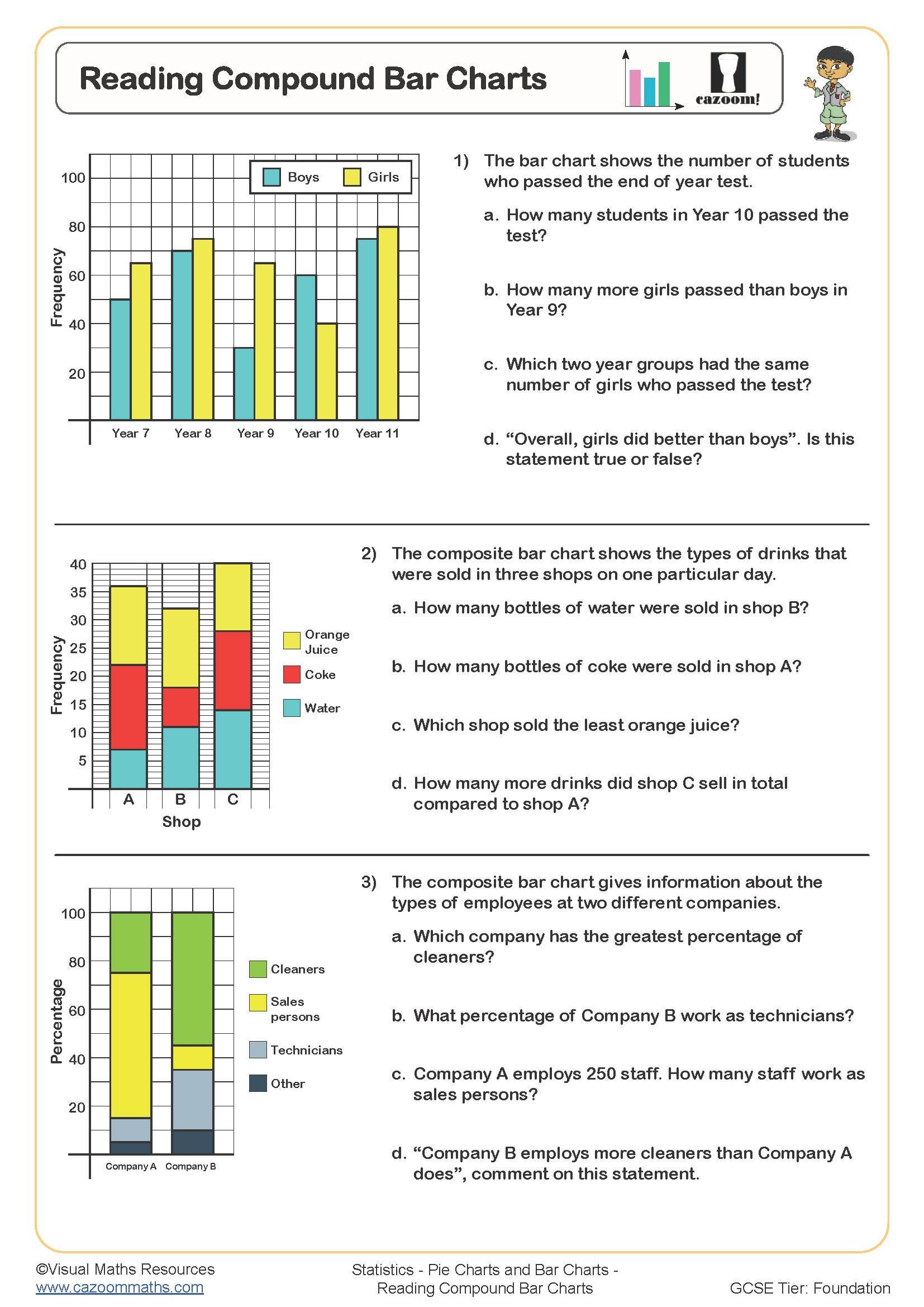
All worksheets are created by the team of experienced teachers at Cazoom Maths.
What should students be able to do when reading bar charts?
Students working with reading and interpreting bar charts should accurately read values from both vertical and horizontal formats, identify maximum and minimum values, and use the data to answer comparison questions. At KS3, the National Curriculum expects students to construct and interpret appropriate tables, charts and diagrams, including frequency tables and bar charts, and to use these to understand and communicate information.
A common error occurs when bar charts use scales in multiples of 2, 5, or 10 where the bar height falls between grid lines. Students often round to the nearest line rather than estimating the precise position. Exam mark schemes expect students to read intermediate values accurately, and marks are lost when students write 23 instead of 25 because they've miscounted or misread the scale intervals.
Which year groups cover reading and interpreting bar charts?
These worksheets target Year 7 and Year 8 students working within KS3 statistics. At this stage, students build on primary understanding of simple bar charts by working with more complex scales, dual bar charts for comparison, and data sets requiring multi-step reasoning. The National Curriculum expects students to interpret and construct charts with increasing sophistication during these years.
Progression across Year 7 and Year 8 involves moving from straightforward value reading to questions requiring calculations based on chart data. Year 7 typically focuses on reading single values and making direct comparisons, whilst Year 8 introduces finding totals across categories, calculating differences, and working with charts where scale intervals require more careful interpretation. This builds foundations for GCSE-level statistical representations.
How do you interpret data from bar charts accurately?
Interpreting bar charts requires systematic reading of each chart element. Students must first identify what the axes represent by reading labels carefully, then establish the scale by checking the value of each grid line or interval. Reading individual bars involves tracing horizontally or vertically to the axis and either reading directly from a marked value or calculating based on position between scale marks.
Bar chart interpretation connects directly to careers in data science, market research, and business analysis where visual data representation is standard practice. NHS trusts use bar charts to track patient waiting times across departments, enabling managers to identify where resources are needed. Understanding how to read these charts accurately means students can question statistics presented in news media, recognising when scales are manipulated to exaggerate differences or when important context is omitted from axis labels.
How can these worksheets help students practise reading bar charts?
The worksheets provide structured practise with varied contexts that require students to apply chart-reading skills systematically. Questions progress from direct value reading to multi-step problems where students must extract several pieces of information and perform calculations. This scaffolding helps students develop confidence with the full range of skills expected at KS3 level, whilst answer sheets allow immediate checking of understanding.
Teachers typically use these worksheets during statistics units as consolidation after introducing bar chart concepts, or as retrieval practise later in the year to maintain skills. They work effectively for intervention with students who rush through chart questions without reading scales properly, as the repetition helps establish careful checking habits. For homework, the answer sheets enable students to self-assess and identify specific areas where they need additional support before the next lesson.