Surds Worksheets
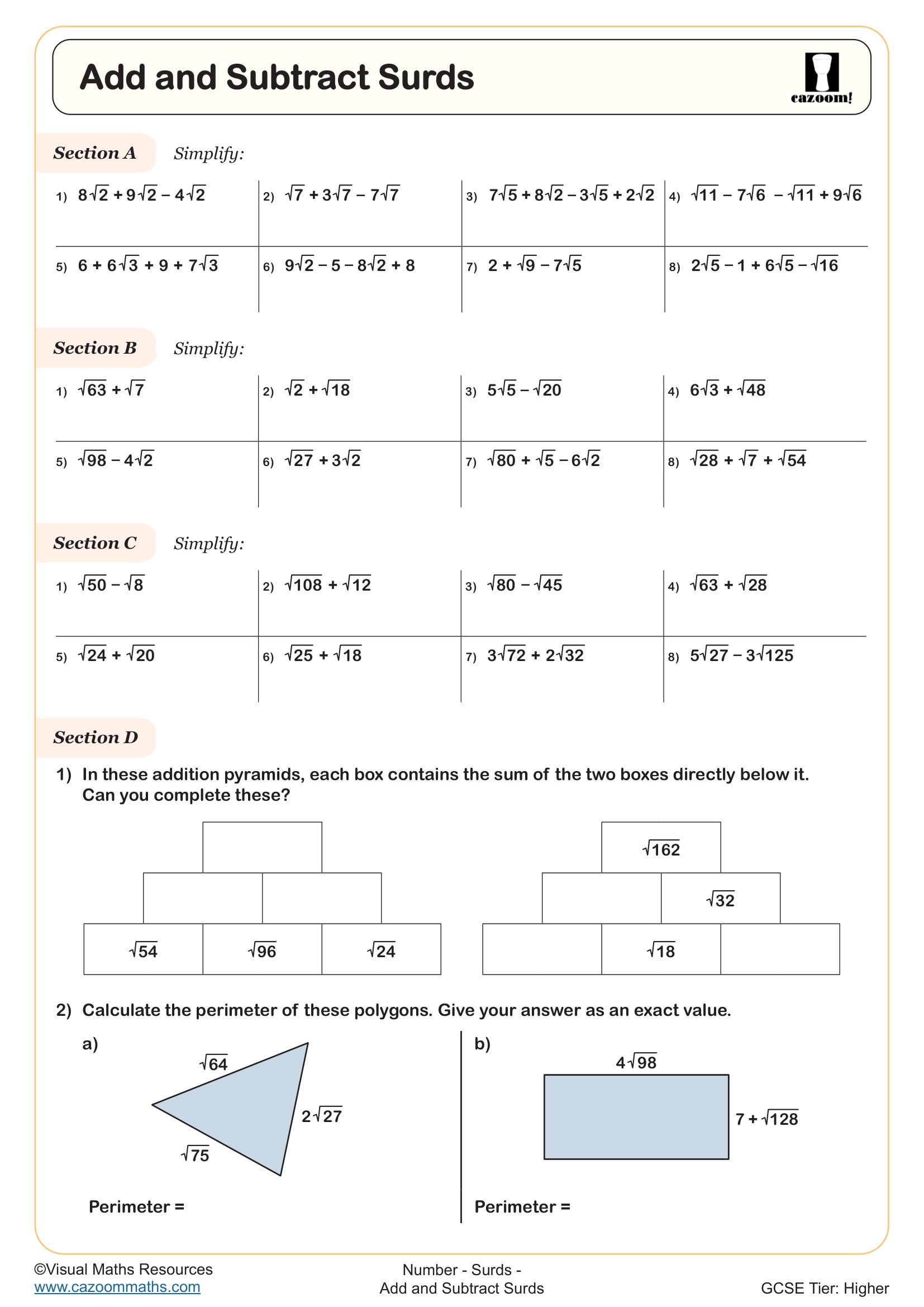
Add and Subtract Surds
Year groups: 10, 11
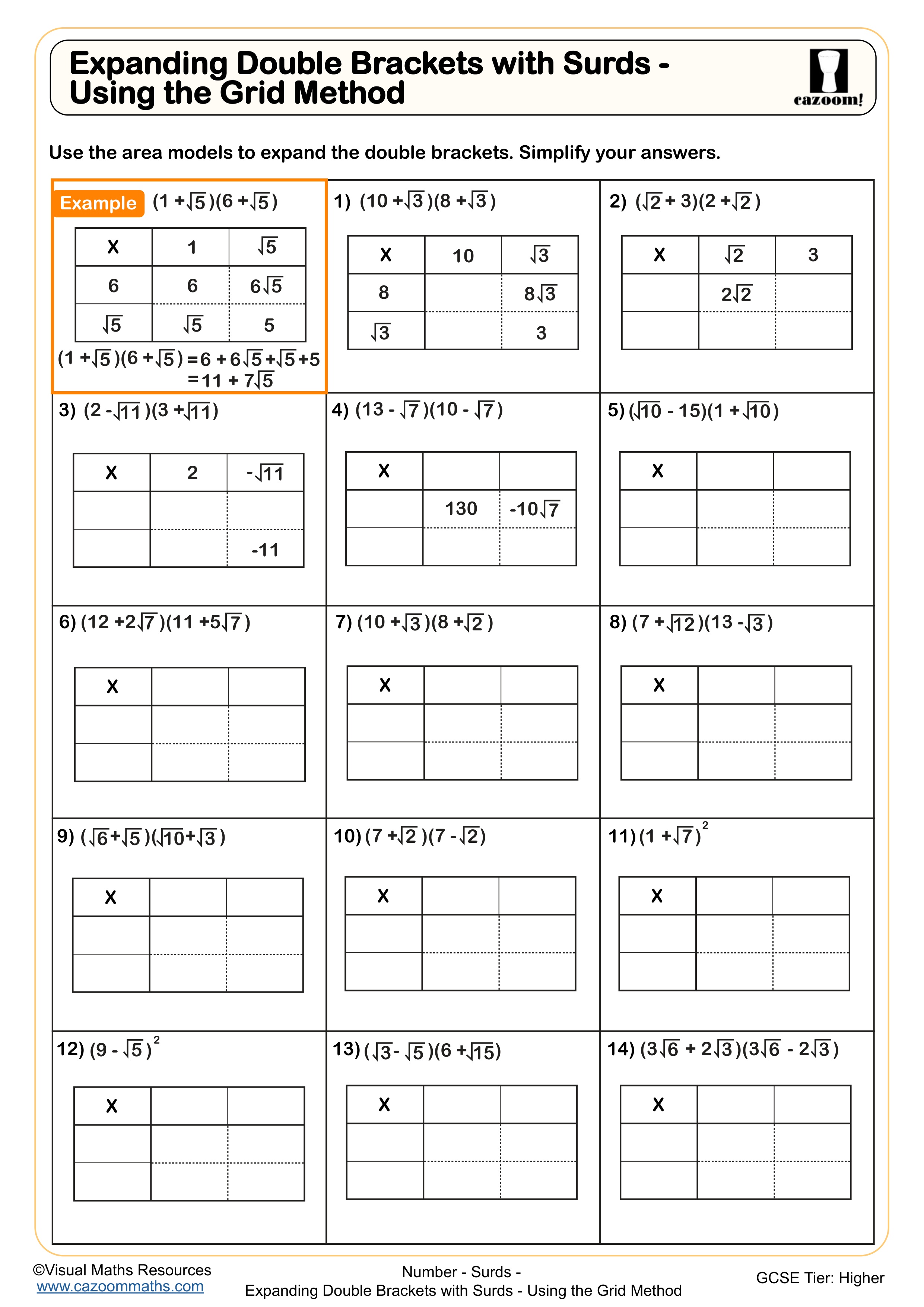
Expanding Double Brackets with Surds - Using the Grid Method
Year groups: 10, 11
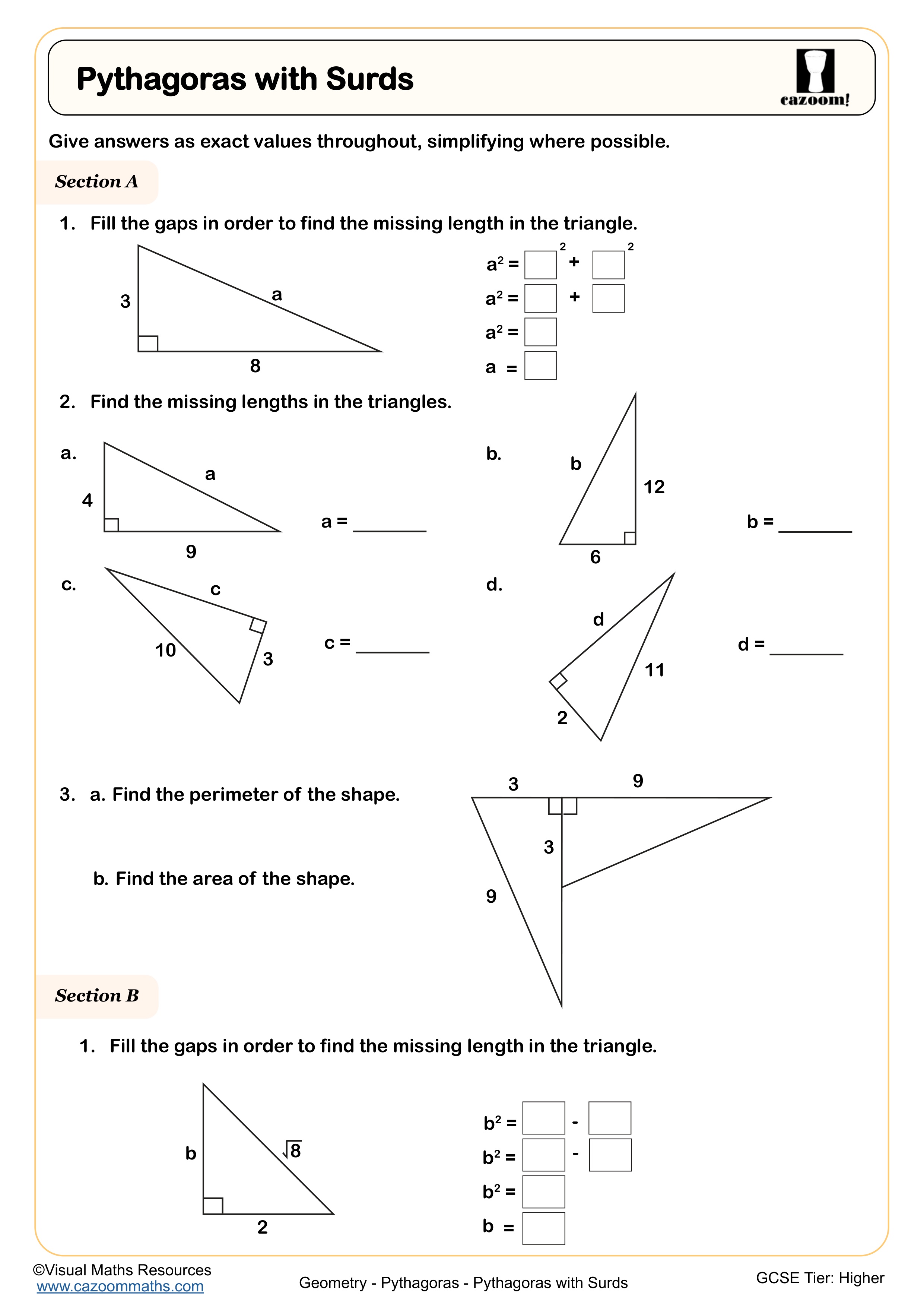
Pythagoras with Surds
Year groups: 10, 11
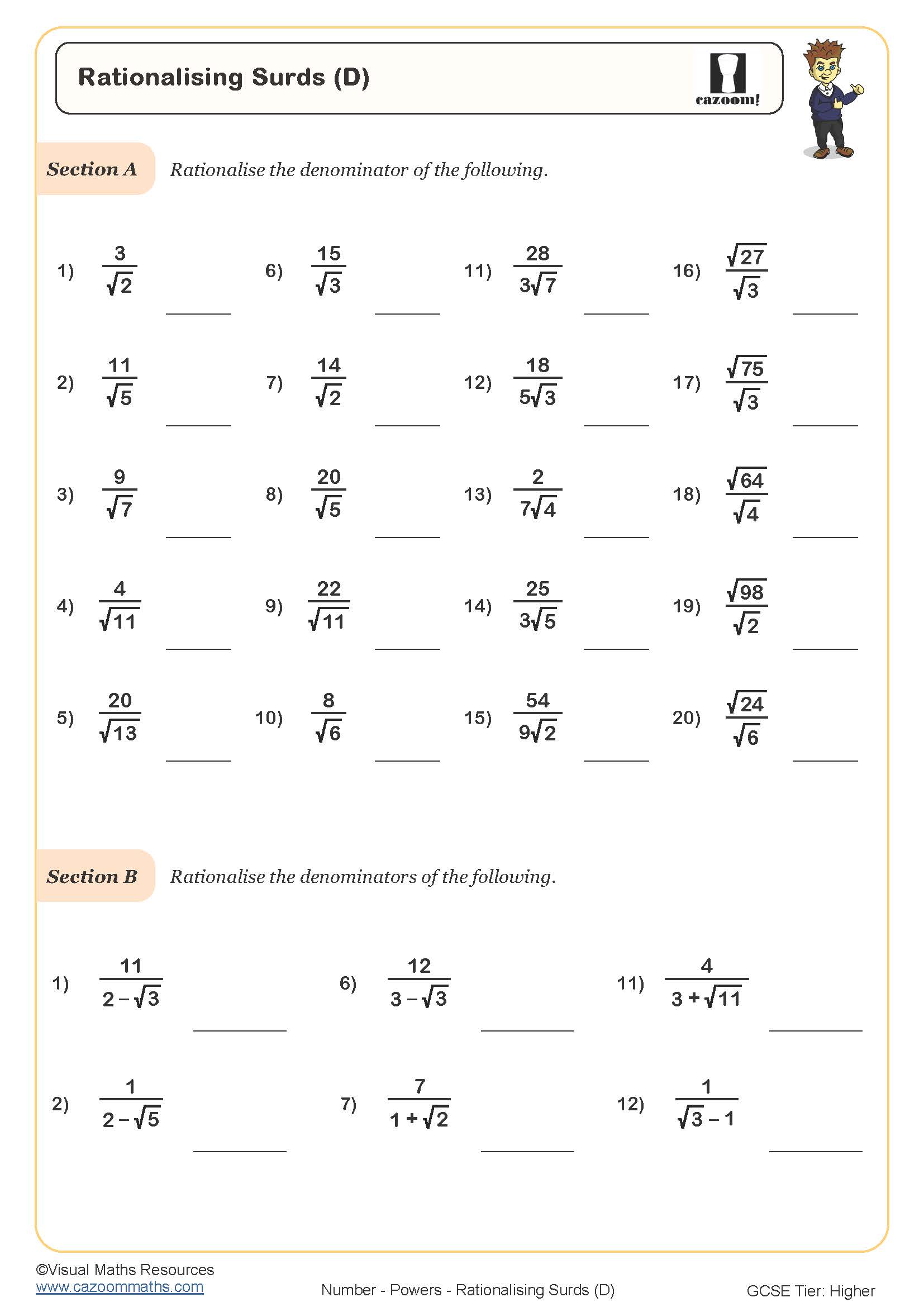
Rationalising Surds (D)
Year groups: 10, 11
Rationalising the Denominator - First Steps
Year groups: 10, 11
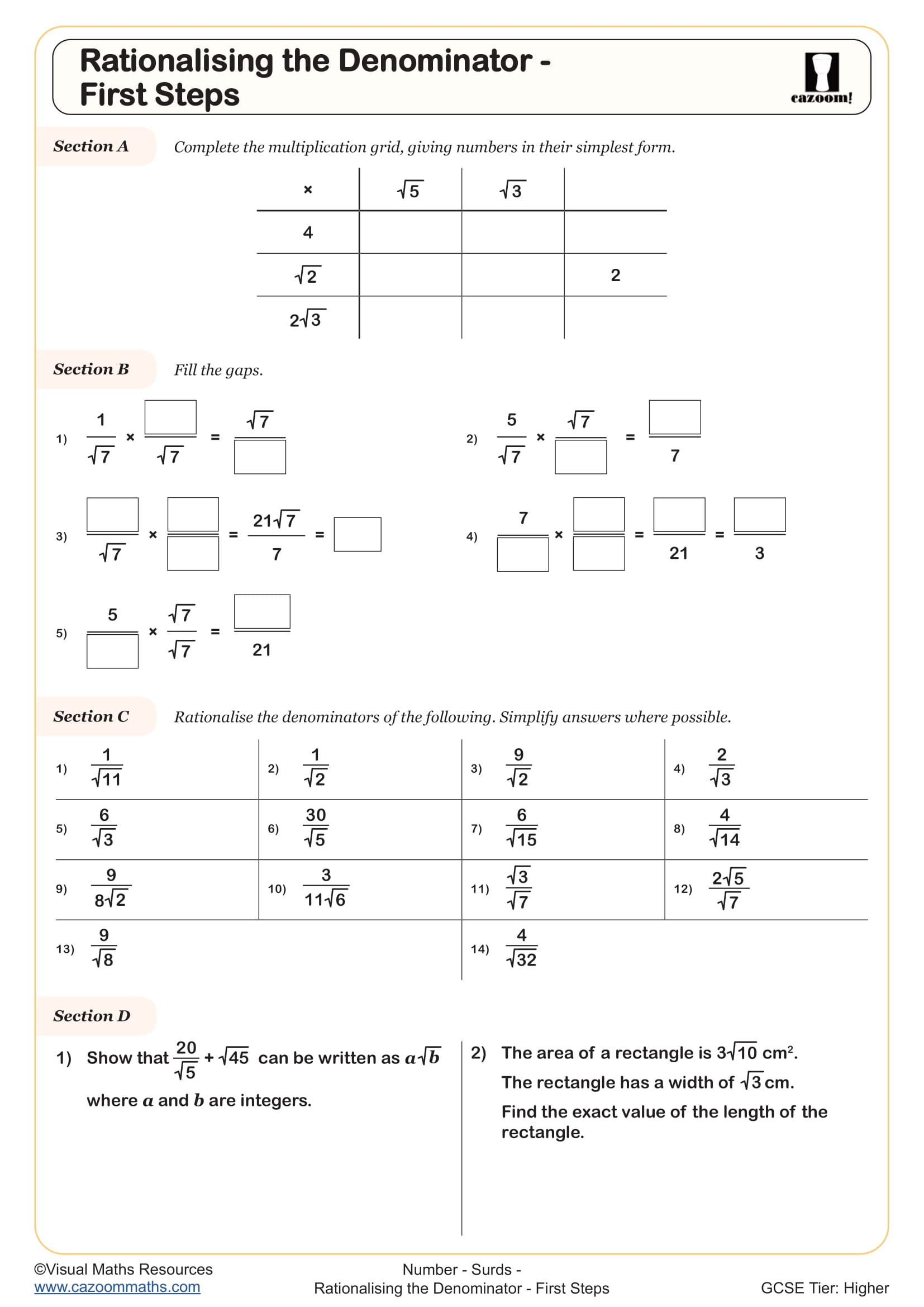
Rationalising the Denominator - with Binomial Denominators
Year groups: 10, 11
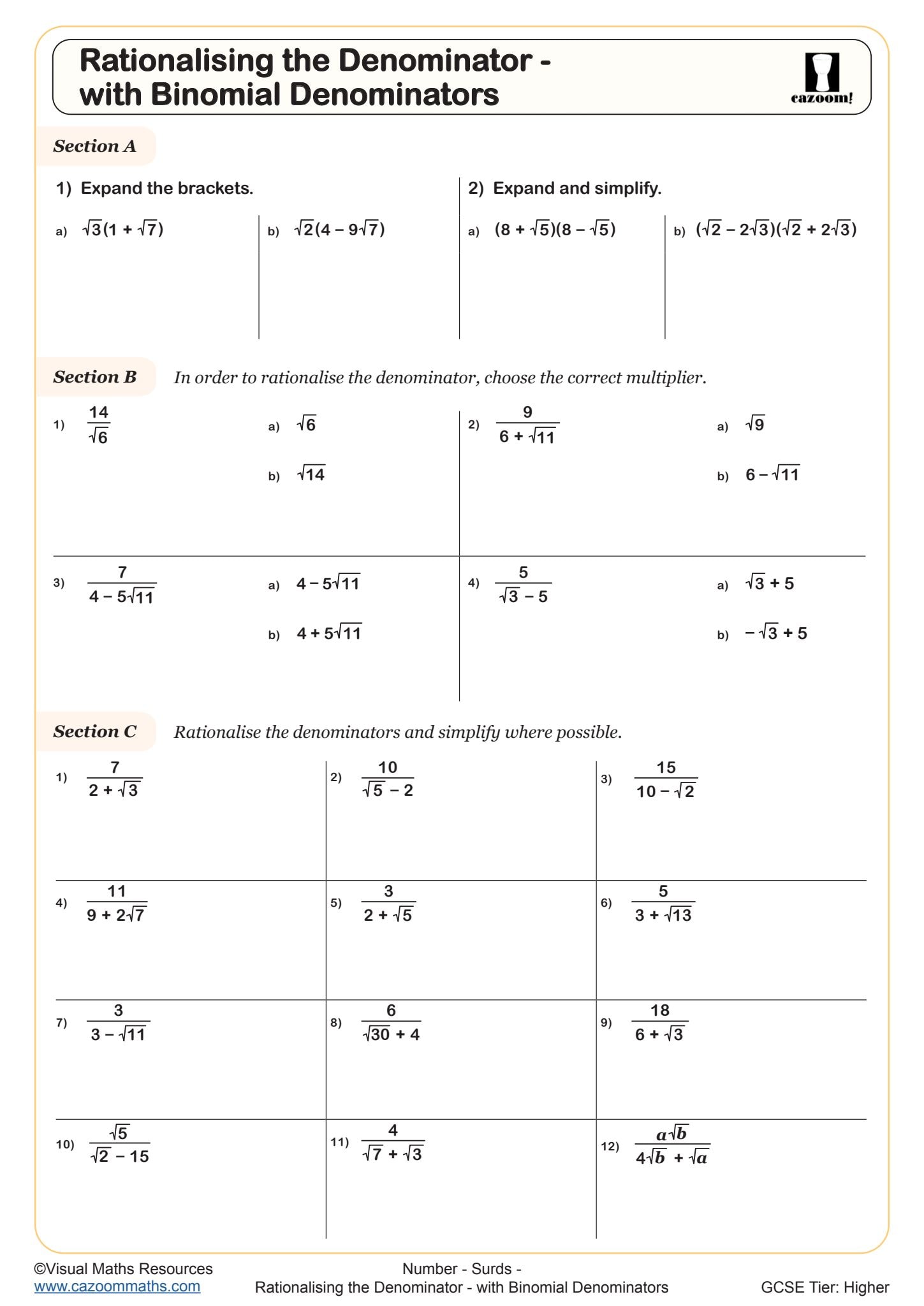
Rationalising the Denominator - with Binomial Numerators
Year groups: 10, 11
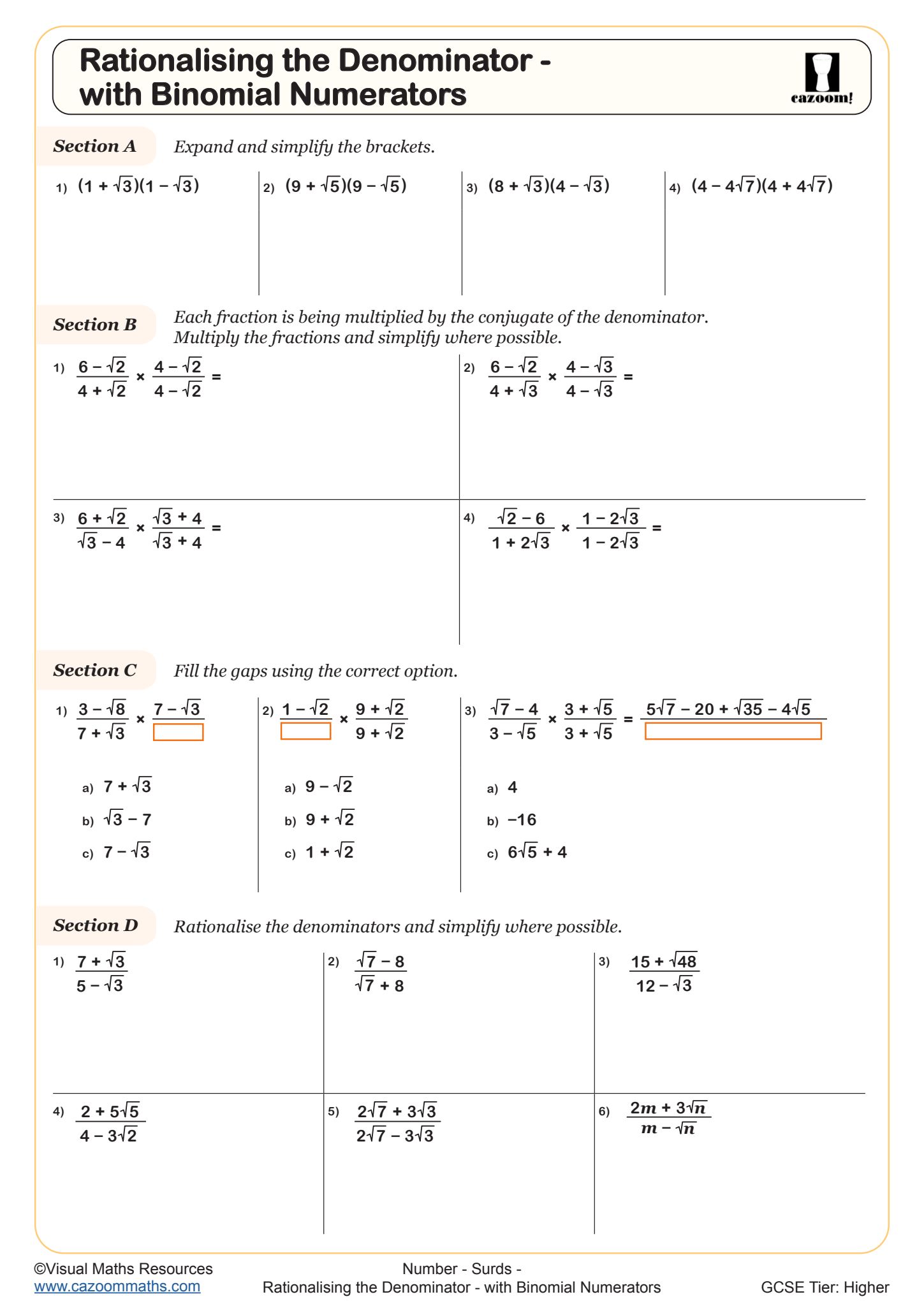
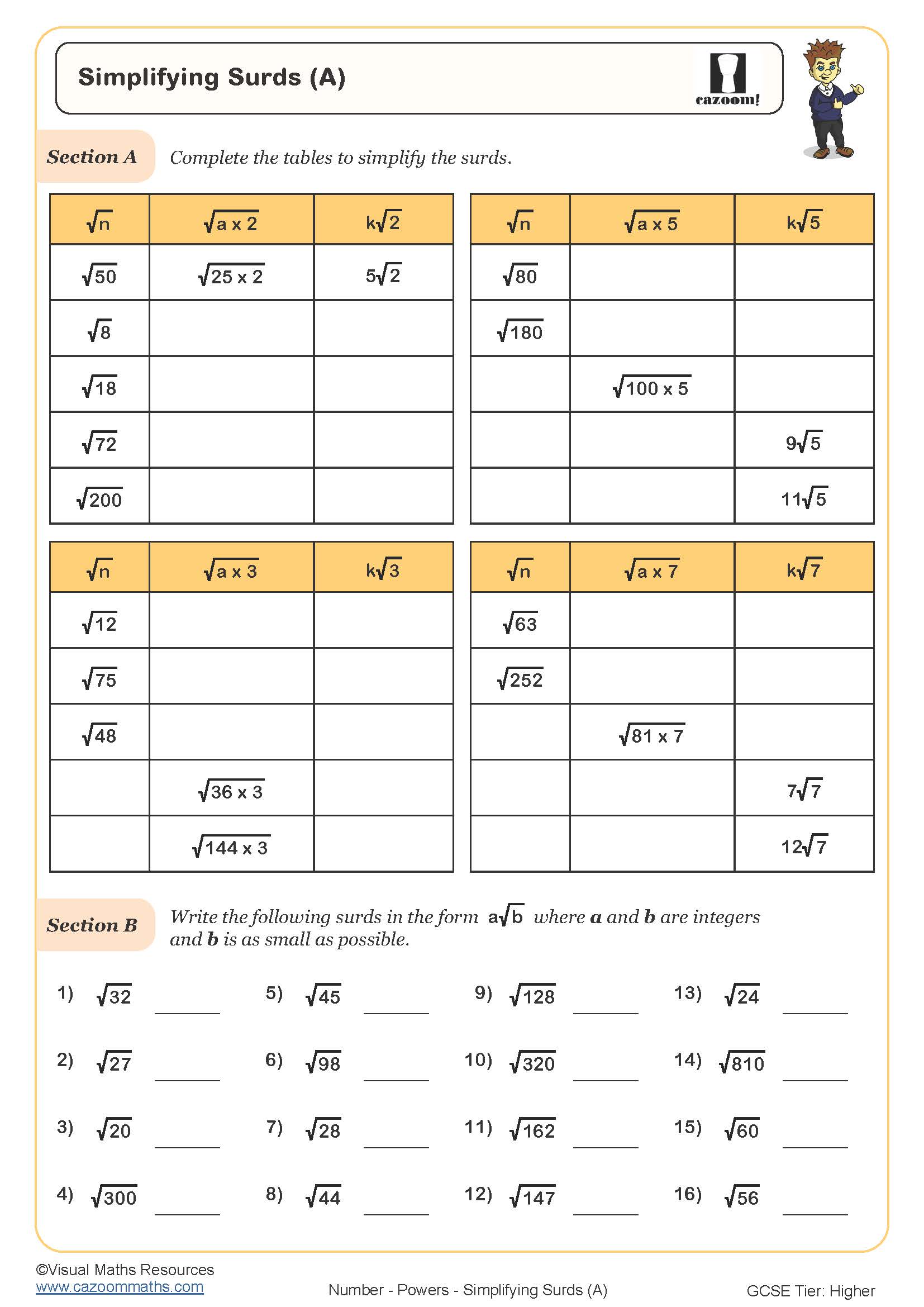
Simplifying Surds (A)
Year groups: 10, 11
Simplifying Surds (B)
Year groups: 10, 11
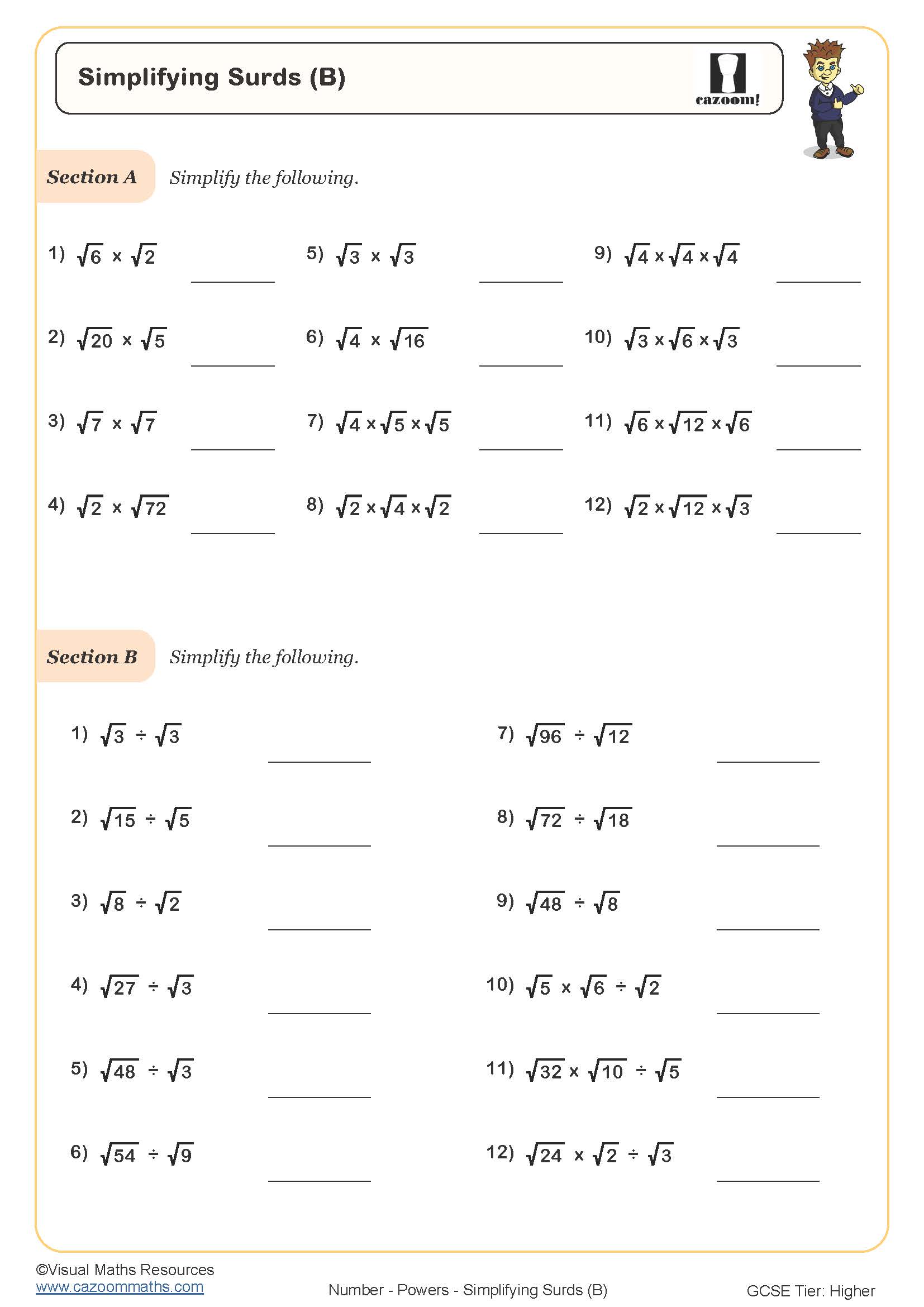
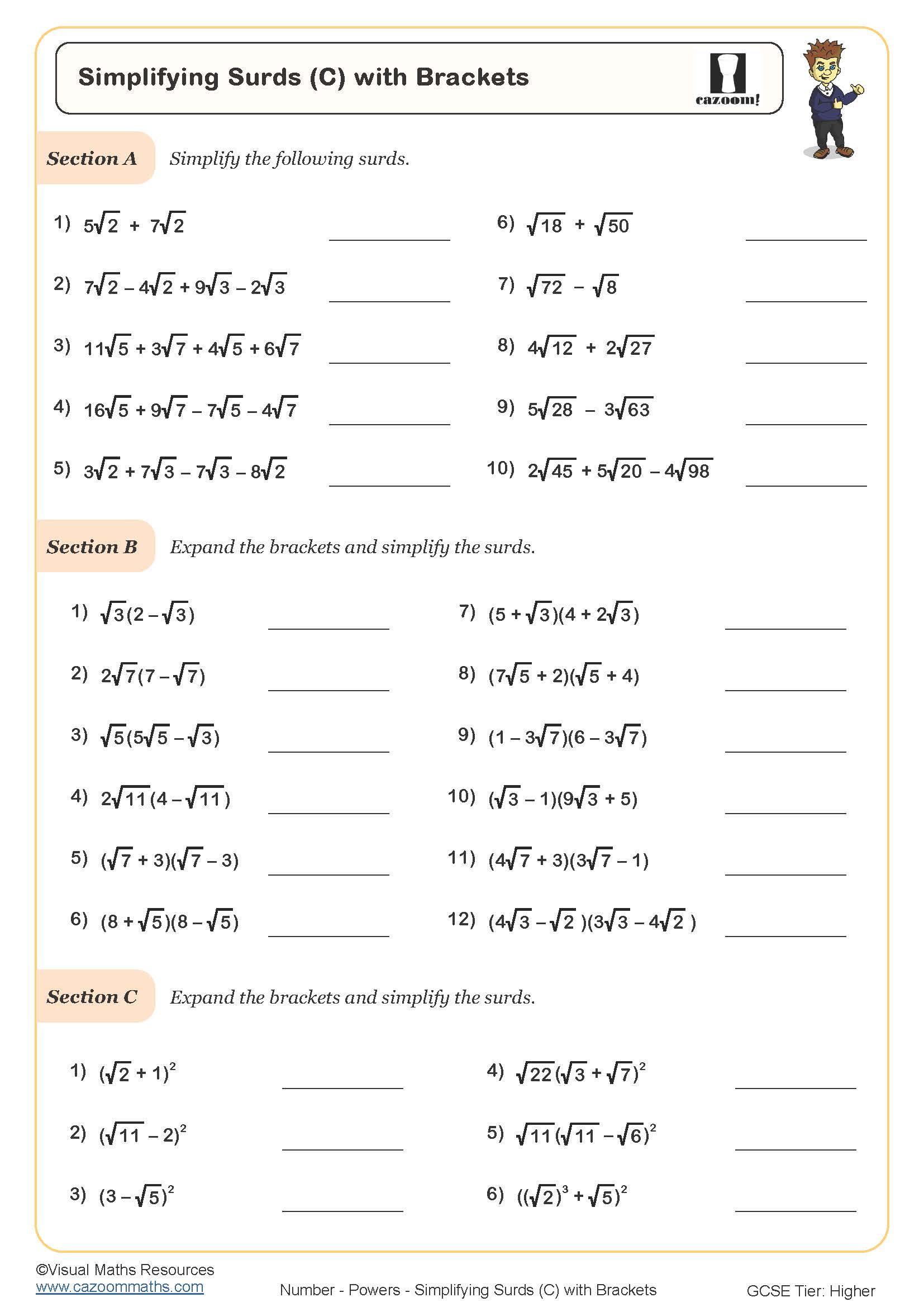
Simplifying Surds with Brackets (C)
Year groups: 10, 11
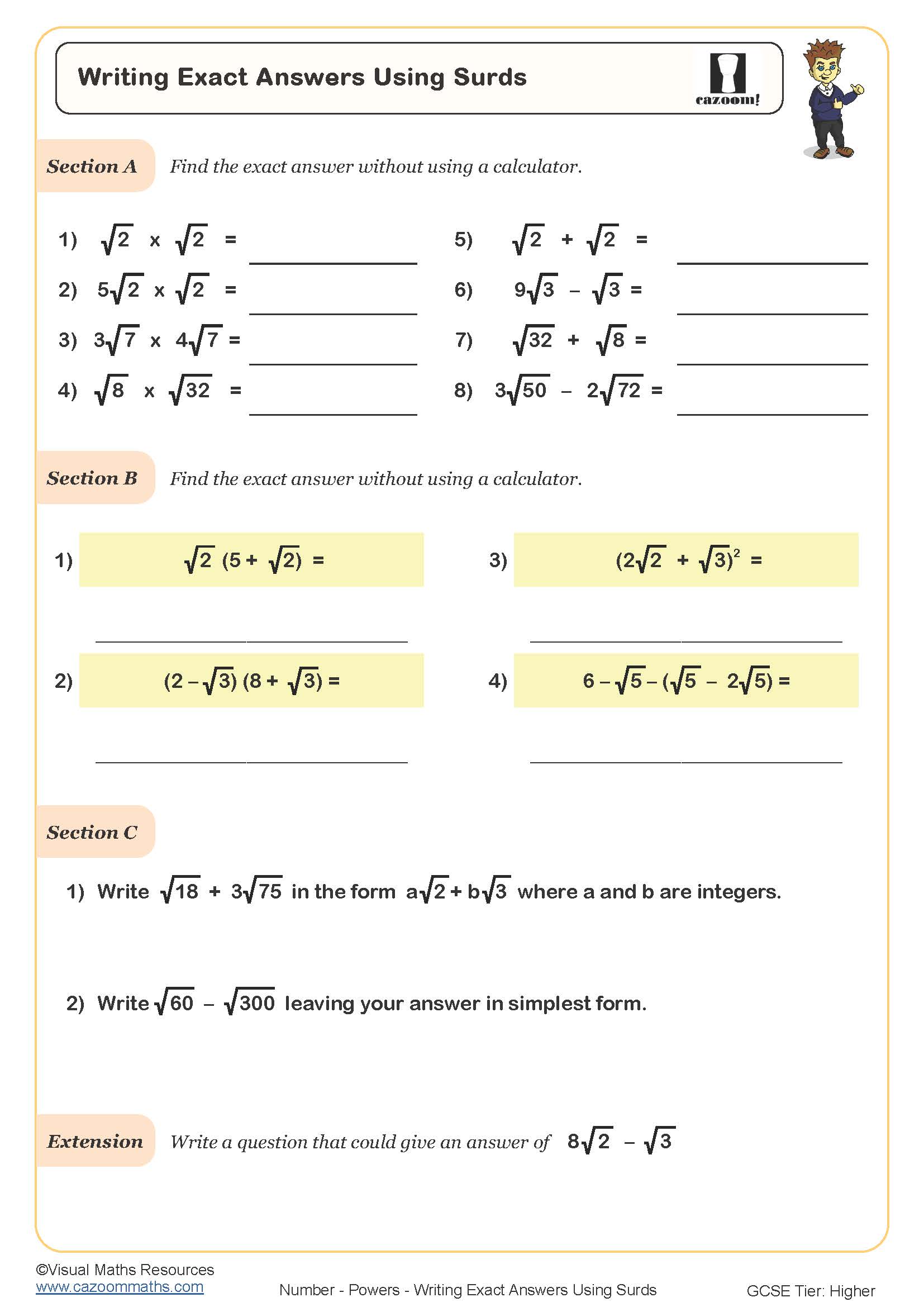
Writing Exact Answers Using Surds
Year groups: 10, 11
All worksheets are created by the team of experienced teachers at Cazoom Maths.
What makes an effective surds worksheet for KS4 students?
An effective surds worksheet targets the specific skills outlined in the National Curriculum for Key Stage 4, progressing from simplifying basic expressions like √18 to complex operations involving brackets and fractions. The worksheet should include problems requiring students to rationalise denominators and solve equations containing surds, as these frequently appear in GCSE examinations.
Teachers report that students benefit most when worksheets include a mix of purely algebraic manipulation and contextual problems, such as calculating exact lengths in right-angled triangles. Students often lose marks by leaving answers in decimal form rather than exact surd form, so quality worksheets emphasise when exact answers are required and provide clear marking guidance.
Which year groups should use surds worksheets and when?
Surds worksheets are primarily designed for Year 10 and Year 11 students following the GCSE mathematics curriculum, particularly those studying higher tier content. The topic typically follows work on indices and precedes more advanced algebra involving quadratic equations, where surd manipulation becomes key for exact solutions.
Some schools introduce basic surd simplification in Year 9 as extension work for higher-attaining students, whilst others reserve the full topic for Year 11 revision. Teachers find that students need solid grounding in prime factorisation and square numbers before tackling surds effectively, as recognising perfect square factors within radicals forms the foundation of surd simplification.
How should students approach simplifying surds worksheet problems?
Students should start by identifying the largest perfect square factor within the radical, using prime factorisation when the number isn't obviously factorisable. For √72, students need to recognise that 72 = 36 × 2, leading to √72 = 6√2. This systematic approach prevents the common error of partial simplification.
Mathematics teachers observe that students frequently make errors when combining like surds, particularly with expressions such as 3√2 + 5√2. Emphasising that surds behave like algebraic terms helps students recognise that only surds with identical radical parts can be added or subtracted directly, whilst different surds require separate handling unless further simplification is possible.
How can teachers use these surds worksheets most effectively in lessons?
Teachers find that introducing surds worksheets after demonstrating the connection between exact values and approximate decimals helps students understand why surd form matters. Starting with calculator work to show that √2 ≈ 1.414 but emphasising that √2 is the exact answer creates meaningful context for maintaining surd notation throughout calculations.
Successful implementation involves using worksheets progressively, beginning with pure simplification before moving to operations and problem-solving. Teachers report that students benefit from working through examples collaboratively before attempting independent practice, particularly when rationalising denominators where the method often seems counterintuitive to students encountering it for the first time.