Year 10 3D Shapes Worksheets
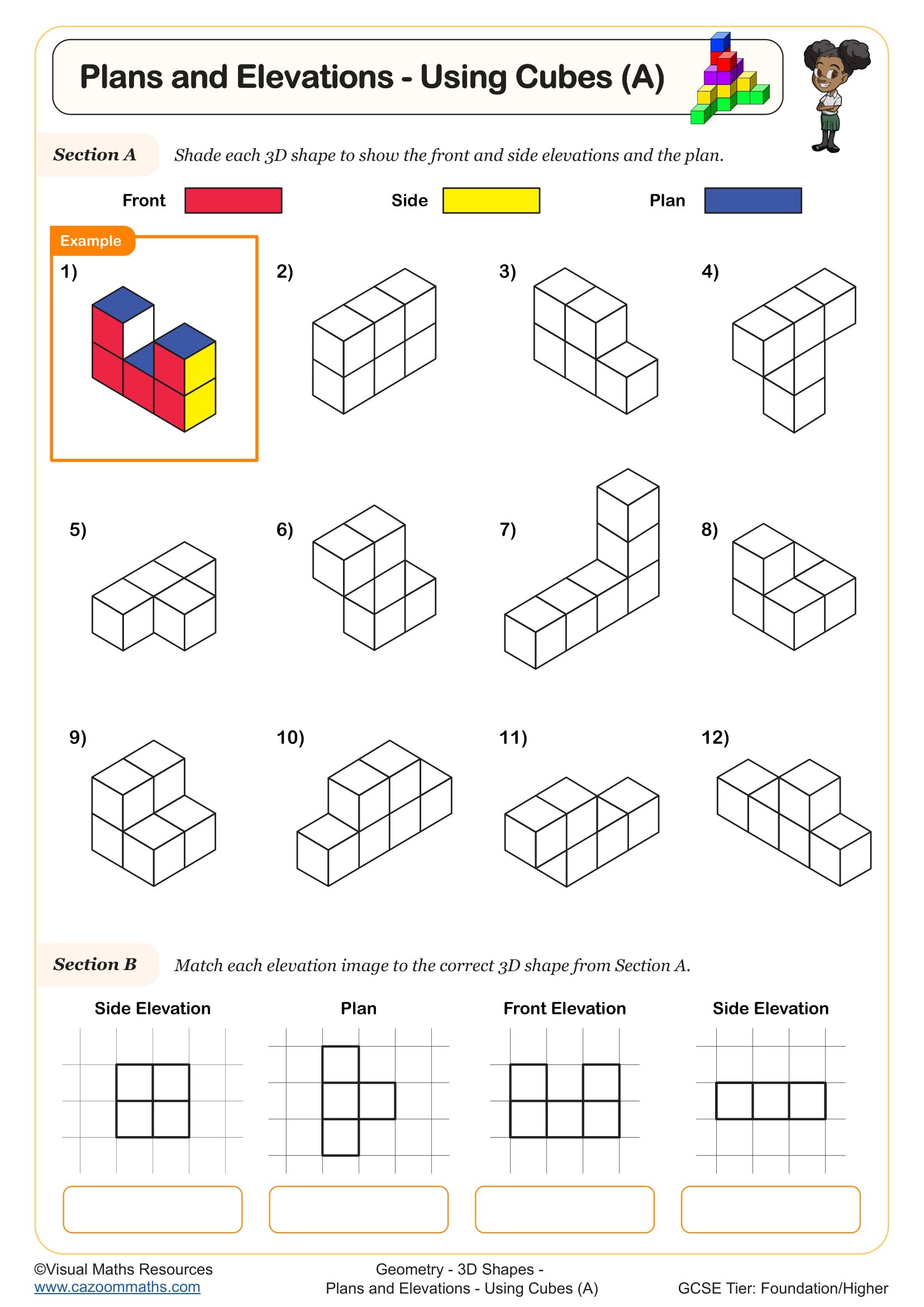
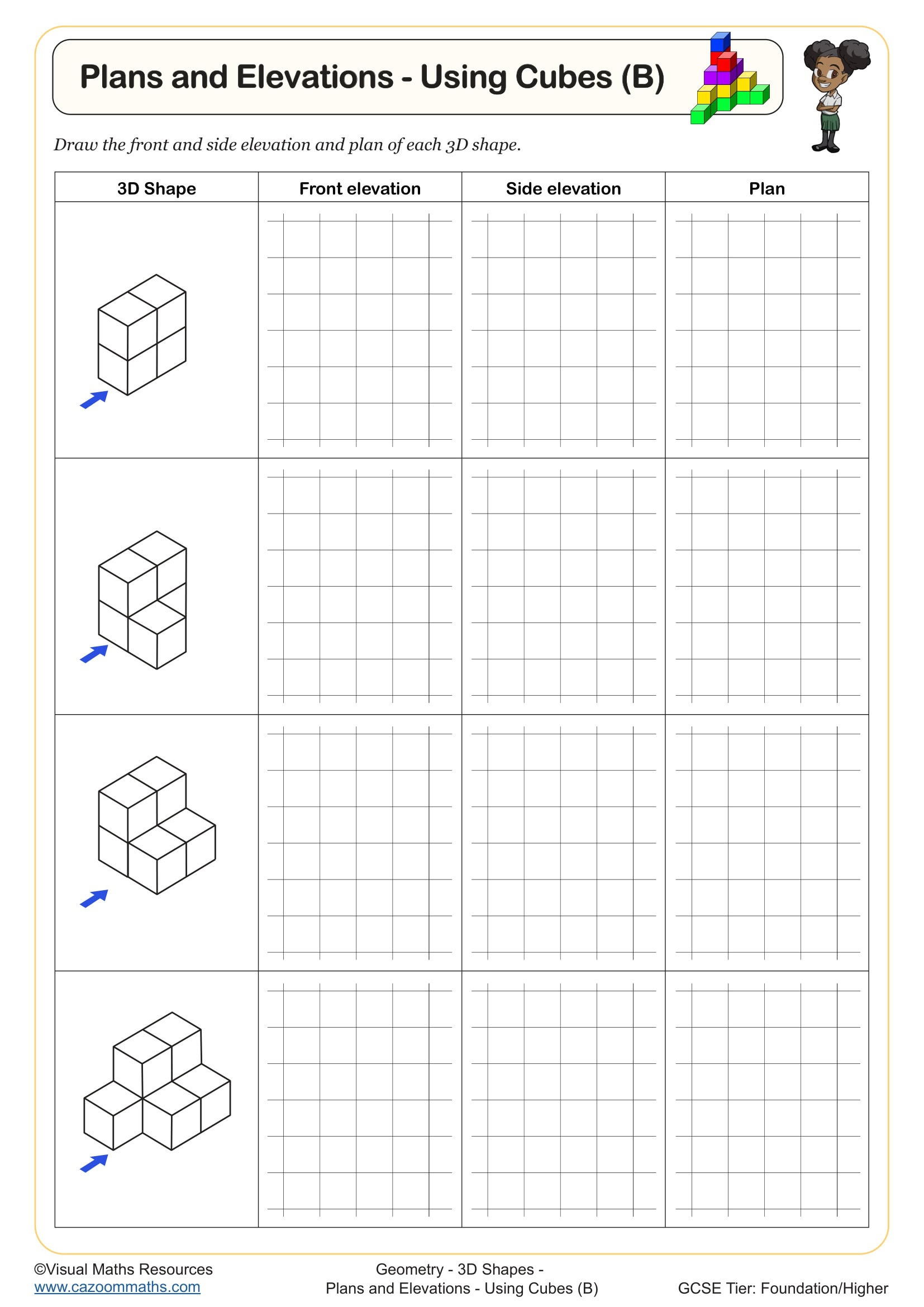
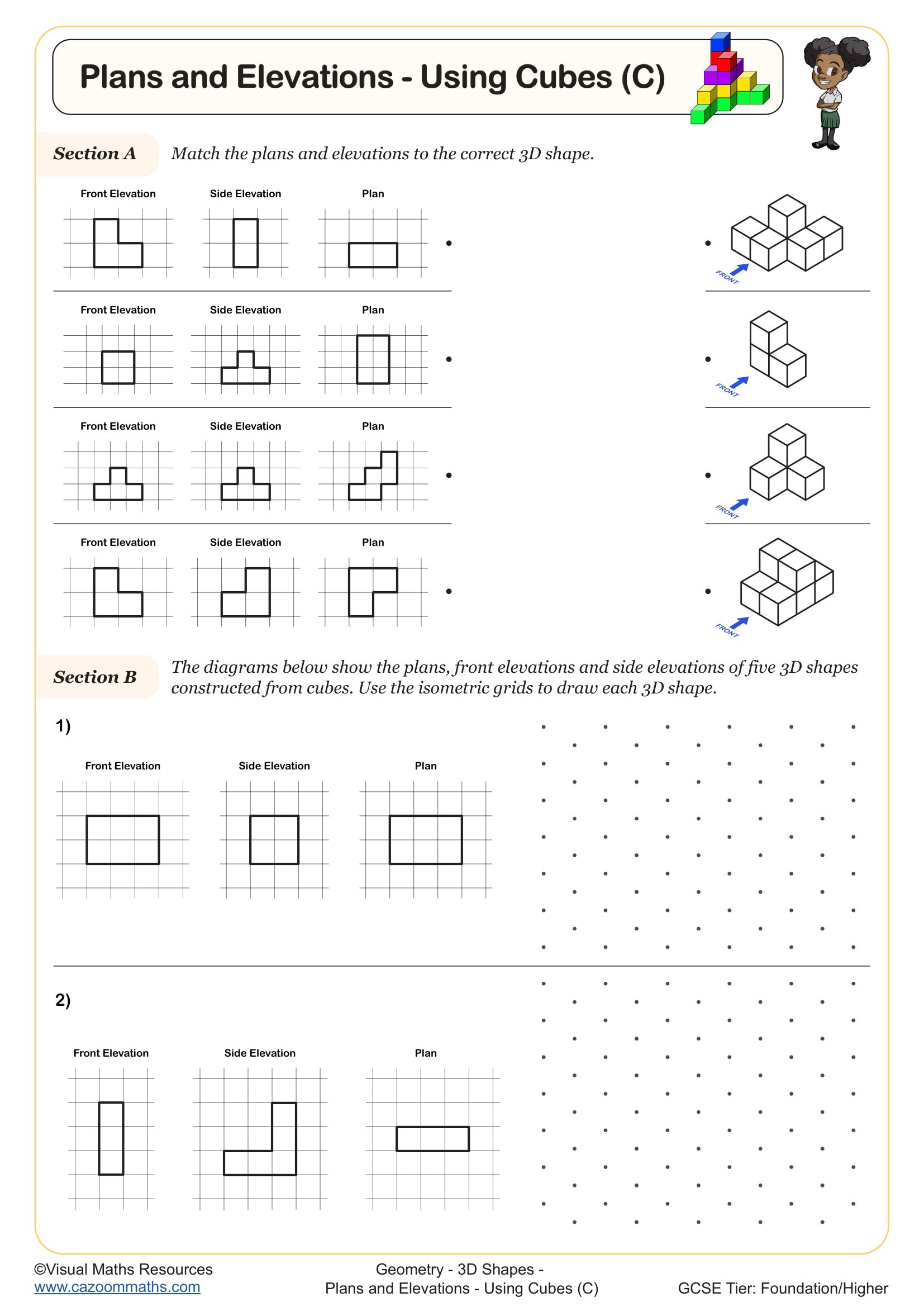
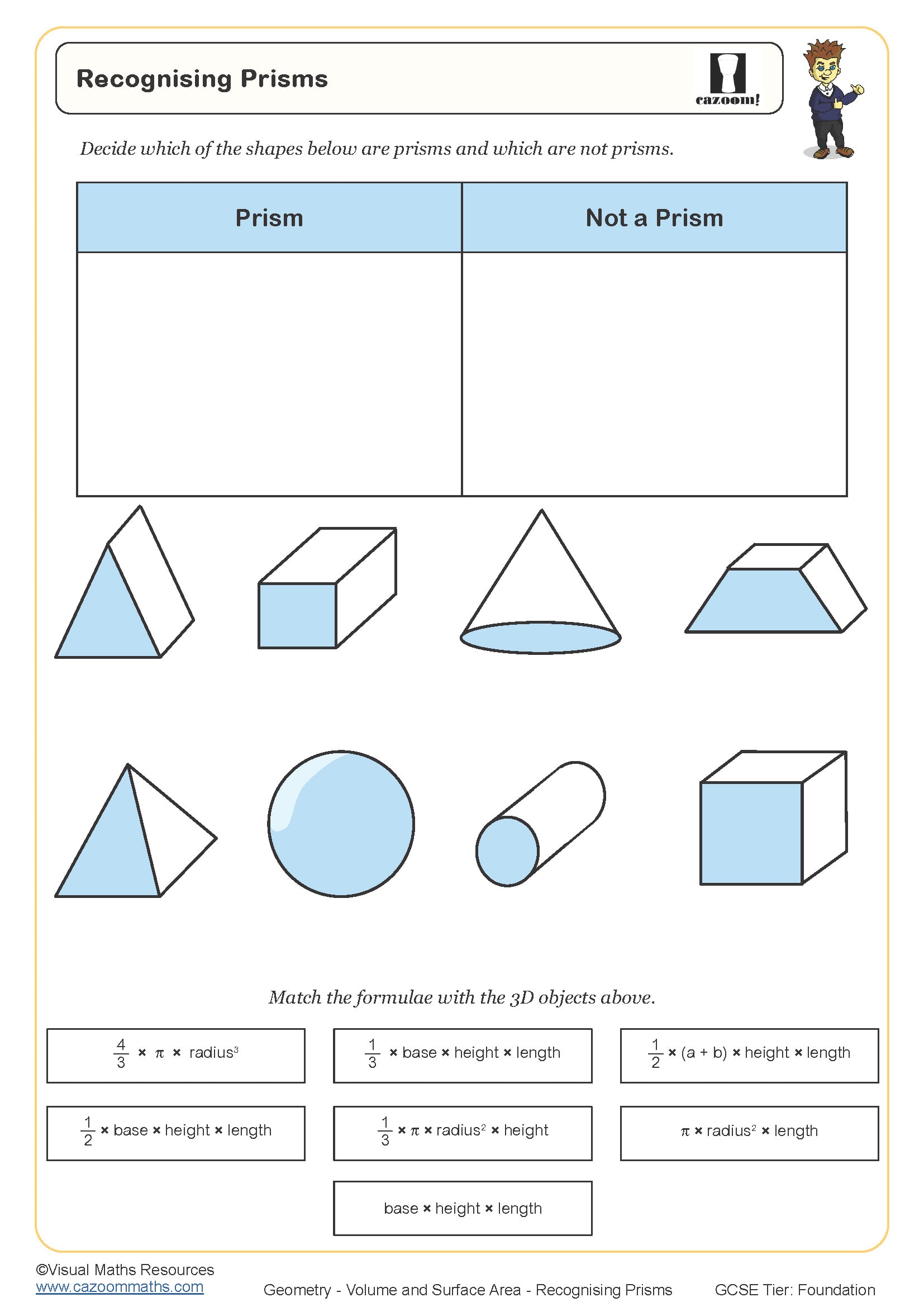
All worksheets are created by the team of experienced teachers at Cazoom Maths.
What 3D shapes do Year 10 students need to know?
Year 10 students work with prisms (including cuboids, triangular prisms, and cylinders), pyramids, spheres, cones, and frustums. The National Curriculum for KS4 expects students to calculate both surface area and volume for these shapes, applying formulae accurately and selecting appropriate units. Students should also tackle composite solids, which combine two or more shapes, and reverse problems where they find a dimension given the volume or surface area.
A common error occurs when students apply formulae incorrectly, such as using πr²h for the surface area of a cylinder instead of 2πr² + 2πrh. Teachers frequently observe students forgetting to square the radius or halving dimensions when dealing with hemispheres. Exam mark schemes penalise insufficient working, so students must show clear substitution into formulae before calculating final answers.
Which year groups are these 3D shapes worksheets suitable for?
This collection targets Year 10 students working at KS4 level, covering the GCSE content for three-dimensional shapes. At this stage, students should be comfortable with area and perimeter from KS3, allowing them to focus on extending these skills into three dimensions. The worksheets assume knowledge of basic 3D shape properties and prioritise fluency with surface area and volume calculations.
The difficulty increases through multi-step problems and unfamiliar contexts rather than introducing new shapes. Early questions might ask for the volume of a single prism with dimensions clearly labelled, whilst later problems require students to decompose composite solids, work with algebraic expressions for dimensions, or apply Pythagoras' theorem to find slant heights before calculating surface area. This progression mirrors typical GCSE question styles.
How do you calculate the surface area of composite 3D shapes?
Calculating surface area for composite shapes requires students to identify the individual components, calculate the surface area of each part, then combine them carefully. The key challenge involves recognising which faces are visible in the final solid and which are hidden where shapes join. Students must subtract the areas of hidden faces to avoid overcounting. For example, when a square-based pyramid sits atop a cube, the square base of the pyramid and the top face of the cube are both hidden.
This skill connects directly to real-world applications in architecture and manufacturing. When designing packaging, engineers calculate the minimum material needed to create boxes with unusual shapes, minimising waste and cost. Construction professionals use these principles when estimating materials for roofing, cladding, or painting complex structures. Understanding surface area allows students to approach practical problems like determining how much wrapping paper covers a gift or how much paint covers a storage tank.
How should teachers use these 3D shapes worksheets in lessons?
The worksheets work well as structured practice following direct teaching of formulae and worked examples. Teachers can use them to identify which specific calculations cause difficulty, then target those areas with additional support. The answer sheets allow students to self-assess during independent work, encouraging them to identify their own errors and correct misconceptions immediately rather than reinforcing mistakes through repeated practice.
Many teachers use these worksheets for intervention with students who struggle to retain formulae, setting small batches of questions as regular retrieval practice. They also function effectively as homework to consolidate classwork, or as starter activities revisiting previously taught content. For students working towards higher GCSE grades, the worksheets provide focused practice on calculation accuracy before tackling more complex problem-solving questions that require selecting and applying formulae without prompts.