Year 10 Bearings Scale and Loci Worksheets
Bearings and Scale Word Problems
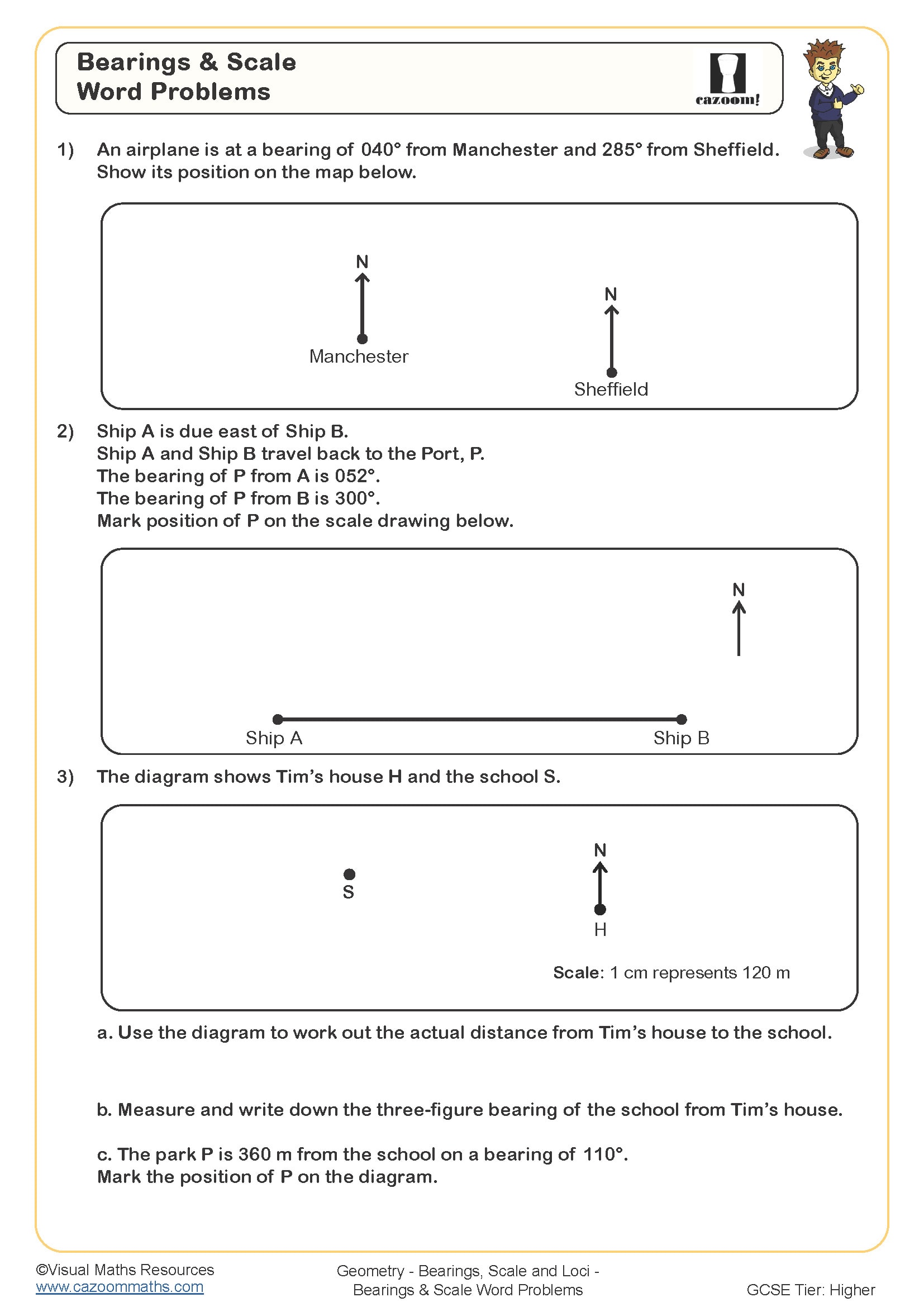
Calculating Bearings - with Angles in Parallel Lines
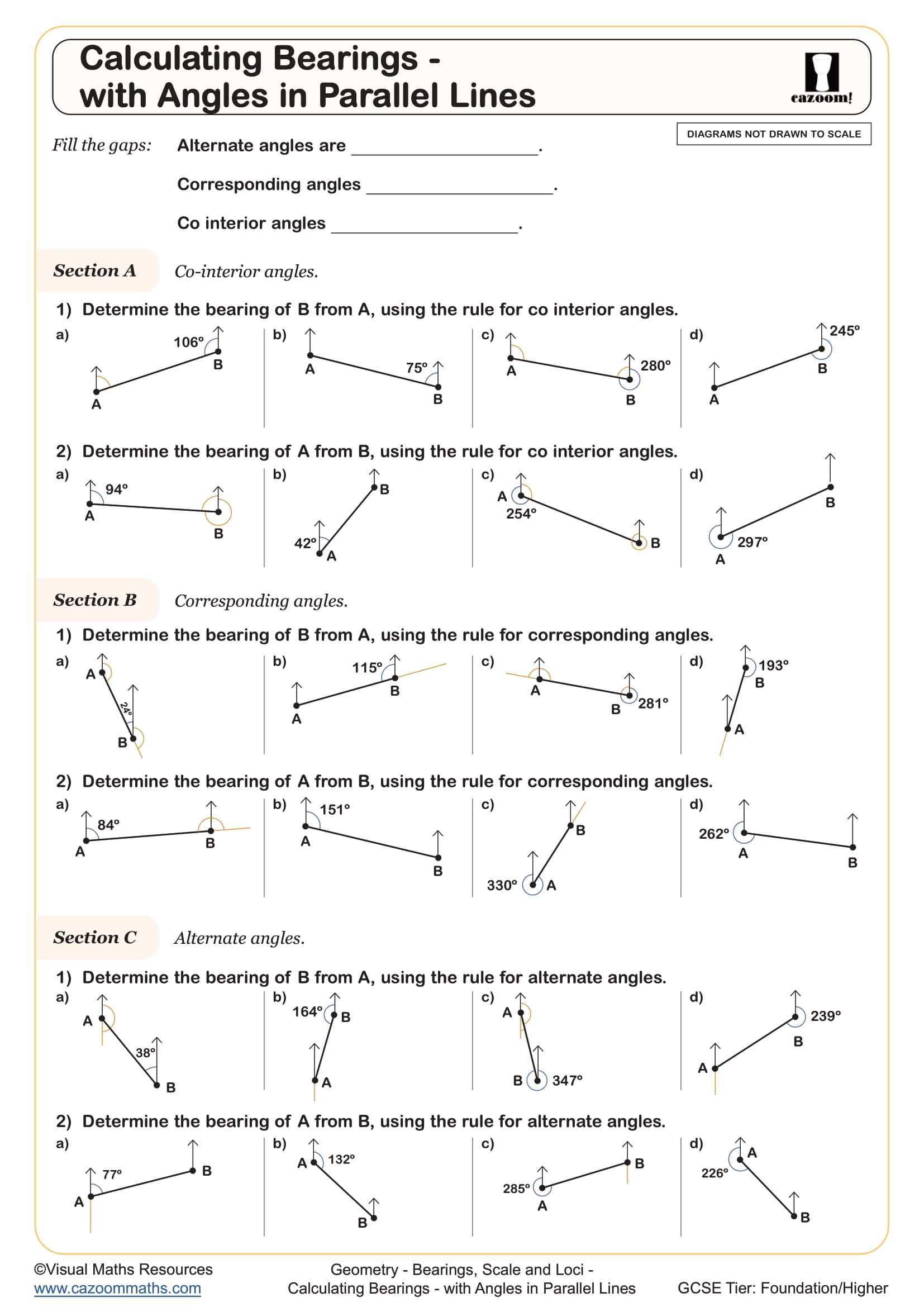
Calculating Bearings (A)
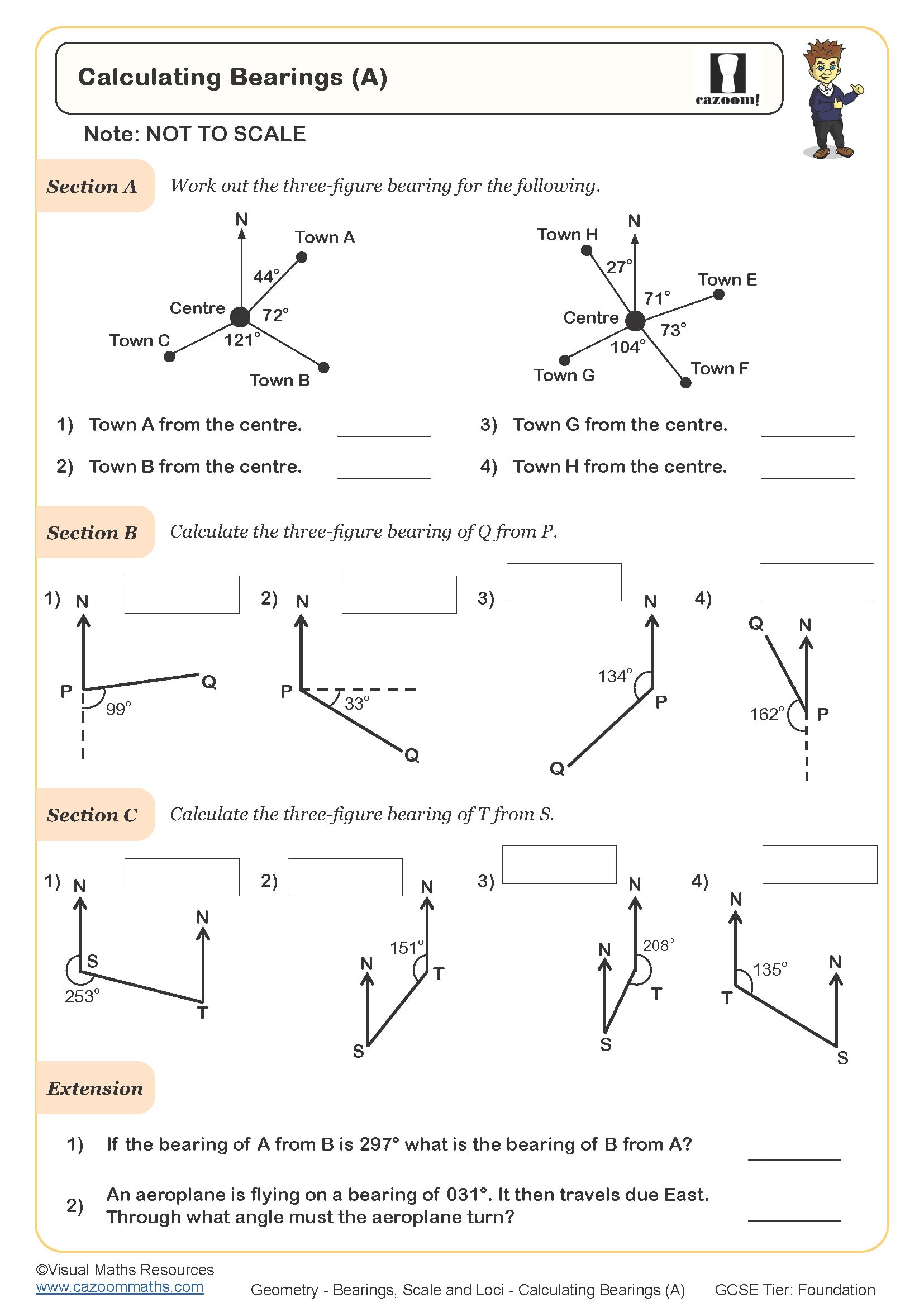
Calculating Bearings (B)
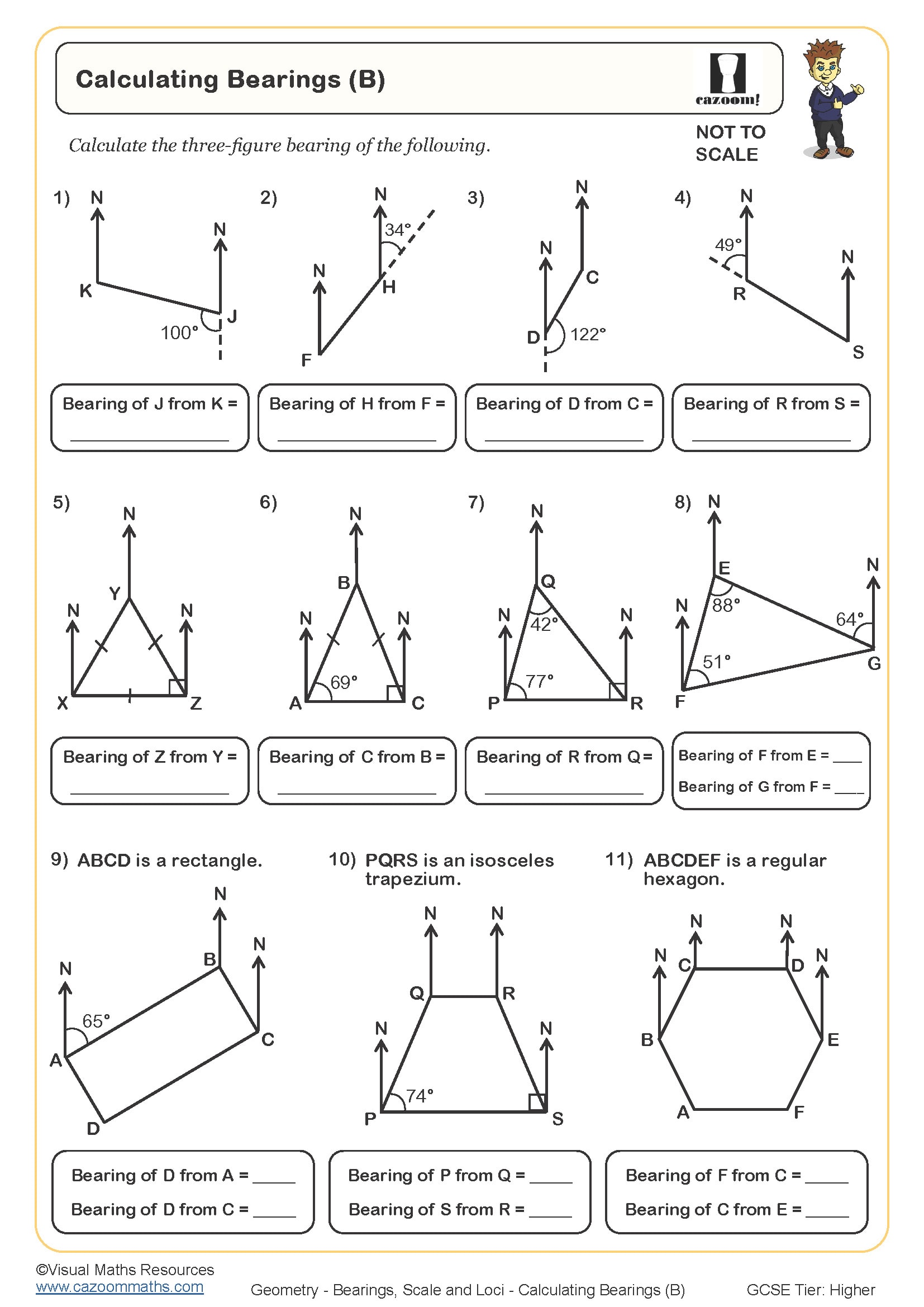
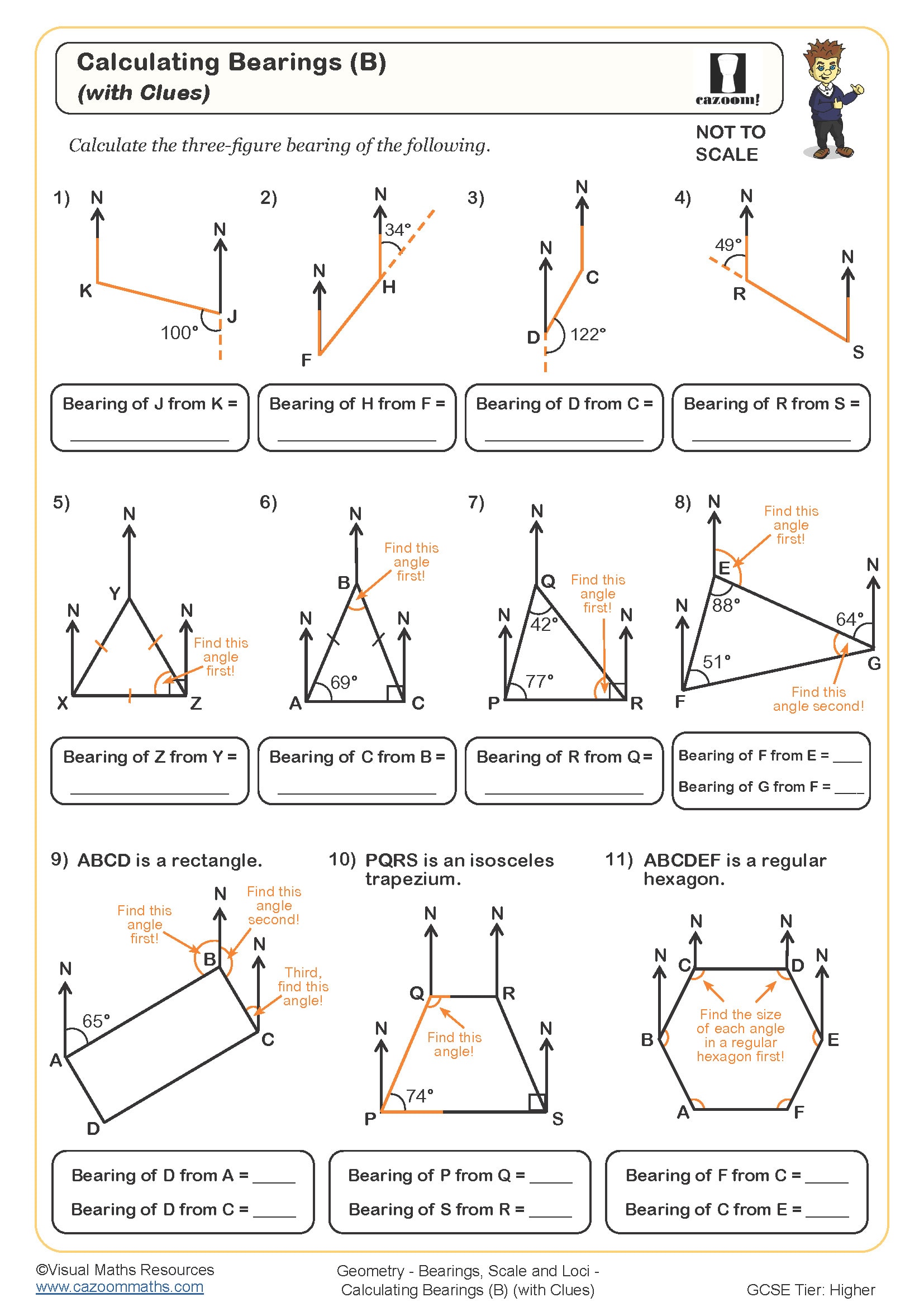
Calculating Bearings (B) (With Clues)
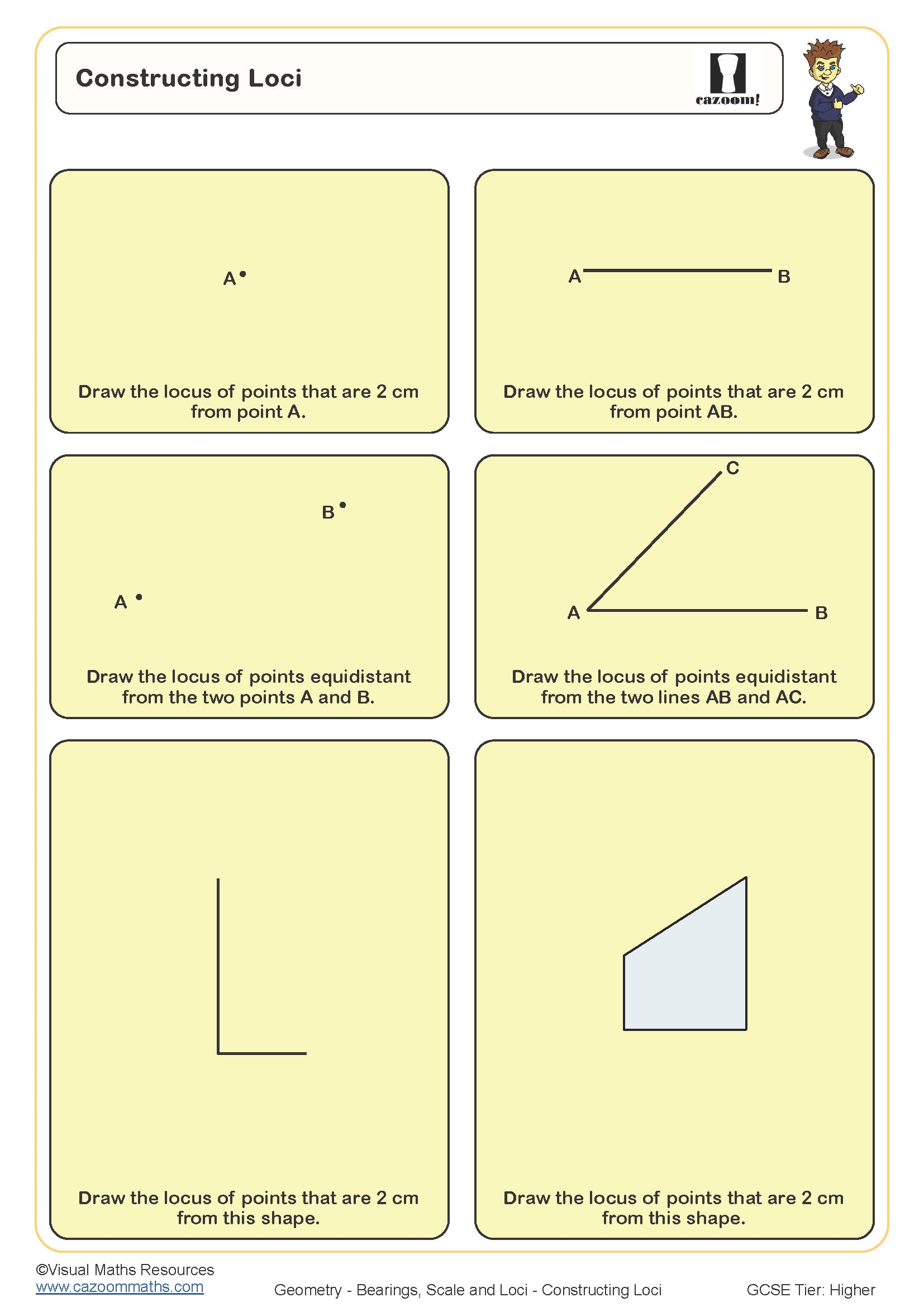
Constructing Loci
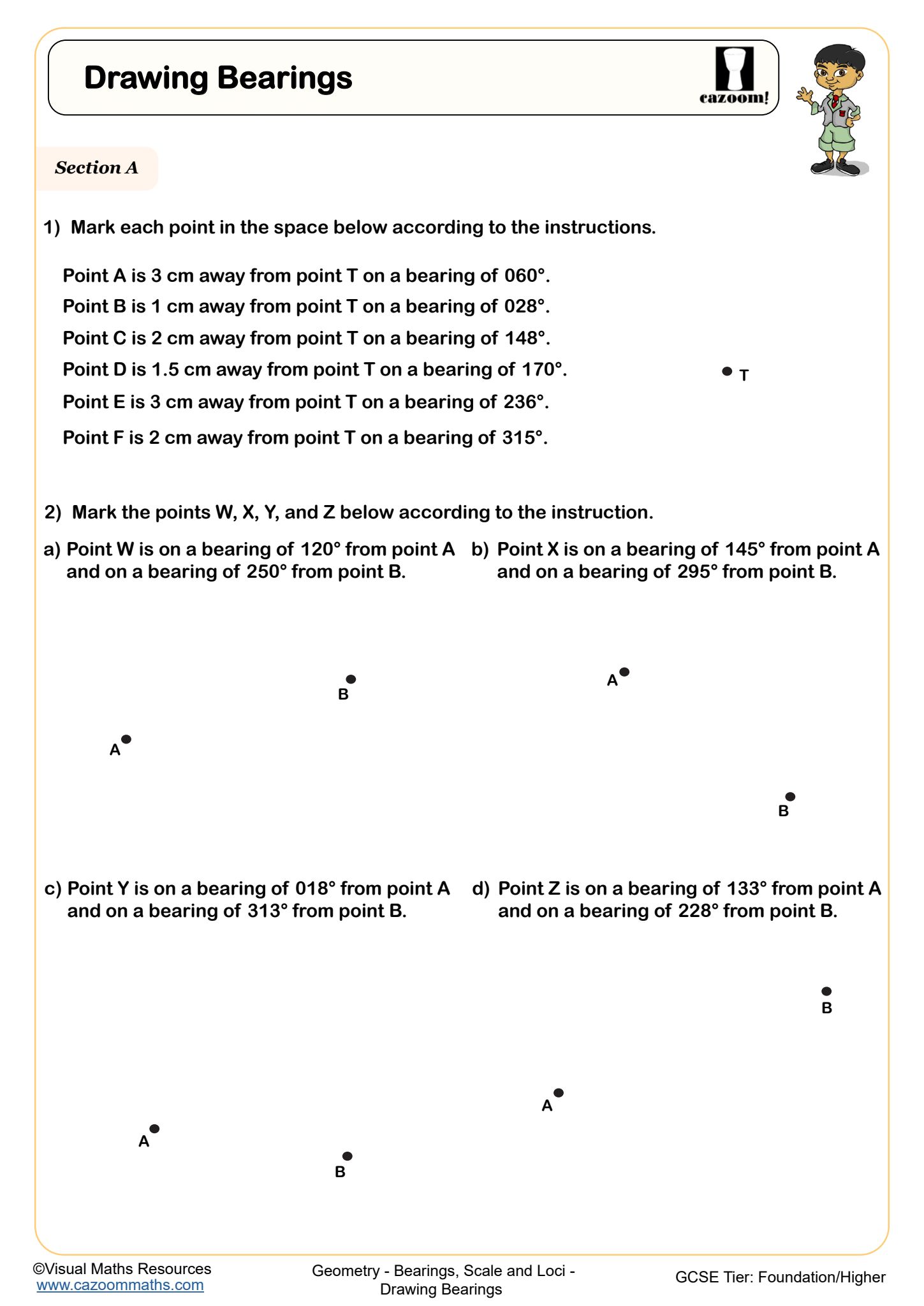
Drawing Bearings
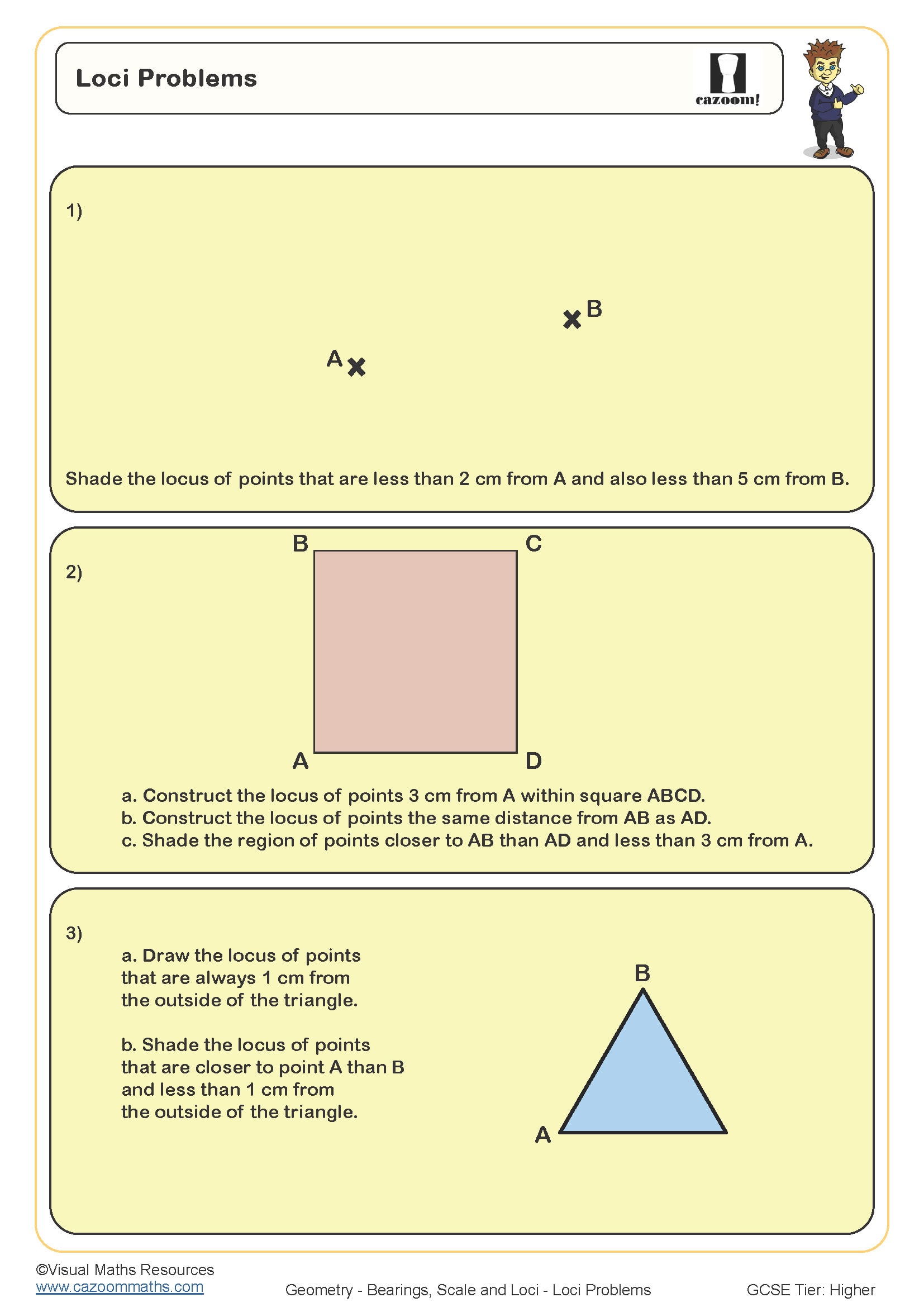
Loci Problems
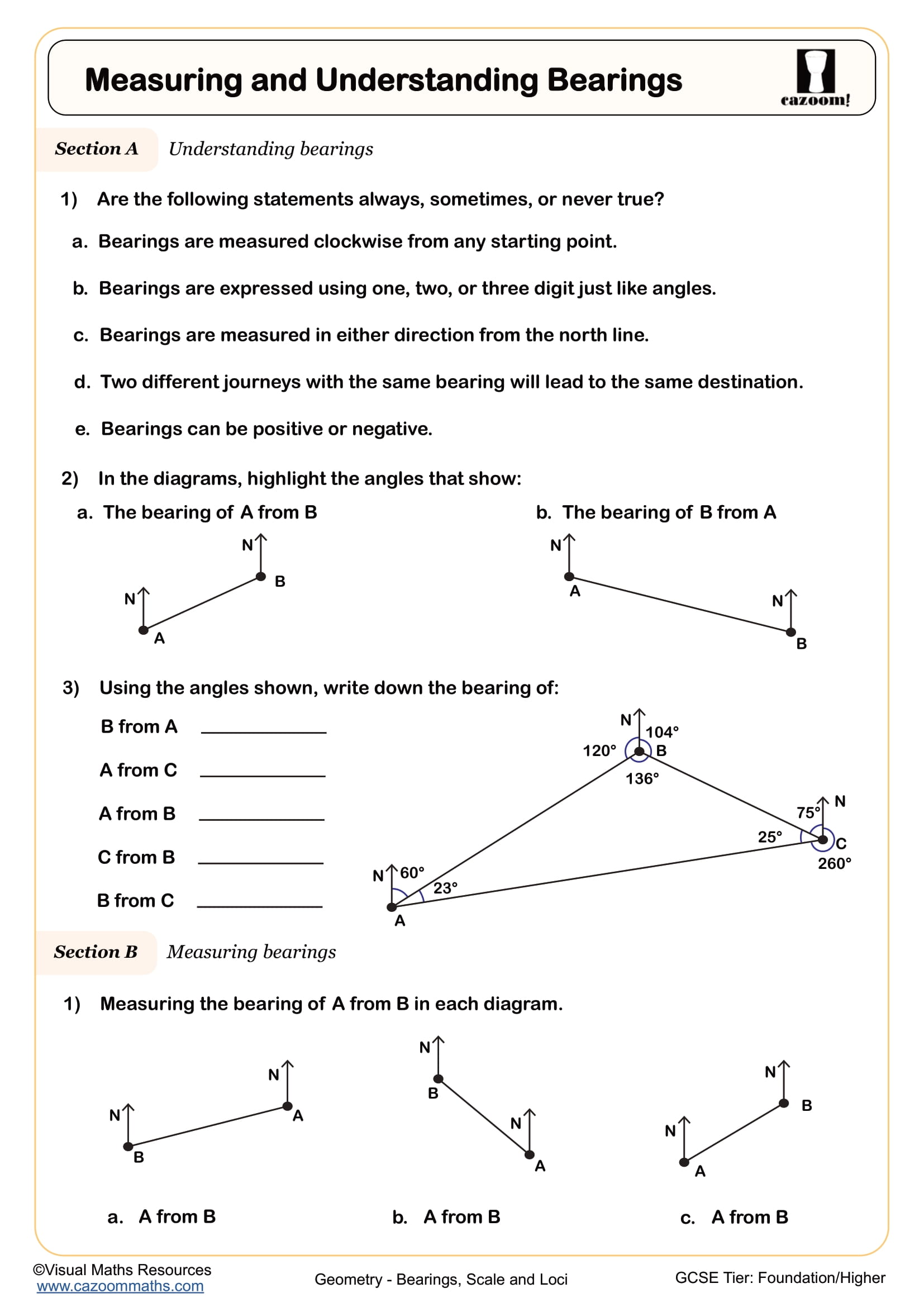
Measuring and Understanding Bearings
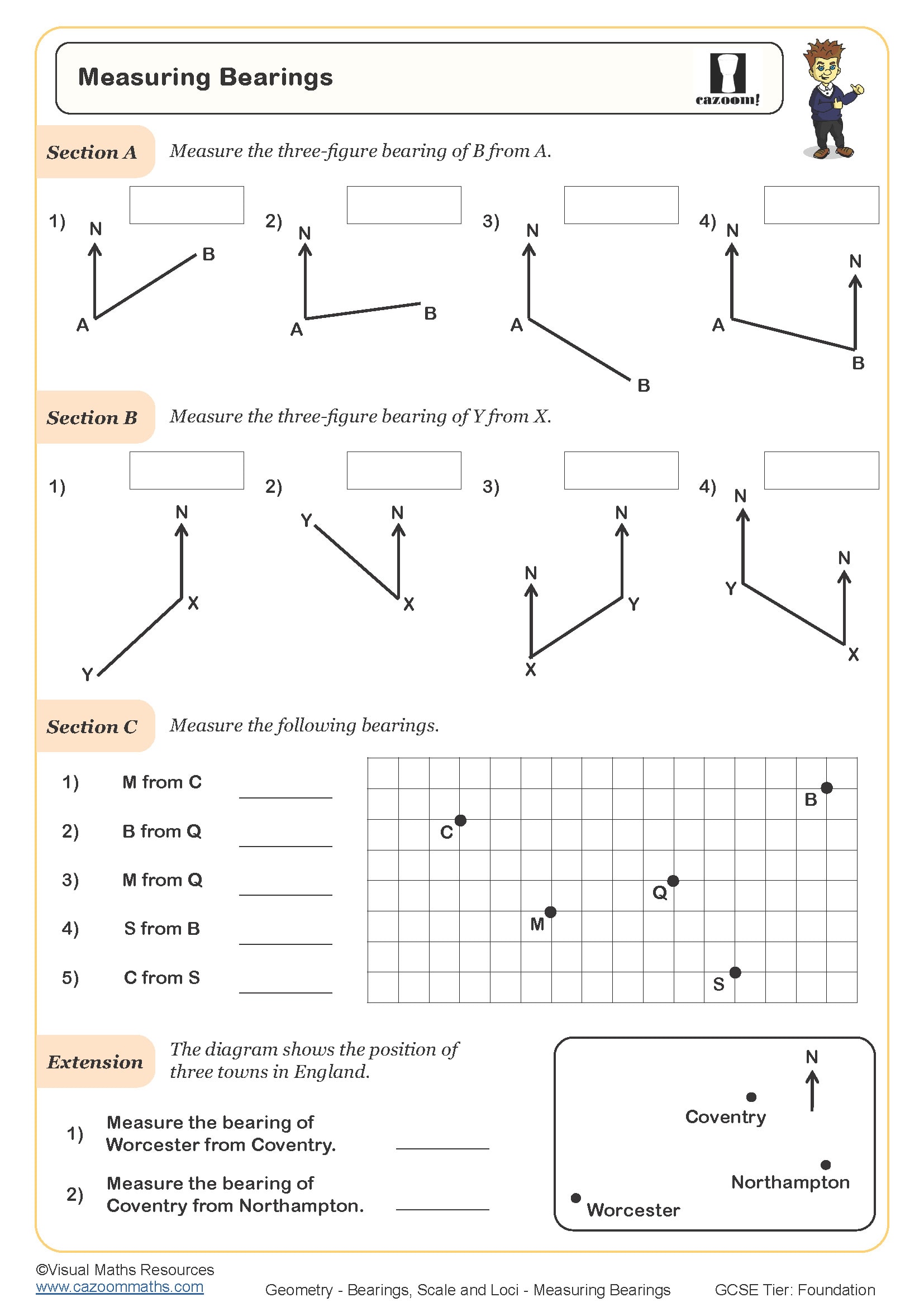
Measuring Bearings
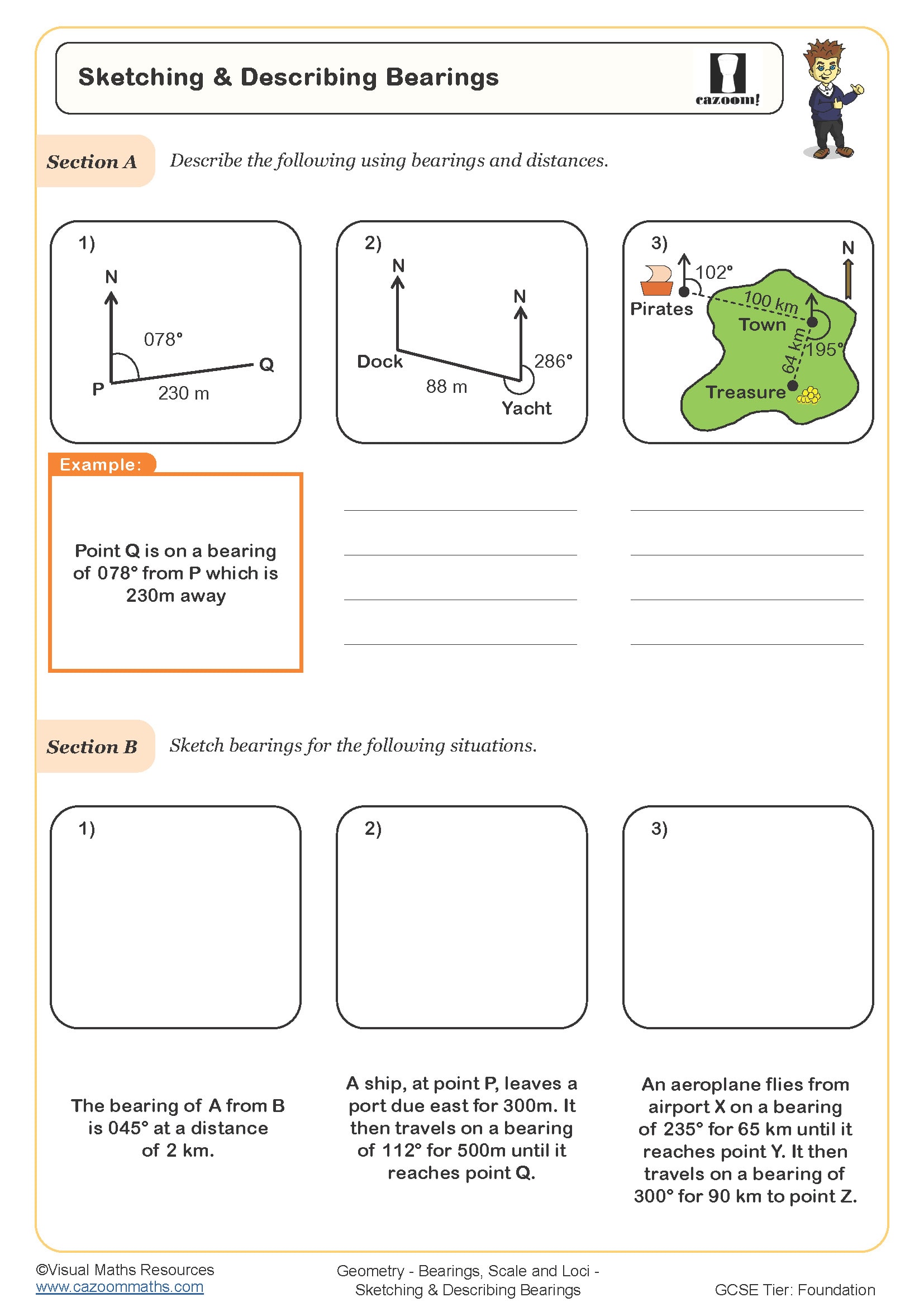
Sketching and Describing Bearings
All worksheets are created by the team of experienced teachers at Cazoom Maths.
What are bearings, scale and loci in maths?
Bearings are three-figure angles measured clockwise from north, used to describe direction precisely. Scale allows accurate representation of real distances on diagrams, expressed as ratios like 1:50,000. A locus (plural: loci) is the set of all points satisfying a specific condition, such as being equidistant from two fixed points. These three skills combine in GCSE questions that require students to interpret maps, plot positions, and construct regions meeting multiple criteria.
Students often lose marks by writing bearings as two-digit numbers (writing 45° instead of 045°) or by measuring anti-clockwise. When working with scale, a common error involves multiplying instead of dividing to convert map distances to real distances. Exam mark schemes expect bearings accurate to within ±2°, so students need practice measuring and drawing angles precisely using protractors aligned correctly with north lines.
Which year groups study bearings, scale and loci?
This topic appears in Year 10 as part of the KS4 geometry curriculum, typically in the spring or summer term after students have secured angle facts and construction techniques. Students should already be confident with compass and protractor use, as these tools are fundamental to drawing accurate loci and measuring bearings. The National Curriculum requires students to apply bearing notation in context and construct standard loci including perpendicular bisectors and angle bisectors.
Within Year 10, the difficulty progresses from straightforward single-bearing problems to multi-step questions combining all three skills. Early worksheets focus on measuring and plotting individual bearings with simple scale conversions, whilst later problems might ask students to find a position using two bearings (triangulation) or shade regions satisfying compound loci conditions. Foundation tier questions typically involve integer scales and simpler geometric loci, whereas Higher tier includes ratio scales like 2:5 and more complex combined inequalities.
How do you construct the locus of points equidistant from two points?
The locus of points equidistant from two points A and B is the perpendicular bisector of line segment AB. Students construct this by opening compasses to a radius greater than half the distance AB, then drawing arcs from both A and B above and below the line. Where these arcs intersect, students mark two points and join them with a straight line that crosses AB at exactly 90° at its midpoint. This construction must be shown with visible arc marks in GCSE exams, as method marks depend on seeing the working.
This particular locus has practical applications in mobile phone network planning. When determining the boundary between coverage areas for two transmission towers, engineers use perpendicular bisectors to identify where signal strength is equal. Similarly, town planners use this principle when deciding which school catchment area a house falls into, or where to position shared facilities like bus stops to serve two communities equally. Students who understand the real-world context tend to remember that "equidistant" means equal distance, reducing errors in exam questions.
How should teachers use these bearings, scale and loci worksheets?
The worksheets scaffold learning by separating the three skills initially before combining them in later questions. Early activities focus on measuring existing bearings or plotting given bearings from points, allowing students to master protractor technique before tackling scale conversions. Subsequent worksheets introduce scale drawing alongside bearings, then add loci construction, building complexity systematically. Answer sheets show the geometric working clearly, including arc marks for constructions, which helps teachers identify where students' technique breaks down.
Many teachers use these resources for targeted intervention with students who struggle with the geometric reasoning required for Grade 5 and above. The worksheets work well for paired work, with one student plotting a bearing whilst their partner checks the angle measurement, building accuracy through peer checking. For homework, the scale drawing questions allow students to work at larger sizes on plain paper, which often improves accuracy compared to rushed exam-sized diagrams. Teachers also report that regular practice with these worksheets significantly reduces protractor alignment errors during mock examinations.