Year 10 Fractions, Decimals and Percentages Worksheets
All worksheets are created by the team of experienced teachers at Cazoom Maths.
What makes an effective FDP worksheet for Year 10 students?
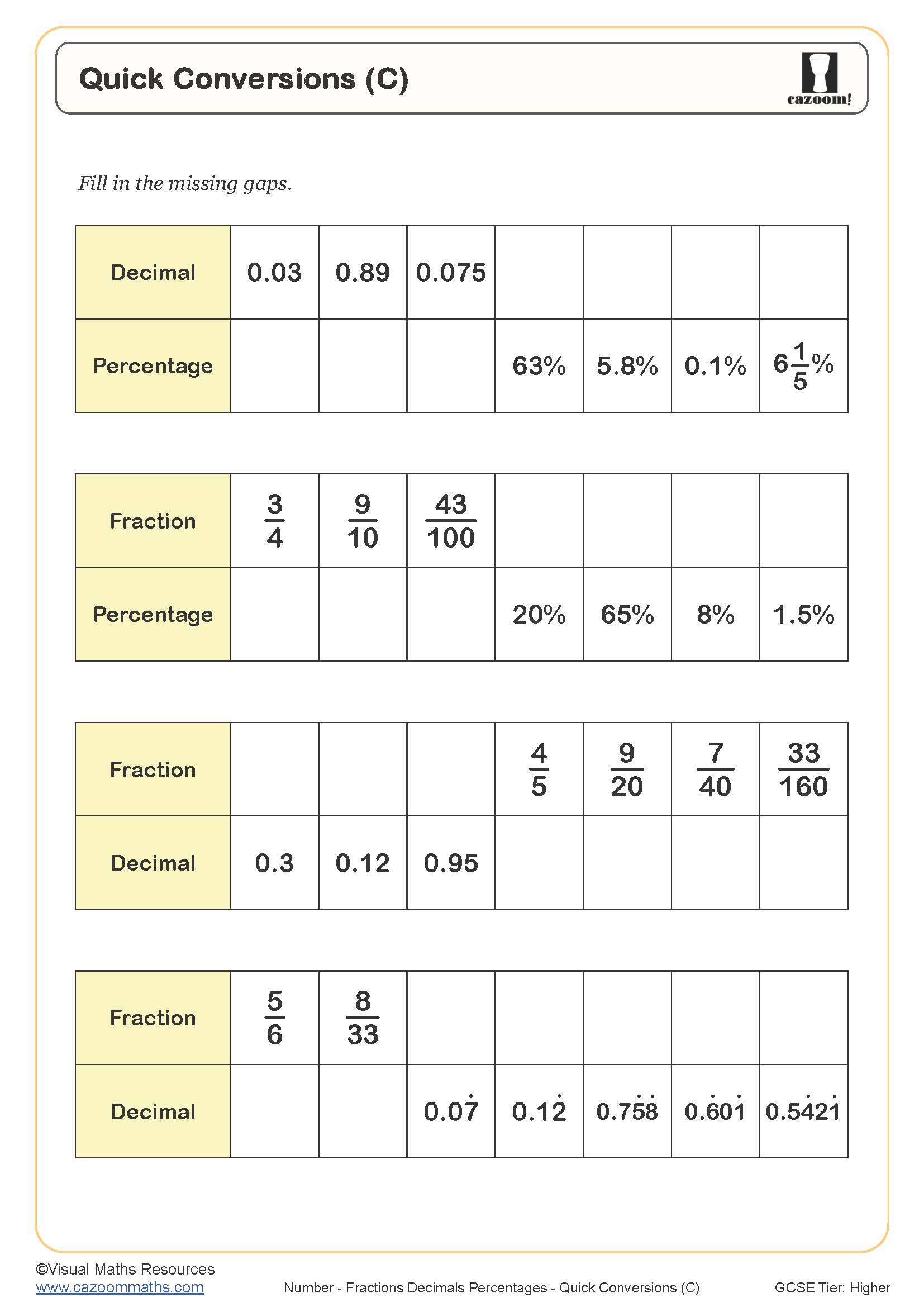
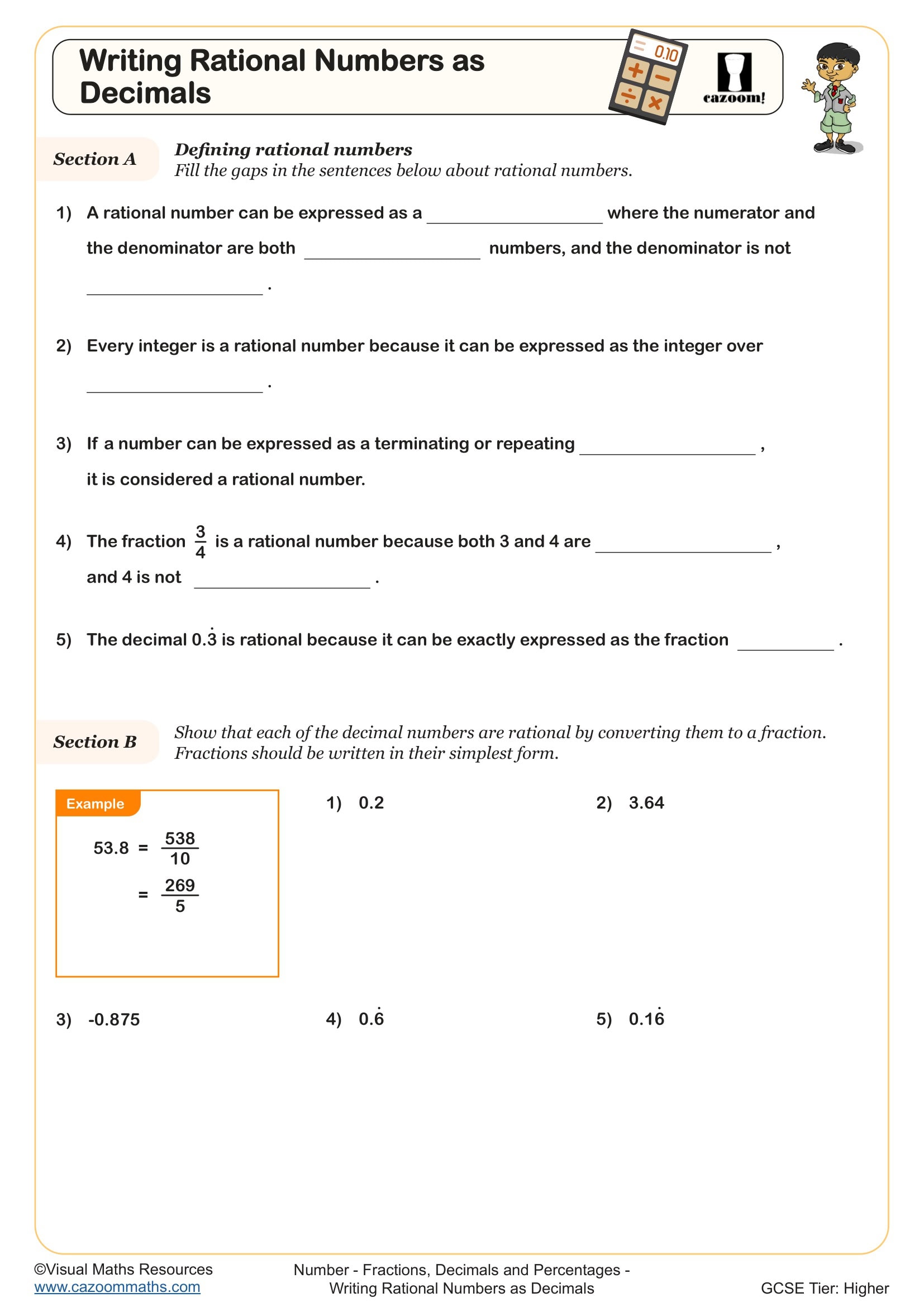
An effective fdp worksheet for Year 10 students balances procedural practice with problem-solving contexts that reflect GCSE expectations. The best fdp worksheets progress systematically through decimal-fraction conversions, percentage calculations, and mixed FDP comparisons, ensuring students encounter both straightforward and multi-step problems.
Teachers find that students often rush through conversion tasks without checking their answers make sense. For instance, when converting 0.375 to a fraction, many students correctly reach 3/8 but fail to recognise this could also be expressed as 37.5%. Quality FDP worksheets include answer verification strategies and require students to express answers in multiple forms.
How do Year 10 FDP skills differ from earlier key stages?
Year 10 FDP work builds significantly on Key Stage 3 foundations by introducing more complex decimal conversions and percentage problems involving compound changes. Students now encounter recurring decimals, surds in fractional form, and percentage calculations with multiple steps such as reverse percentages and compound interest scenarios.
The cognitive demand increases substantially as students must select appropriate methods rather than following prescribed procedures. Teachers observe that many students can convert 1/3 to a decimal at KS3 level but struggle with finding the exact fractional equivalent of 0.142857... at Year 10, requiring understanding of recurring decimal notation and systematic conversion techniques.
Why do students find recurring decimal conversions particularly challenging?
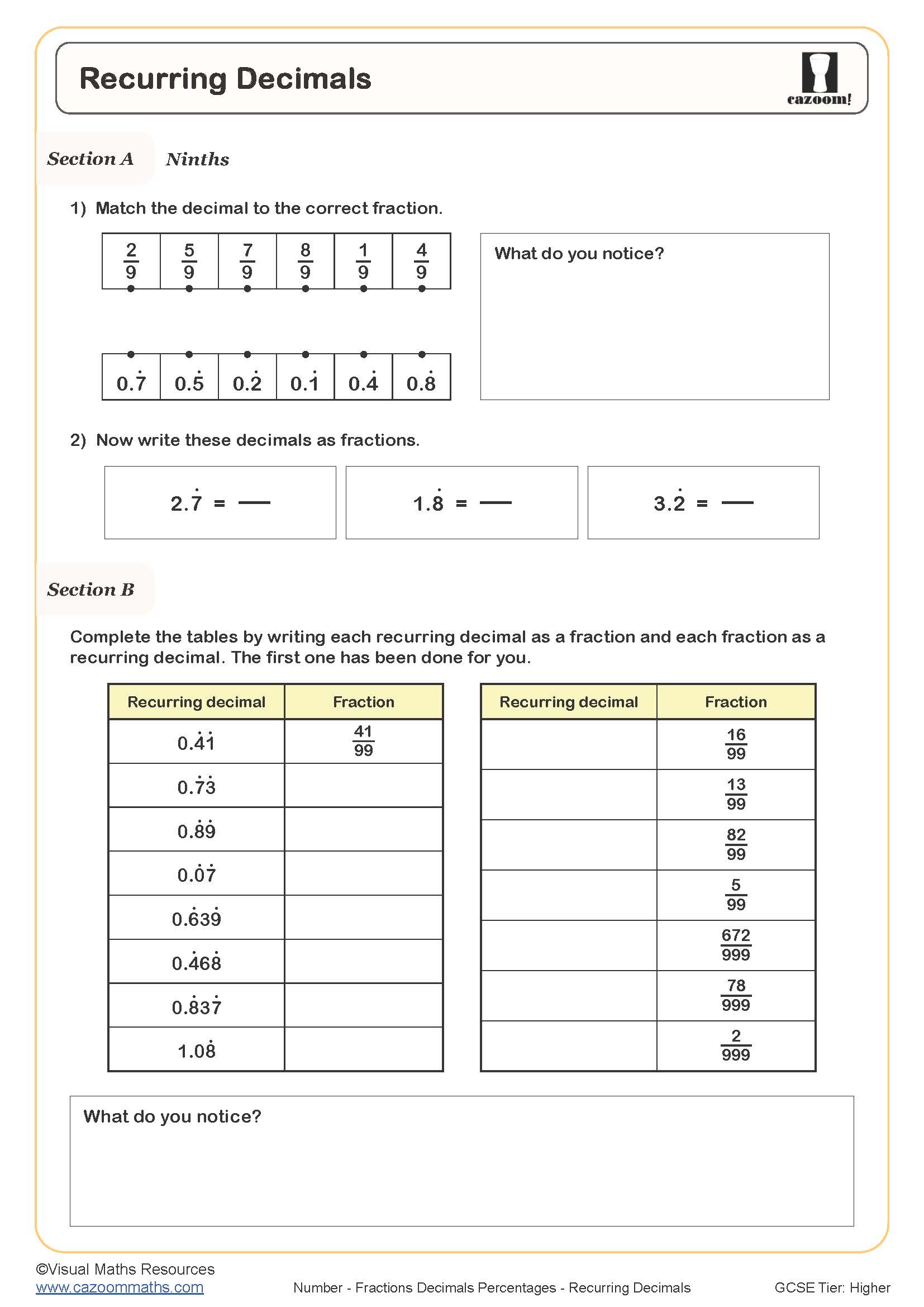
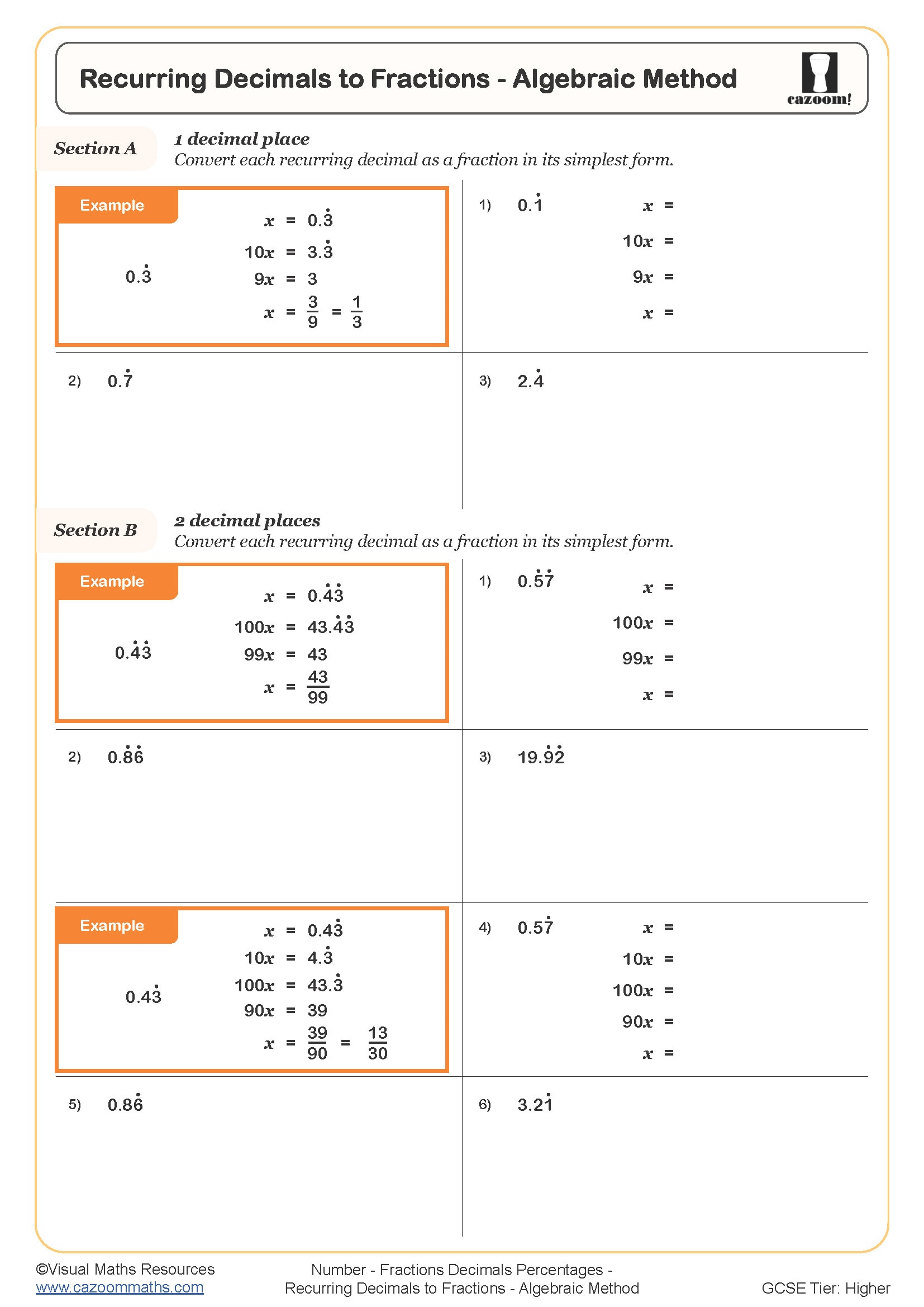
Recurring decimal conversions present conceptual difficulties because students must understand the difference between terminating and non-terminating decimals, then apply algebraic thinking to find exact fractional forms. The process requires setting up equations and manipulating them systematically, skills that bridge arithmetic and algebraic reasoning.
Mathematics teachers frequently observe students attempting to round recurring decimals rather than finding exact equivalents. When converting 0.454545... to a fraction, students often write 0.45 instead of recognising the pattern and using the algebraic method to reach 5/11. This highlights the importance of explicit teaching about when approximations are appropriate versus when exact values are required.
How should teachers structure FDP worksheet practice for maximum impact?
Teachers achieve best results when they sequence FDP worksheet practice to move from isolated skill work to mixed problem sets that require students to choose conversion methods strategically. Beginning with straightforward conversions allows students to build confidence before tackling multi-step problems that combine FDP work with other mathematical concepts.
Classroom experience shows that spaced practice works more effectively than concentrated drilling. Teachers report better retention when students complete shorter worksheet sections regularly rather than lengthy sessions. The inclusion of real-world contexts such as financial calculations, measurement conversions, and statistical representations helps students understand why FDP fluency matters beyond the mathematics classroom, particularly for STEM subjects and everyday numeracy.