Year 10 Function Machines Worksheets
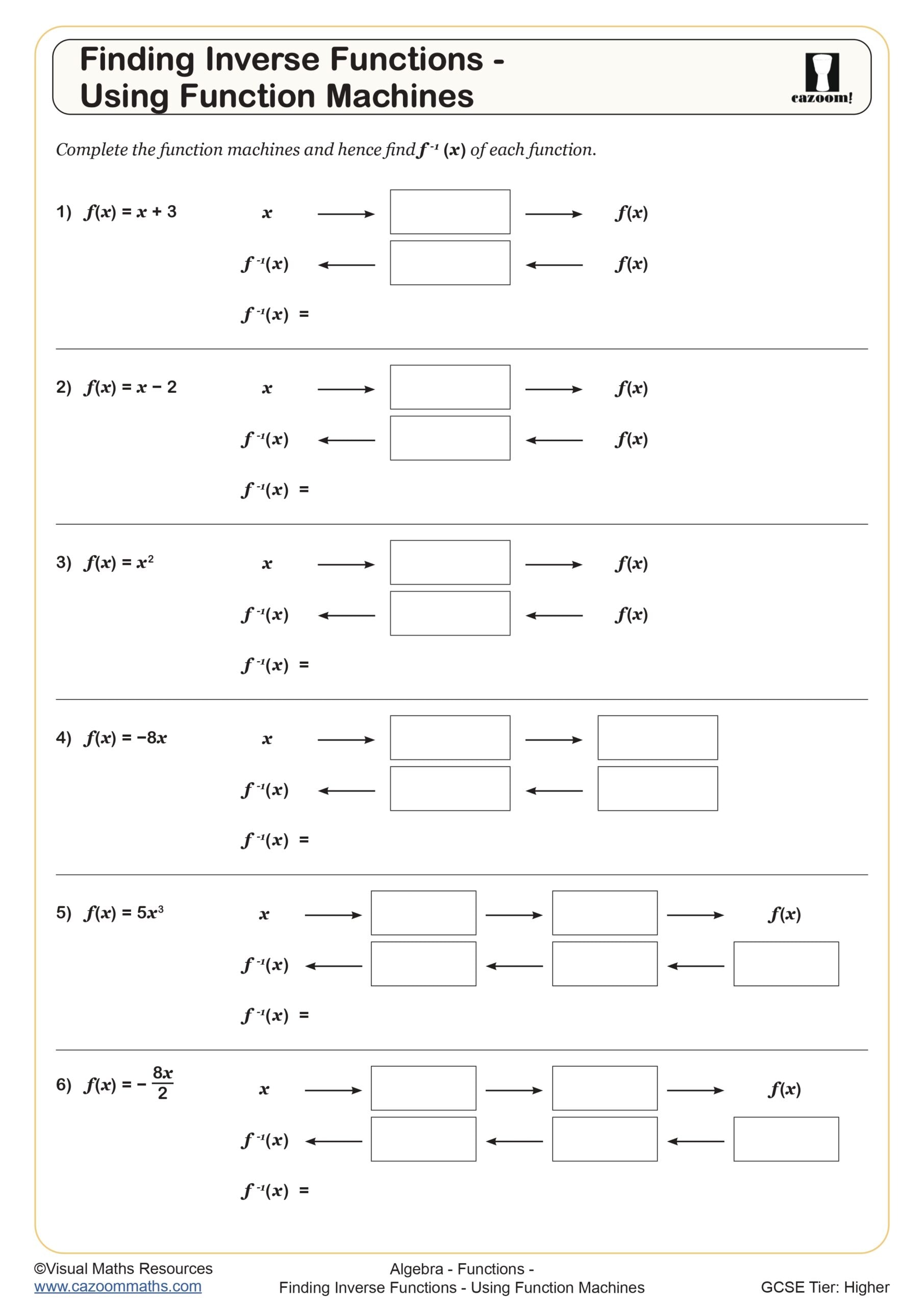
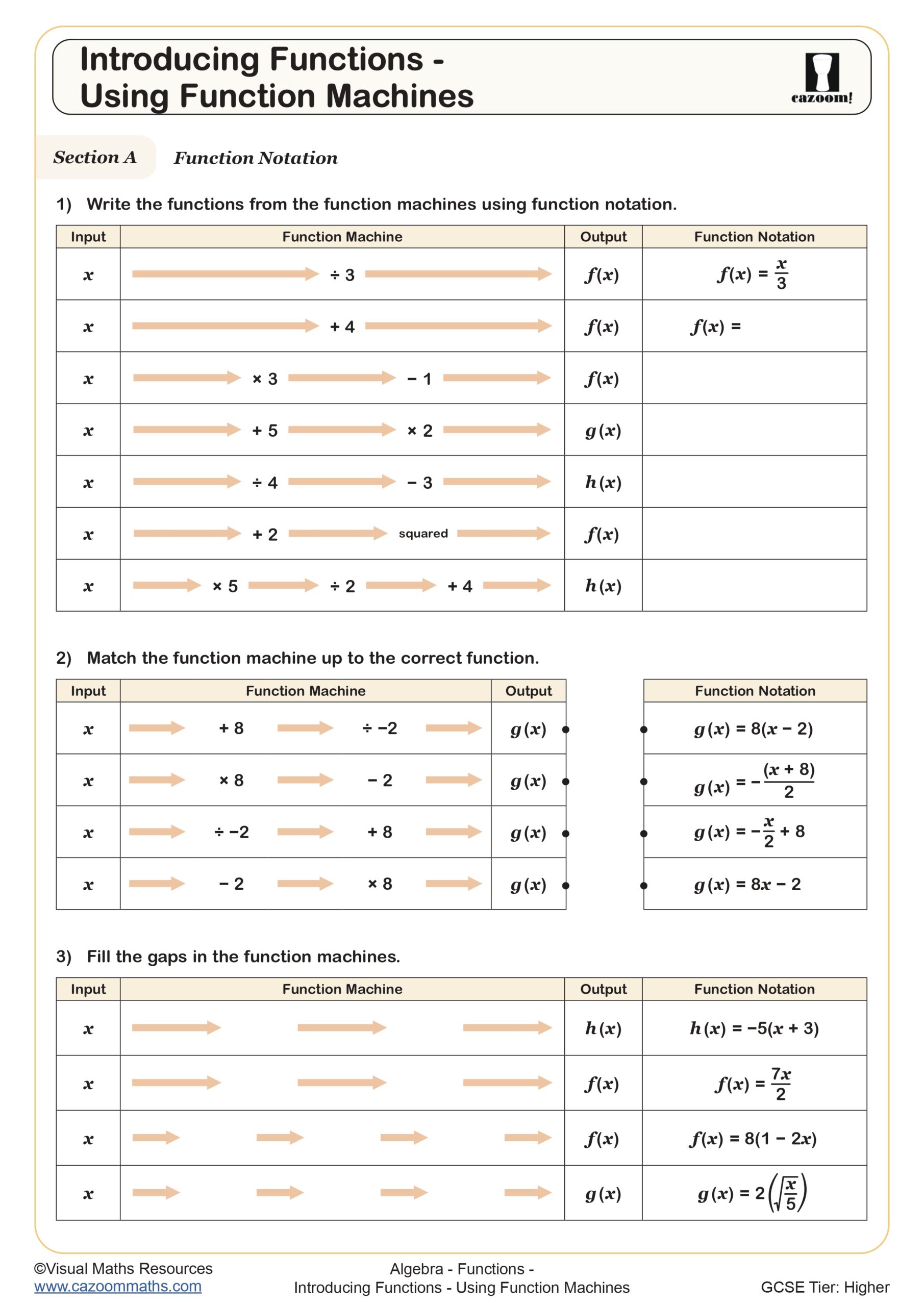
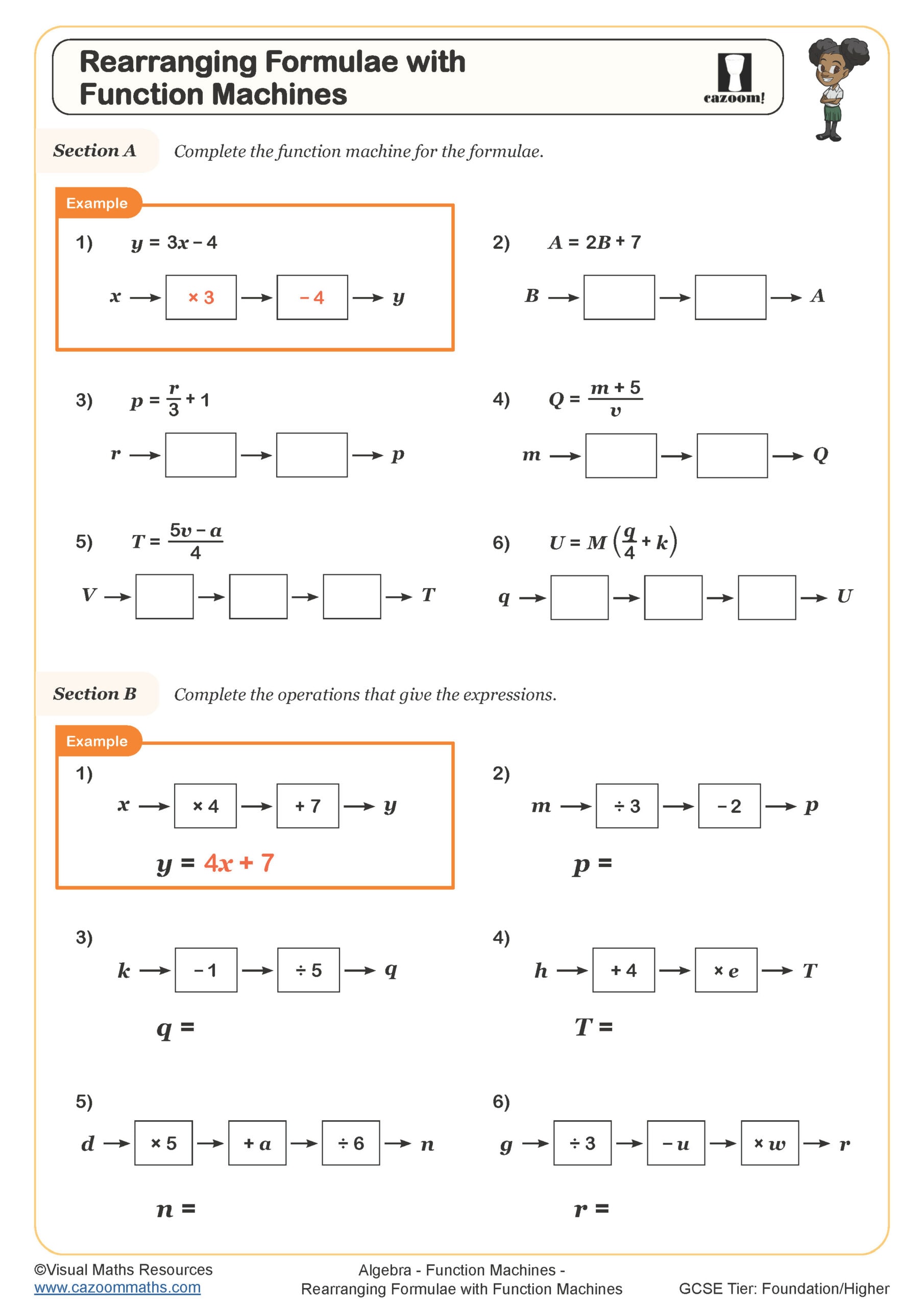
All worksheets are created by the team of experienced teachers at Cazoom Maths.
What Are Function Machines in Year 10 Maths?
Function machines are visual representations of algebraic processes that transform inputs into outputs through defined operations. At Year 10, students move beyond basic one-step functions to tackle two-step function machines and formal function notation like f(x) = 2x + 3, bridging the gap between arithmetic processes and algebraic thinking required for GCSE.
Teachers frequently notice that students can follow the 'forwards' direction confidently but falter when finding inverse functions. A typical error involves pupils subtracting 3 then dividing by 2 when reversing f(x) = 2x + 3, forgetting that inverse operations must be applied in reverse order—divide by 2 first, then subtract 3. This misconception often persists until students physically work through multiple examples with clear visual representations.
Which Year Groups Study Function Machines?
Function machines are primarily taught at KS4, with Year 10 being the main focus as students develop fluency with algebraic manipulation and formal function notation. At this stage, the work connects directly to solving equations, substitution, and rearranging formulae—all essential skills for both Foundation and Higher tier GCSE maths.
The progression at Year 10 moves from simple two-step machines with positive integers through to more complex examples involving negative numbers, fractions, and algebraic inputs. Higher-attaining students begin exploring composite functions and understanding function notation that will underpin A-level work, whilst Foundation students consolidate the mechanical process of applying and reversing operations systematically.
How Do Function Machines Connect to Real-World Applications?
Function machines model any process where inputs transform into outputs through defined rules—the fundamental concept behind computer programming, engineering calculations, and data processing. Understanding that operations can be reversed is particularly important in science and technology, from calibrating instruments to converting between measurement units or decoding encrypted information.
In computer science, every algorithm is essentially a function machine, taking input data and producing output through step-by-step operations. Engineers use inverse functions constantly when designing products—working backwards from desired specifications to determine required inputs. Students who grasp function machine reversal find coding logic more intuitive, as they understand that processes can be 'undone' systematically, which is exactly how version control and debugging work in software development.
How Can Teachers Use These Function Machines Worksheets?
The worksheets build fluency through graduated examples that systematically increase in complexity, starting with straightforward two-step machines before introducing challenges like negative coefficients or fractional operations. Answer sheets allow students to identify exactly where their reasoning breaks down—particularly valuable when teaching inverse operations, as pupils can trace back through their working to spot where the order went wrong.
Many teachers use these worksheets for targeted intervention with students who struggle with equation solving, as function machines make the abstract process concrete. They work well as starter activities to activate prior knowledge before tackling rearranging formulae, or as homework following initial teaching. Paired work is particularly effective, with one student calling out inputs whilst their partner calculates outputs, then swapping roles for inverse problems—this verbal rehearsal helps embed the systematic thinking required for more complex algebraic manipulation.