Year 11 Fractions Worksheets
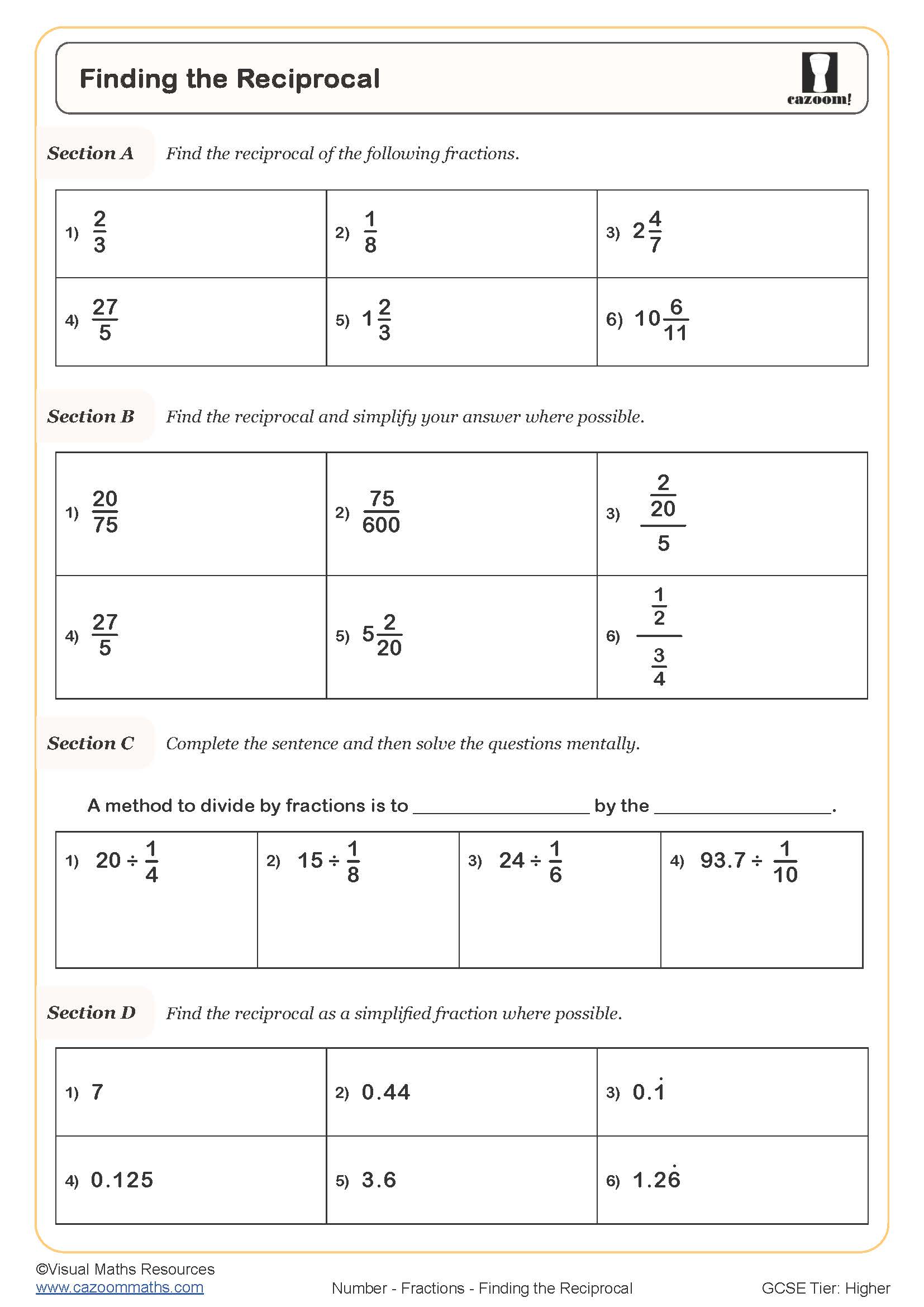
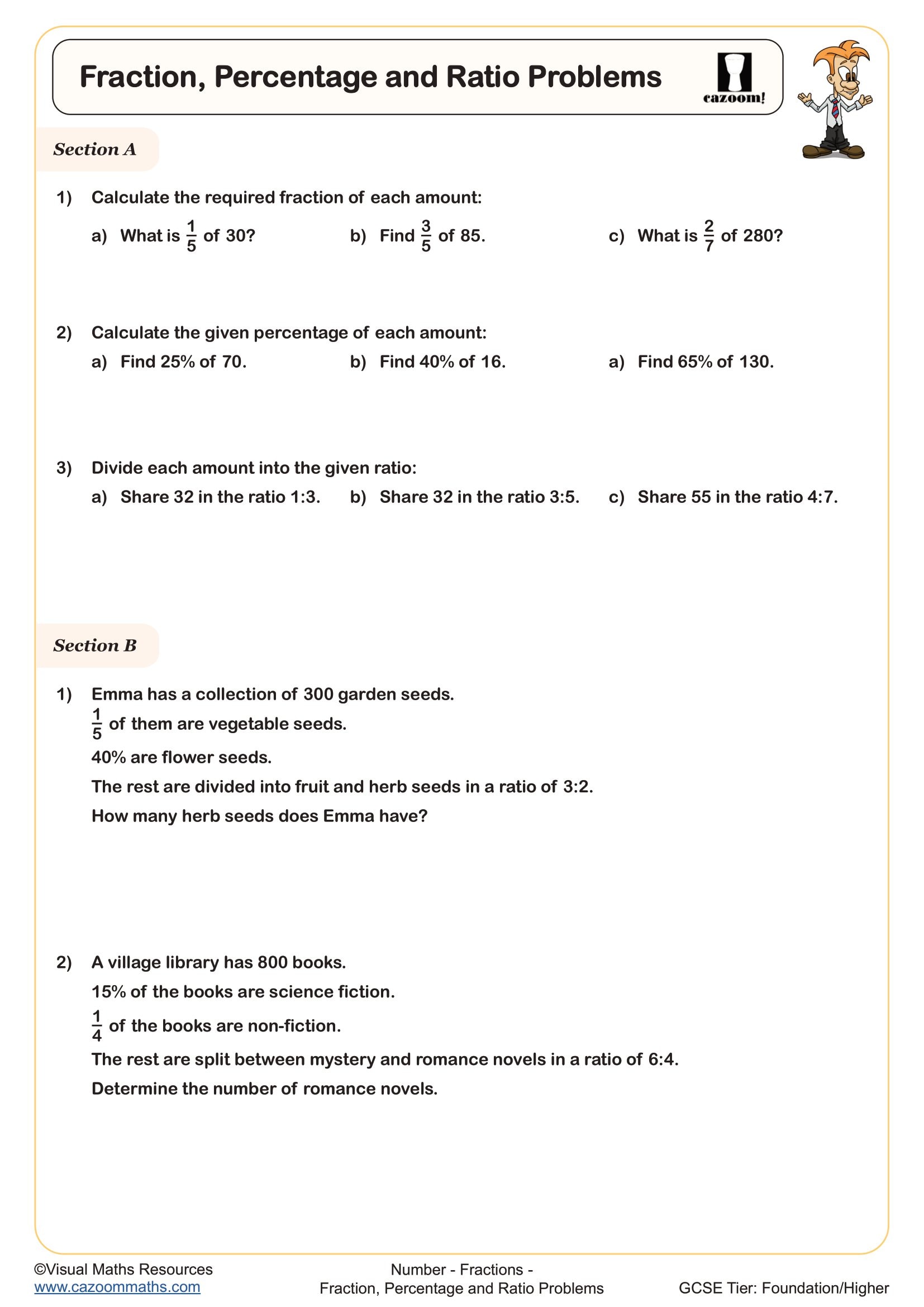
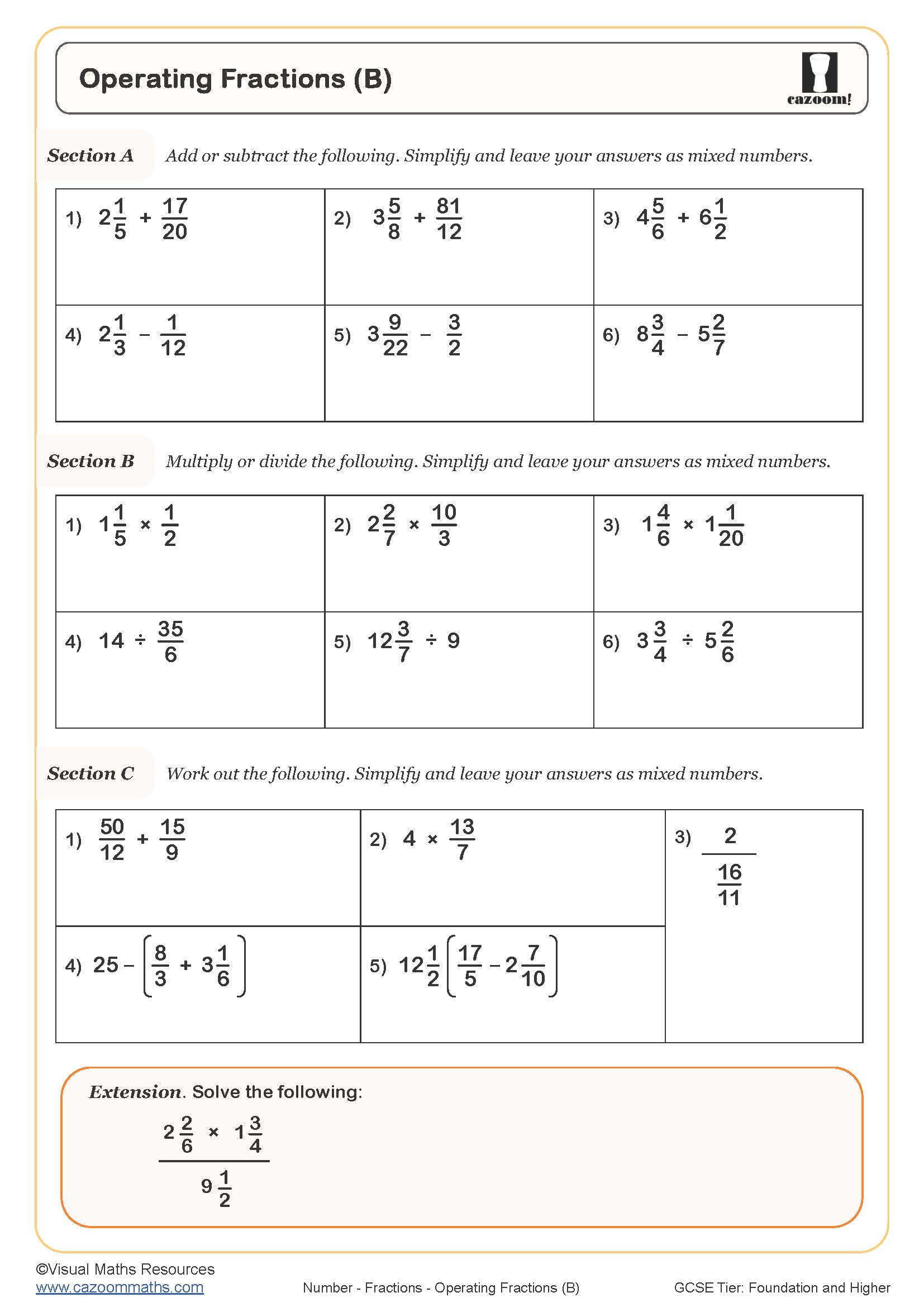
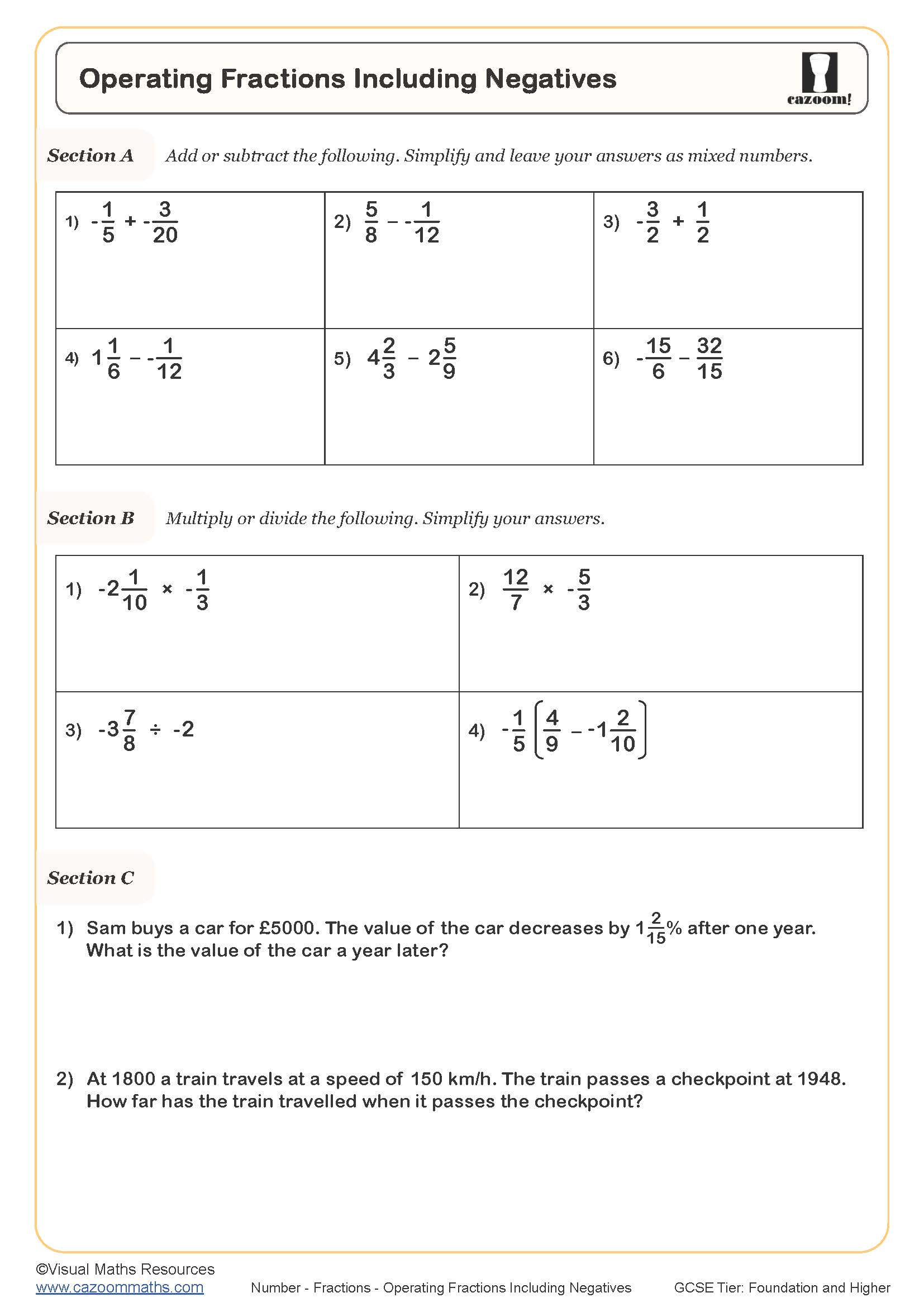
All worksheets are created by the team of experienced teachers at Cazoom Maths.
What types of questions appear on GCSE fractions worksheets with answers?
GCSE fraction problems typically include operations with mixed numbers, algebraic fractions, and complex multi-step calculations involving addition, subtraction, multiplication and division. Students encounter questions requiring conversion between fractions, decimals and percentages, often within real-world contexts such as recipe scaling or probability calculations. The worksheets align with Key Stage 4 requirements and prepare students for both foundation and higher tier examinations.
Teachers notice students frequently lose marks on questions involving negative fractions or when simplifying algebraic expressions with fractional coefficients. The complete answer sheets help identify these common errors early, showing full working methods including intermediate steps that examination marking schemes reward.
Are these worksheets suitable for different year groups beyond Year 11?
Whilst designed for Year 11 students, these fraction worksheets serve multiple year groups depending on ability levels and curriculum demands. High-achieving Year 9 and Year 10 students benefit from early exposure to GCSE-style fraction problems, whilst some Year 12 students use them for revision before starting A-level mathematics topics involving rational functions.
The 11+ fractions questions also support grammar school preparation, as many selective schools test fraction skills at this advanced level. Teachers find the worksheets particularly valuable for setting extension work or targeted intervention, as the varied difficulty levels accommodate different mathematical confidence levels within the same class.
How do these worksheets help with algebraic fractions specifically?
Algebraic fraction problems require students to apply arithmetic fraction rules to expressions containing variables, often causing confusion about when to factorise denominators or find common factors. The worksheets progress systematically from simple algebraic fractions through to complex rational expressions involving quadratic factors in denominators.
Many teachers observe that students attempt to 'cancel' terms incorrectly, such as cancelling x from numerator and denominator when x appears as part of a larger expression rather than as a complete factor. The detailed solutions demonstrate proper algebraic manipulation techniques, emphasising when factorisation must occur before simplification and highlighting common misconceptions through worked examples.
What's the most effective way to use these fraction worksheets in lessons?
Teachers achieve best results by using these worksheets as structured practice following concept introduction, rather than as initial teaching tools. Students benefit from attempting 3-4 questions independently before checking answers, allowing them to identify errors in their method whilst the working remains fresh in their minds.
The answer sheets work effectively for peer marking activities, where students explain solutions to classmates and discuss alternative methods. This approach particularly helps with fraction problems that have multiple solution pathways, such as mixed number calculations where students might convert to improper fractions first or work with the whole number and fractional parts separately.