Year 11 Proportion Worksheets
All worksheets are created by the team of experienced teachers at Cazoom Maths.
What topics are covered in a direct and inverse proportion worksheet?
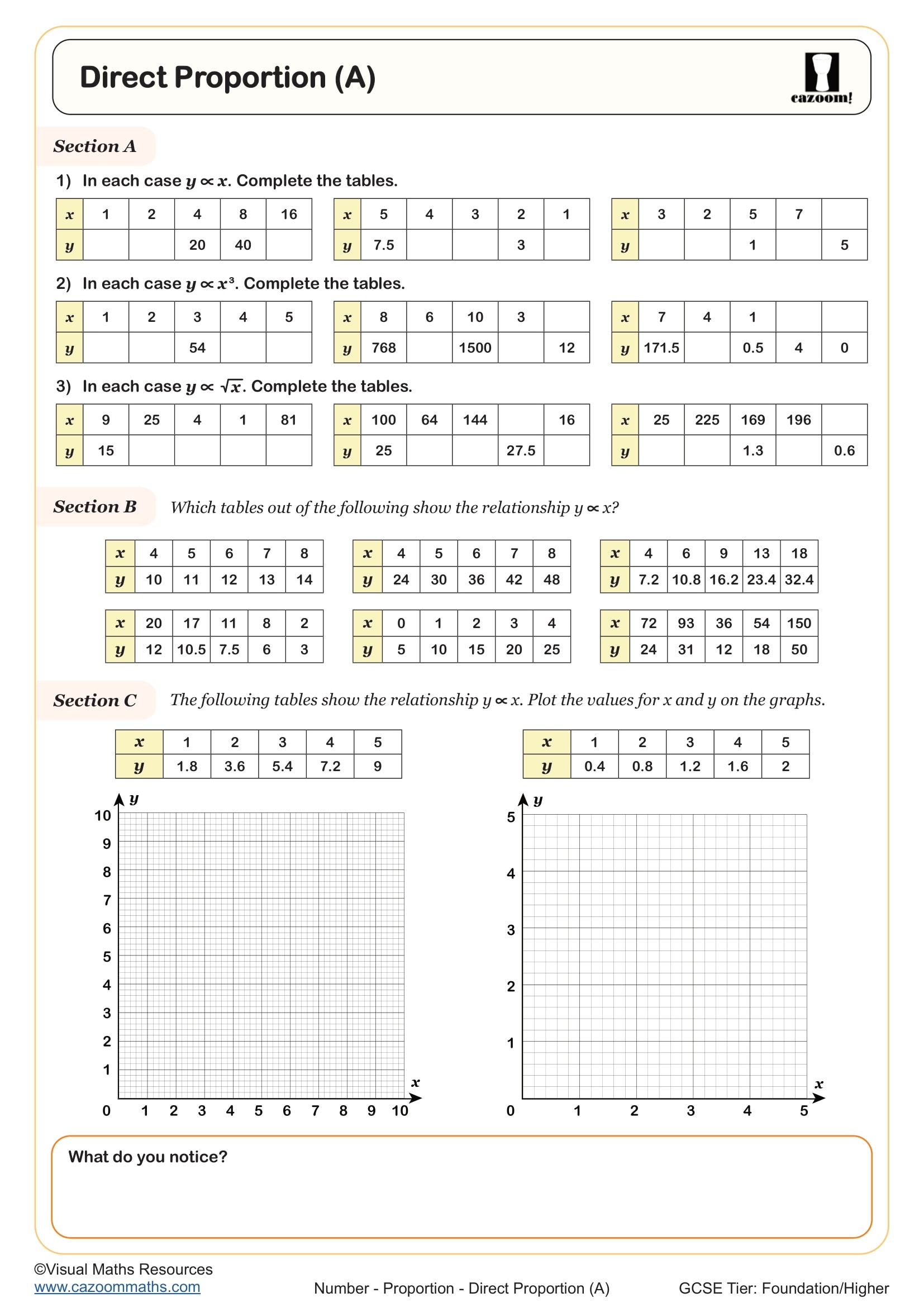
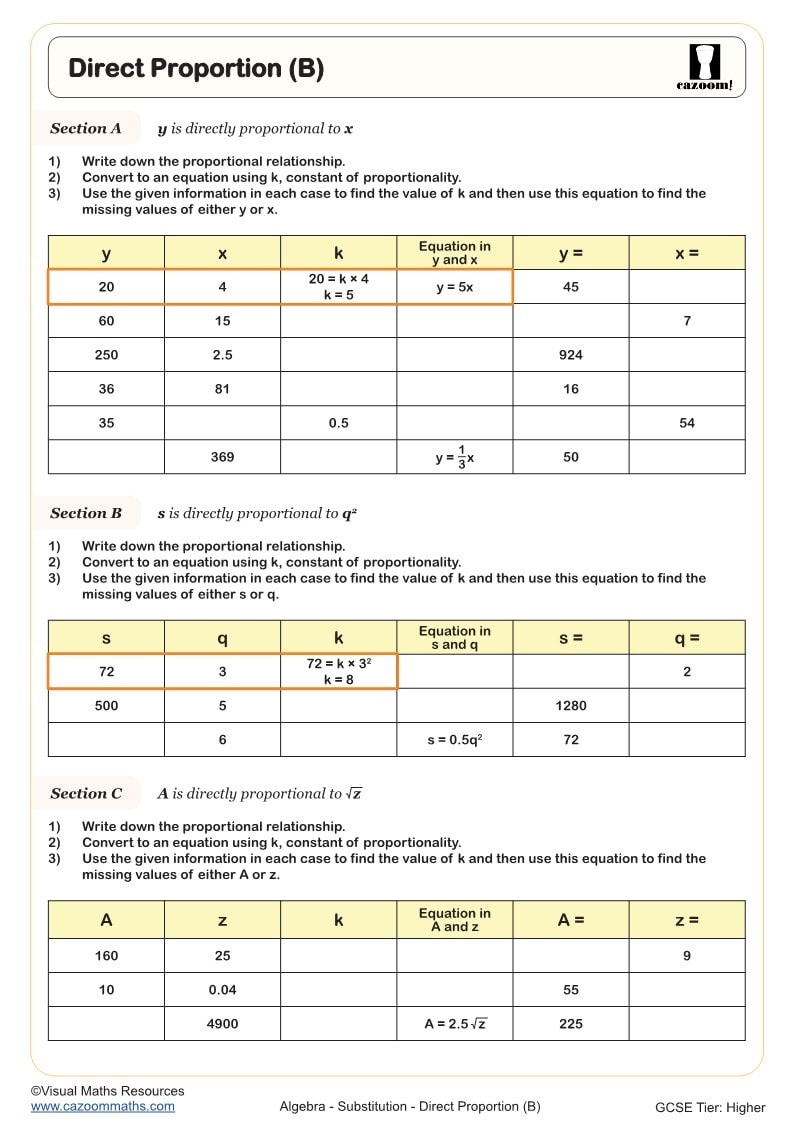
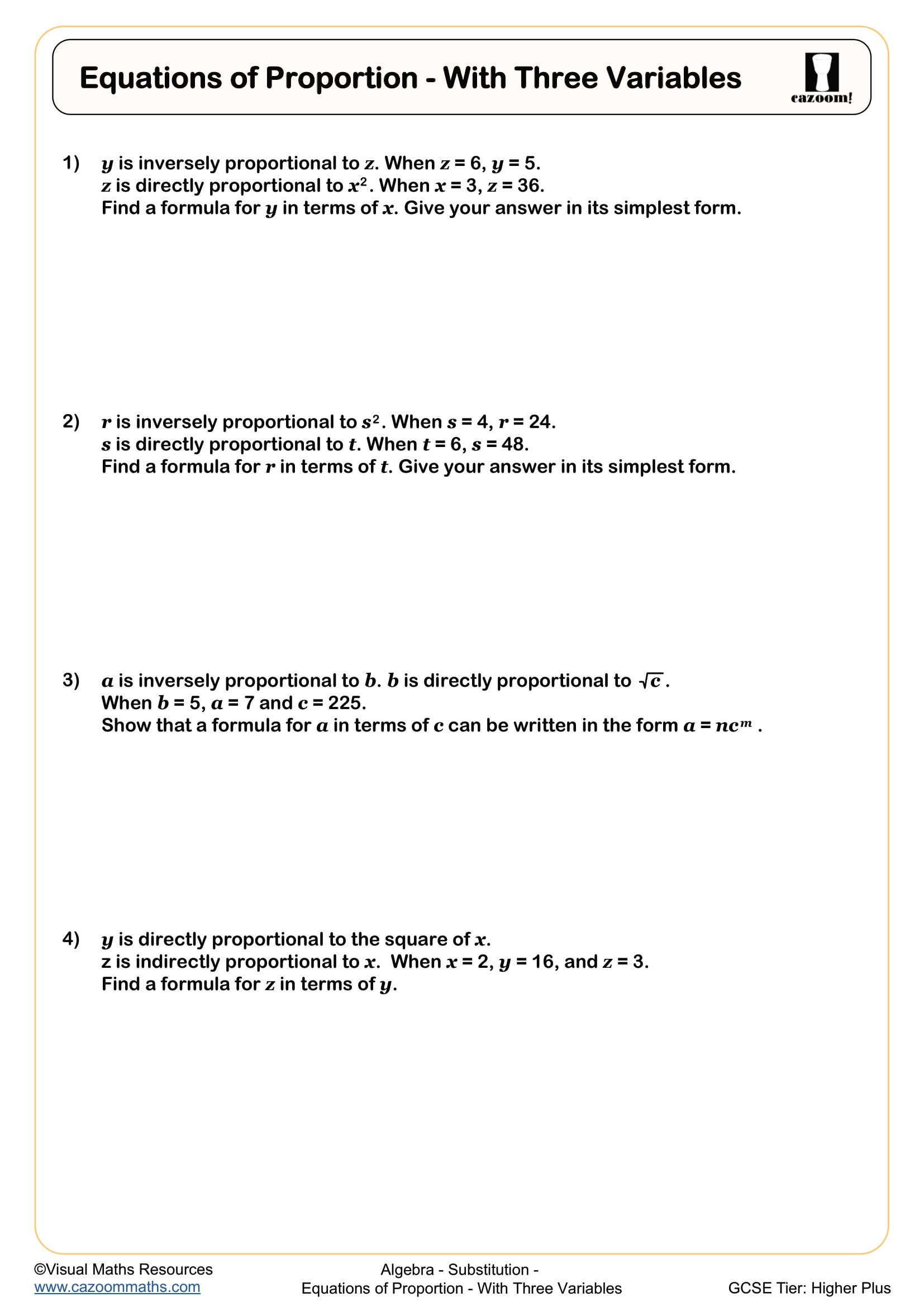
Direct and inverse proportion worksheets cover identifying proportional relationships, writing proportion equations using k as the constant, and solving problems where one quantity increases as another increases (direct) or decreases (inverse). Students work through currency conversion, recipe scaling, speed-time-distance problems, and scientific applications like Boyle's Law in physics.
Teachers notice students often confuse the two types when reading word problems. A common error occurs when students see 'more workers, less time' scenarios but incorrectly apply direct proportion methods. The worksheets include mixed question types to help students develop this crucial discrimination skill needed for GCSE examinations.
Which year groups should use these proportion worksheets?
These worksheets target Year 11 students preparing for GCSE mathematics, though some Year 10 students studying higher tier content may benefit from the structured approach. The National Curriculum introduces proportion concepts earlier, but the algebraic manipulation and complex problem-solving featured here aligns with Key Stage 4 expectations.
Teachers find that students who struggled with basic ratio work in Years 9 and 10 often experience renewed success with these materials. The progression from simple proportion calculations to exam-style questions helps bridge the gap between foundation concepts and the analytical thinking required for higher GCSE grades.
How do students tackle inverse proportion problems effectively?
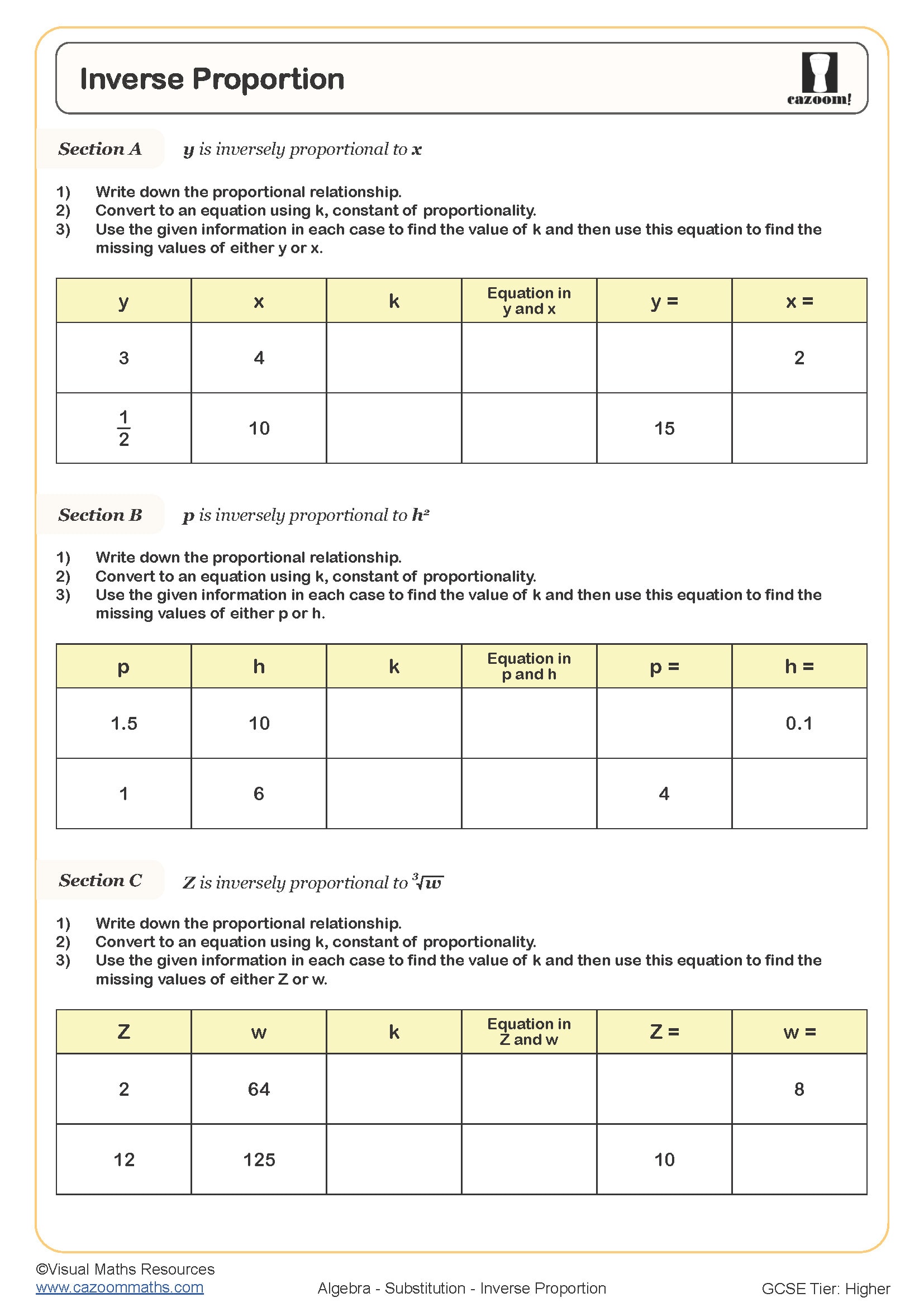
Inverse proportion problems require students to recognise that as one quantity increases, the other decreases at a predictable rate, expressed as y = k/x. Students must identify the constant k by using given values, then apply this relationship to find unknown quantities. Common applications include worker productivity, gear ratios, and gas pressure-volume relationships.
Mathematics teachers observe that students frequently make sign errors when rearranging inverse proportion equations. Many attempt to cross-multiply incorrectly or forget to reciprocate values when solving for the unknown. The worksheets provide systematic practice with checking methods, helping students verify their answers make logical sense within the problem context.
How can teachers use these worksheets to improve exam performance?
Teachers can use these proportion worksheets as targeted intervention for students who lose marks on GCSE proportion questions. The structured progression from identifying proportional relationships to complex problem-solving mirrors exam question difficulty. Complete answer sheets allow for efficient marking and enable students to check their working independently.
Experienced teachers recommend using these materials in small group settings where students can discuss their approach to identifying direct versus inverse relationships. The real-world contexts help students connect abstract mathematical concepts to practical applications, improving retention and transferable problem-solving skills important for higher tier GCSE success.