Year 11 Simplification Worksheets
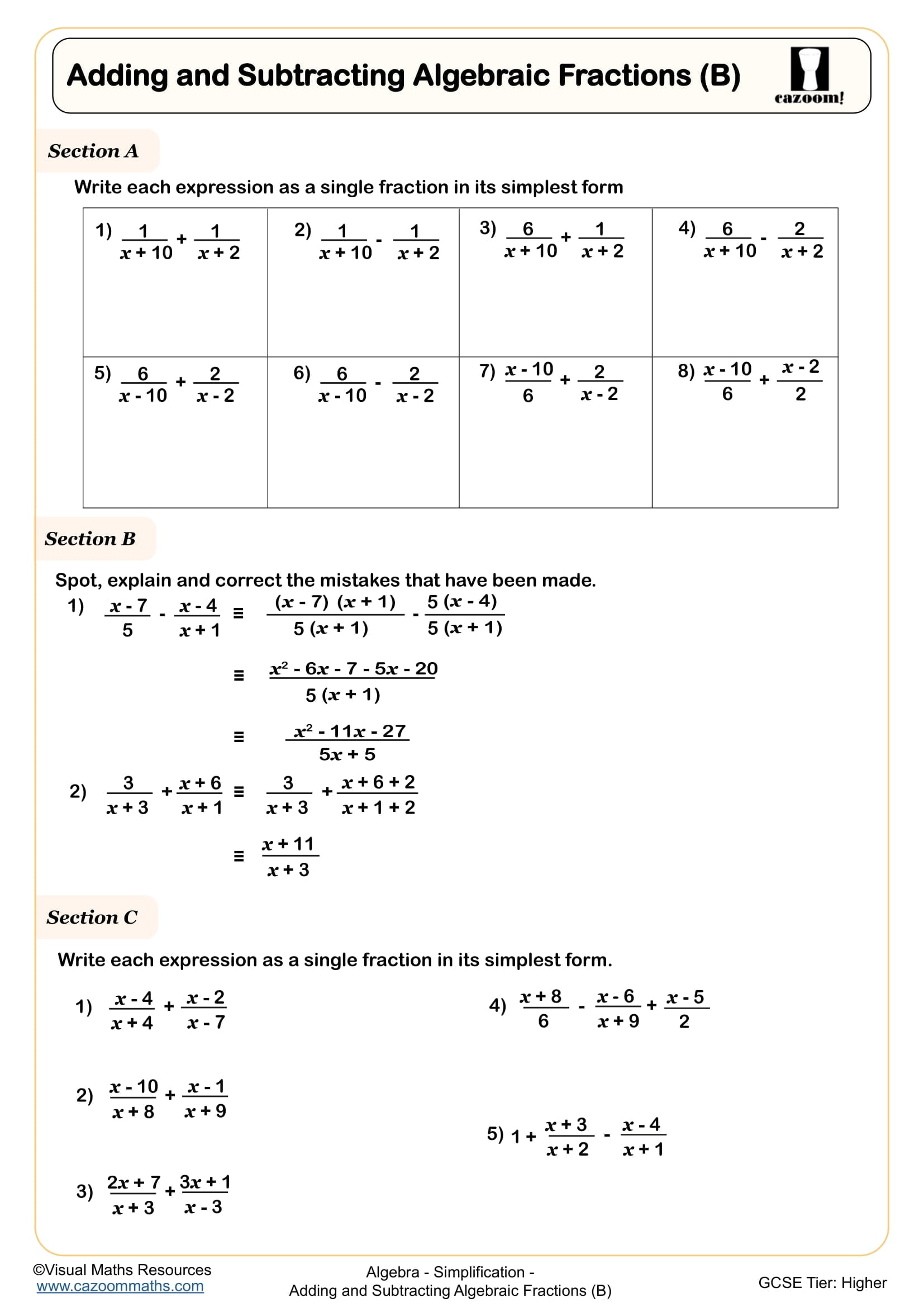
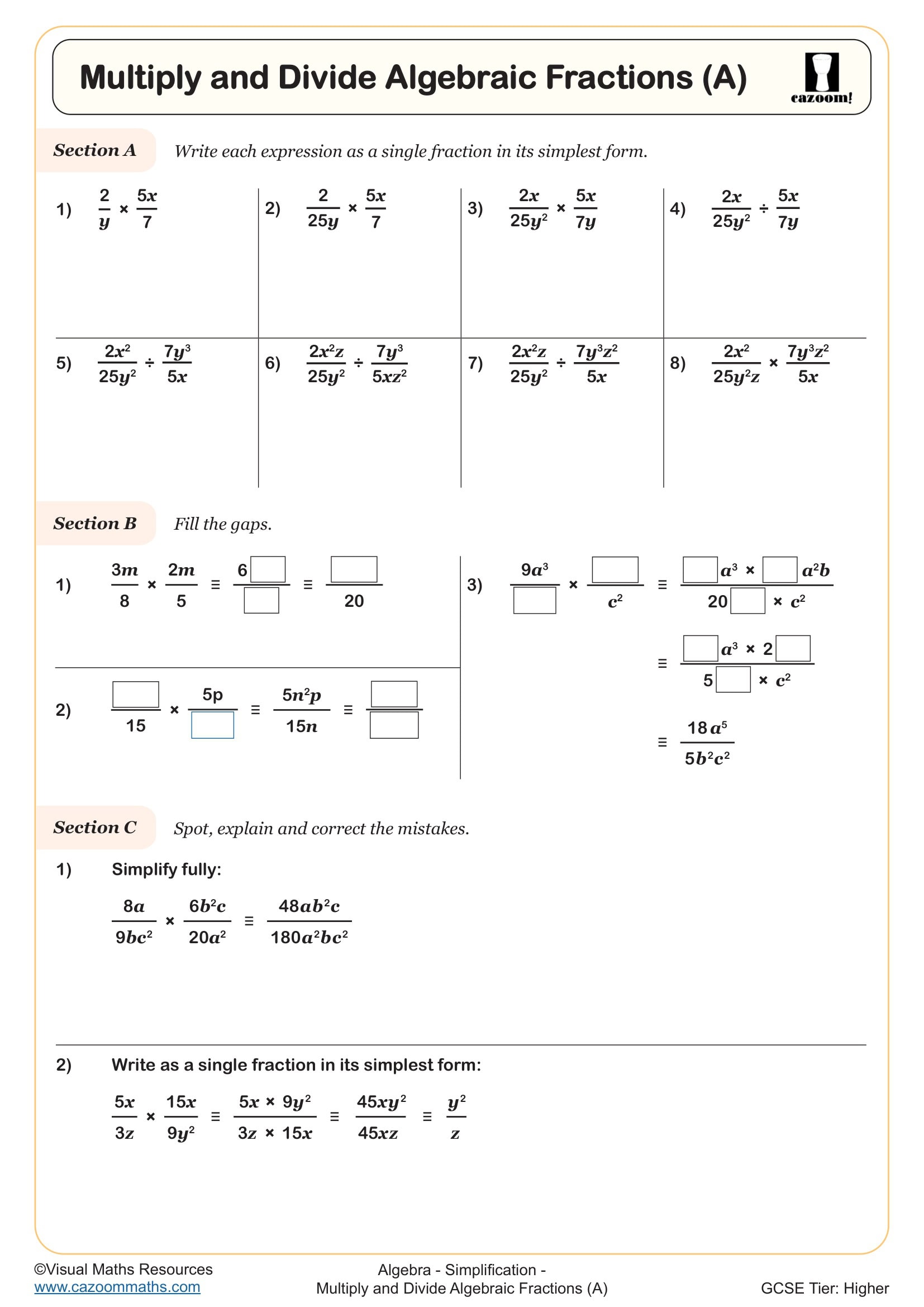
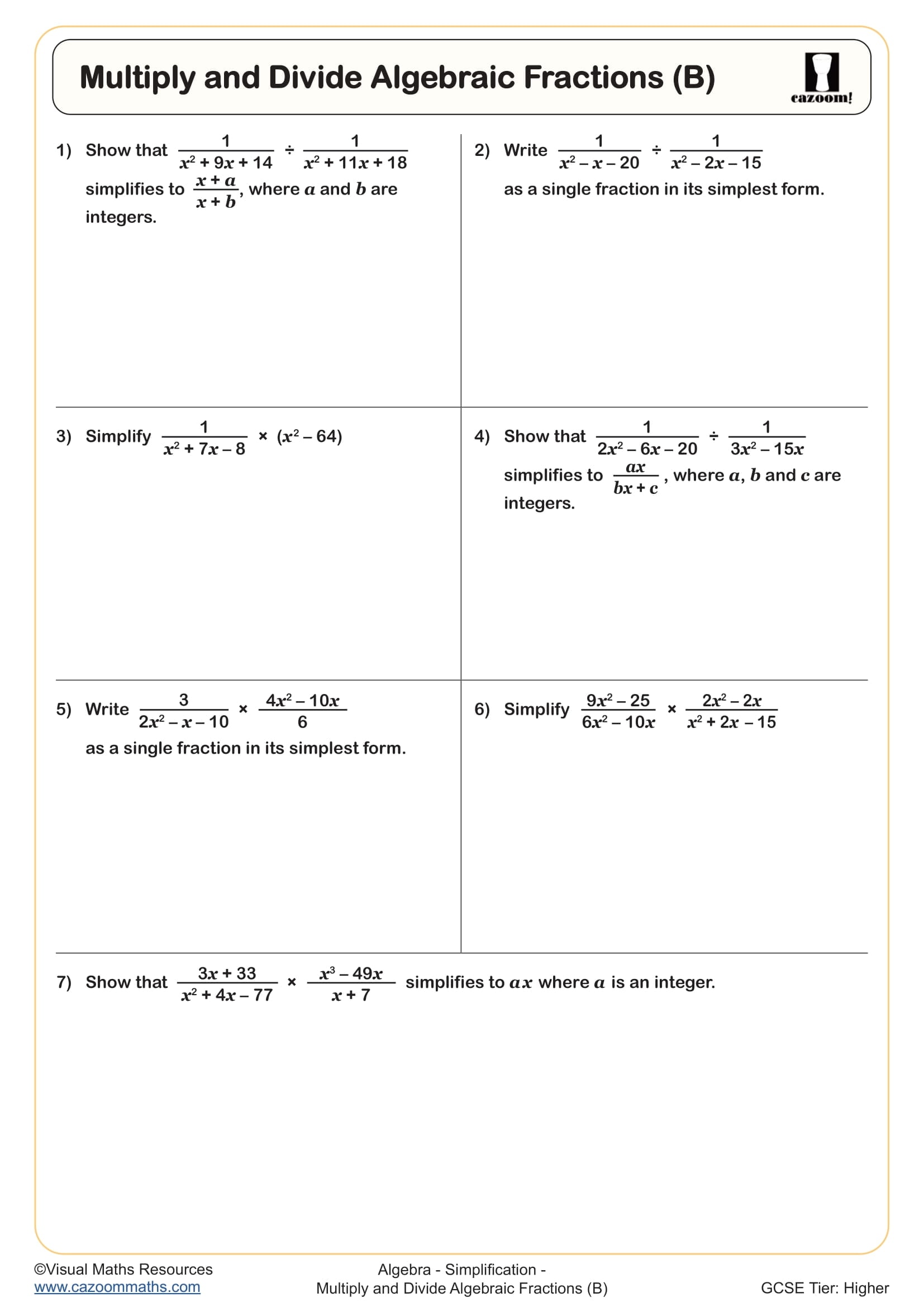
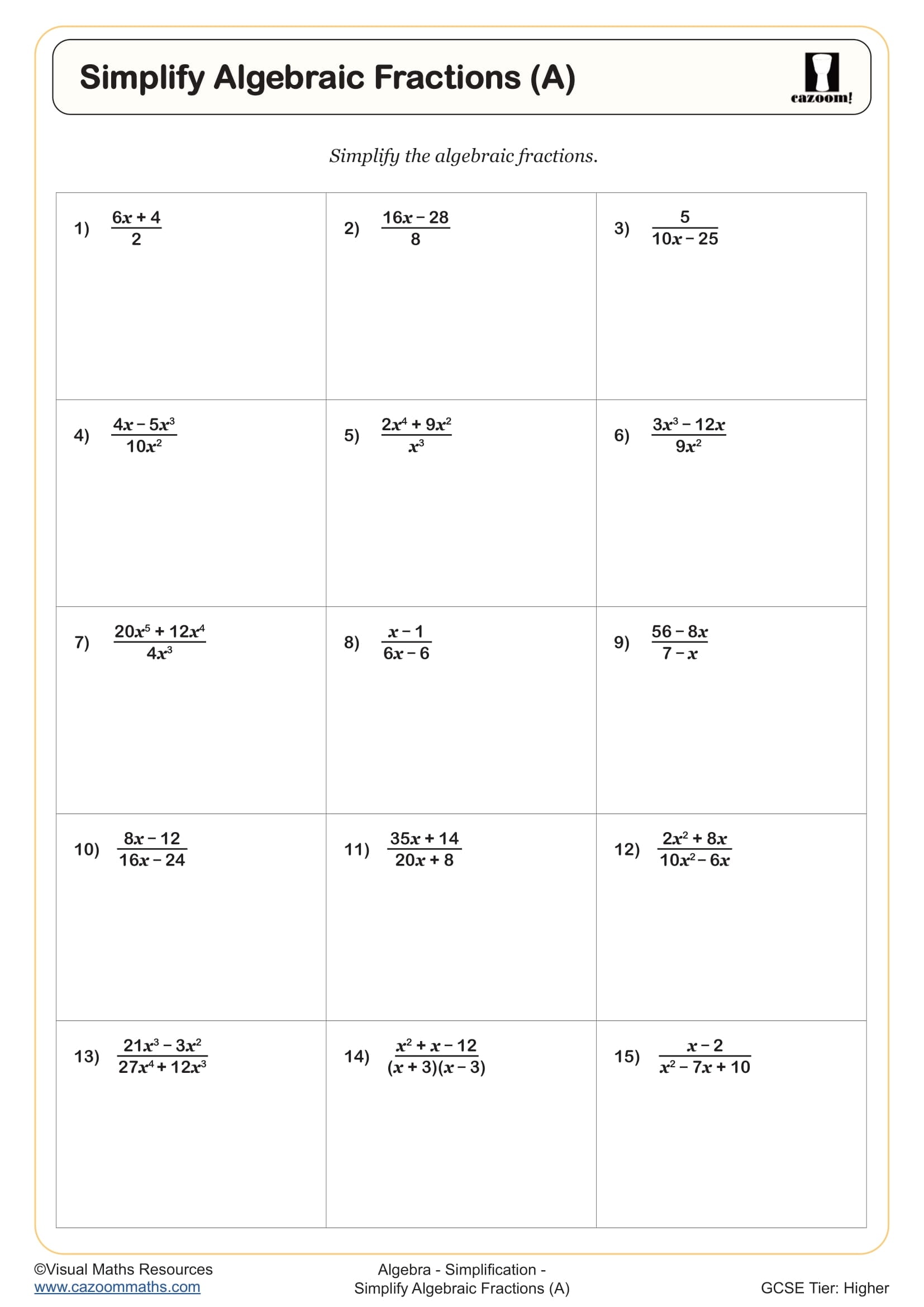
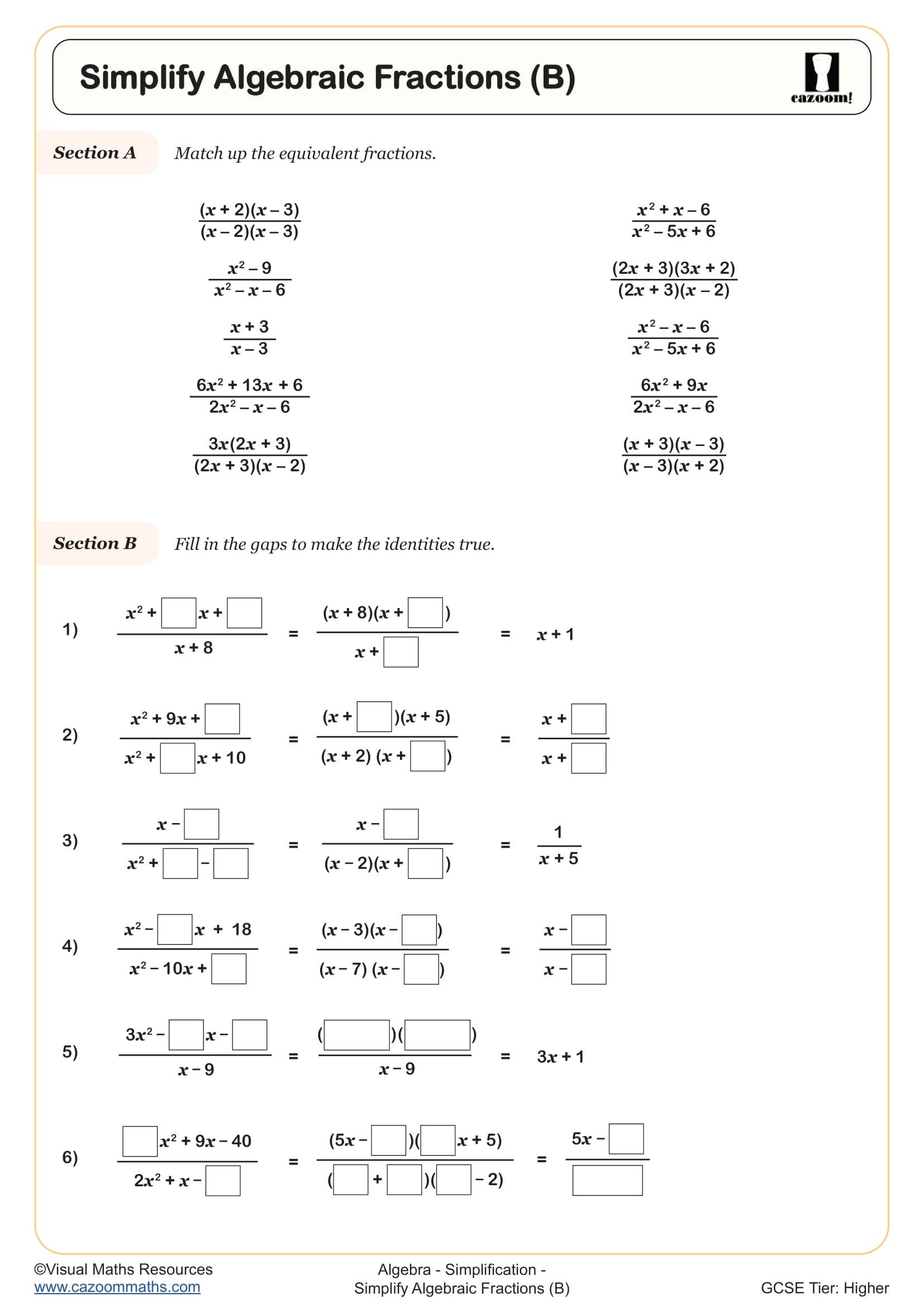
All worksheets are created by the team of experienced teachers at Cazoom Maths.
What are the main types of simplification in Year 11 maths?
Year 11 simplification encompasses algebraic fractions, surds, indices, and expressions involving brackets. Students simplify algebraic fractions by factorising numerators and denominators before cancelling common factors, rationalise denominators containing surds, and apply index laws to condense expressions with powers. These skills directly support equation solving, graph work, and proof questions at GCSE.
A common error occurs when students attempt to cancel terms rather than factors in algebraic fractions. For example, incorrectly cancelling the x in (x+3)/x to give 3, rather than recognising this fraction cannot be simplified further. Exam mark schemes routinely penalise this misconduct, making it essential that students distinguish between terms and factors when simplifying.
Which year groups study simplification?
These worksheets target Year 11 students at Key Stage 4, focusing on the advanced simplification techniques required for GCSE higher tier. At this stage, students consolidate earlier algebraic skills whilst tackling more demanding problems involving surds, complex algebraic fractions, and expressions requiring multiple steps to simplify fully.
The progression from earlier years sees students moving from basic collecting like terms in Year 7 through to sophisticated manipulation of rational expressions by Year 11. Students who struggled with fraction arithmetic in Key Stage 3 often find algebraic fractions particularly challenging, as they must apply numerical fraction rules whilst managing variable terms simultaneously. The worksheets provide targeted practise at this crucial examination stage.
Why is simplifying surds important in maths?
Simplifying surds involves expressing roots in their simplest form by identifying and extracting perfect square factors. For instance, √50 simplifies to 5√2 because 50 = 25 × 2, and √25 = 5. Students must recognise that surds should be left in exact form rather than converted to decimals, maintaining mathematical precision throughout calculations.
This skill proves essential in physics and engineering contexts where exact values matter. When calculating distances using Pythagoras' theorem or determining wavelengths in wave mechanics, leaving answers as simplified surds preserves accuracy. Converting √2 to 1.414 introduces rounding errors that compound through subsequent calculations, whereas maintaining the surd form ensures results remain mathematically exact throughout problem-solving sequences.
How do these worksheets support GCSE preparation?
The worksheets scaffold learning through progressive difficulty levels, starting with standard simplification tasks before advancing to examination-style questions requiring multi-step approaches. Students encounter problems that mirror GCSE paper formats, including those where simplification forms part of a larger algebraic proof or equation-solving question, building the stamina needed for higher-tier papers.
Many teachers use these resources for targeted intervention sessions with students who lose marks through algebraic manipulation errors rather than conceptual misunderstanding. The answer sheets enable students to work through problems independently during revision sessions or homework, whilst the structured layout makes them effective for paired work where students compare methods. Teachers also find them useful for quick starter activities to maintain algebraic fluency throughout Year 11.