Year 11 Substitution Worksheets
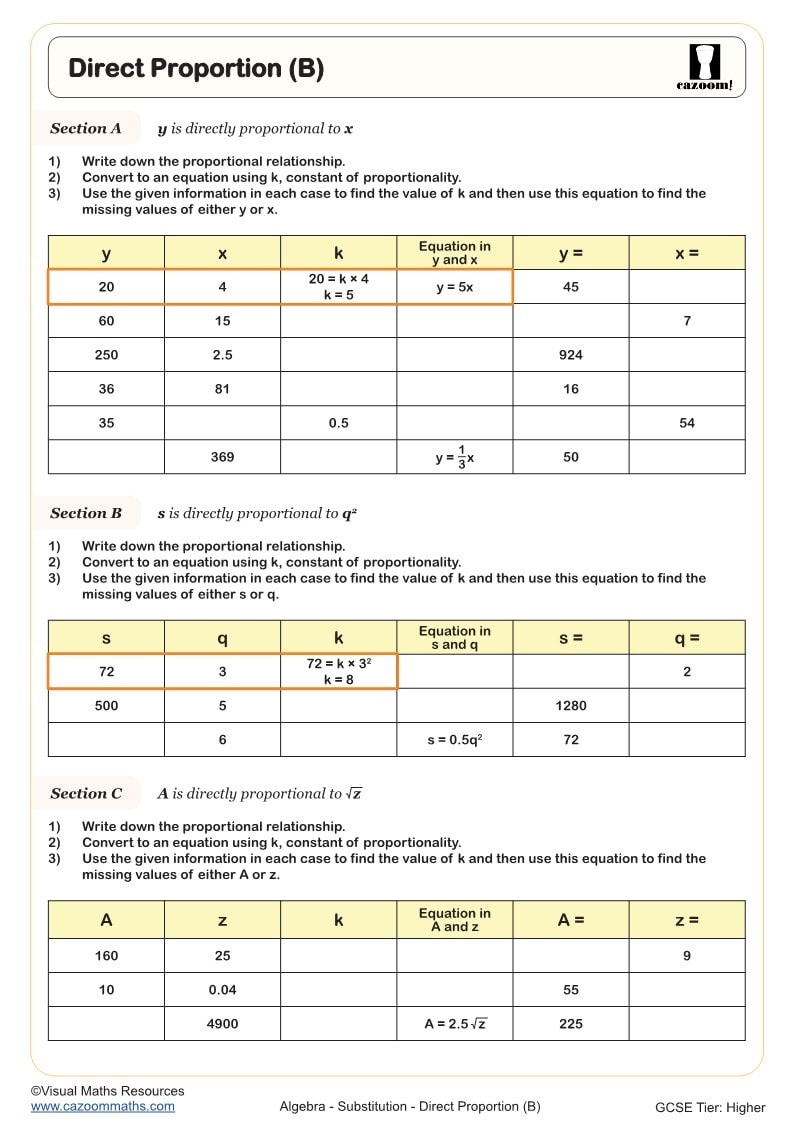
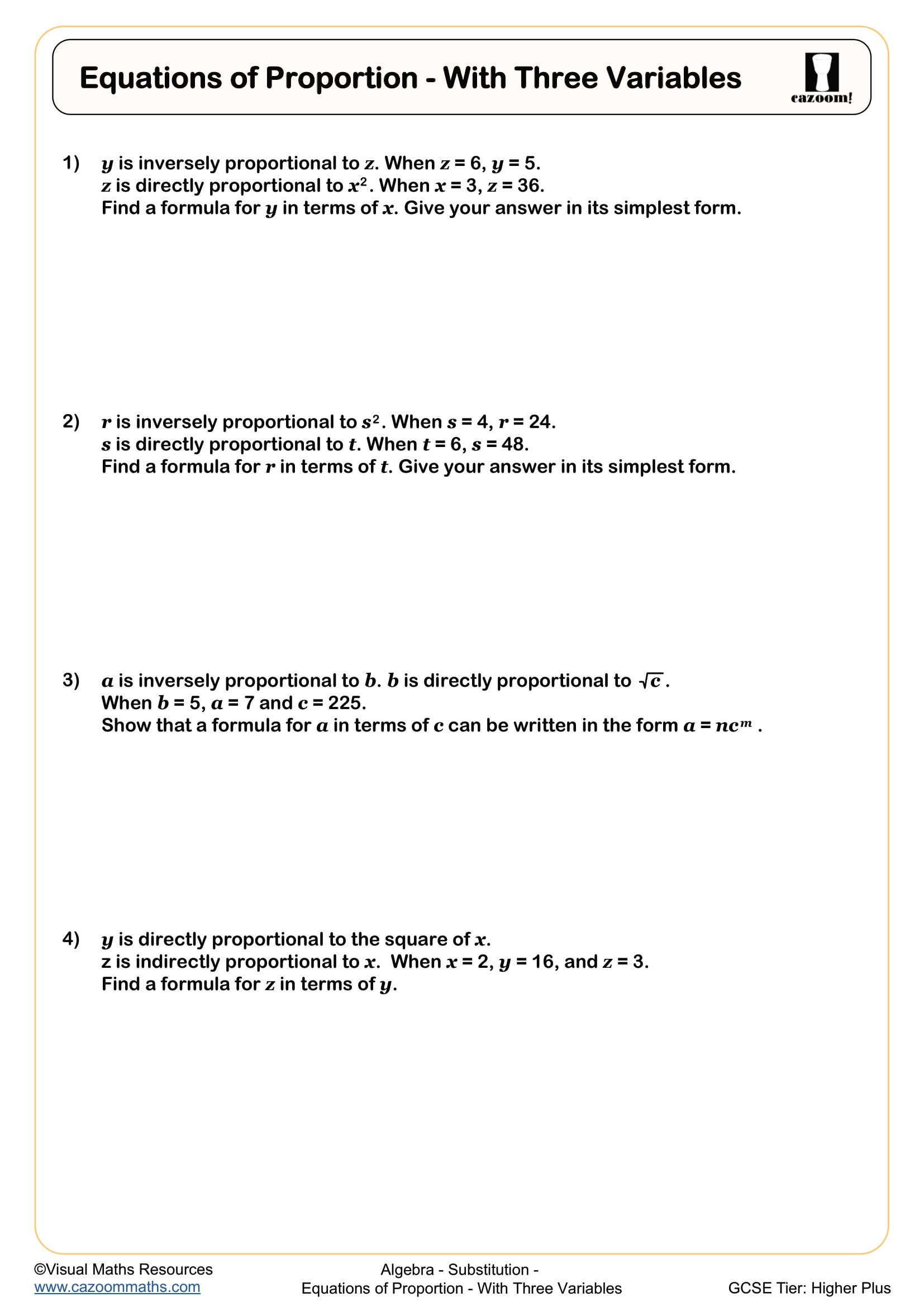
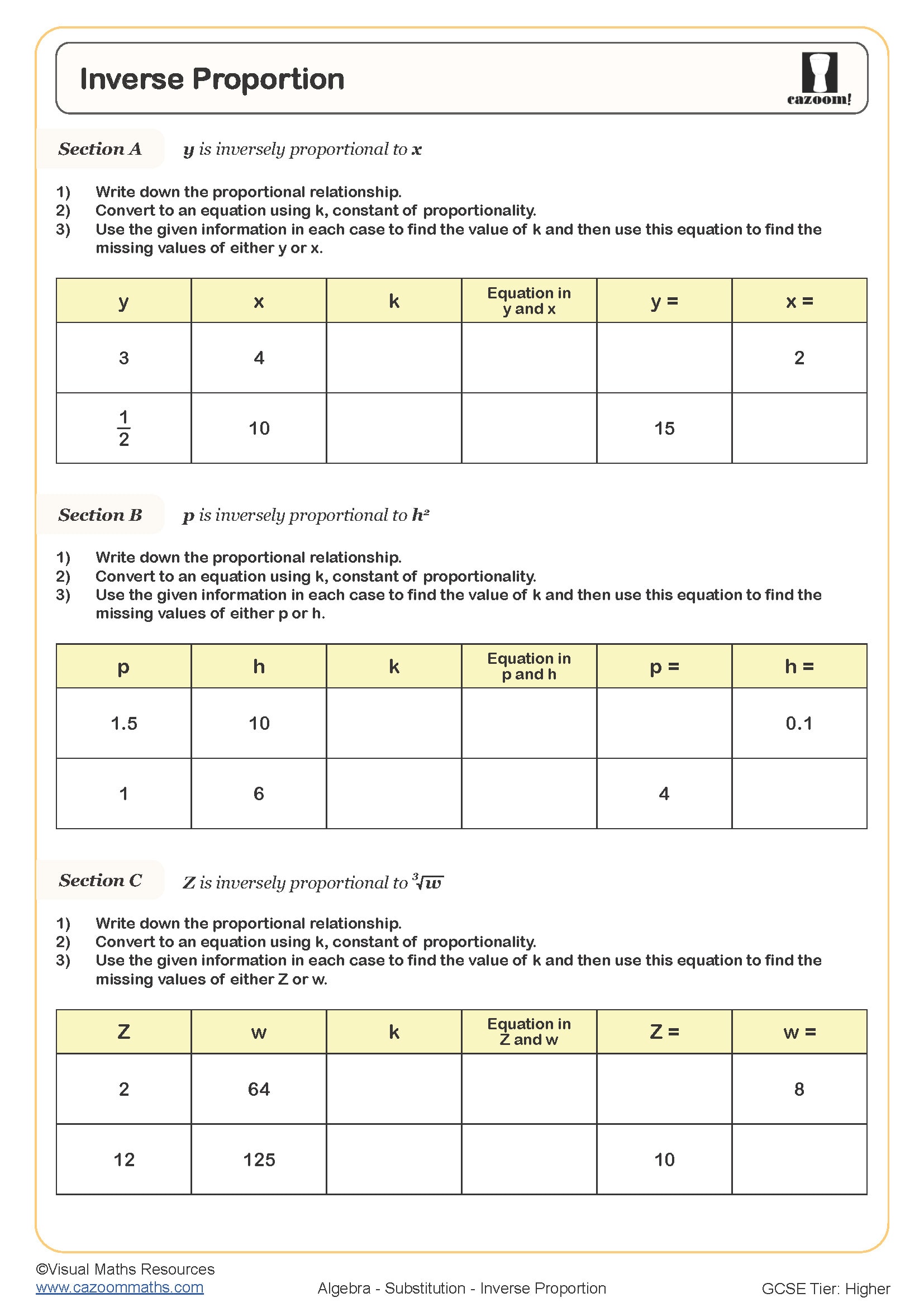
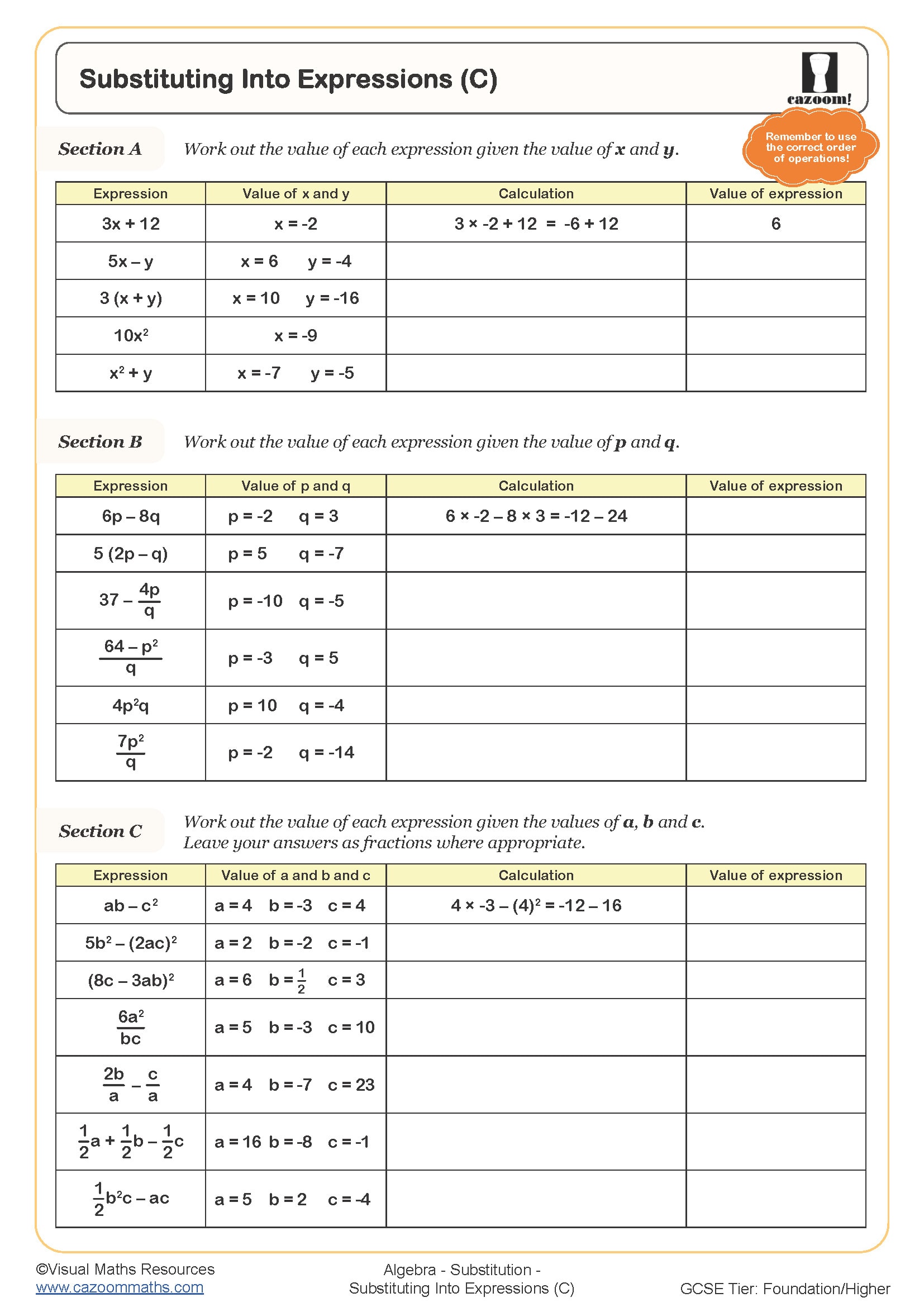
All worksheets are created by the team of experienced teachers at Cazoom Maths.
What is substitution in maths?
Substitution in maths involves replacing letters or variables in an algebraic expression with specific numerical values, then calculating the result. At GCSE level, students encounter substitution when working with formulae in science (such as speed, density, or area calculations), evaluating functions, and solving equations. The skill requires careful attention to the order of operations and the handling of negative numbers.
A common misconception is that students substitute the values but fail to treat the expression as a cohesive whole. For example, when substituting x = -3 into 2x², many students write 2 × -3² and get -18 instead of recognising that the square applies only to the 3, giving 2 × 9 = 18. Exam mark schemes consistently penalise this error, which stems from insufficient practice with brackets and priority of operations during substitution tasks.
Which year groups study substitution?
These worksheets are designed for Year 11 students at Key Stage 4, where substitution becomes increasingly sophisticated in preparation for GCSE examinations. At this stage, students work with more complex expressions involving powers, roots, fractions, and multiple variables, often within the context of formulae from geometry, science, or problem-solving scenarios. The skill is essential for both Foundation and Higher tier papers.
By Year 11, students are expected to substitute into expressions confidently and accurately under exam conditions, often as part of multi-step questions. Teachers observe that while basic substitution may have been introduced in Year 7 or 8, many students still struggle with the systematic approach required at GCSE level, particularly when expressions involve multiple operations or when they must rearrange formulae before substituting values.
How is substitution used in real-world contexts?
Substitution forms the basis of using formulae across countless practical applications. Students use substitution when calculating distances using speed and time formulae, determining costs from pricing structures, finding areas and volumes using geometric formulae, or evaluating compound interest. In each case, they're taking a general relationship and applying specific values to find a particular result.
In STEM careers, substitution is fundamental to engineering calculations, computer programming (where variables are assigned values), and scientific experiments. Physicists substitute measured values into equations to predict outcomes, whilst engineers use substitution to test whether designs meet safety specifications. This skill bridges the gap between abstract algebraic thinking and practical problem-solving, demonstrating why accuracy with brackets, signs, and operations matters beyond the classroom.
How do these worksheets help students master substitution?
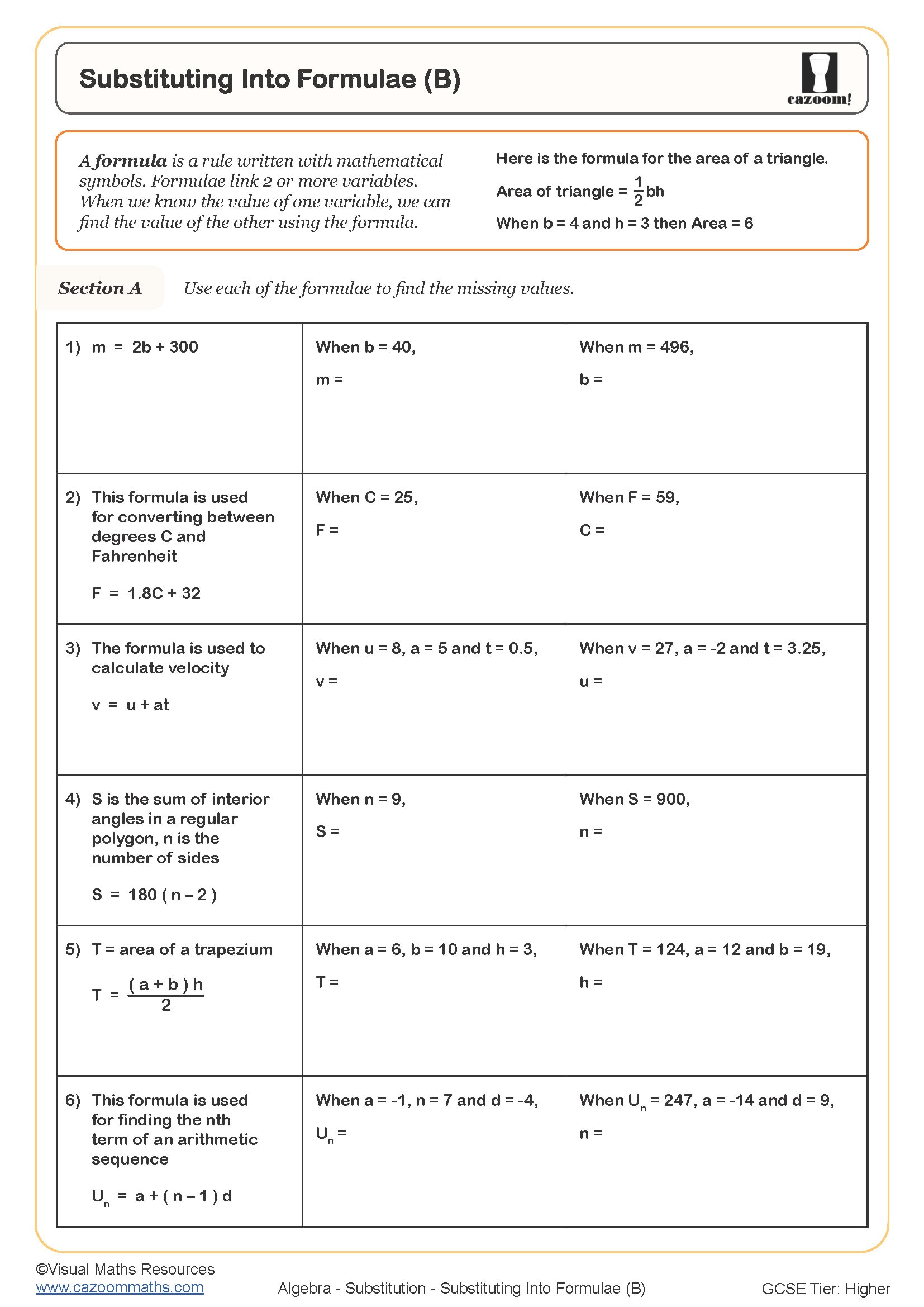
The worksheets build proficiency through progressive questioning that starts with straightforward single-variable substitution before introducing complications like negative values, brackets, and indices. This scaffolded approach allows students to consolidate basic technique before tackling the multi-step problems typical of GCSE questions. The included answer sheets enable students to identify exactly where errors occur, whether in the substitution step itself or in subsequent calculations.
Teachers use these worksheets for targeted intervention with students who struggle in exam-style questions, as homework to reinforce lesson content, or as starter activities to maintain fluency throughout Year 11. They work particularly well for paired practice, where one student substitutes values whilst their partner checks the working, encouraging mathematical discussion about order of operations and common errors. The downloadable PDF format makes them convenient for printing as needed or setting as remote learning tasks.