Year 7 3D Shapes Worksheets
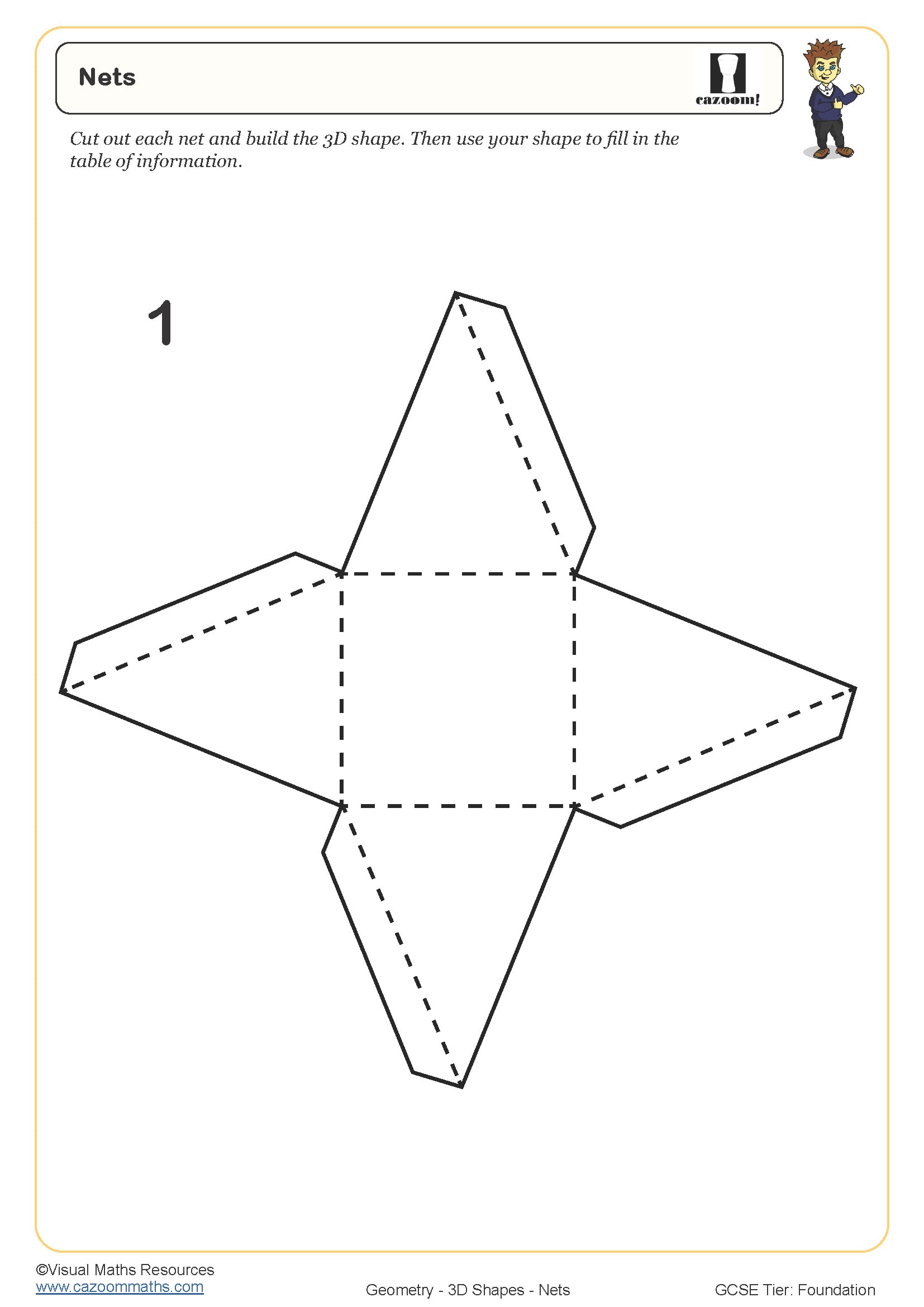
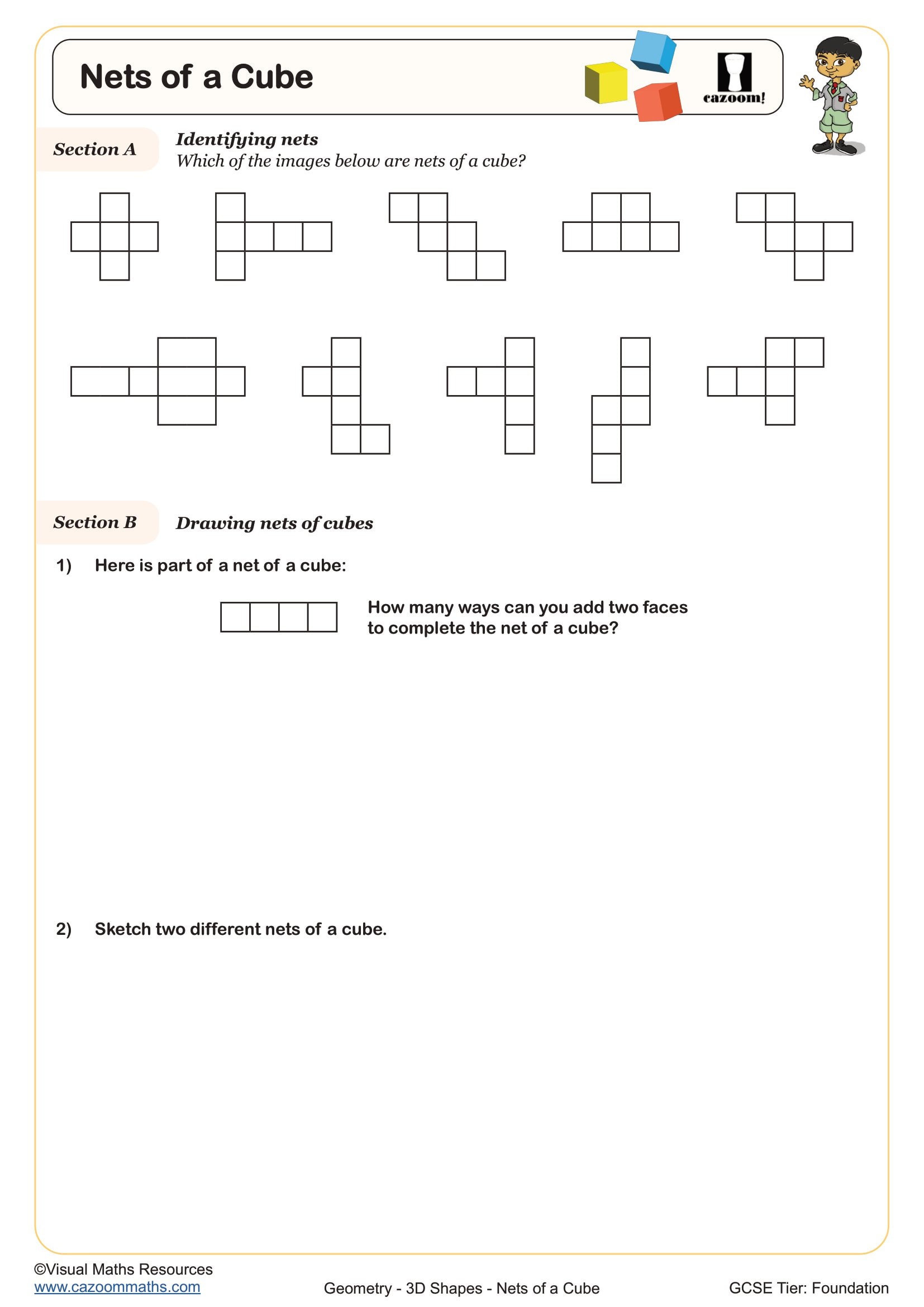
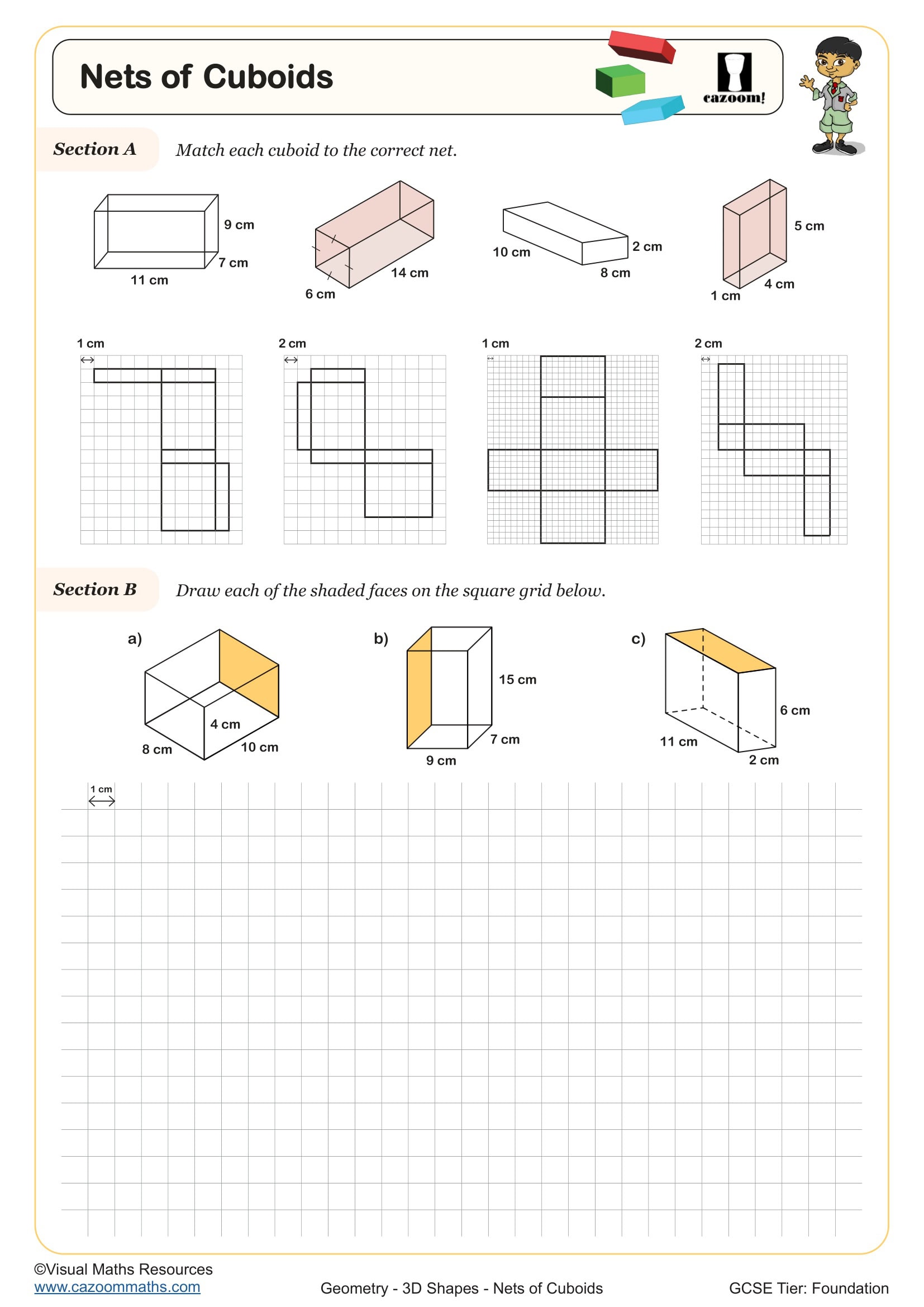
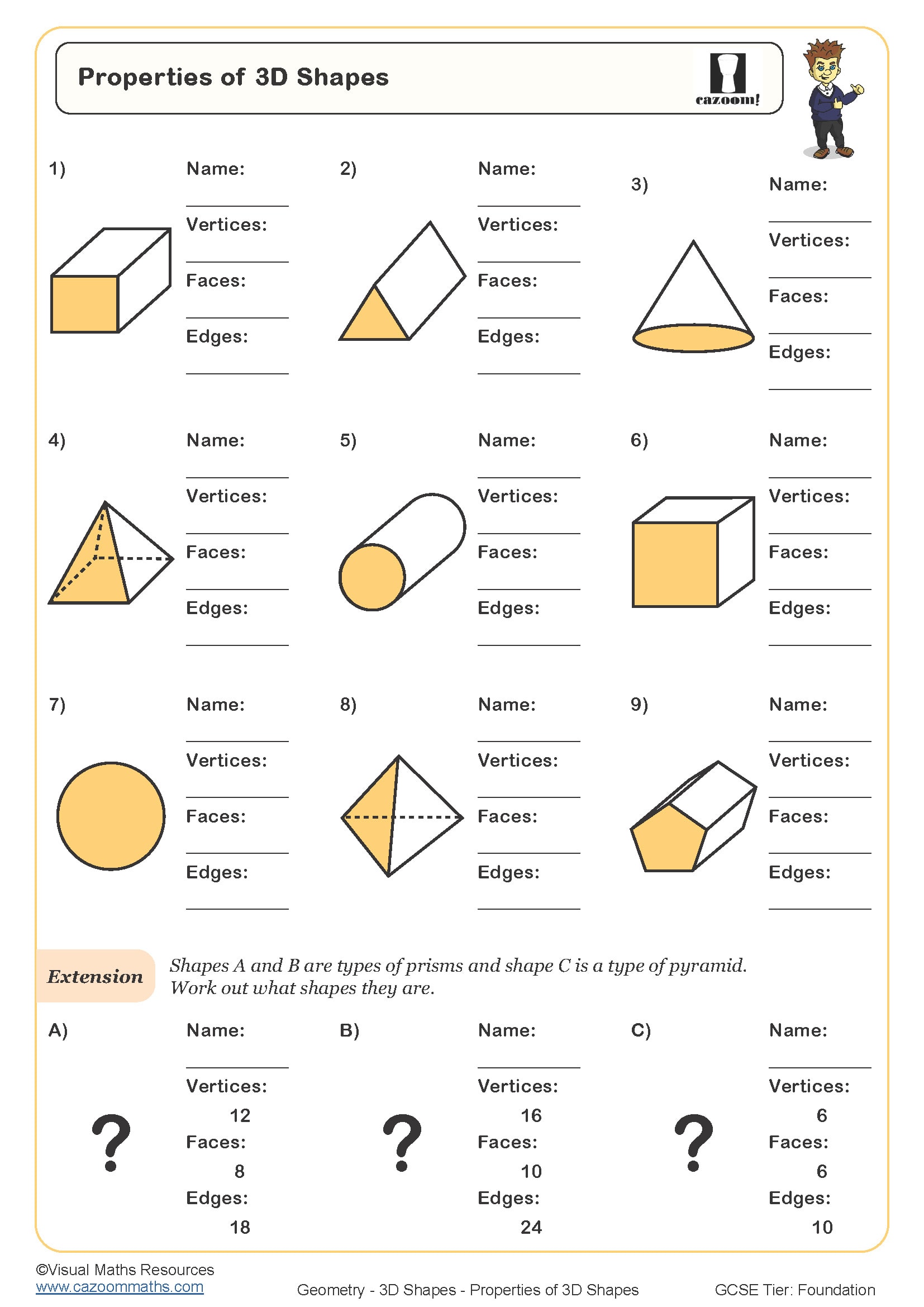
All worksheets are created by the team of experienced teachers at Cazoom Maths.
What properties of 3D shapes do Year 7 students need to know?
Year 7 students working with 3D shapes need to identify and count faces, edges and vertices across common solids including cubes, cuboids, prisms, pyramids, cylinders, cones and spheres. The National Curriculum at KS3 expects students to calculate surface area and volume of cuboids and other prisms, understand how nets fold to create three-dimensional objects, and recognise cross-sections through solids. Students also explore the relationship between 2D and 3D shapes, identifying which polygons form the faces of different solids.
A frequent error occurs when students calculate surface area by counting only the visible faces in a diagram, forgetting hidden faces at the back or bottom. When marking surface area questions, exam papers expect students to show they've identified all faces systematically, often by listing the area of each face type before totalling. This methodical approach prevents the common mistake of calculating just three faces of a cuboid and doubling, which fails when faces aren't in matching pairs.
Which year groups study 3D shapes?
These worksheets target Year 7 students at KS3, where three-dimensional geometry becomes more formal and calculation-based compared to primary work. Students arrive from KS2 having named common 3D shapes and identified their properties, but Year 7 introduces formulae for volume and surface area, requires algebraic approaches when dimensions are given as expressions, and demands accurate visualisation of nets and cross-sections.
The progression across KS3 sees increasing complexity in the shapes studied and calculations required. Year 7 typically focuses on cuboids, triangular prisms, cylinders and simple pyramids with integer dimensions. By Year 9, students work with composite solids, frustums, hemispheres and problems requiring multiple steps across different formulae. Many schools introduce volume and surface area of spheres, cones and pyramids in Year 8 or 9, building towards GCSE content where these appear as Foundation tier topics with calculator methods expected.
How do you calculate the surface area of a prism?
Surface area of a prism involves calculating the area of each face separately, then totalling all areas to find the complete outer surface. For a cuboid with length l, width w and height h, this means finding 2lw + 2lh + 2wh by identifying the three pairs of identical rectangular faces. For a triangular prism, students calculate the area of two identical triangular ends plus three rectangular faces that wrap around the sides, requiring both triangle area formula and multiplication of base lengths by the prism's depth.
Understanding surface area has practical applications in packaging design, construction and engineering. Architects calculate surface areas when specifying materials for cladding buildings, ensuring they order sufficient panels or sheeting to cover all external faces. In manufacturing, surface area determines how much cardboard a company needs to produce boxes, directly affecting costs and environmental impact. Students working in product design or engineering careers regularly use these calculations when creating protective packaging, designing storage containers, or estimating paint quantities for industrial components.
How can teachers use these 3D shapes worksheets effectively?
The worksheets provide structured practice that moves from identifying properties through to multi-step calculations, allowing teachers to target specific skills where students need reinforcement. Questions typically begin with naming shapes and counting faces, edges and vertices before progressing to net drawing, then surface area and volume calculations with scaffolding that shows which formula to apply. This gradual increase in demand suits mixed-ability classes where some students need basic property work whilst others tackle complex composite solids.
Many teachers use these resources during intervention sessions with students who struggle to visualise three-dimensional objects from two-dimensional diagrams, pairing worksheet questions with physical models or nets that students can fold. The complete answer sheets support independent revision before assessments, allowing students to identify misconceptions about which faces to include in surface area calculations. Homework tasks often combine one worksheet across a week, with different sections set on different evenings to maintain regular engagement with spatial reasoning without overwhelming students with lengthy problem sets.