Year 8 Powers and Roots Worksheets
Add and Subtract in Standard Form
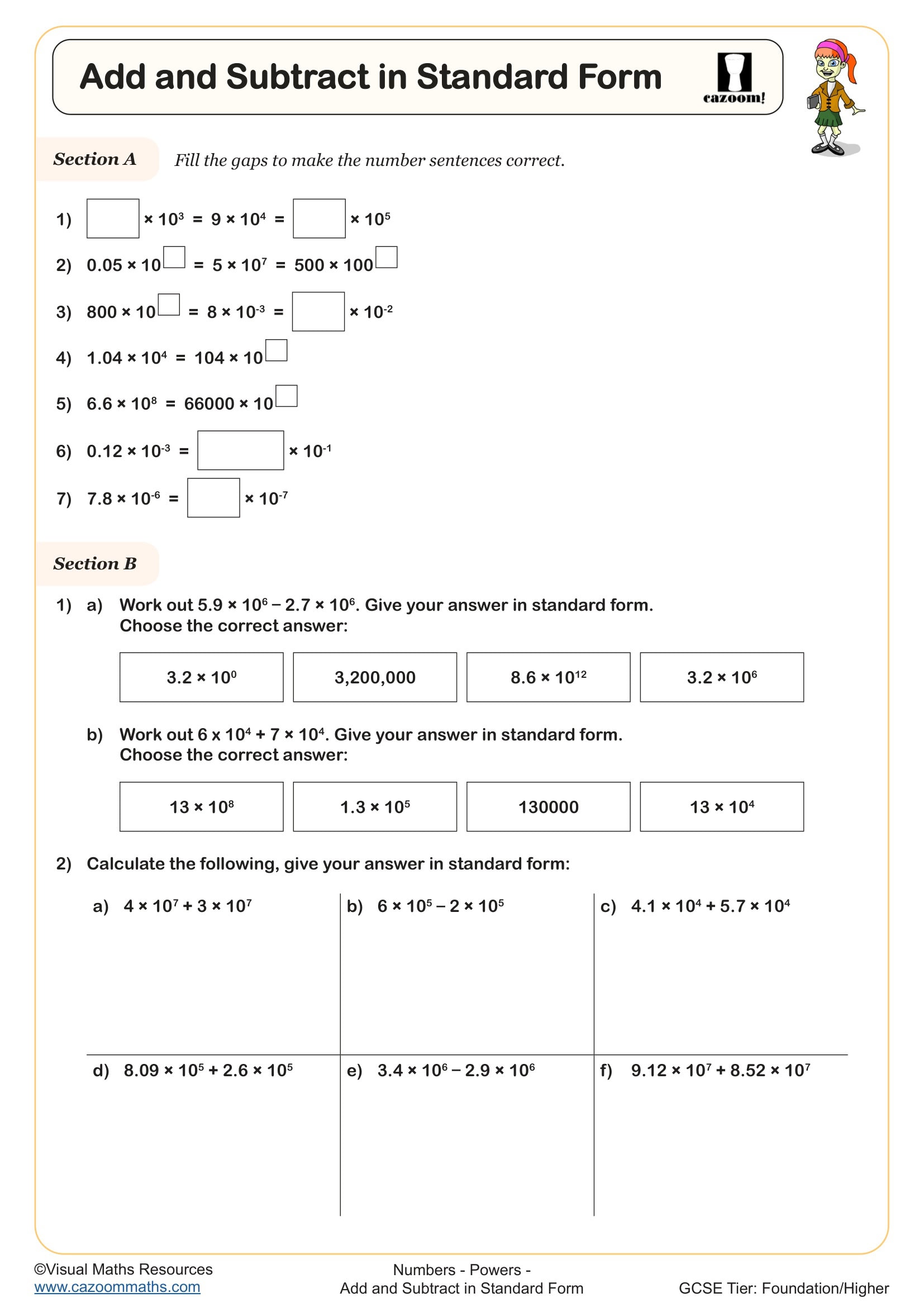
Calculating Using Standard Form
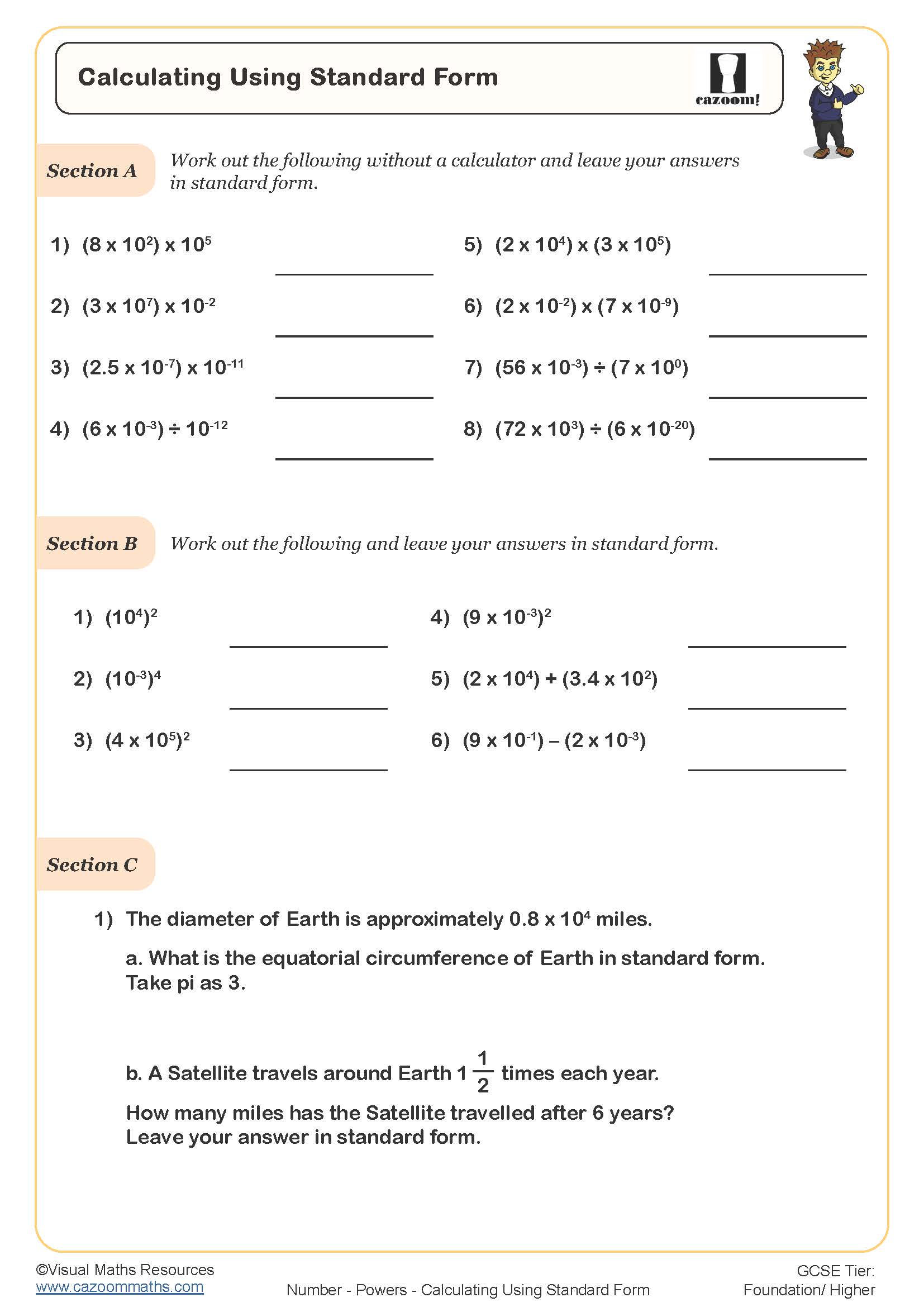
Calculations Using Indices (A)
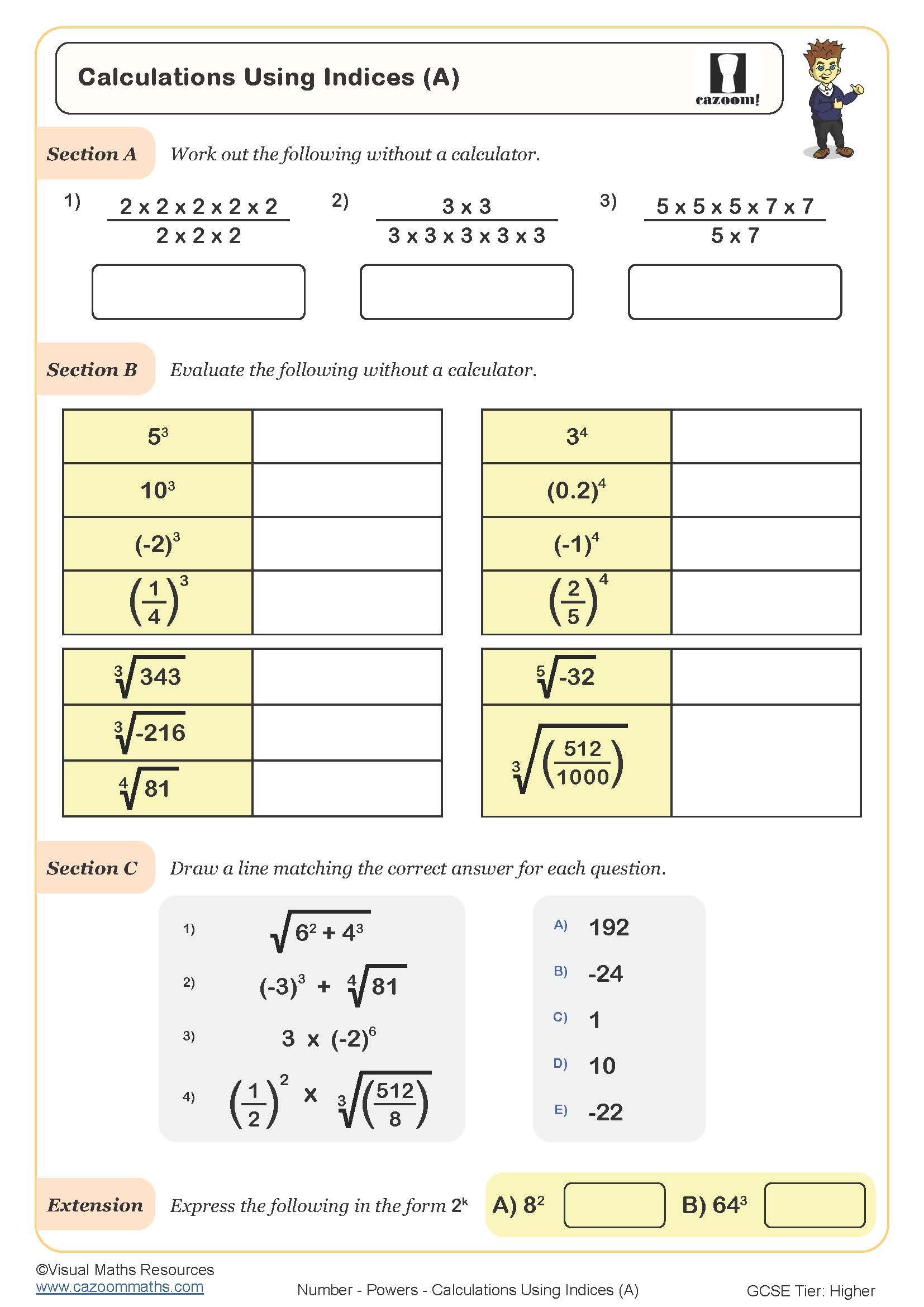
Converting from Standard Form
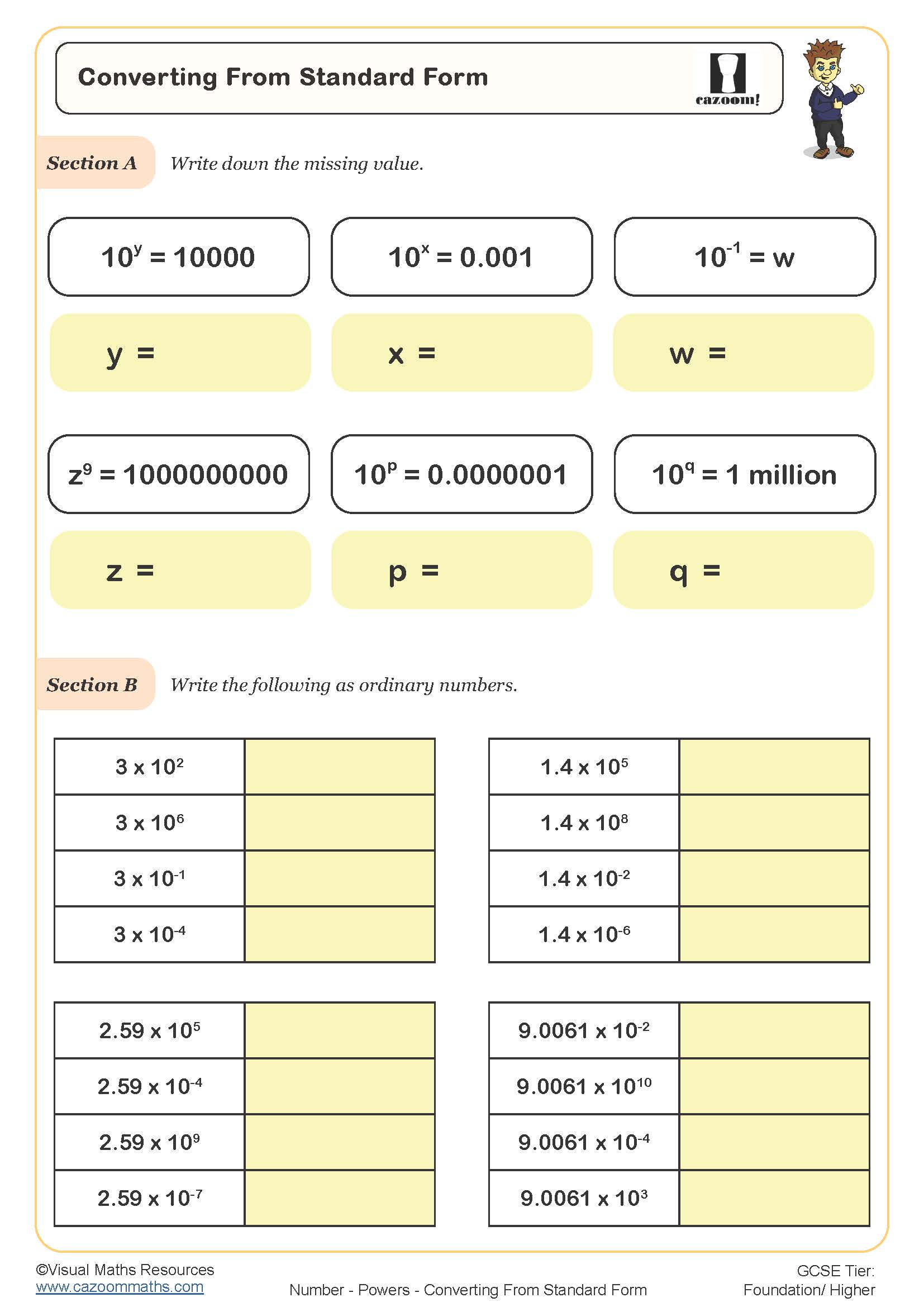
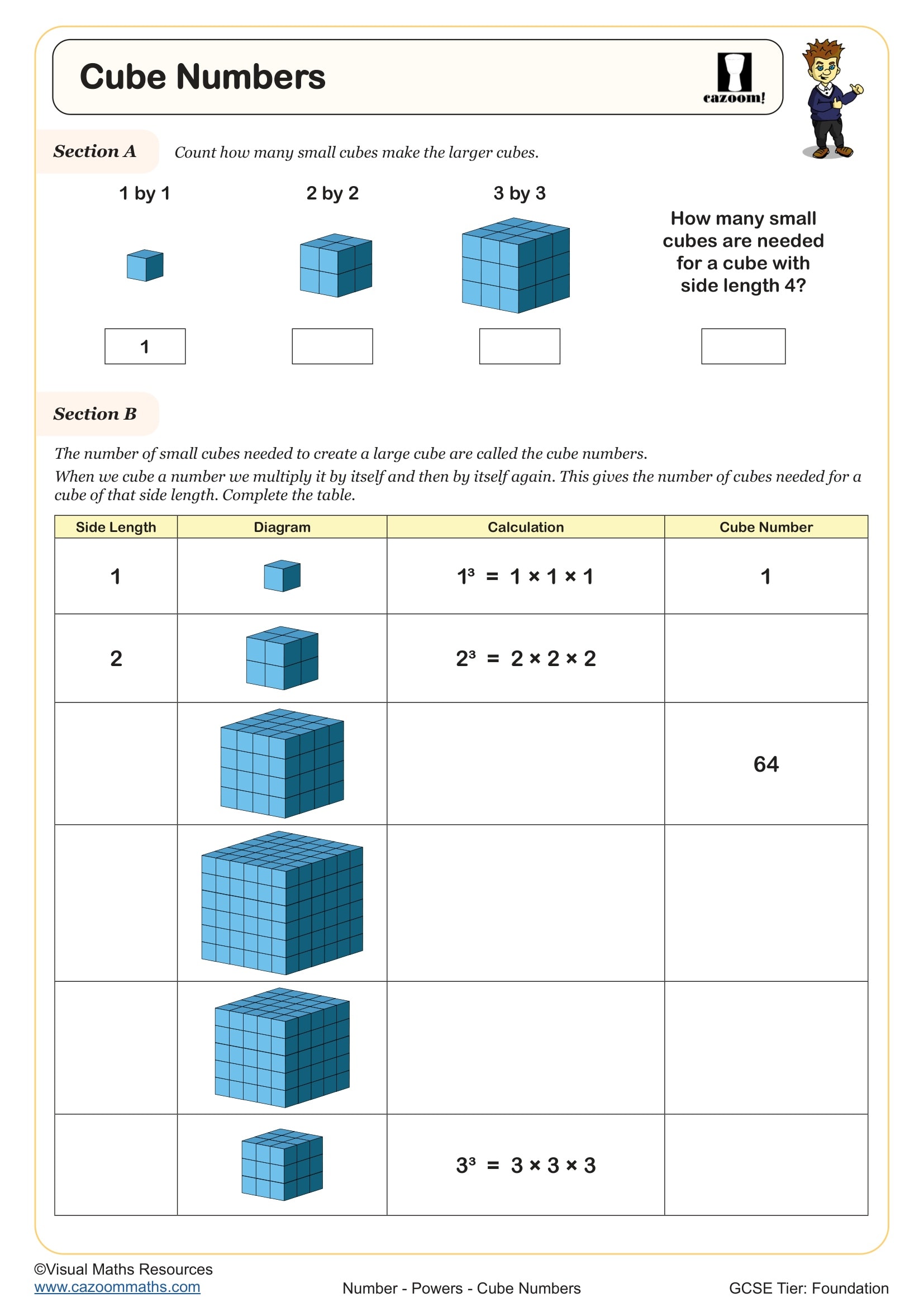
Cube Numbers
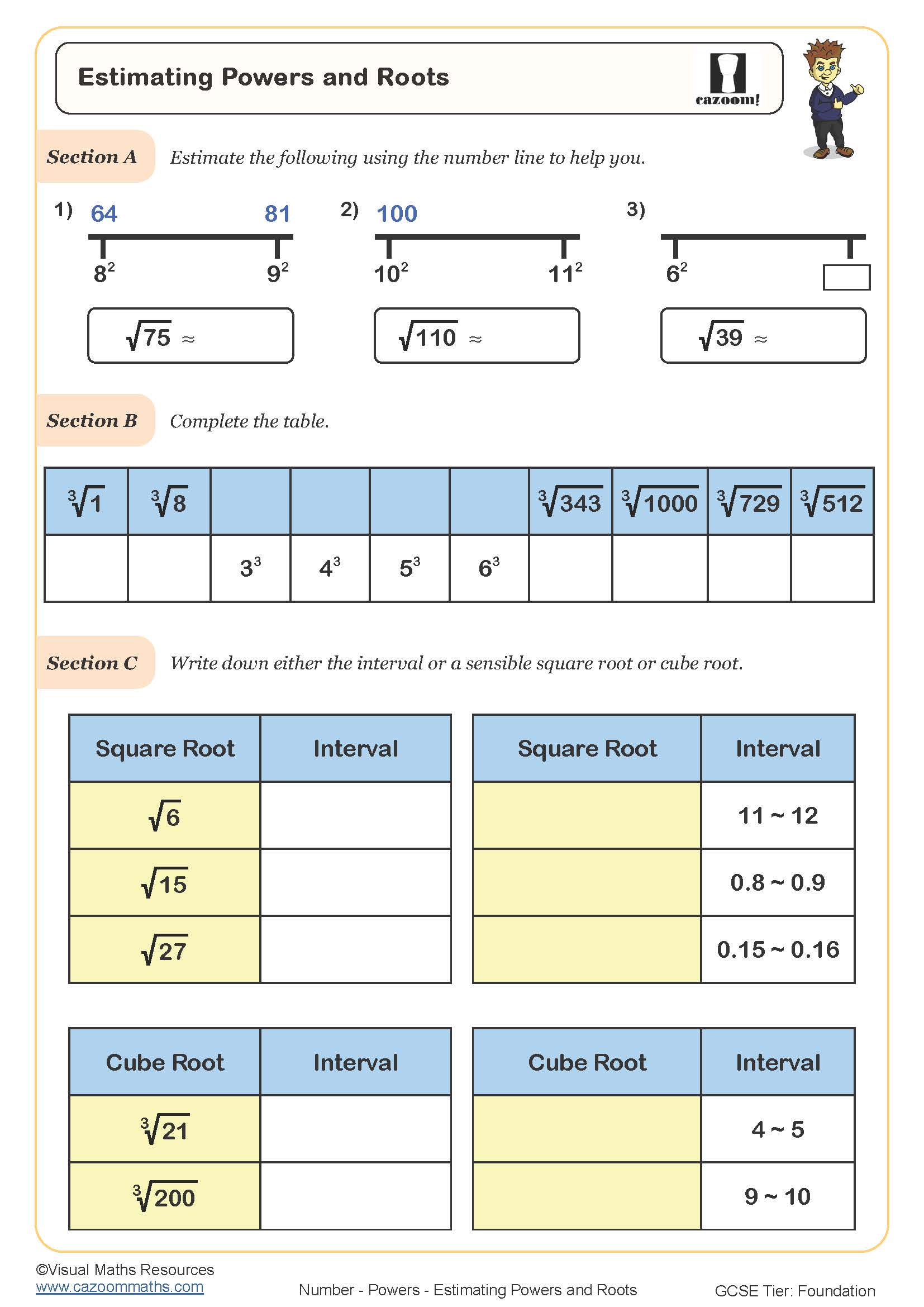
Estimating Powers and Roots
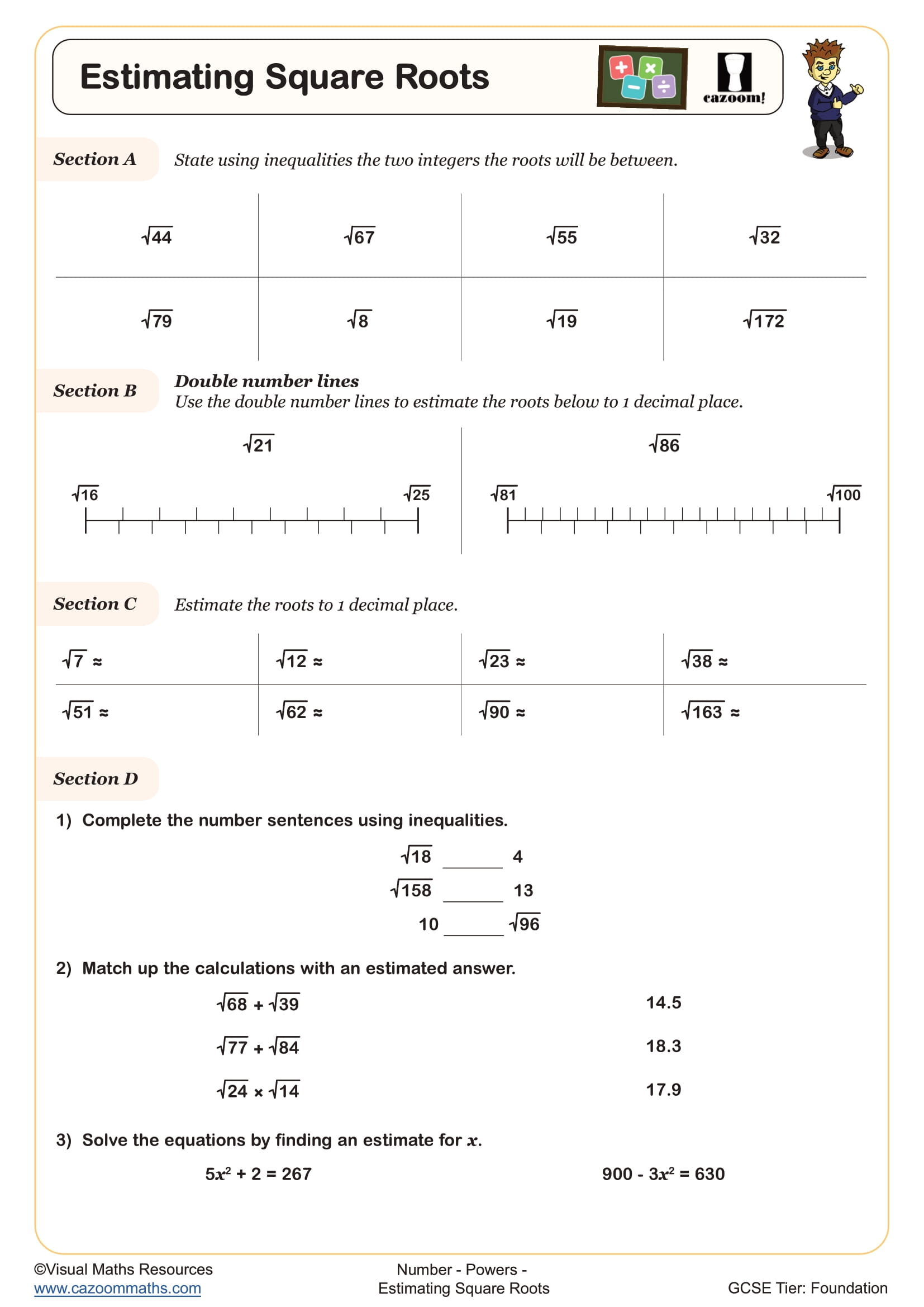
Estimating Square Roots
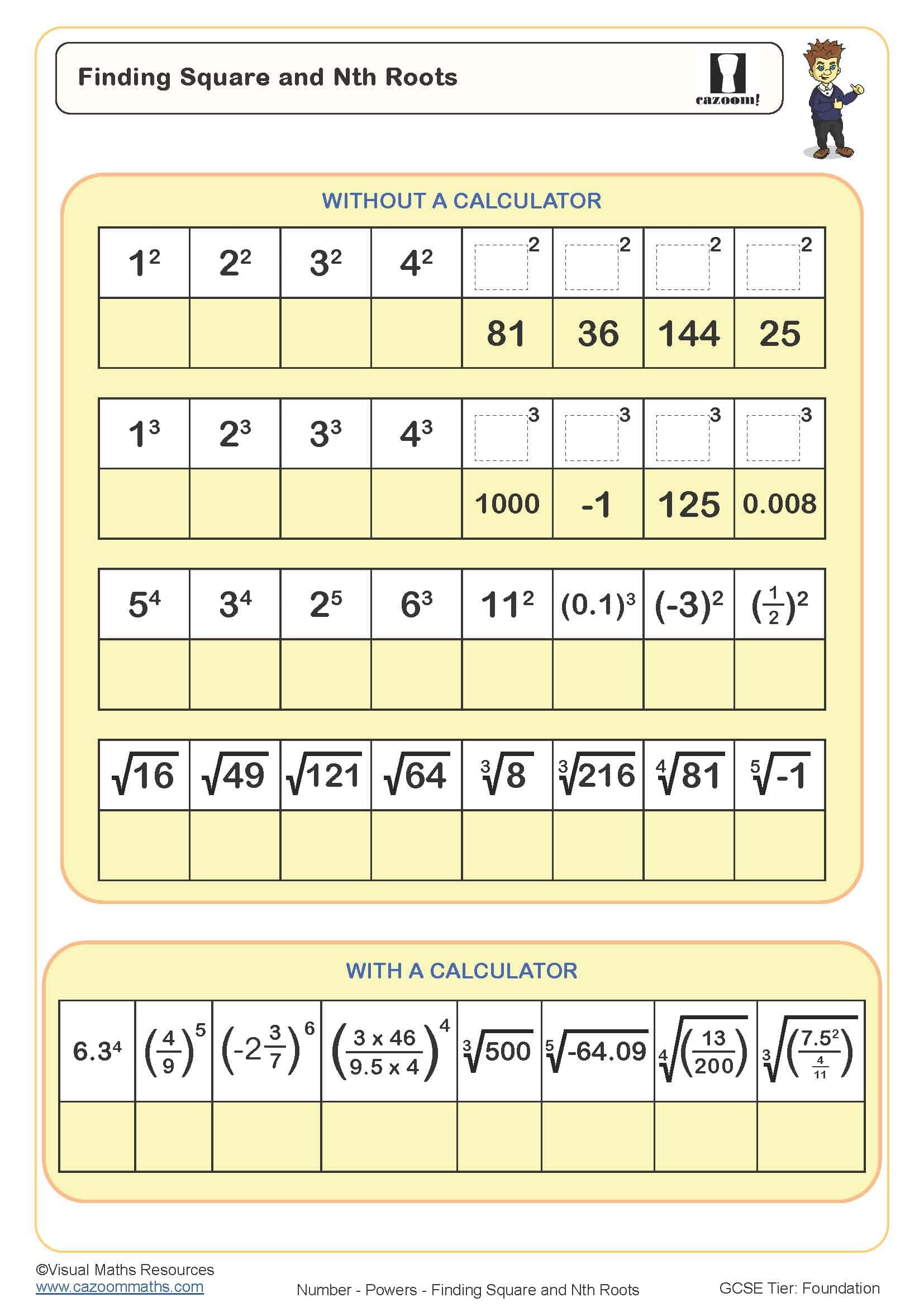
Finding Square and Nth Roots
Manipulating Standard Form (B)
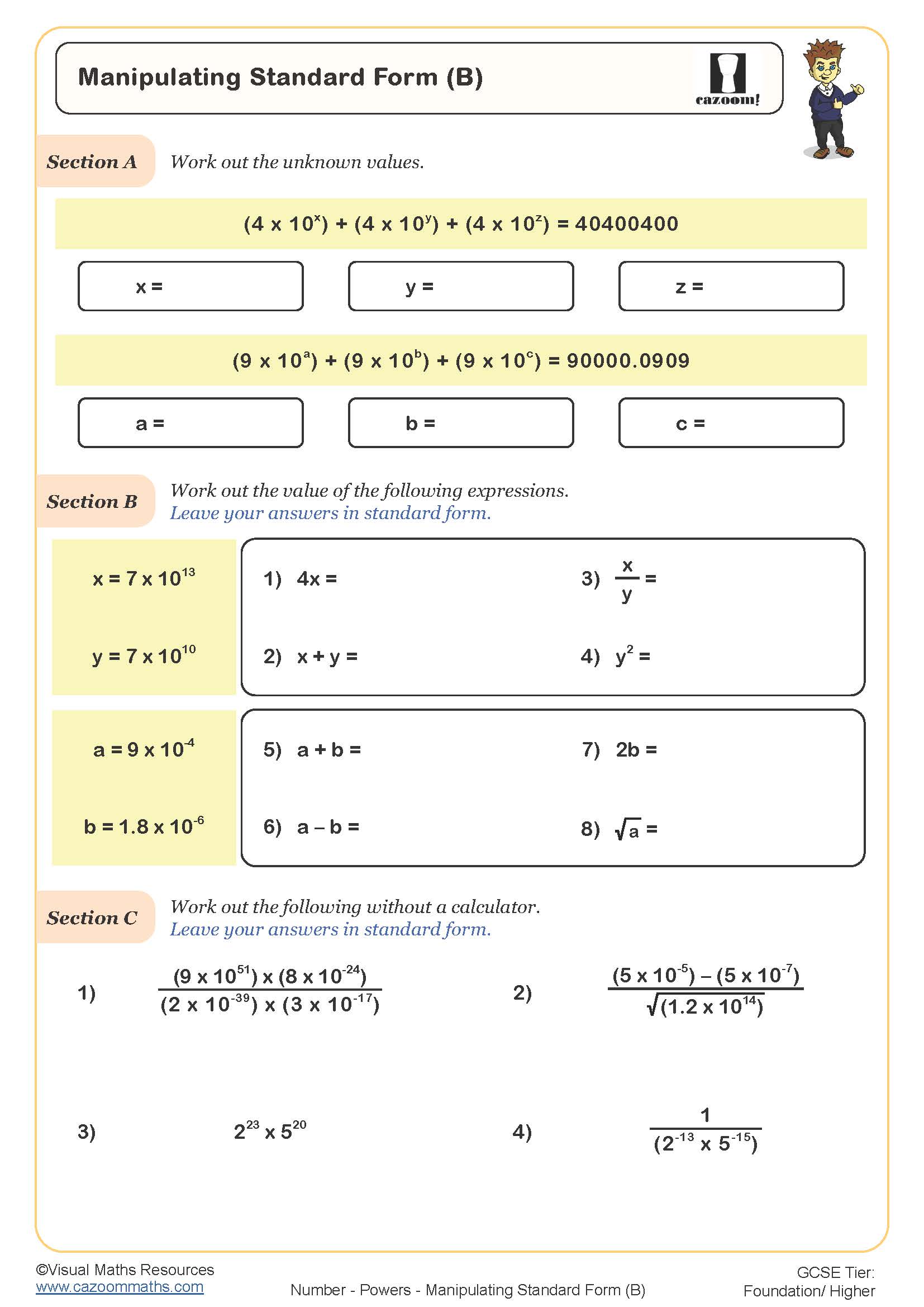
Multiplying and Dividing by 10, 100 and 1,000 Codebreaker
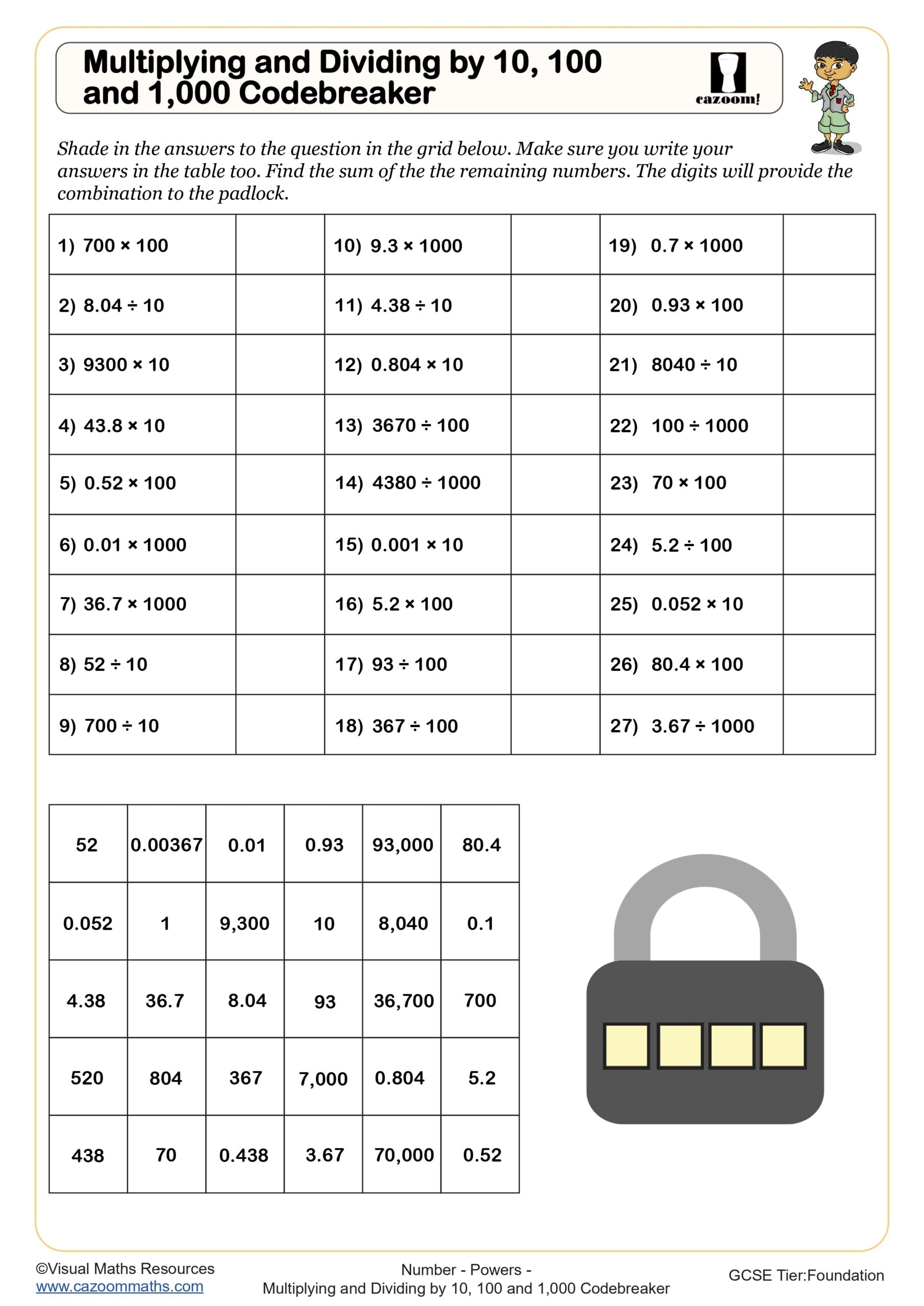
Multiplying and Dividing by Powers of Ten (A)
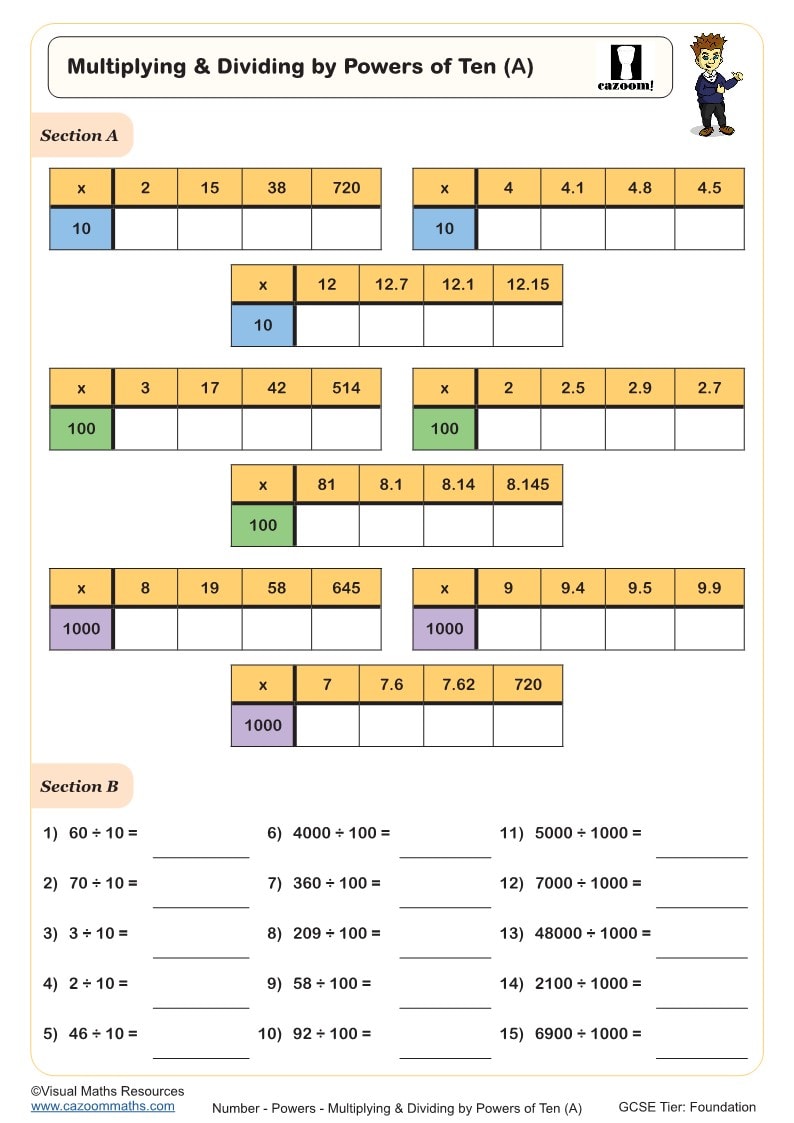
Multiplying and Dividing by Powers of Ten (B)
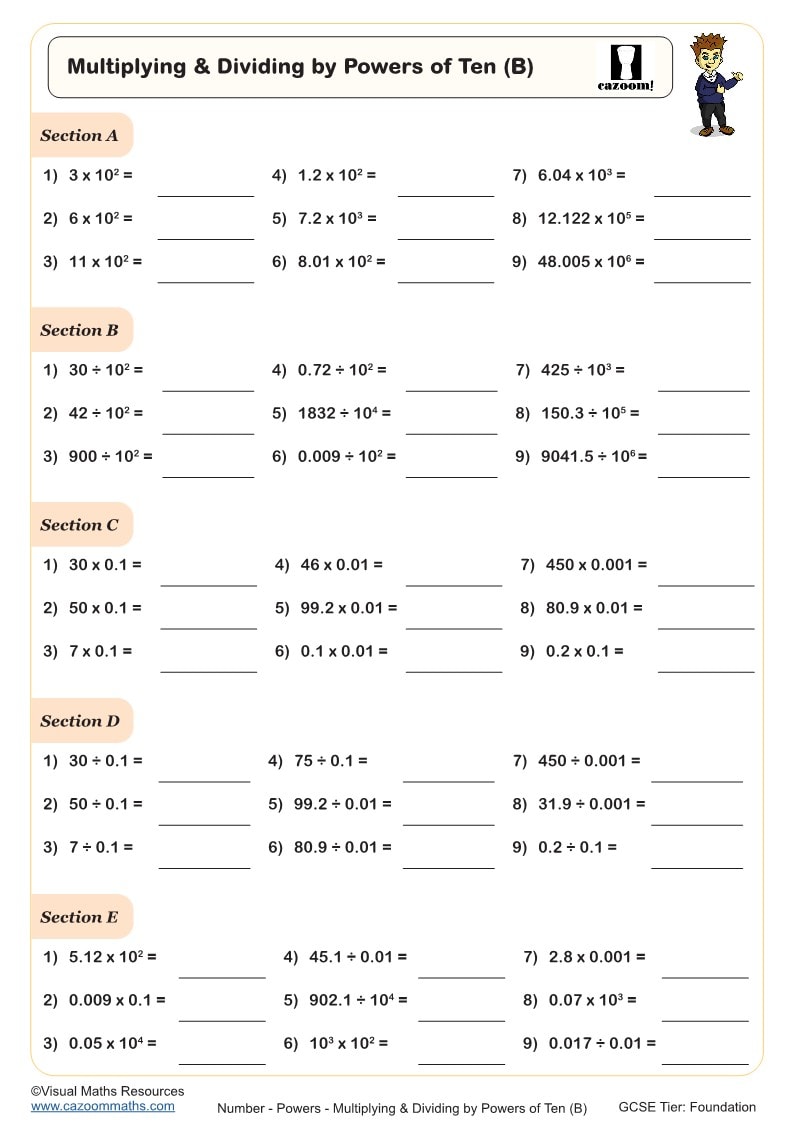
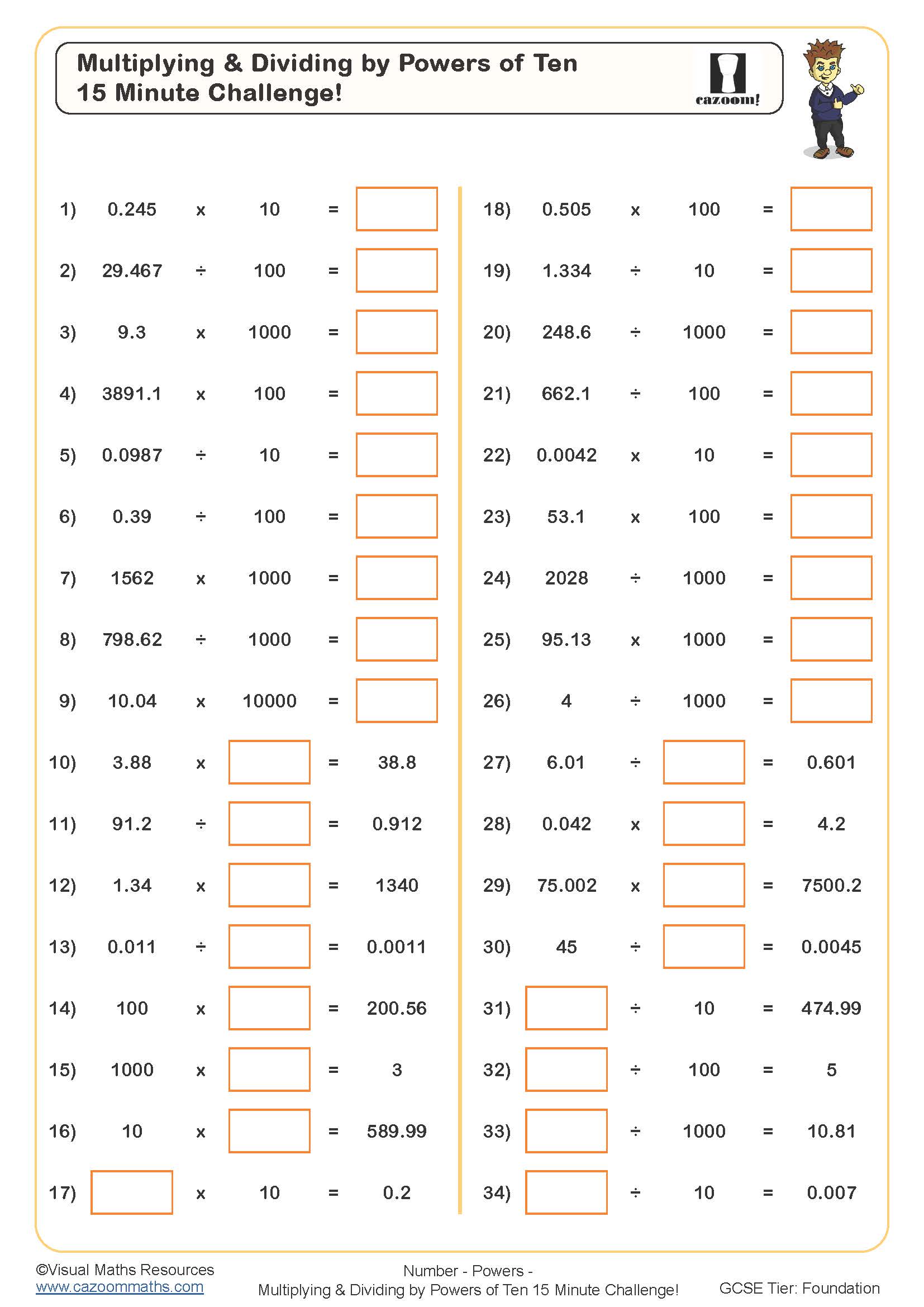
Multiplying and Dividing by Powers of Ten 15 Minute Challenge
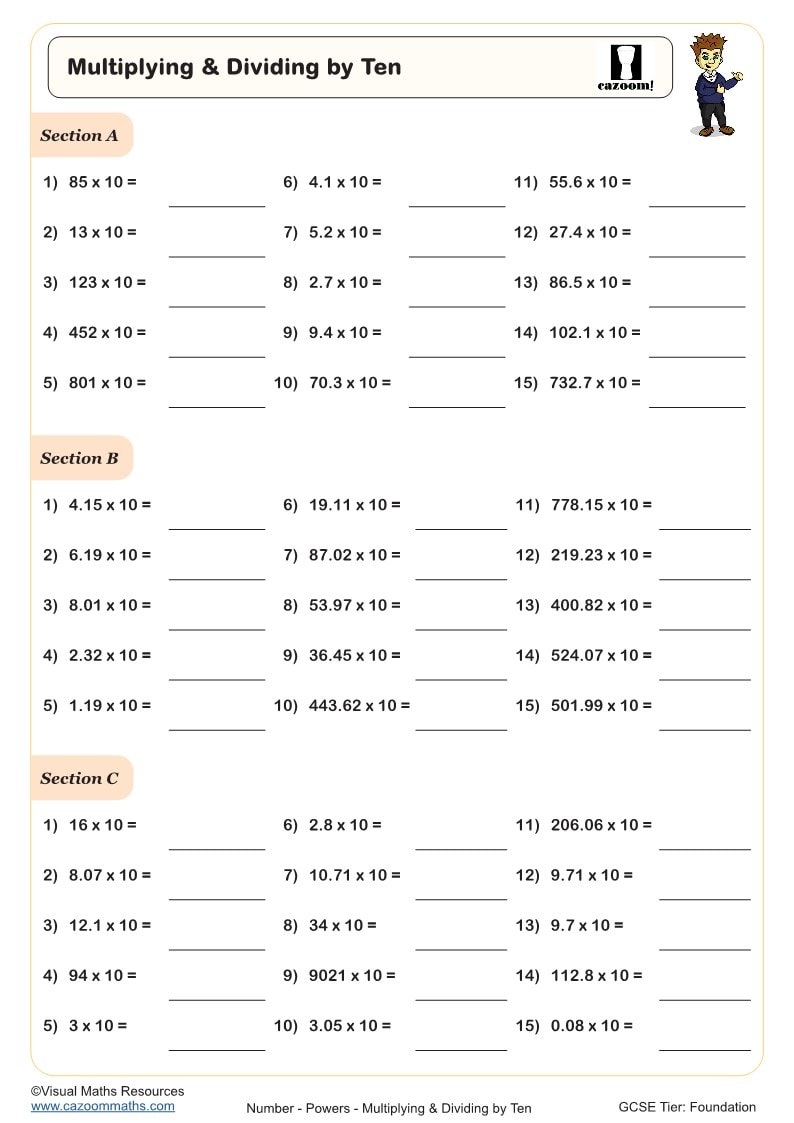
Multiplying and Dividing by Ten
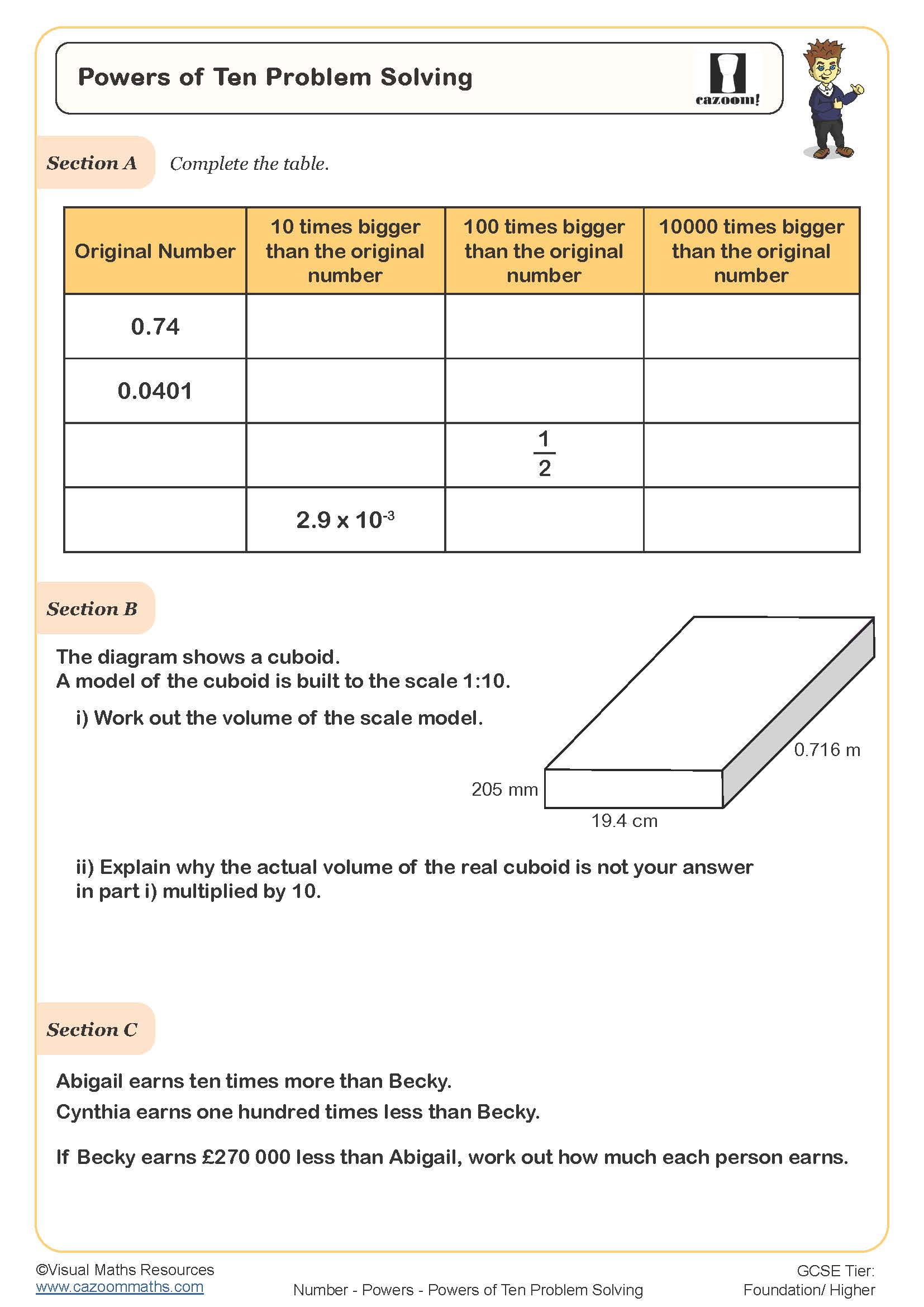
Powers of Ten Problem Solving
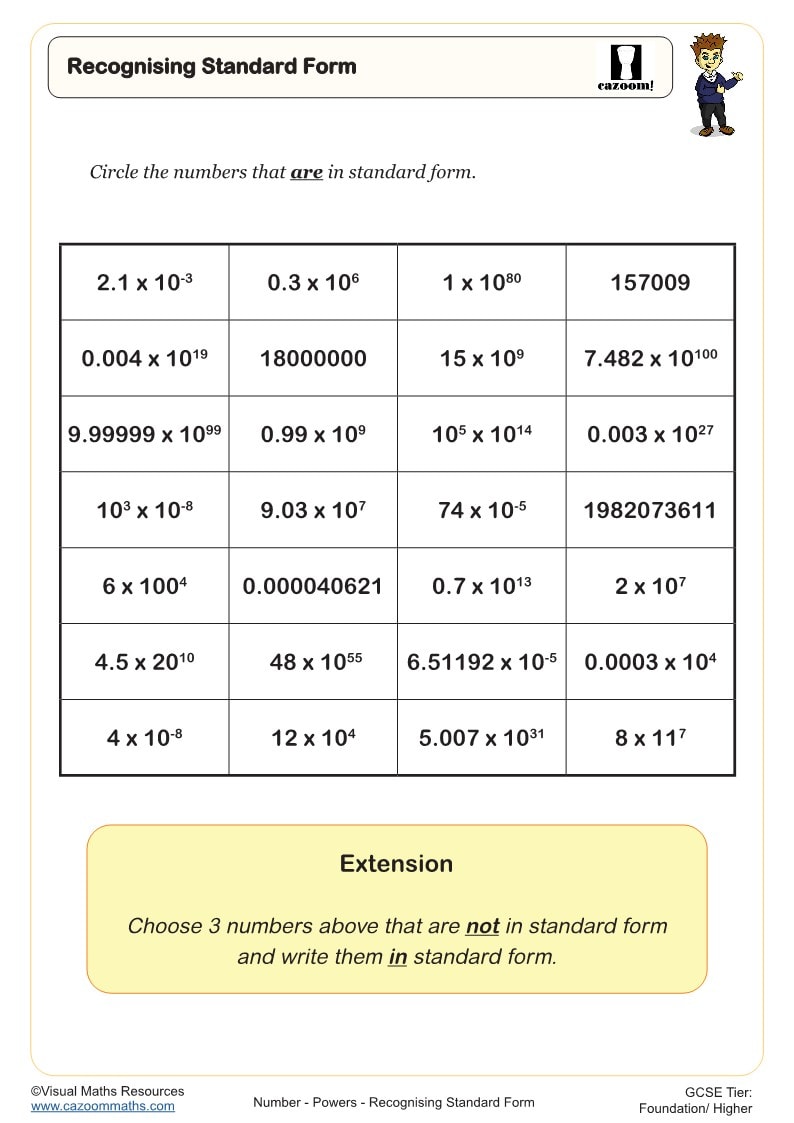
Recognising Standard Form
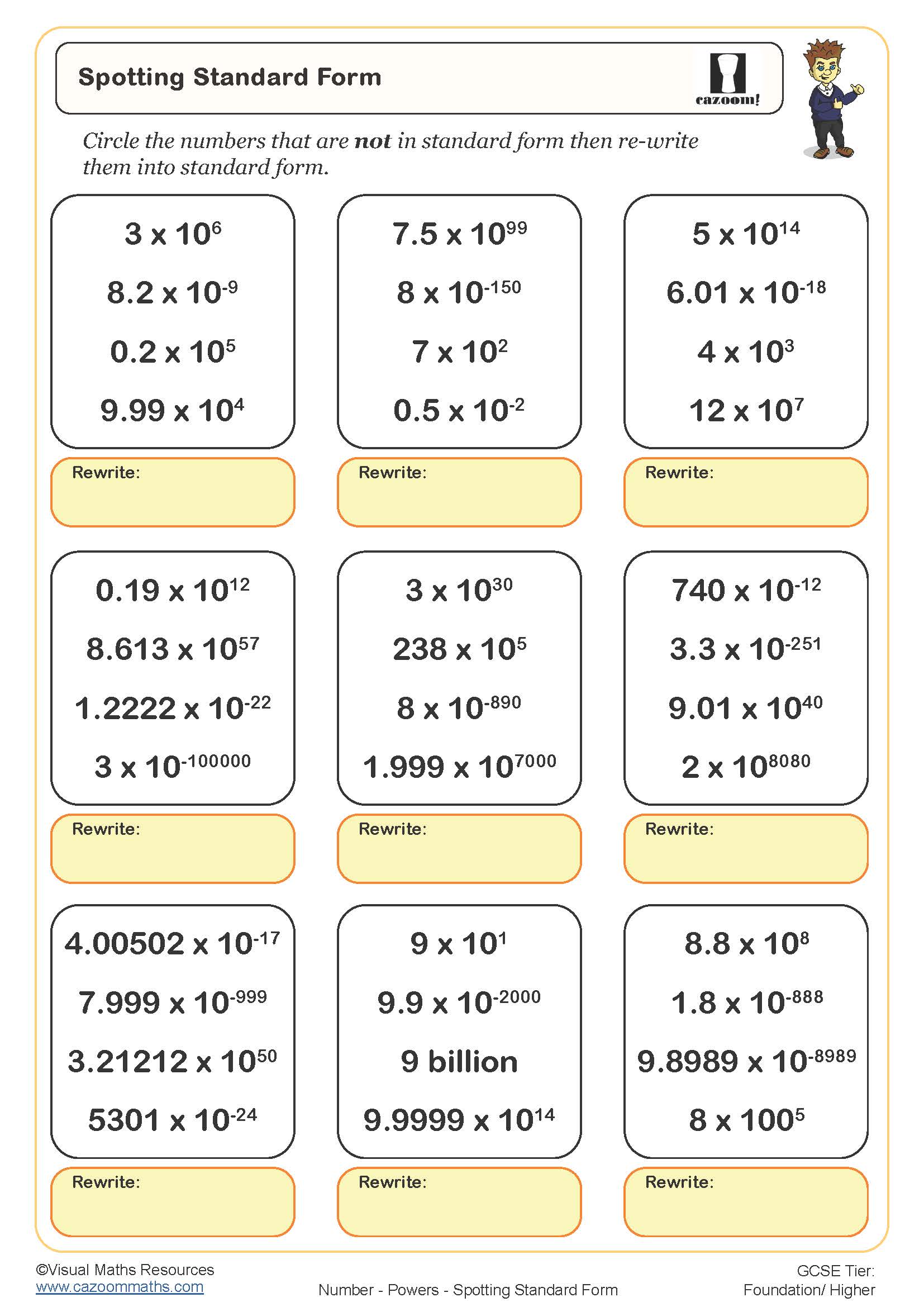
Spotting Standard Form
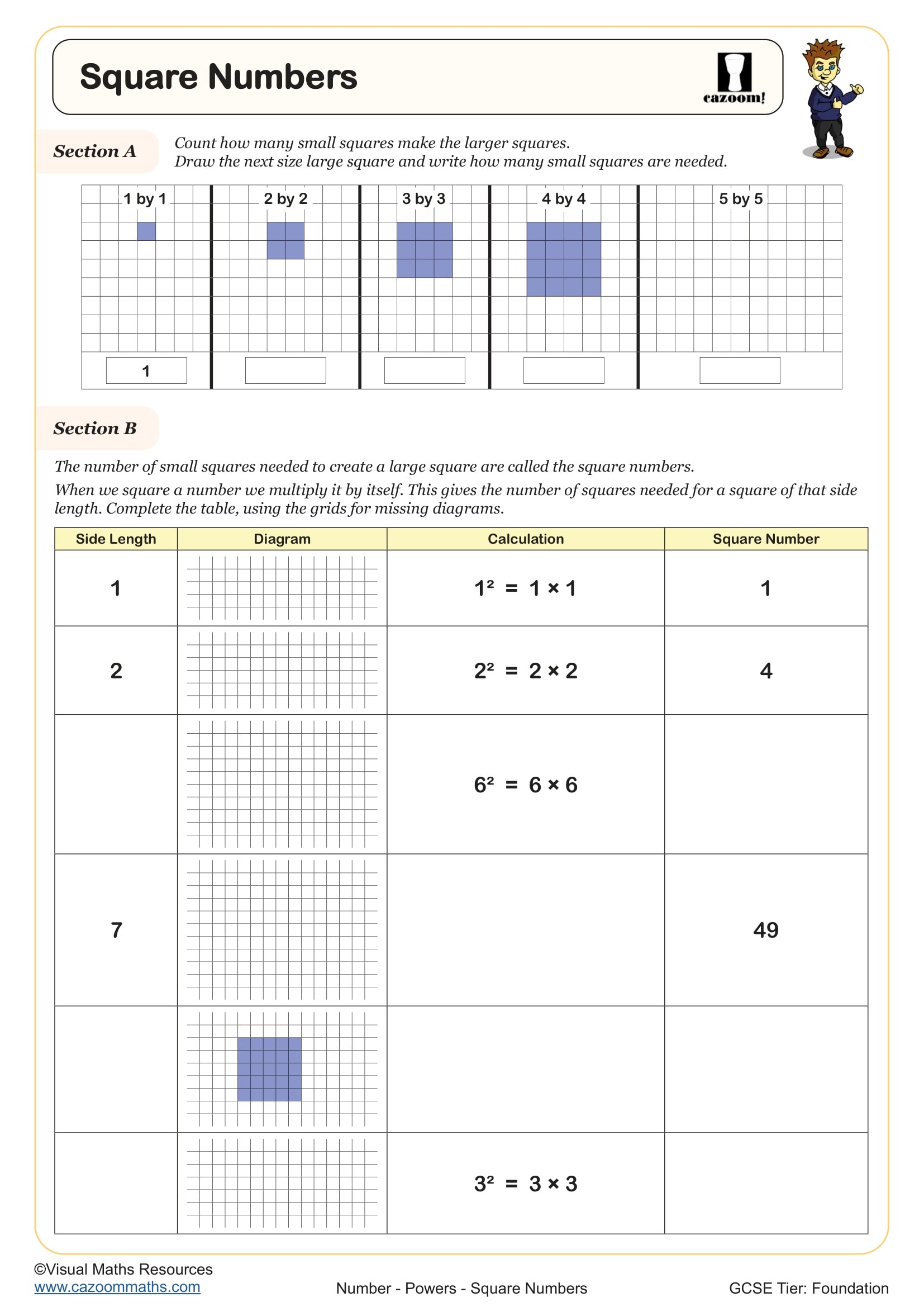
Square Numbers
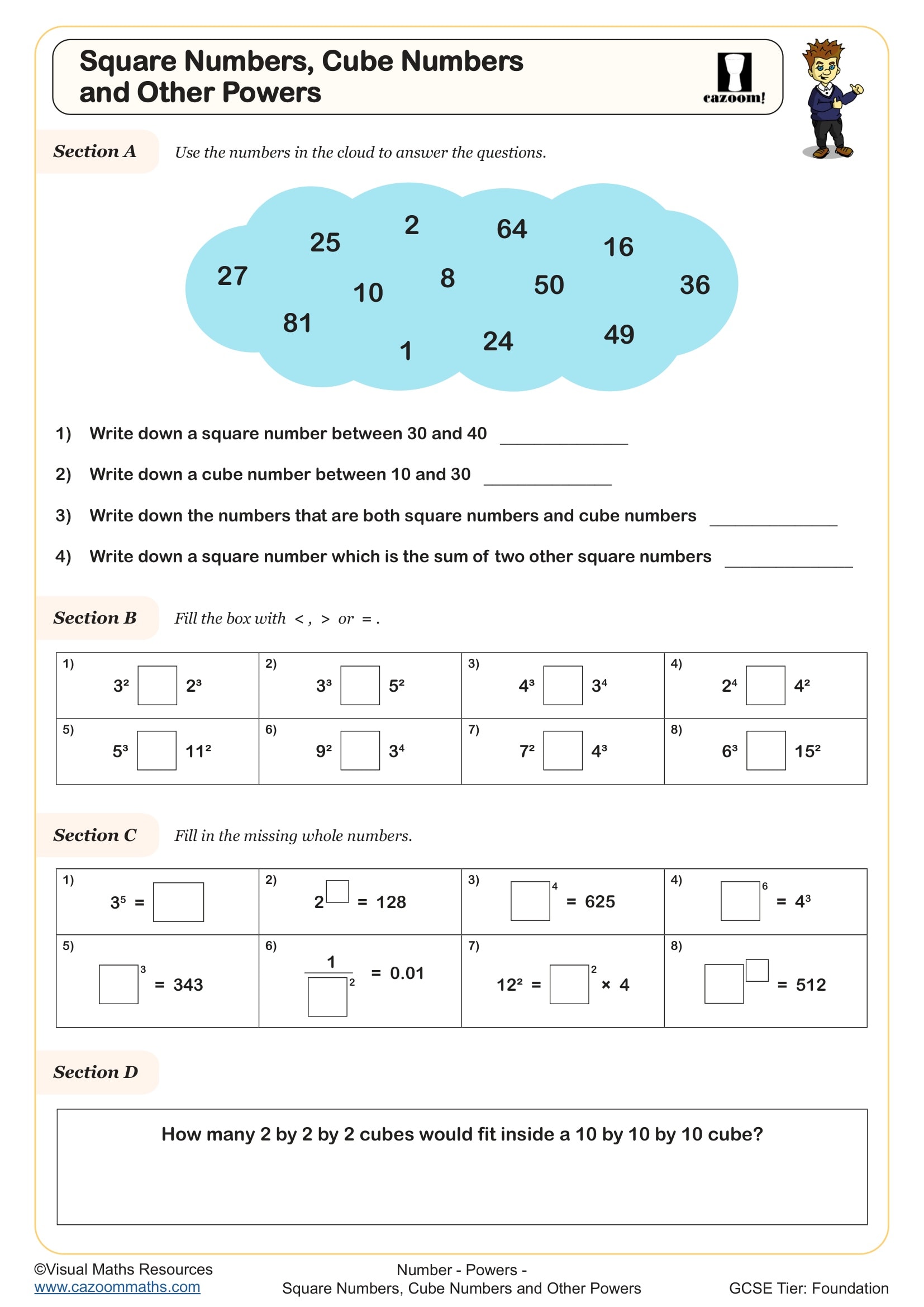
Square Numbers, Cube Numbers and Other Powers
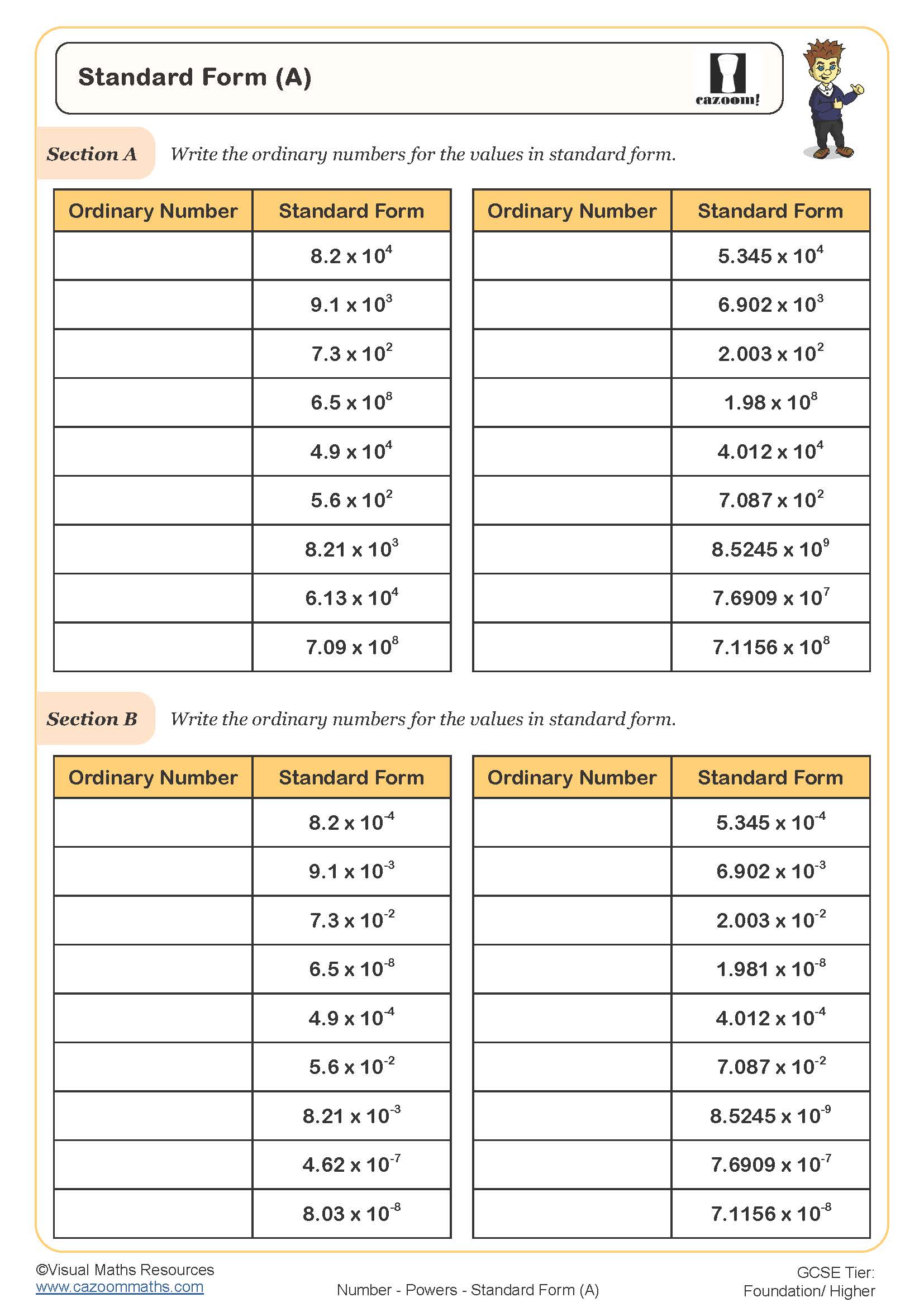
Standard Form (A)
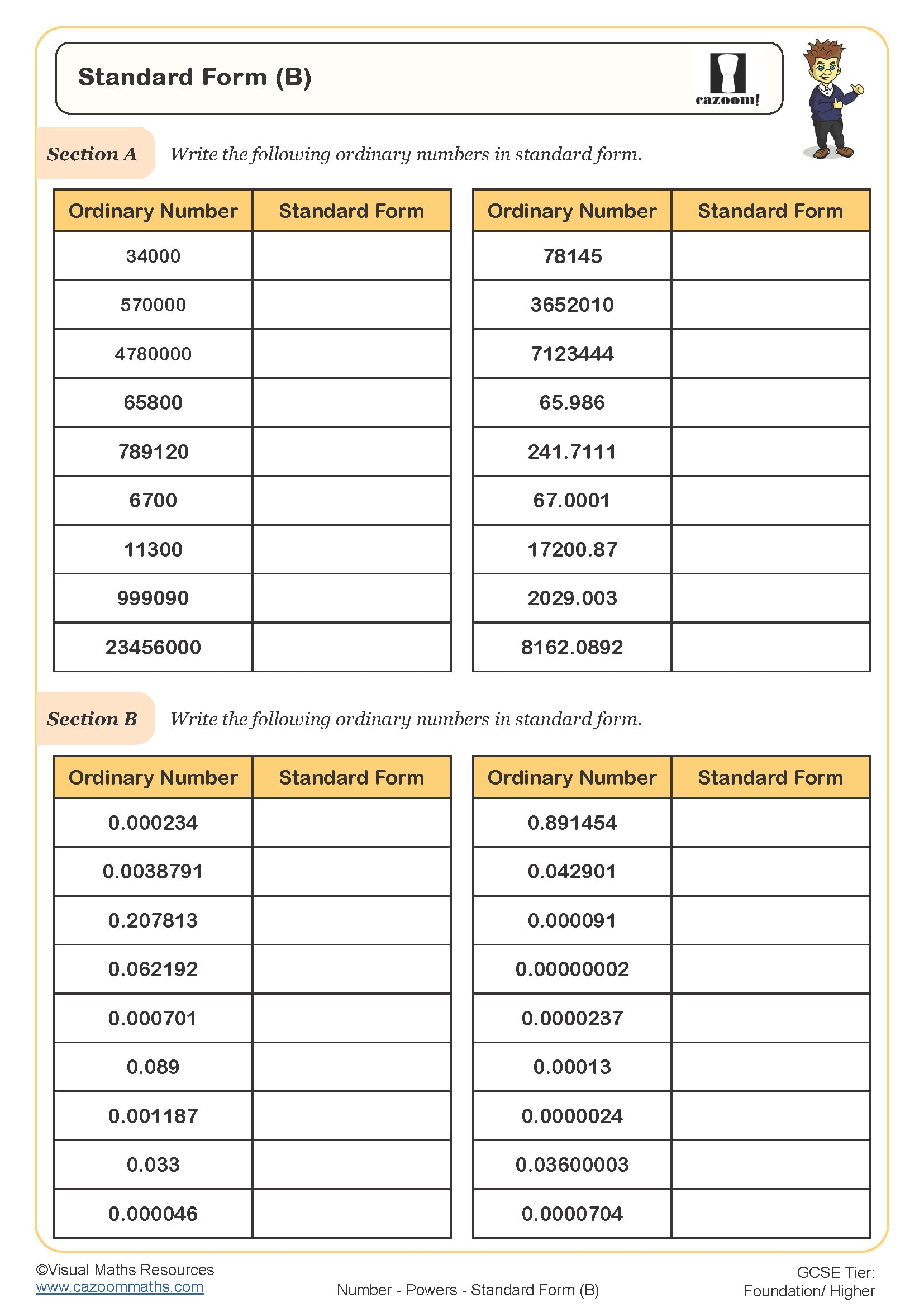
Standard Form (B)
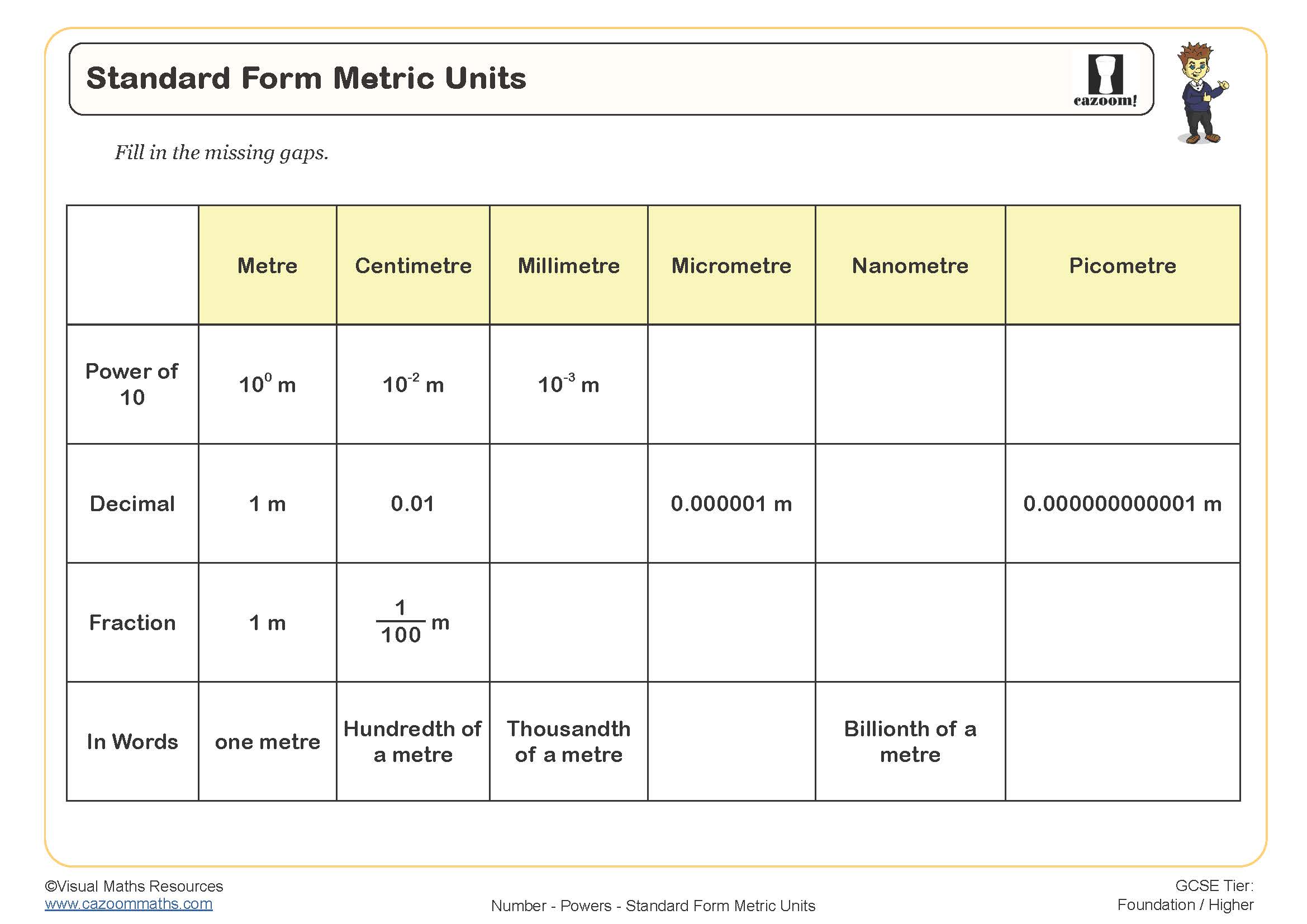
Standard Form Metric Units
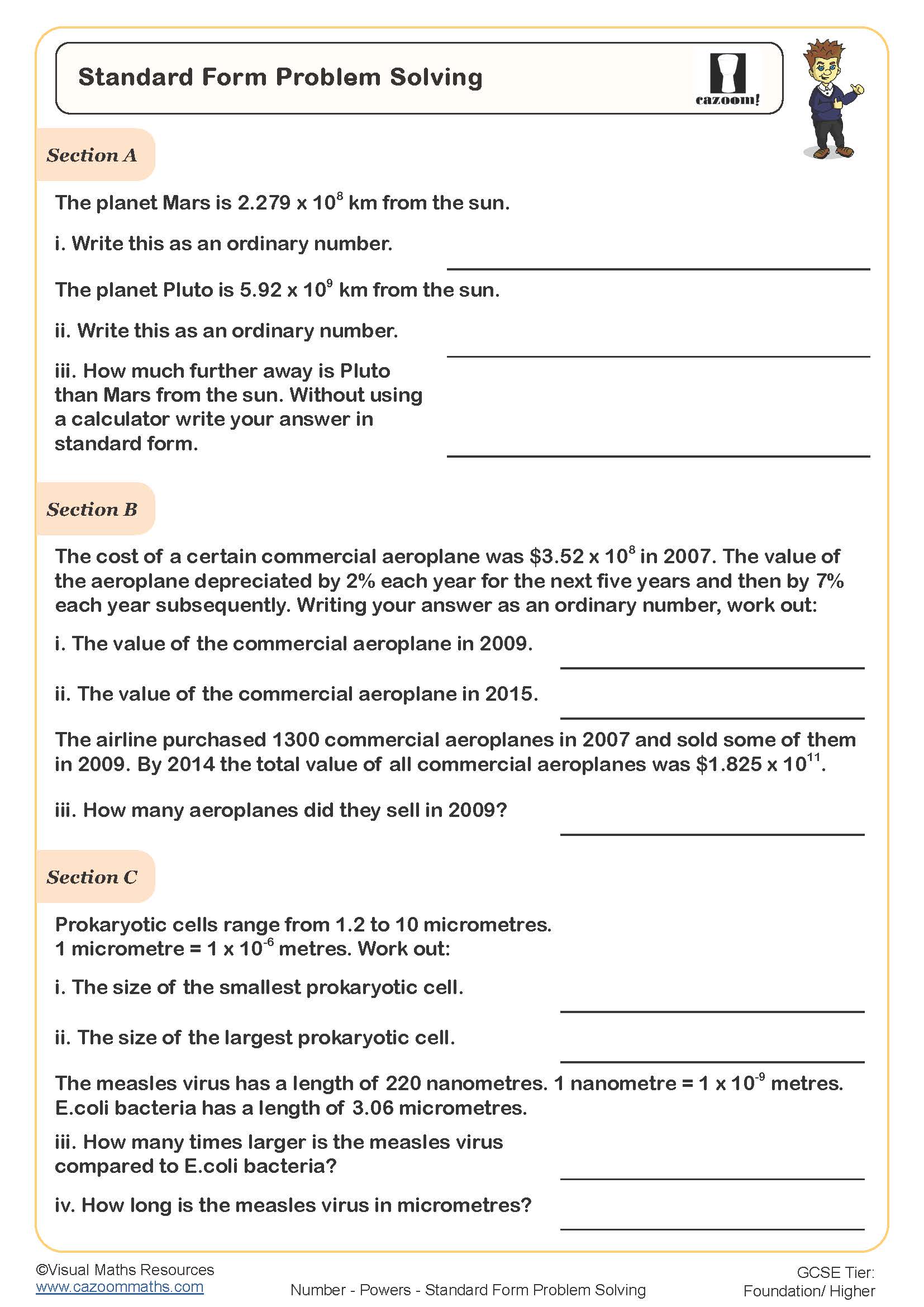
Standard Form Problem Solving
All worksheets are created by the team of experienced teachers at Cazoom Maths.
What makes an effective powers and roots worksheet?
An effective powers and roots worksheet with answers pdf should progress systematically from recognising square numbers and cube numbers through to applying index laws in algebraic contexts. The National Curriculum for KS3 expects students to calculate with roots and use standard index form, making structured practice targeted.
Teachers notice that students often confuse the square root symbol with division, writing √16 ÷ 4 instead of √16 = 4. Quality worksheets address this by including visual representations and requiring students to verify their answers by squaring their solutions, reinforcing the inverse relationship between powers and roots.
Are these worksheets suitable for different year groups?
While designed primarily for Year 8, these resources support learning across Years 7-9 depending on students' prior knowledge and the school's curriculum sequence. Some schools introduce square numbers in Year 7, whilst others delay negative indices until Year 9, making flexible resources valuable for differentiation.
Year 8 maths worksheets typically bridge the gap between basic arithmetic and more abstract algebraic thinking. Teachers find that students who struggle with times tables often need additional support with perfect squares, whilst more confident learners can extend to surds and fractional indices within the same lesson framework.
How do students best learn to estimate square roots and cube roots?
Students develop estimation skills most effectively when they first memorise perfect squares up to 15² and perfect cubes up to 5³, creating reference points for approximation. Teachers observe that many students can calculate 7² = 49 but cannot work backwards to recognise that √50 is slightly larger than 7.
Practical activities help consolidate understanding - measuring square floor tiles to find dimensions or calculating cube volumes in science lessons. This connects mathematical concepts to real-world applications, helping students understand why engineers and architects need to work fluently with powers and roots in construction and design calculations.
How should teachers use these worksheets most effectively in lessons?
Teachers achieve best results when they use these worksheets as structured practice after introducing concepts through concrete examples and visual representations. Starting with known facts like 10² = 100 helps students build confidence before tackling unfamiliar calculations or algebraic applications.
The complete answer sheets enable peer marking and immediate feedback, which teachers find particularly valuable for identifying misconceptions early. Many teachers pair weaker students with stronger ones during worksheet activities, allowing mathematical discussion about methods whilst maintaining individual accountability for learning.