Year 8 Similarity and Congruence Worksheets
All worksheets are created by the team of experienced teachers at Cazoom Maths.
What is the difference between similarity and congruence?
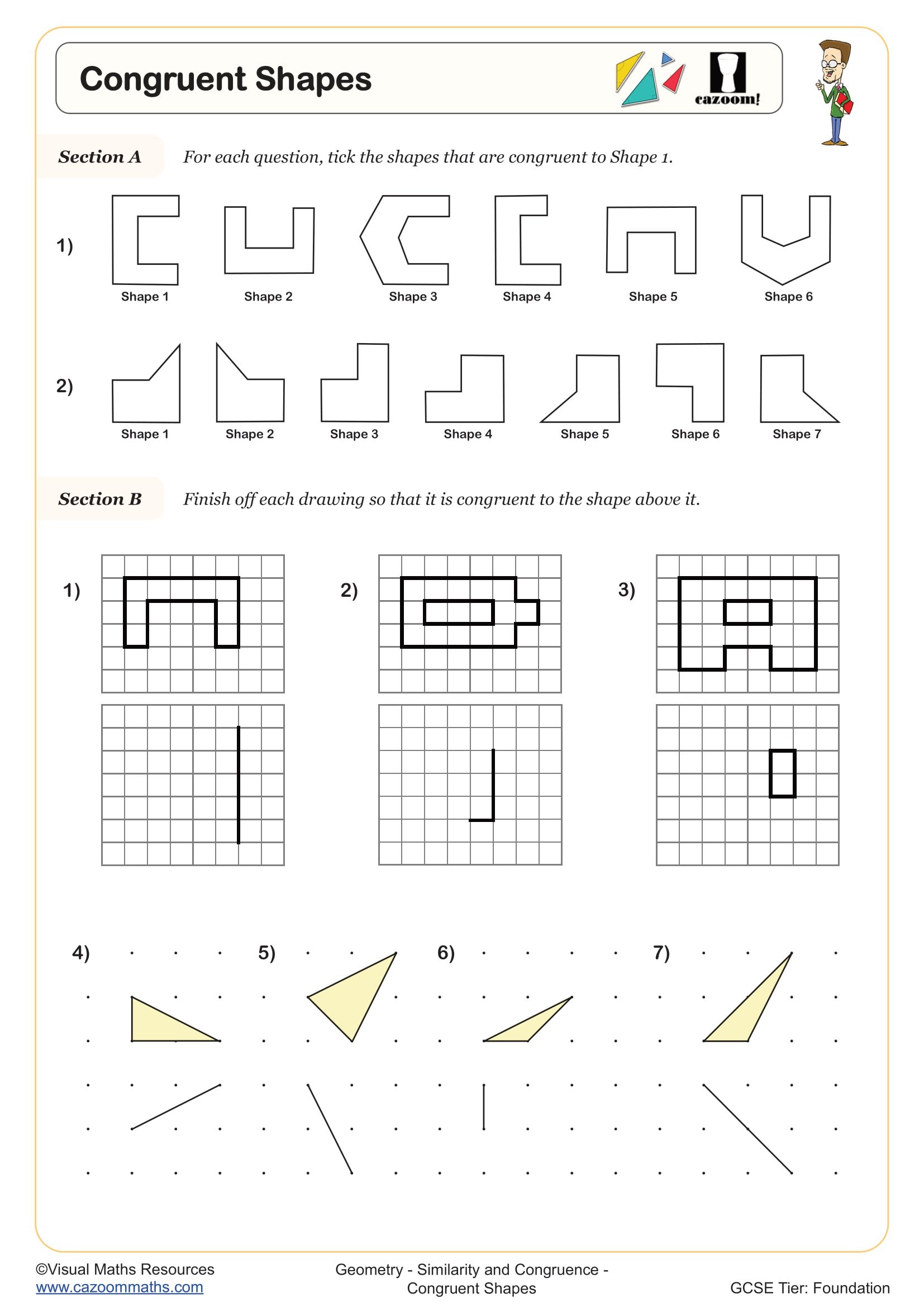
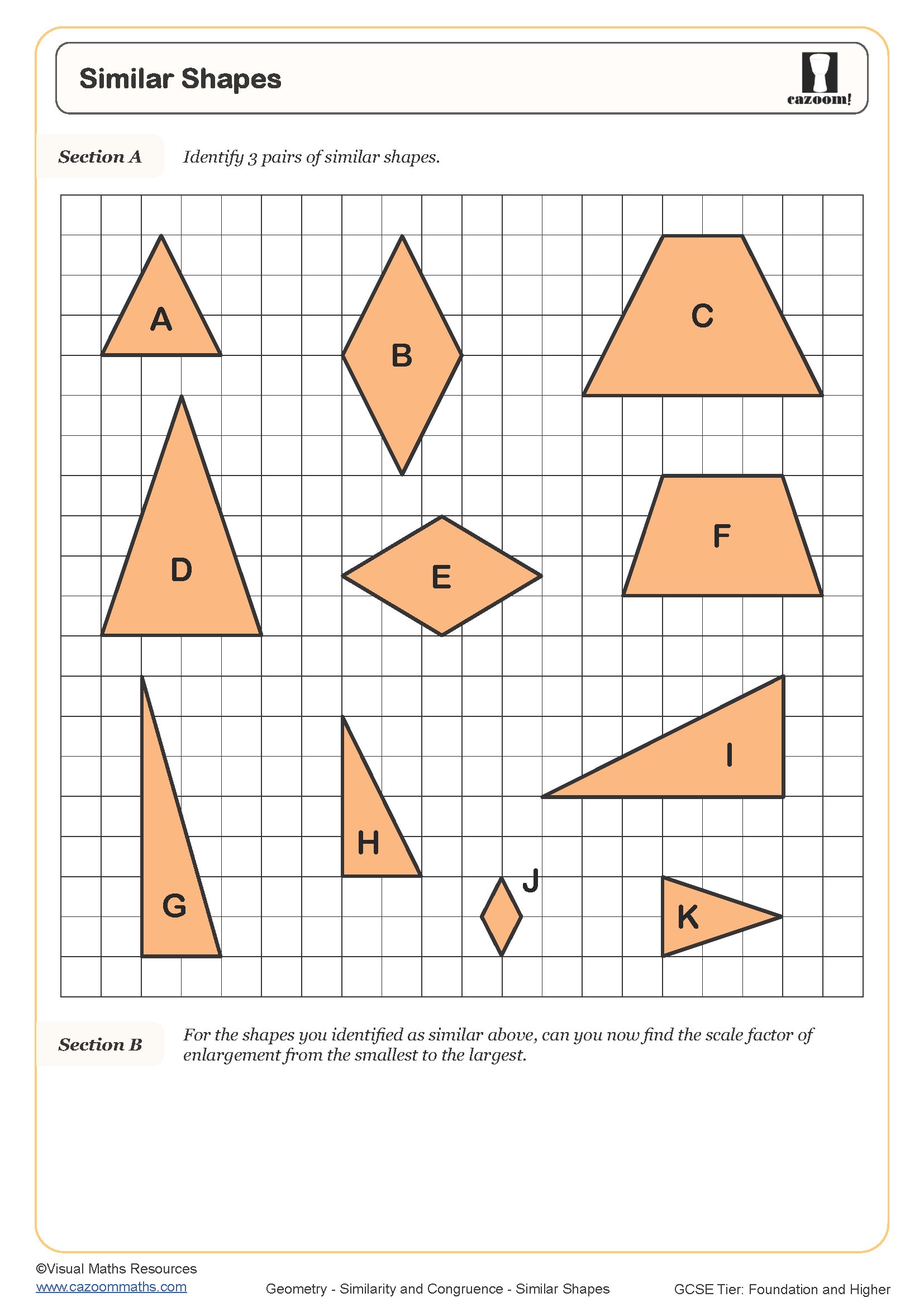
Congruent shapes are identical in both size and shape, meaning all corresponding angles and sides are equal. Similar shapes have the same shape but different sizes, with corresponding angles equal and corresponding sides in the same ratio. At KS3, students need to recognise that congruent shapes can be rotated, reflected, or translated but remain congruent, whilst similar shapes involve an enlargement transformation.
A common error occurs when students identify shapes as similar simply because they 'look the same', without checking that the scale factor is consistent across all corresponding sides. Exam questions often test this by including diagrams where one pair of sides has a different ratio to the others, deliberately catching students who haven't verified all measurements. Students lose marks when they state shapes are similar without showing the calculation that proves corresponding sides are in proportion.
Which year groups study similarity and congruence?
Similarity and congruence appear in the Year 8 curriculum as part of the KS3 geometry strand. Students build on their Year 7 knowledge of transformations and properties of shapes to explore more formal relationships between geometric figures. The National Curriculum expects students to understand both concepts and apply them to solve problems involving lengths and angles.
The difficulty progresses from identifying whether pairs of shapes are congruent or similar through visual inspection, to calculating unknown lengths using scale factors and ratios. Year 8 work typically focuses on triangles and quadrilaterals, with students learning to justify their reasoning using properties such as corresponding angles and proportional sides. This foundation prepares students for GCSE topics including circle theorems, trigonometry, and proof, where similarity and congruence arguments become essential.
How do you find missing lengths in similar shapes?
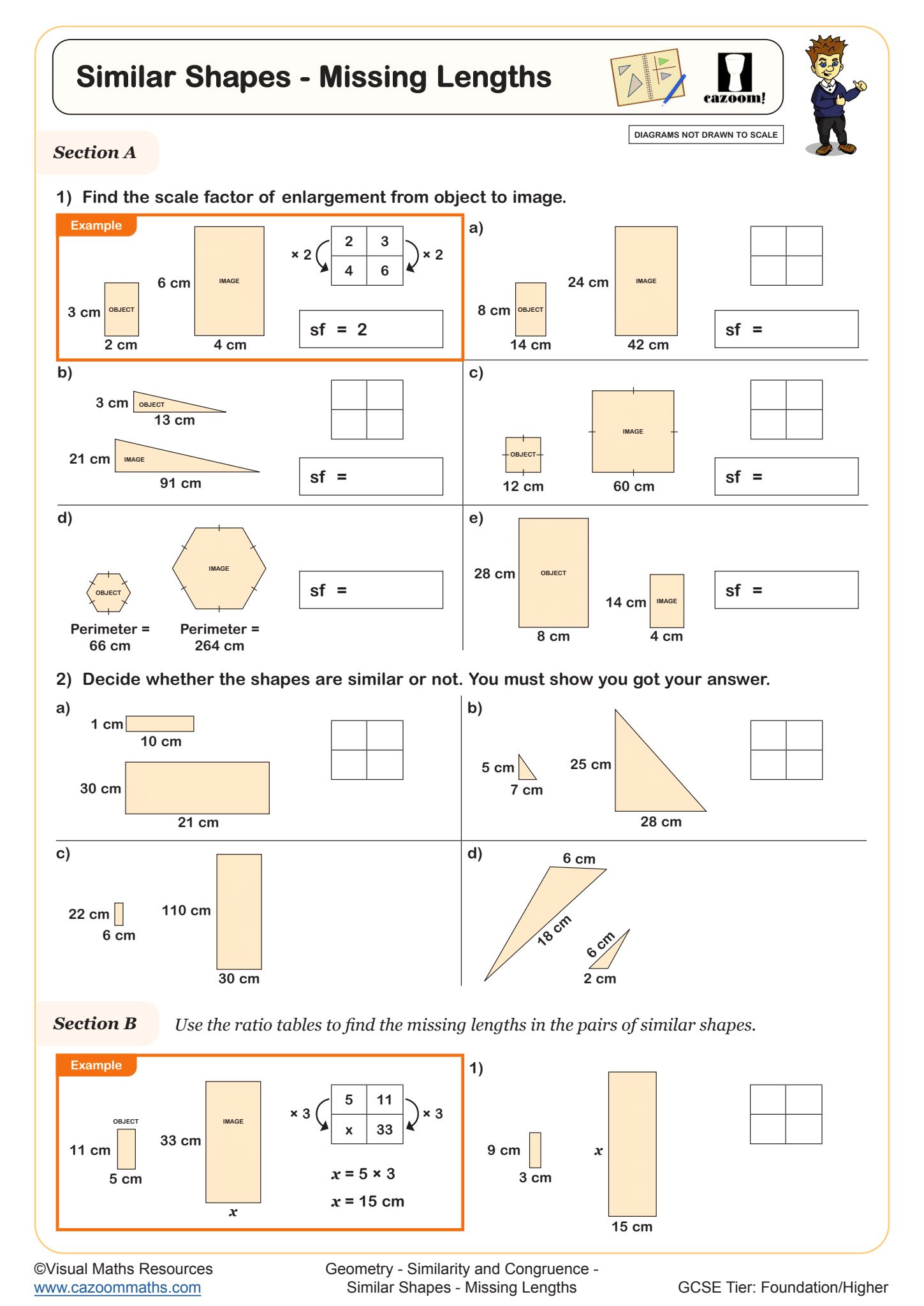
To find missing lengths in similar shapes, students first identify corresponding sides between the two shapes, then calculate the scale factor by dividing a known length in the enlarged shape by the corresponding length in the original shape. This scale factor is then applied to other sides to find missing measurements. Teachers often notice students multiplying when they should divide, particularly when working backwards from a larger to smaller shape.
Similarity has direct applications in architecture and engineering, where scale models are used to design buildings, bridges, and vehicles before construction. Architects create drawings at scales such as 1:50 or 1:100, requiring precise calculations using similarity ratios to ensure accurate measurements. In surveying, similar triangles help calculate distances that cannot be measured directly, such as the height of buildings or width of rivers, making this a practical skill beyond the classroom.
How can these worksheets support classroom teaching?
The worksheets provide structured practice that builds from recognising congruent and similar shapes to applying scale factors in multi-step problems. Each sheet includes diagrams drawn to different orientations, helping students develop the visual reasoning needed to identify corresponding parts regardless of position. Answer sheets allow students to check their understanding independently, which is particularly valuable when practising ratio calculations that can go wrong at any stage.
Many teachers use these resources for targeted intervention with students who struggle to distinguish between the two concepts, setting one worksheet as initial practice then reviewing common errors before attempting the next. The worksheets work well for homework following classroom introduction of scale factors, or as revision material before end-of-unit assessments. Paired work can be effective, with students comparing their methods for identifying corresponding sides and checking each other's scale factor calculations before finding missing lengths.