Year 8 Trigonometry Worksheets
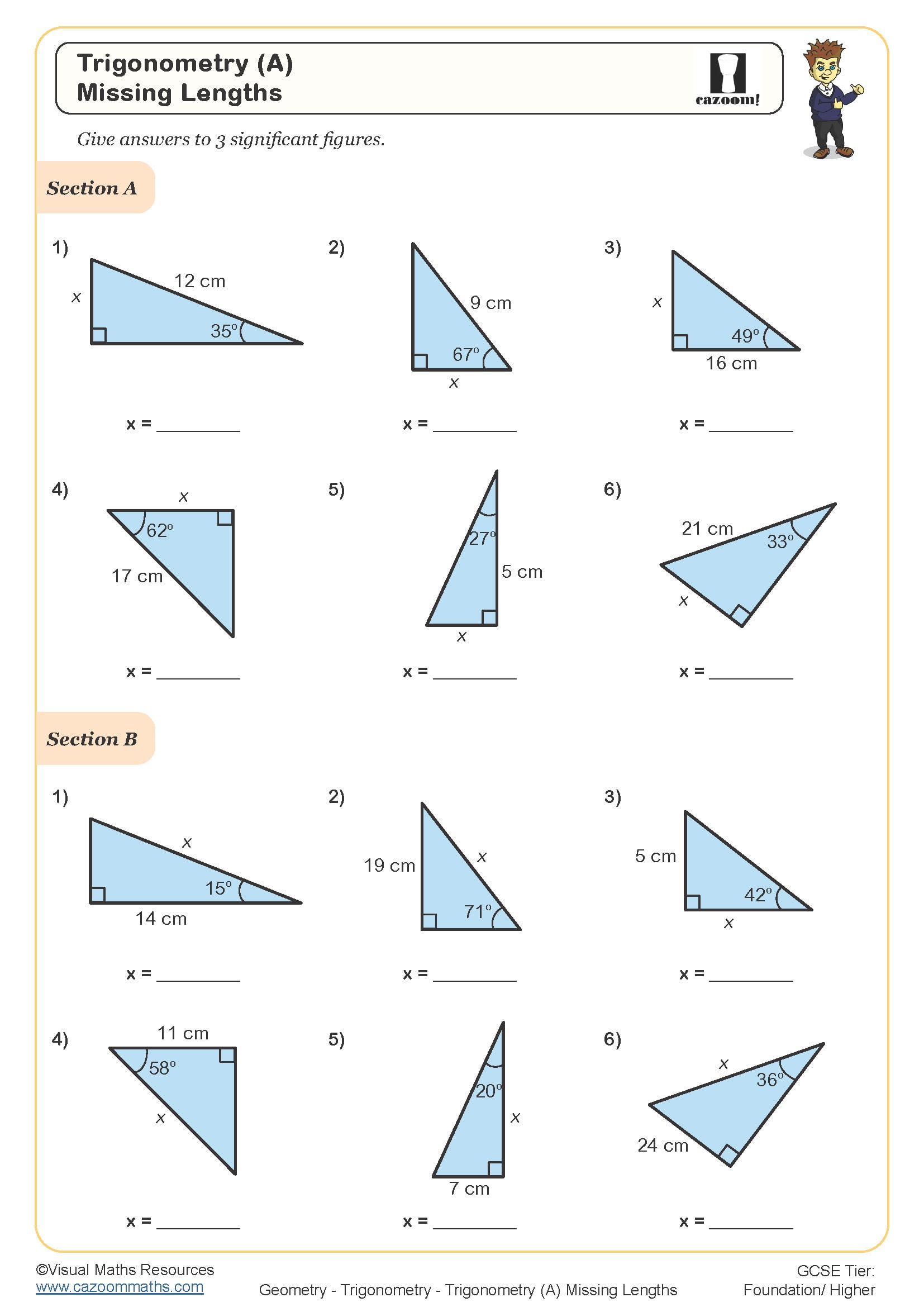
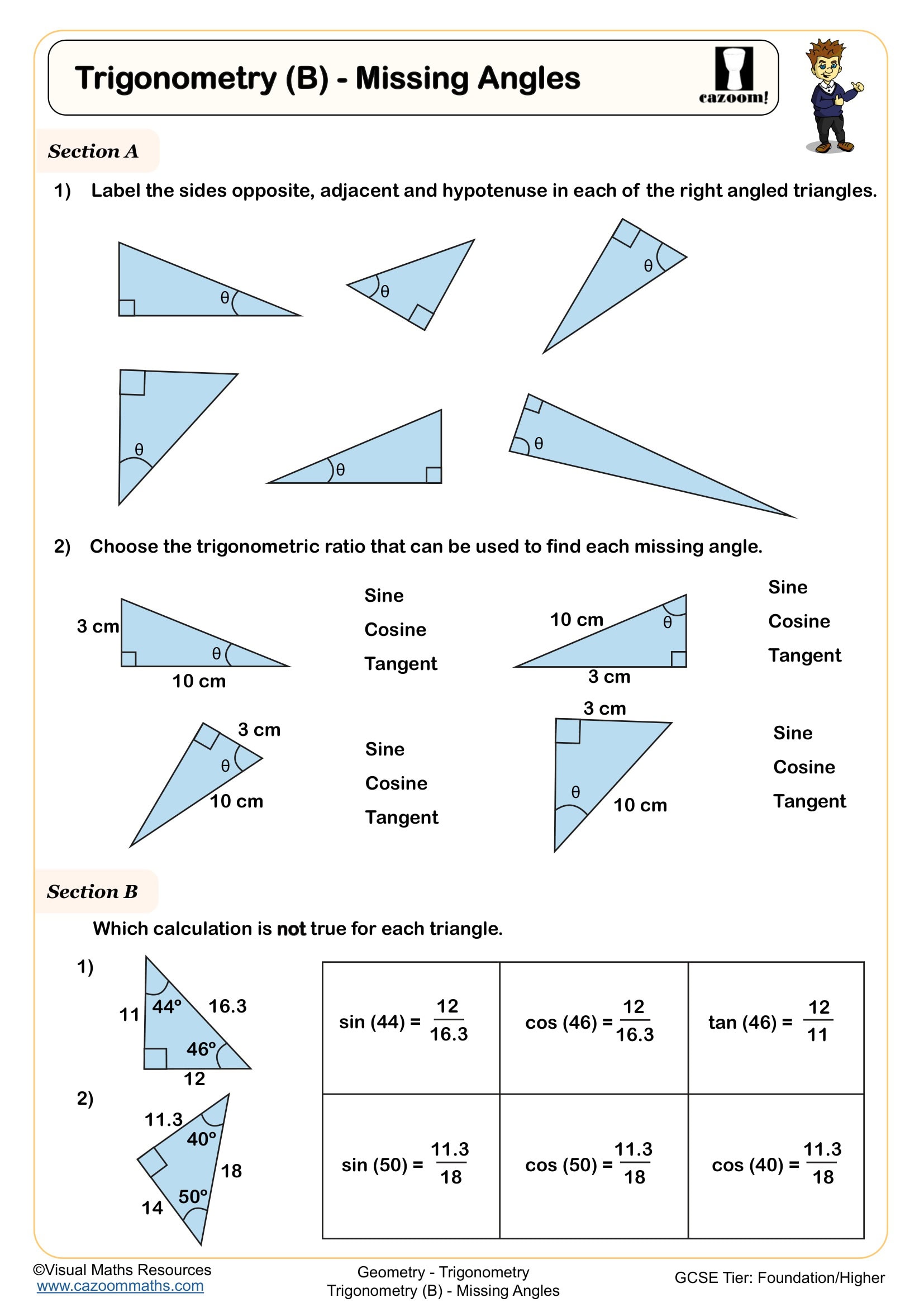
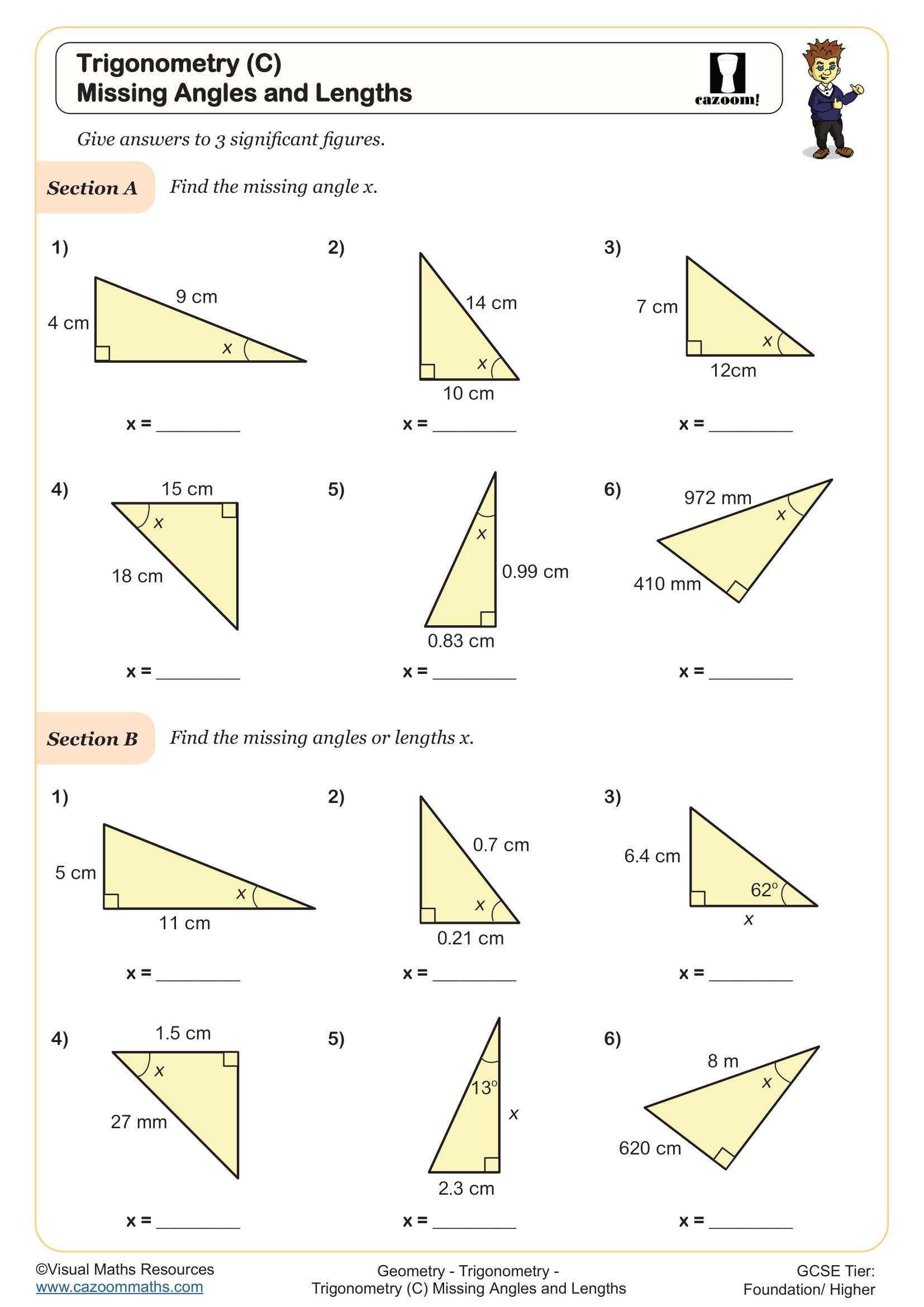
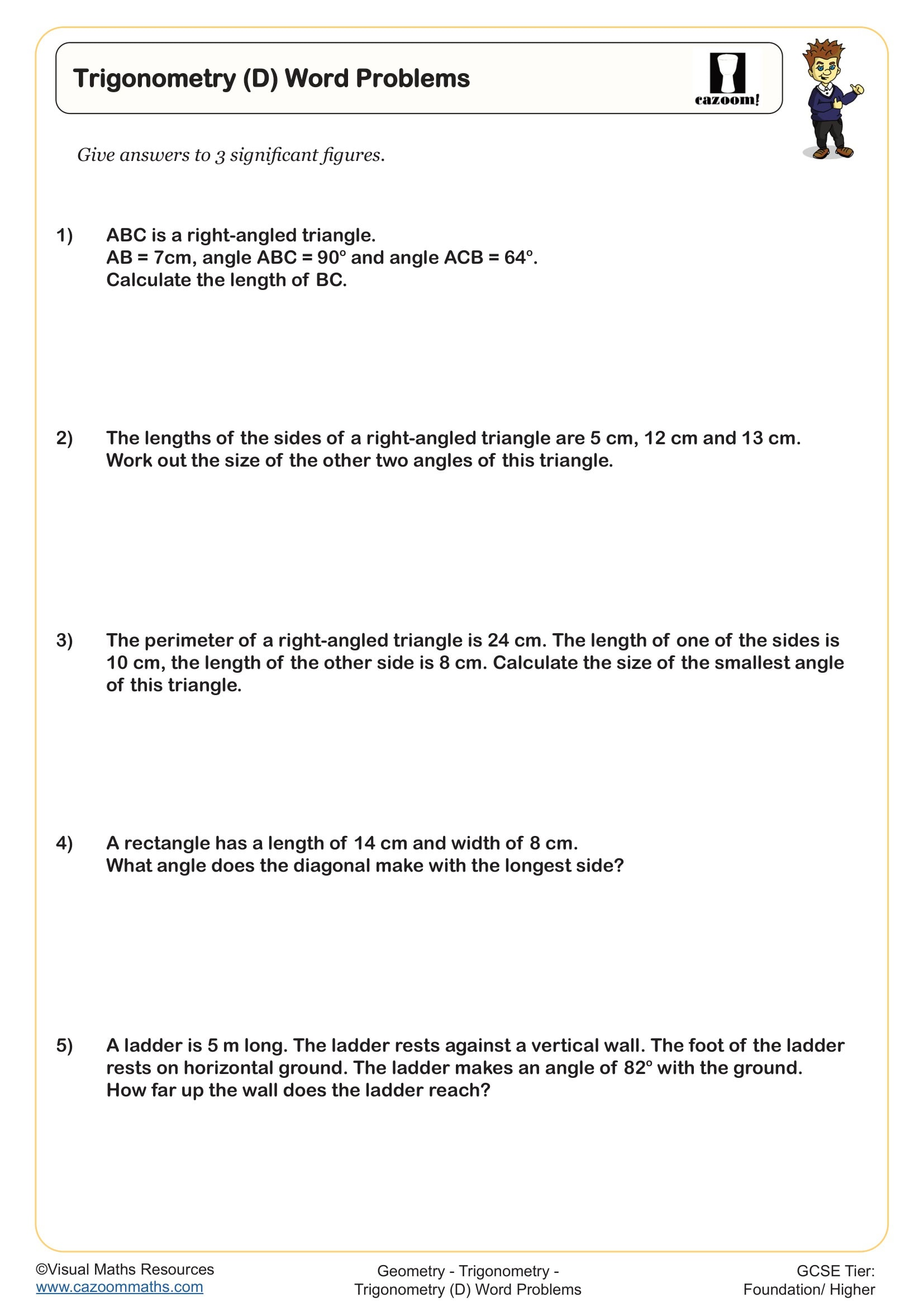
All worksheets are created by the team of experienced teachers at Cazoom Maths.
What visual maths resources help students with trigonometry (a) missing lengths?
Visual maths resources for trigonometry (a) missing lengths typically include clearly labelled right-angled triangles with colour-coded sides showing opposite, adjacent, and hypotenuse. These diagrams help students identify which trigonometric ratio to apply when finding unknown side lengths. Year 8 trigonometry worksheets often feature triangles in various orientations to prevent students from memorising positions rather than understanding the mathematical relationships.
Teachers report that students make fewer errors when worksheets include visual cues such as angle markers and consistent labelling conventions. The most effective trigonometry (a) missing lengths worksheet designs combine clear diagrams with worked examples, showing students how to set up their calculations systematically. This visual approach is particularly valuable for students who struggle with abstract mathematical concepts.
Is trigonometry suitable for all Year 8 students?
Trigonometry year 8 introduces students to basic concepts using right-angled triangles, forming part of the KS3 geometry curriculum. Most students encounter finding missing lengths first, typically after mastering Pythagoras' theorem, as this provides a solid foundation for understanding triangle relationships. The progression from Pythagoras to basic trigonometry feels natural for many learners.
However, teachers observe significant variation in student readiness for trigonometric concepts. Some students excel with the ratio work, whilst others need additional support with fraction manipulation and calculator skills. Schools often differentiate by providing scaffolded worksheets that begin with simpler triangles before progressing to more complex problems, ensuring all students can access the content at an appropriate level.
How should students approach SOH CAH TOA problems systematically?
Teachers recommend that students develop a consistent method for SOH CAH TOA problems: identify the angle, label opposite and adjacent sides, determine which ratio applies, then substitute values into the formula. This systematic approach reduces errors and builds confidence with trigonometric calculations. Students often benefit from writing out 'opposite', 'adjacent', and 'hypotenuse' rather than using abbreviations initially.
A common error occurs when students confuse which side is opposite to the given angle, particularly in triangles rotated from standard position. Teachers find that encouraging students to trace around the triangle with their finger, starting from the given angle, helps establish the correct relationships. Regular practice with varied triangle orientations strengthens this spatial understanding.
How can teachers use these worksheets most effectively in lessons?
Teachers achieve best results when introducing trigonometry worksheets gradually, beginning with problems where students identify the correct ratio before performing calculations. Starting lessons with a brief review of SOH CAH TOA helps activate prior knowledge, whilst mini-whiteboards allow teachers to quickly assess student understanding during guided practice. The included answer sheets enable peer marking activities that promote discussion about methods.
Many teachers structure lessons using a 'think-pair-share' approach, where students attempt problems individually, discuss solutions with partners, then share strategies with the class. This approach works particularly well with trigonometry problems, as students often discover multiple valid approaches to the same question. Regular low-stakes assessment using worksheet questions helps identify misconceptions before they become entrenched.