Year 9 Algebraic Fractions Worksheets
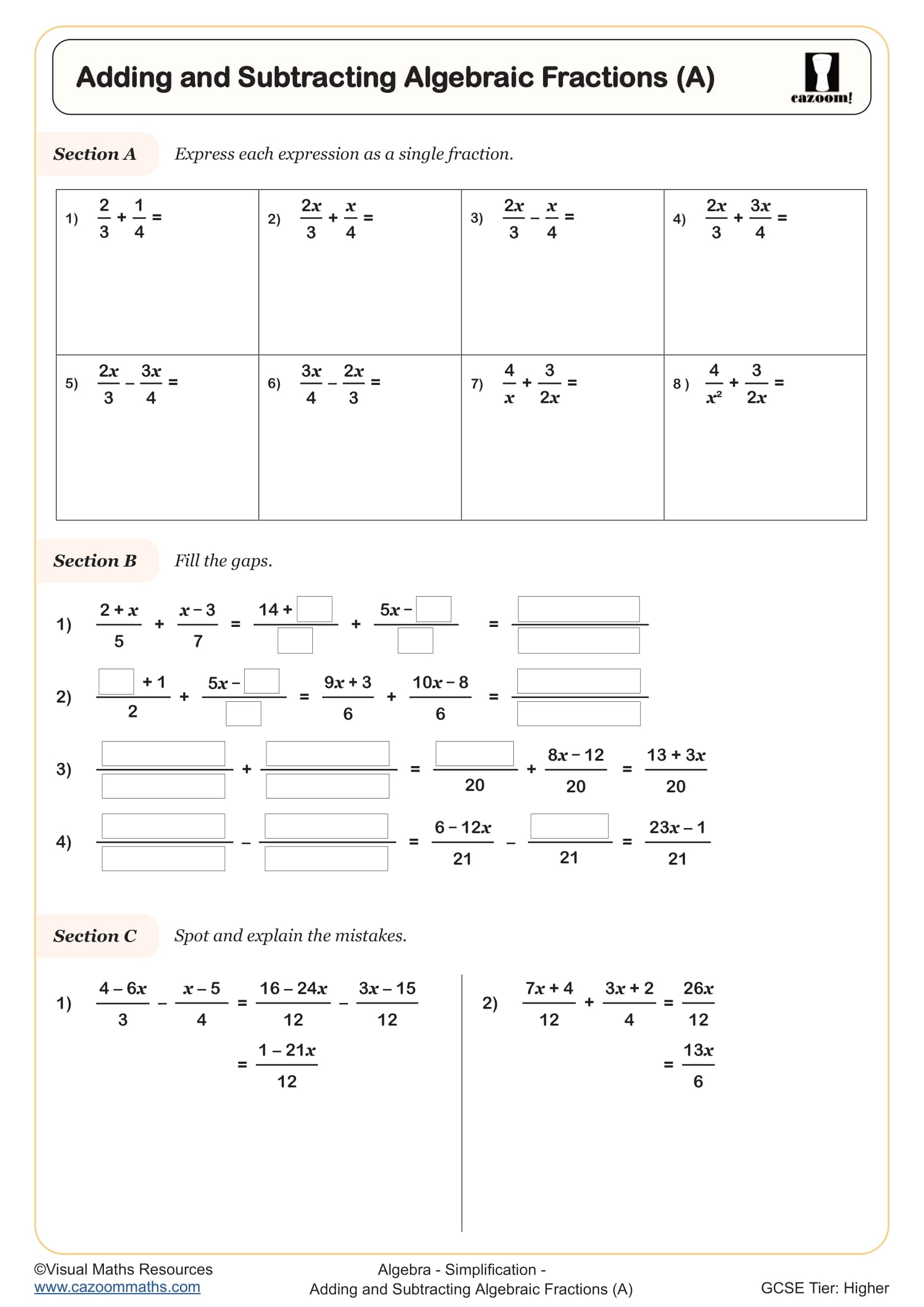
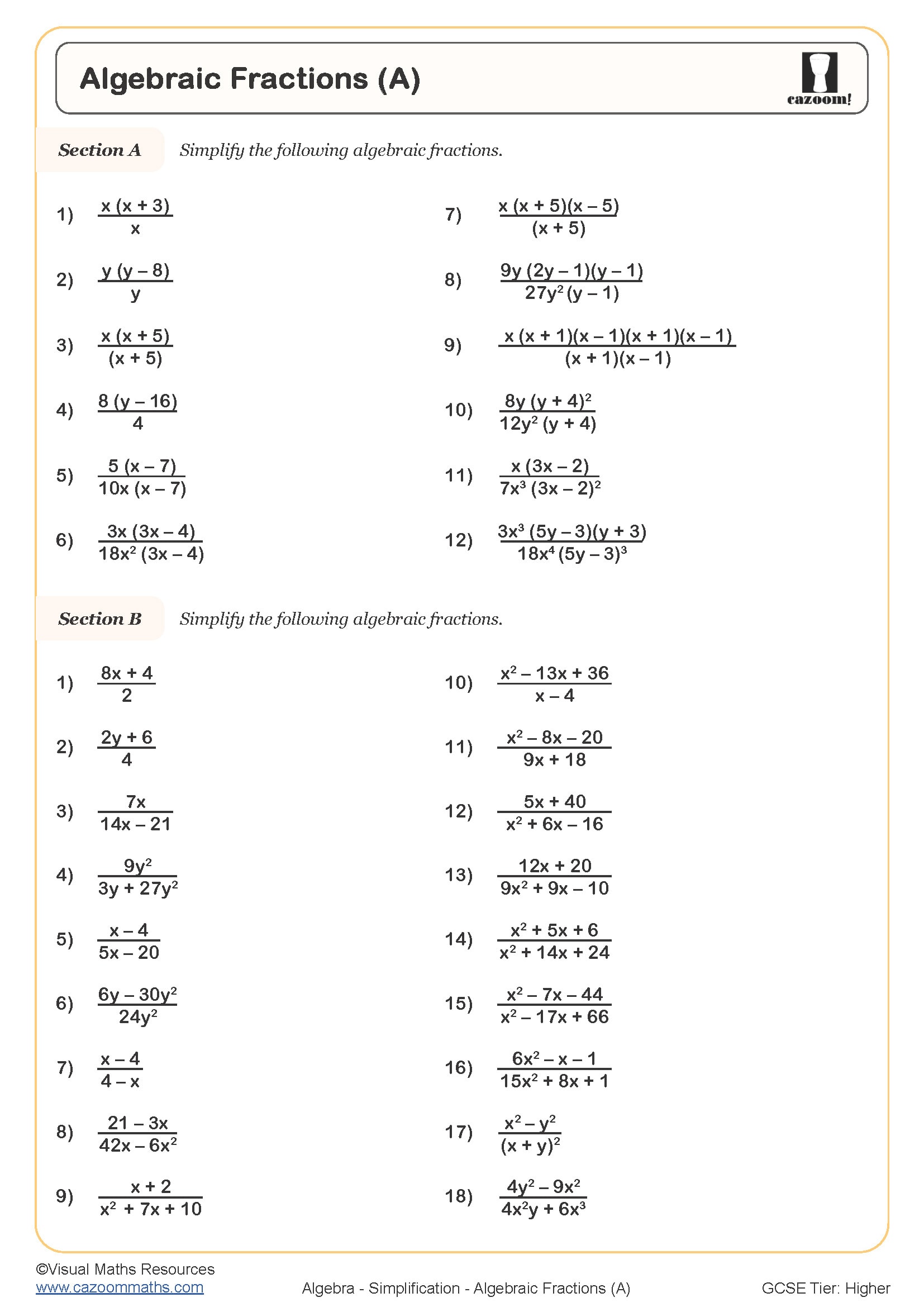
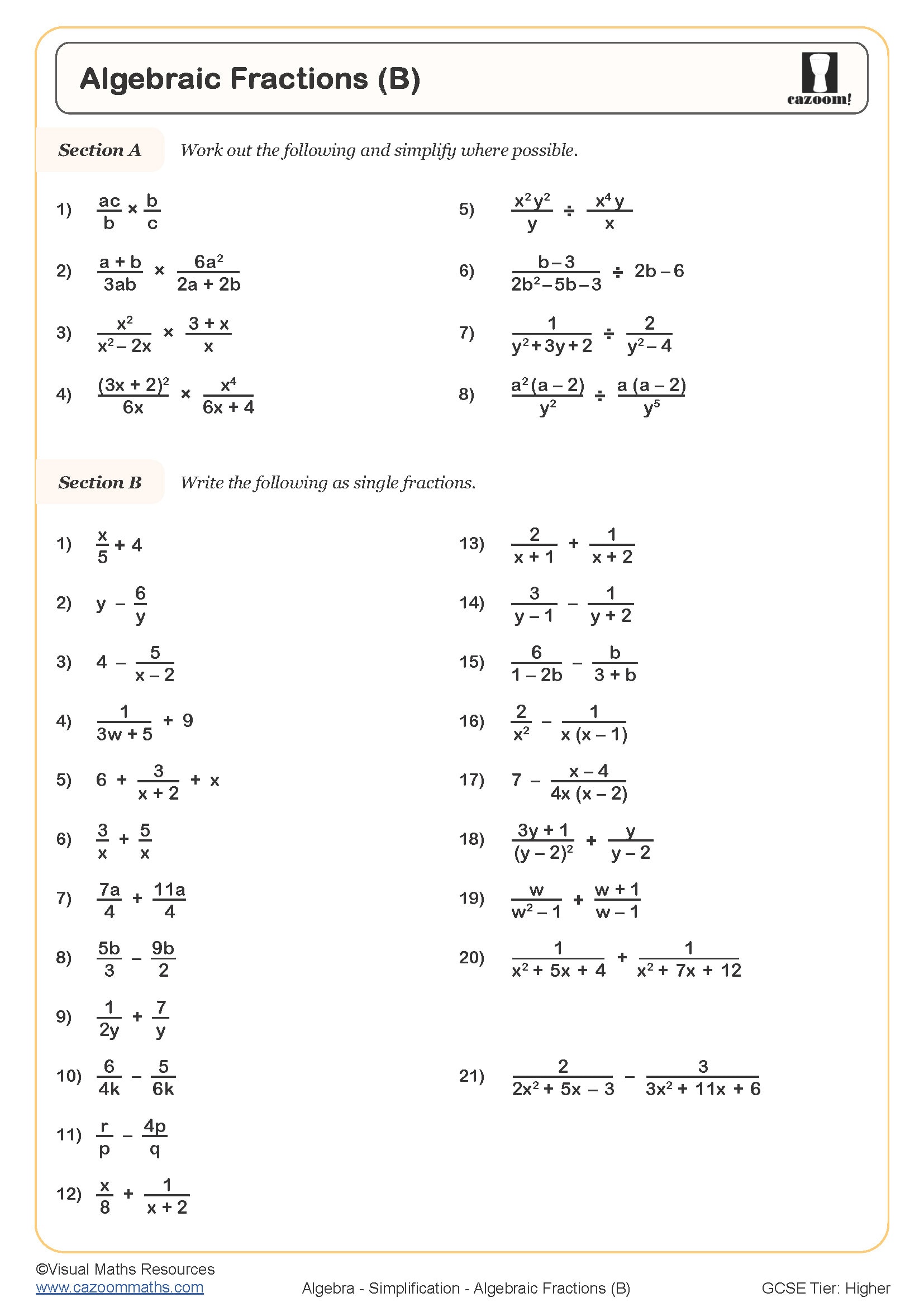
All worksheets are created by the team of experienced teachers at Cazoom Maths.
What makes algebraic fractions year 9 particularly challenging for students?
Algebraic fractions year 9 represents a significant conceptual leap where students must apply fraction rules to expressions containing variables. At this Key Stage 3 level, students often treat algebraic fractions as completely separate from numerical fractions, forgetting fundamental principles they already know. The challenge intensifies when factorising becomes practical for simplification.
Most teachers observe that students attempt to cancel individual terms rather than common factors, leading to errors like cancelling the 'x' in (x+3)/x to get 1+3. Building connections between numerical and algebraic fraction work proves crucial for developing reliable algebraic manipulation skills.
Should students tackle algebraic fractions Year 10 concepts if they struggle with Year 9 basics?
Students should consolidate Year 9 algebraic fraction fundamentals before progressing to more advanced algebraic fractions Year 10 topics. Key Stage 3 focuses on basic operations and simple rational expressions, while GCSE level introduces complex fractions, solving equations with algebraic fractions, and applications in coordinate geometry. Rushing this progression often creates persistent gaps.
Teachers frequently find that students who haven't mastered factorising quadratics struggle significantly with Year 10 algebraic fraction problems. The increased complexity at GCSE level, including partial fractions for A-level preparation, demands solid foundational skills that many students haven't fully developed.
Why do students find adding and subtracting algebraic fractions so difficult?
Adding and subtracting algebraic fractions challenges students because it requires simultaneous application of multiple skills: finding common denominators, factorising expressions, and algebraic manipulation. Unlike numerical fractions where common denominators are often obvious, algebraic expressions require students to identify and create equivalent forms through factorisation.
Classroom experience shows students frequently attempt to add numerators and denominators separately, or struggle to recognise that expressions like (x-1) and (1-x) are related by a factor of -1. The multi-step nature of these problems, combined with the abstract nature of algebraic expressions, makes this topic particularly demanding for many learners.
How can teachers use these worksheets to build student confidence with algebraic fractions?
Teachers can maximise worksheet effectiveness by starting with numerical fraction revision before introducing algebraic equivalents, helping students recognise familiar patterns in new contexts. The answer sheets enable students to self-check their working, identifying where errors occur in multi-step solutions. Many teachers find that pairing struggling students with more confident peers creates valuable discussion about solution strategies.
Regular short practice sessions work better than lengthy problem-solving marathons with algebraic fractions. Teachers often use the worksheets diagnostically, identifying whether errors stem from fraction knowledge, factorising skills, or algebraic manipulation, then targeting specific weaknesses with focused intervention rather than generic revision.