Year 9 Constructions Worksheets
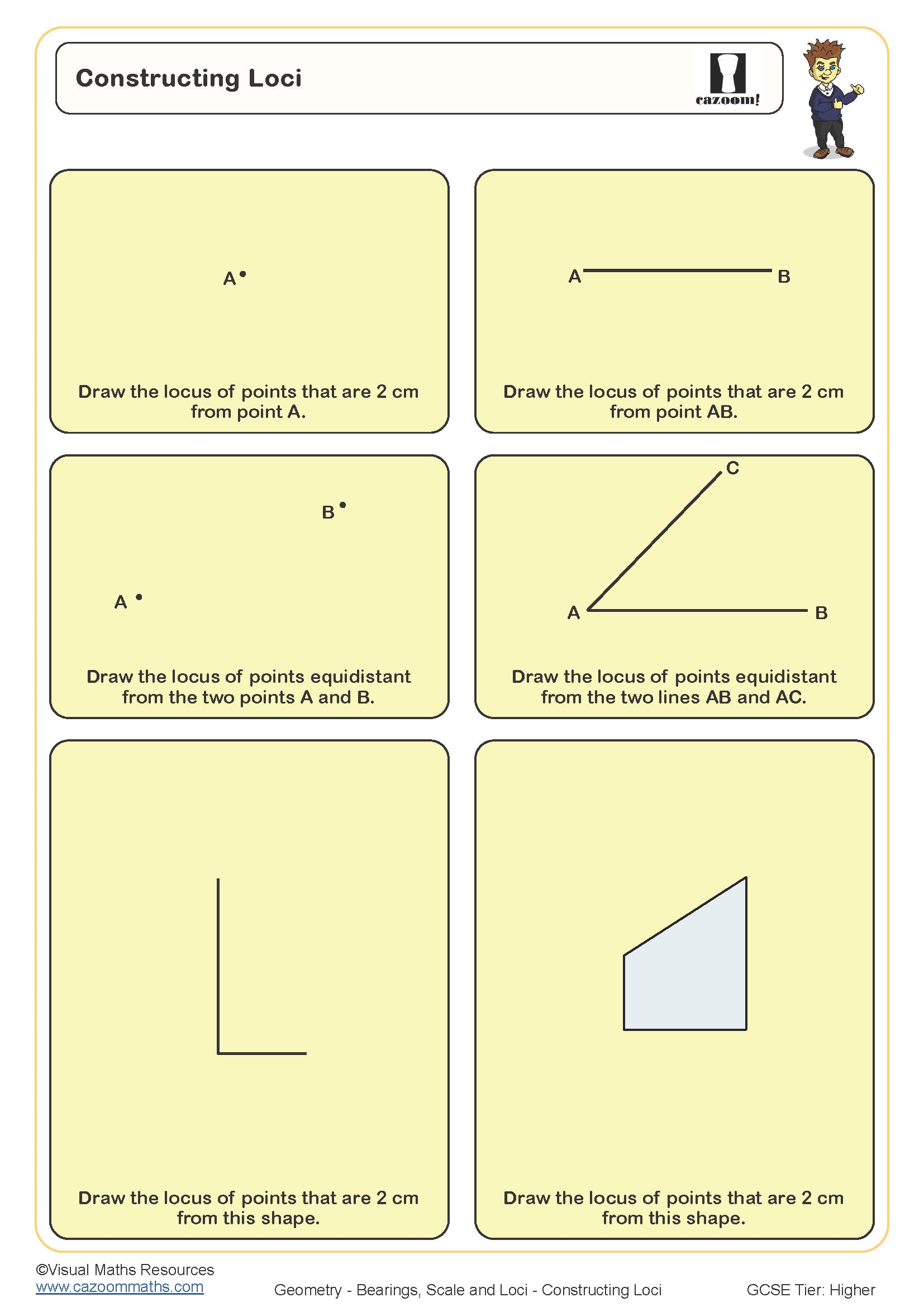
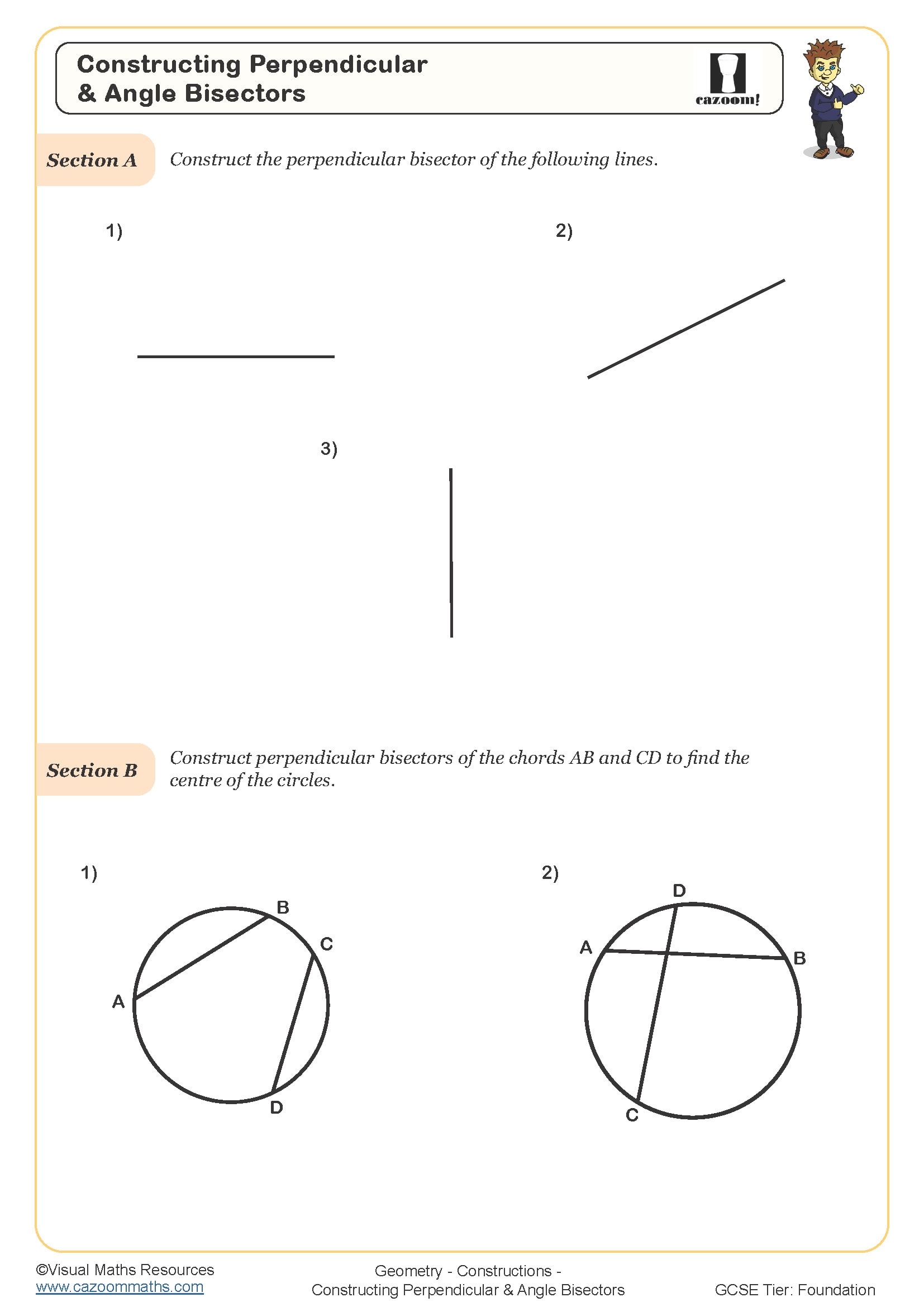
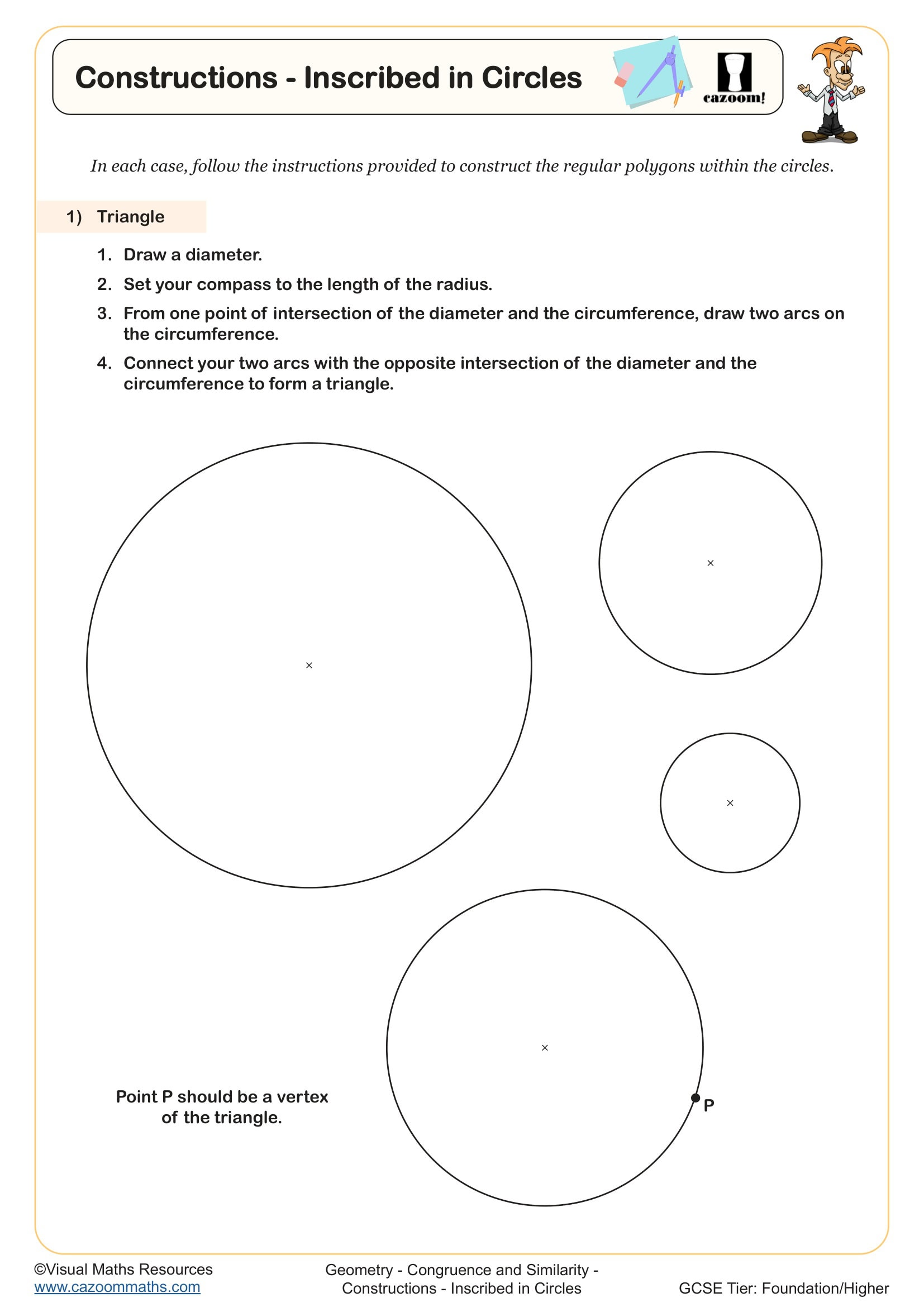
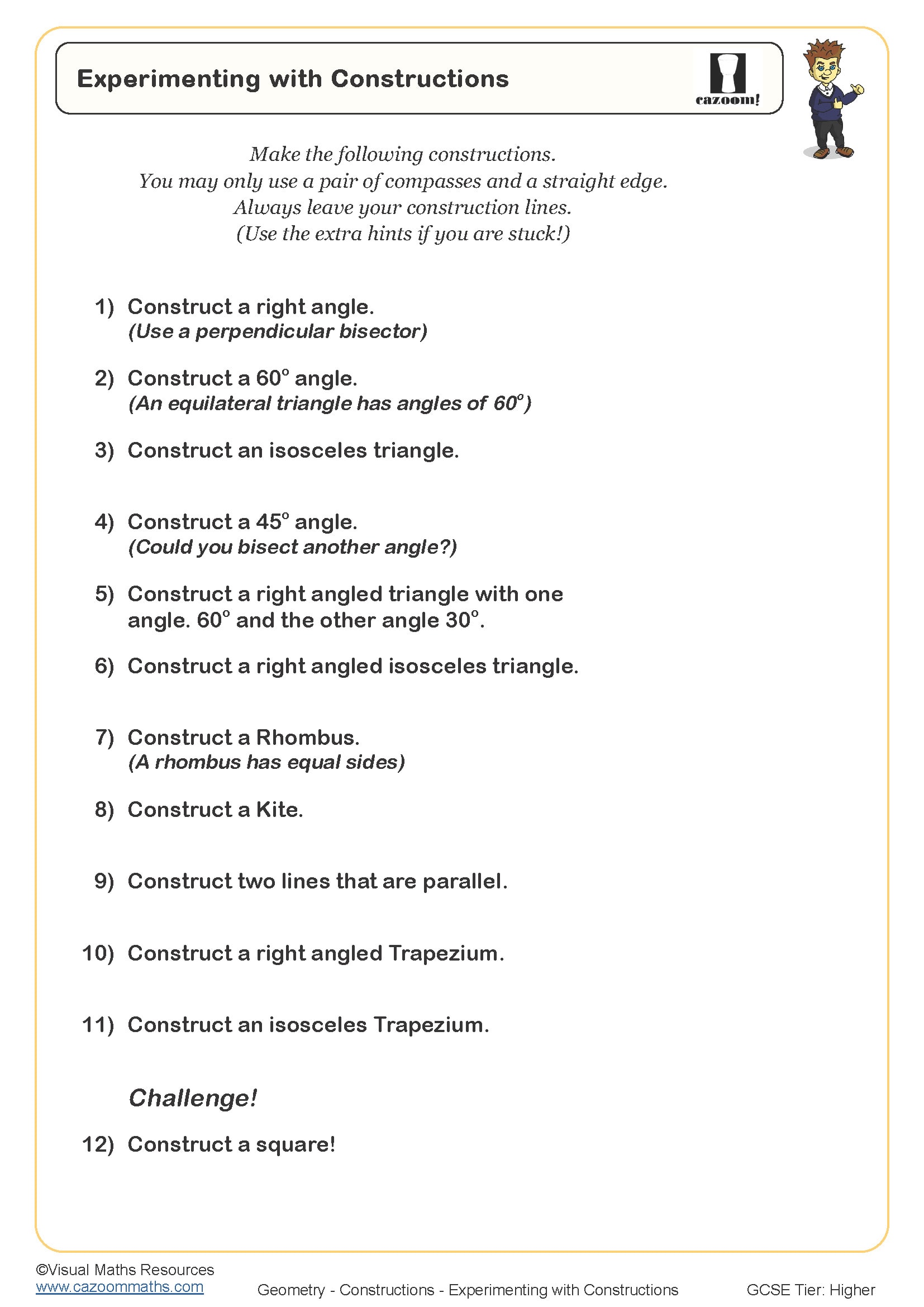
All worksheets are created by the team of experienced teachers at Cazoom Maths.
What are geometric constructions in maths?
Geometric constructions involve creating accurate mathematical shapes and lines using only a compass and straight edge (ruler without measurements). At KS3, students learn to construct perpendicular bisectors, angle bisectors, perpendiculars from a point to a line, and triangles when given specific side lengths or angles. These techniques appear in GCSE exam questions worth 3-4 marks, where method marks depend on showing construction arcs clearly.
A common error occurs when students try to measure angles with a protractor instead of using compass arcs to bisect them. Exam mark schemes specifically require construction arcs to be visible and the correct radius maintained throughout, so students who erase their working lose marks even if their final answer looks accurate. The discipline of ruler-and-compass constructions develops spatial reasoning that underpins technical drawing and engineering design.
Which year group learns constructions?
Constructions are taught in Year 9 as part of the KS3 geometry curriculum, building on the angle and shape work from Years 7 and 8. The National Curriculum requires students to use standard ruler and compass constructions, including constructing shapes inscribed in circles. This timing allows students to develop confidence with geometric tools before tackling the more complex loci and circle theorem proofs at GCSE.
At Year 9, the difficulty progresses from basic perpendicular and angle bisectors to constructing triangles from given information and understanding which shapes can be inscribed within others. Students move from following step-by-step instructions to recognising which construction to apply in problem-solving contexts. This progression means they're ready to tackle the compound loci questions and bearing problems that appear in GCSE Foundation and Higher papers.
Why do we inscribe shapes in circles?
An inscribed shape sits inside a circle with all its vertices touching the circumference – a concept that connects construction skills to circle theorems at GCSE. Students construct inscribed triangles and regular polygons using compass arcs to divide the circle into equal segments, developing understanding of how angles relate to arc lengths. This foundational work prepares them for cyclic quadrilaterals and the inscribed angle theorem in Year 10.
Architects and engineers use inscribed shapes extensively when designing domed structures, stadiums, and amphitheatres. The Romans constructed the Colosseum using inscribed ellipses to create optimal viewing angles, whilst modern architects use computer-aided design based on the same geometric principles to ensure structural stability in curved buildings. Understanding inscribed shapes helps students recognise why certain geometric arrangements appear repeatedly in architecture – they maximise space whilst maintaining structural integrity.
How do construction worksheets help students improve?
These worksheets build confidence through structured practice that isolates each construction type before combining techniques. Questions progress from basic single-step constructions to multi-stage problems, with answer sheets showing the exact arc positions and radius lengths that students should replicate. This visual feedback helps students self-check their method, not just their final answer – particularly important since construction marks depend on visible working.
Teachers use these worksheets effectively for differentiated group work, where students working at different speeds can access the same construction tasks with built-in scaffolding. They work well as homework before introducing loci, allowing students to master compass control in a low-stakes setting. Many teachers find paired work particularly effective for constructions – one student performs the construction whilst another checks that arcs are the correct radius, developing both technical skill and mathematical vocabulary for describing geometric procedures.