Year 9 Similarity and Congruence Worksheets
All worksheets are created by the team of experienced teachers at Cazoom Maths.
What Do Students Learn from Similarity and Congruence Worksheets?
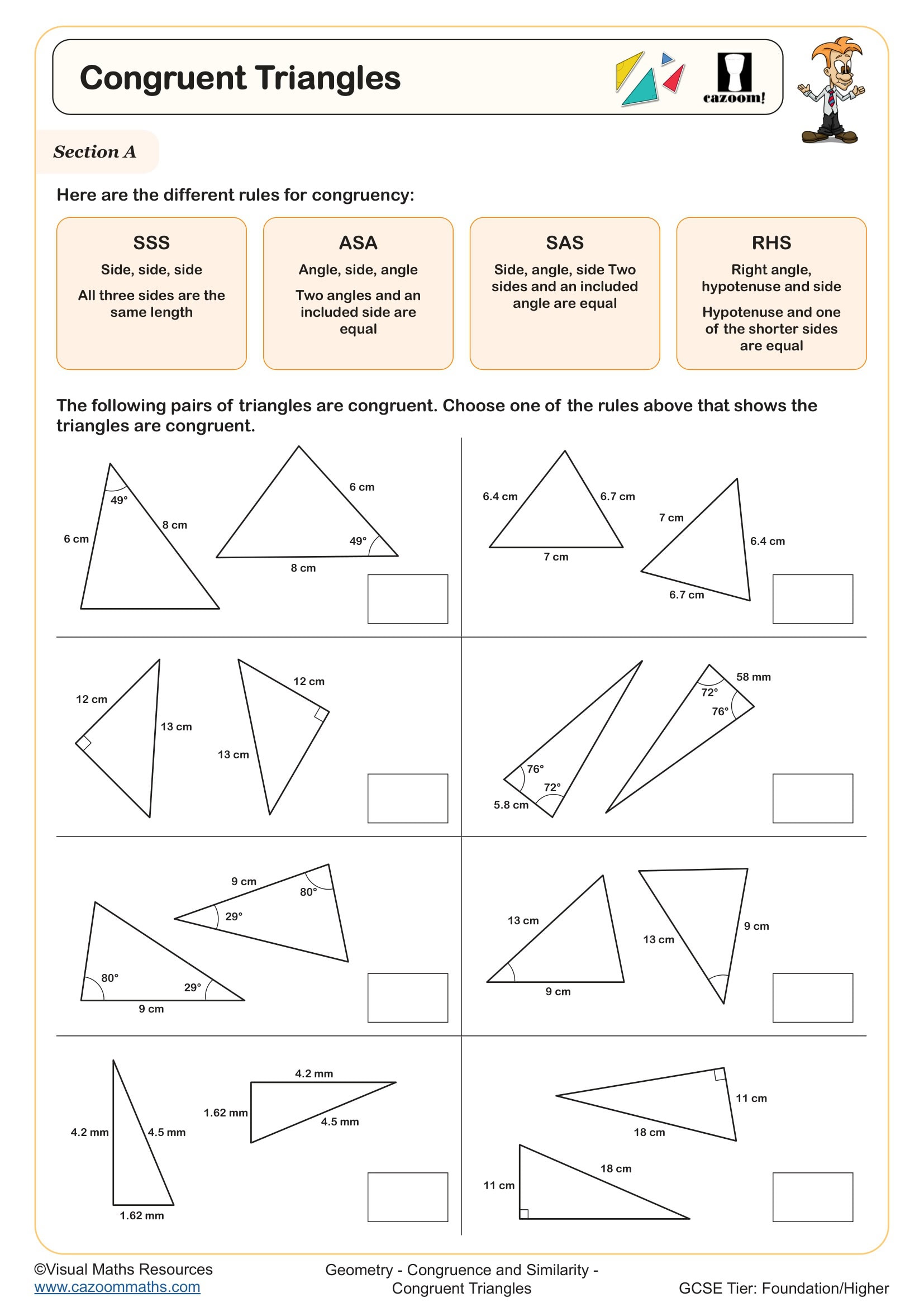
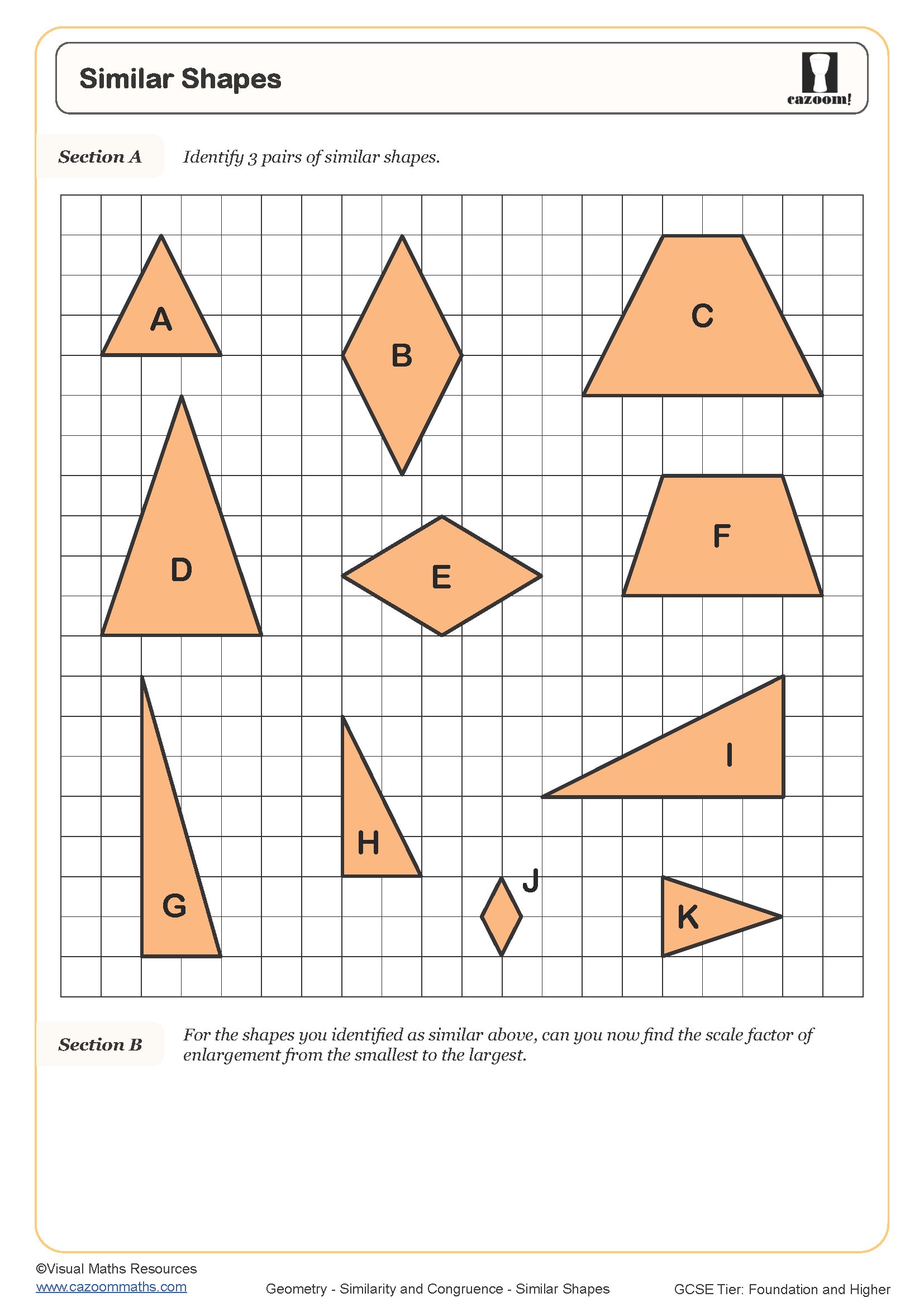
Similarity and congruence worksheet resources teach students to distinguish between shapes that are identical in every way (congruent) and those that are the same shape but different sizes (similar). At Year 9 level within KS3, students develop skills in identifying corresponding angles and sides, calculating scale factors, and applying formal tests for congruence such as SSS, SAS, ASA, and RHS. This connects directly to the National Curriculum requirement for students to understand and use the conditions for shapes to be congruent or similar.
A common error occurs when students assume all rectangles are similar, or that congruent shapes must be in the same orientation. Teachers observe that many students write 'the shapes look the same' without measuring or comparing angles systematically. Effective similarity worksheet grade 9 resources address this by requiring students to show working, measure accurately, and explain their reasoning using mathematical terminology rather than visual impression alone.
Which Year Groups Study Similarity and Congruence?
These worksheets target Year 9 students working within KS3, where similarity and congruence appear as distinct topics in the geometry strand. The National Curriculum introduces informal recognition of similar shapes earlier, but Year 9 marks the point where students begin formal work with scale factors, congruence conditions, and proof. This builds the foundation needed for GCSE, where similarity and congruence appear extensively in both Foundation and Higher tier papers, particularly within questions on geometric proof and problem-solving.
The progression from earlier year groups involves moving from visual recognition to mathematical justification. In Year 7 and 8, students might identify that shapes 'look the same', but by Year 9 they must prove congruence using specific conditions or calculate exact scale factors for similarity. Teachers notice that students who struggle with this transition often haven't fully grasped that congruence requires both shape and size to match, whilst similarity permits proportional enlargement or reduction.
How Do Scale Factors Connect Similarity to Real-World Applications?
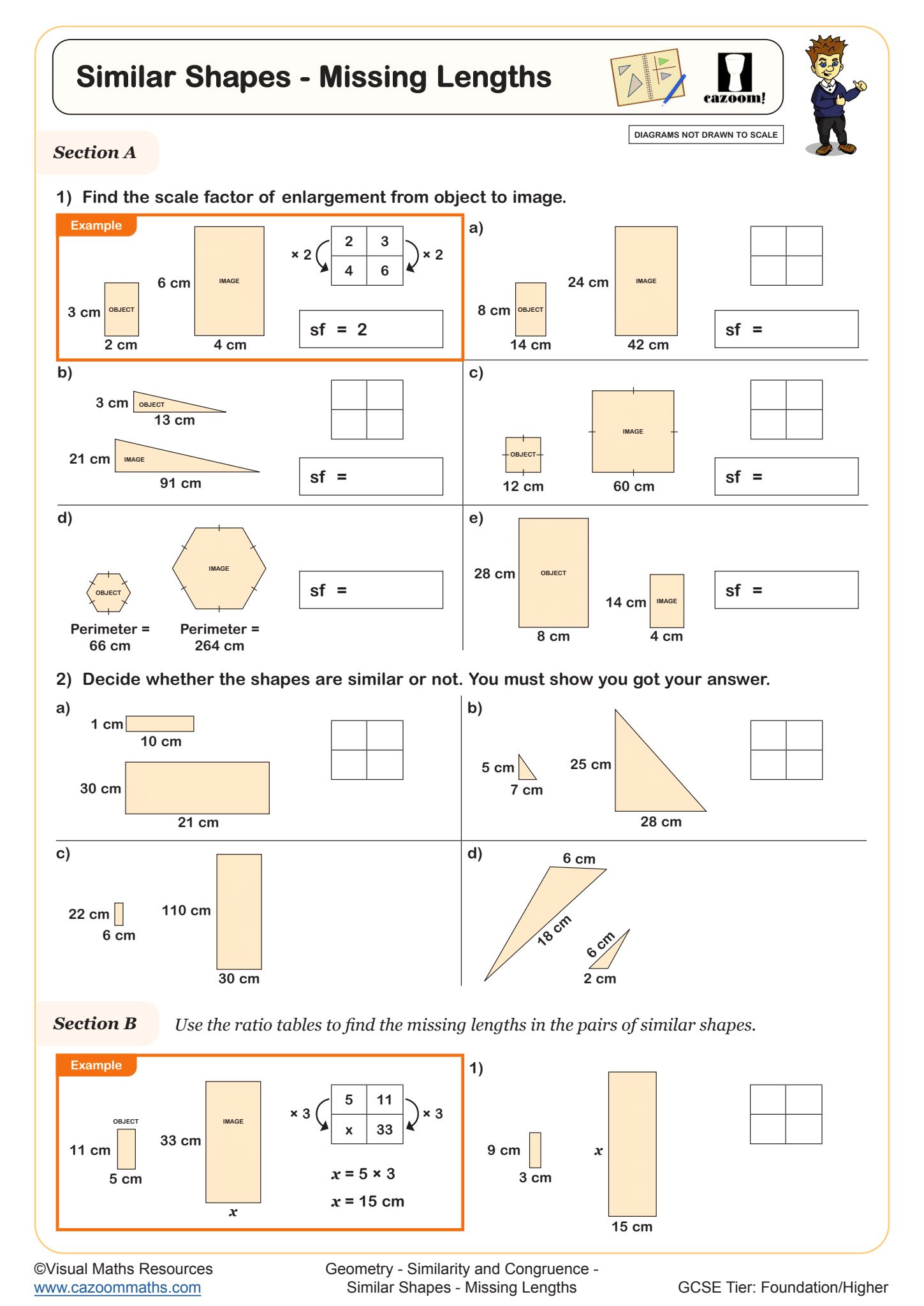
Scale factors express the multiplicative relationship between corresponding lengths in similar shapes, written as a ratio or decimal. Students calculate scale factors by dividing a length in the enlarged shape by the corresponding length in the original, then apply this factor to find unknown sides. This appears throughout the worksheets as students progress from identifying given scale factors to calculating them from pairs of shapes, then using them to solve problems involving area and volume relationships.
This mathematical concept underpins countless real-world applications across STEM fields. Architects use scale factors when creating building plans, where 1:50 or 1:100 scale drawings allow entire structures to fit on manageable sheets. Map makers apply similarity principles, with scale factors determining how distances on paper correspond to actual kilometres. Engineers designing components use similar triangles and scale factors to ensure parts fit together correctly, whilst photographers and graphic designers manipulate images proportionally to avoid distortion. Understanding that area scales by the factor squared, whilst volume scales by the factor cubed, becomes crucial in manufacturing and materials estimation.
How Can Teachers Use These Worksheets in the Classroom?
The worksheets provide structured progression from basic identification tasks through to multi-step problems requiring both similarity and congruence knowledge. Questions typically begin with clearly oriented shapes before introducing rotation and reflection, helping students develop systematic approaches rather than relying on visual matching. The included answer sheets allow students to self-check their understanding, particularly valuable when working on the justification and reasoning elements that mark schemes reward at GCSE.
Many teachers use these resources for differentiated homework, assigning different question sets based on prior assessment results. They work effectively in intervention sessions for students who struggled with the topic during whole-class teaching, as the scaffolded approach allows focused practice on specific aspects like calculating scale factors or applying congruence tests. Some teachers set paired work where one student completes questions whilst their partner checks answers and explanations, building both calculation skills and mathematical communication. The worksheets also serve as useful pre-assessment tools before beginning GCSE-style similarity and enlargement topics.