Back to:
Doubling using Pictorial Representation WORKSHEET
Suitable for Grades: 1st Grade, 2nd Grade
CCSS: 1.NBT.C.4, 2.NBT.B.5
CCSS Description: Add within 100, including adding a two-digit number and a one-digit number, and adding a two-digit number and a multiple of 10, using concrete models or drawings and strategies based on place value, properties of operations, and/or the relationship between addition and subtraction; relate the strategy to a written method and explain the reasoning used. Understand that in adding two-digit numbers, one adds tens and tens, ones and ones; and sometimes it is necessary to compose a ten.
Fluently add and subtract within 100 using strategies based on place value, properties of operations, and/or the relationship between addition and subtraction.
Fluently add and subtract within 100 using strategies based on place value, properties of operations, and/or the relationship between addition and subtraction.
Doubling using Pictorial Representation WORKSHEET DESCRIPTION
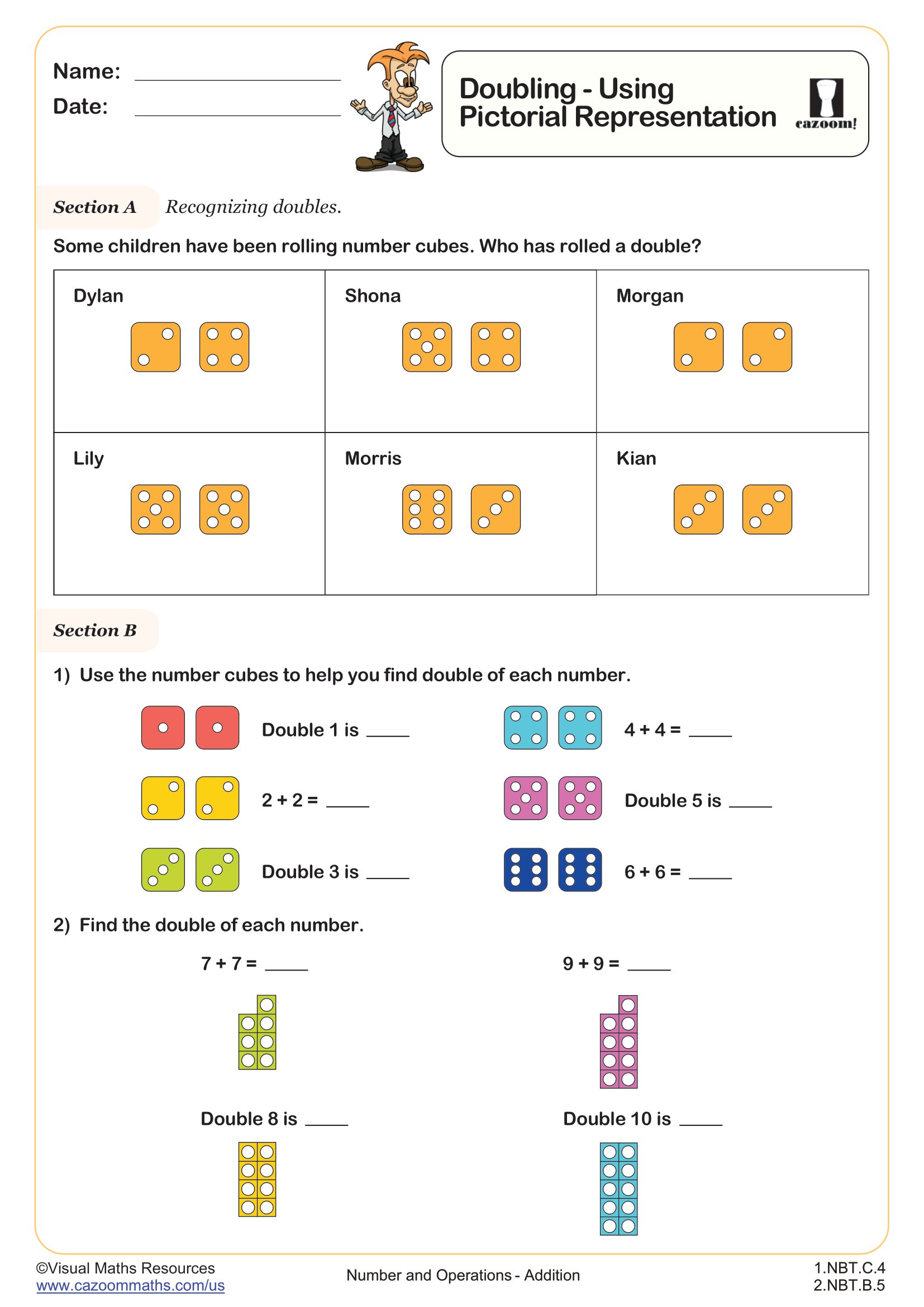
The worksheet uses pictorial representations (dice and number frames) to aid in understanding the concept of doubling in a visual way.
Section A focuses on identifying doubles. It presents students with pairs of number cubes and they will select the pairs that represent doubles.
Then, in section B learners will use number cubes to find the double of the numbers 1 - 6 and number frames to double 7, 8, 9 and 10.
Doubling number sentences are of the form “7 + 7 = “ and “Double 3 is…”.
All worksheets are created by the team of experienced teachers at Cazoom Math.
RELATED TO Doubling using Pictorial Representation WORKSHEET
Frequently Asked Questions
This doubling using pictorial representation worksheet is designed for students in 1st Grade and 2nd Grade and aligns with Common Core State Standards.