1st Grade 2D Shapes Worksheets
All worksheets are created by the team of experienced teachers at Cazoom Math.
What Are 2D Shapes and Why Do First Graders Study Them?
Two-dimensional shapes are flat figures with length and width but no depth, including circles, triangles, squares, rectangles, and hexagons. First grade geometry standards focus on identifying these shapes by their defining attributes, such as the number of sides and corners. Students learn to distinguish between shapes based on features rather than just memorizing names, which builds analytical thinking skills early in their mathematical development.
Teachers frequently notice that students initially identify shapes only when they appear in standard orientations. A common misconception occurs when a square is tilted 45 degrees—many first graders call it a diamond rather than recognizing it still has four equal sides and four right angles. Drawing shapes themselves helps students internalize these defining characteristics and understand that orientation doesn't change a shape's identity.
What Should First Graders Know About 2D Shapes?
By the end of first grade, students should identify and distinguish between circles, triangles, squares, rectangles, and hexagons. They should recognize these shapes regardless of size or orientation, understanding that defining attributes—not position or color—determine shape identity. Students also begin describing shapes using informal language about sides and corners, laying groundwork for more precise geometric vocabulary in later grades.
This understanding builds on kindergarten work where students sorted shapes into categories and identified basic shapes in their environment. First grade deepens this knowledge by emphasizing attributes and introducing the concept that shapes can be combined to create new shapes. This foundation becomes crucial in second grade when students partition shapes into equal parts and begin exploring fractions, making early shape recognition a building block for more advanced mathematical concepts.
How Does Drawing Shapes Help Students Learn Geometry?
Drawing shapes requires students to actively think about defining attributes rather than passively recognizing patterns. When a first grader attempts to draw a square, they must consider that all four sides need equal length and all corners form right angles. This hands-on approach strengthens understanding of what makes each shape unique and helps students move beyond surface-level identification to deeper geometric reasoning.
Shape drawing connects directly to real-world design and engineering concepts. Architects use geometric shapes to create building plans, while graphic designers combine basic shapes to form logos and illustrations. Even simple activities like arranging furniture in a room or creating art projects require understanding how shapes fit together. When students learn to draw shapes accurately, they develop spatial reasoning skills that transfer to tasks like reading maps, following assembly instructions, and eventually understanding coordinate grids in upper elementary grades.
How Can Teachers Use These 2D Shapes Worksheets Effectively?
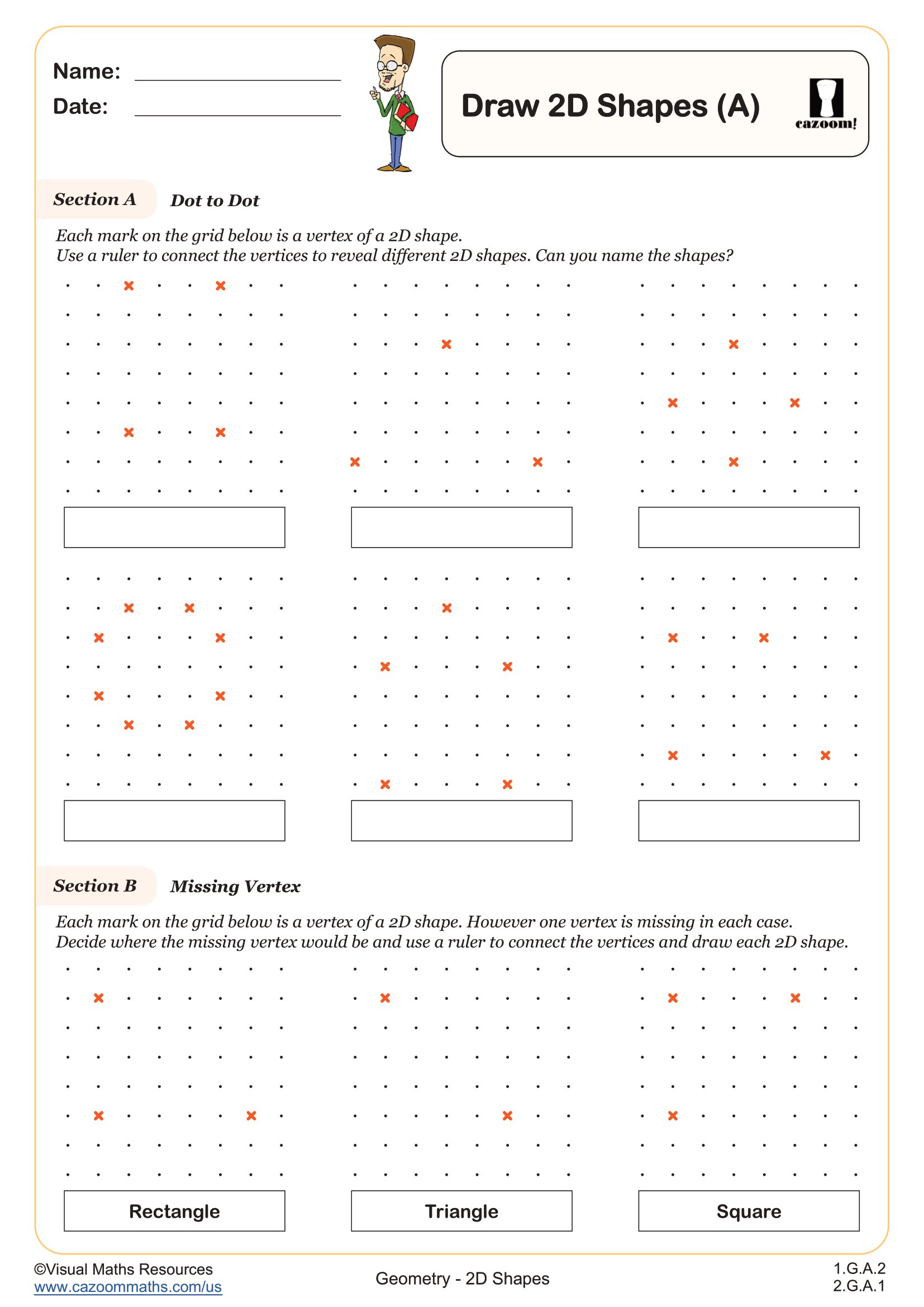
The worksheets provide structured practice in drawing shapes with clear visual models, helping students develop fine motor control alongside geometric understanding. Answer keys allow teachers to quickly verify that students are creating shapes with correct attributes, particularly checking that sides are relatively straight and corners are properly formed. This immediate feedback helps identify students who may need additional support with either the geometric concepts or the physical act of drawing.
Teachers use these worksheets during math centers to reinforce whole-group instruction, as morning work to review previously taught concepts, or as formative assessments to gauge student understanding before moving to more complex shape combinations. The drawing component makes these worksheets particularly effective for kinesthetic learners who benefit from creating rather than simply identifying shapes. Some teachers pair students to compare their drawings and discuss whether each shape meets the defining attributes, turning individual practice into collaborative learning that builds mathematical vocabulary.