1st Grade 3D Shapes Worksheets
All worksheets are created by the team of experienced teachers at Cazoom Math.
What 3D Shapes Should First Graders Learn?
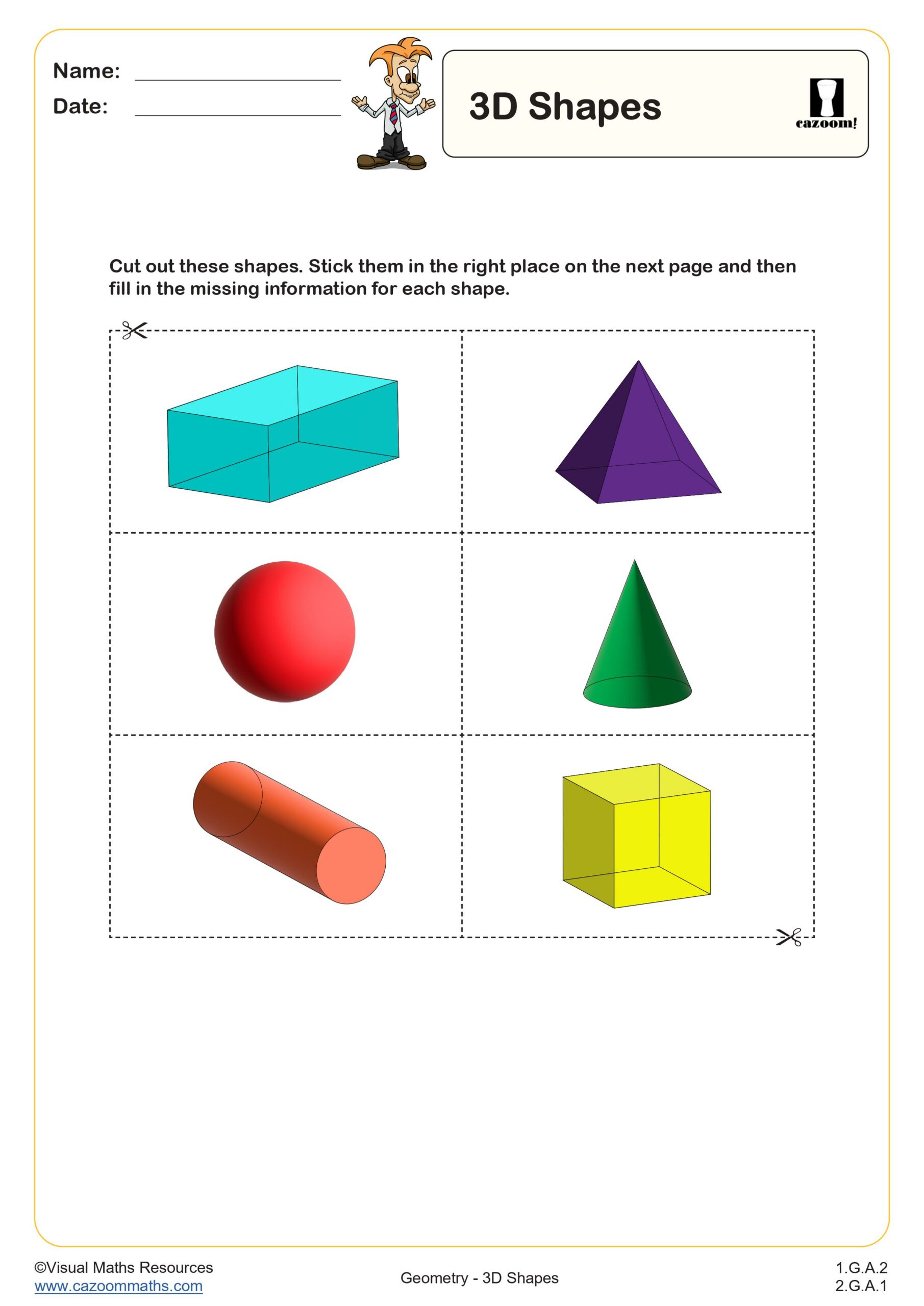
First grade students typically focus on four main 3D shapes: cubes, spheres, cones, and cylinders. According to Common Core State Standards (1.G.A.1), students should recognize and identify these shapes regardless of their size or orientation. They should also begin describing attributes like curved versus flat surfaces and understanding that 3D shapes are solid objects.
Many teachers find success introducing 3D shapes through physical objects students can hold and manipulate. A common error occurs when students count only the faces they can see rather than all faces of a shape. For example, when viewing a cube from the front, students might say it has three faces instead of six because they don't yet visualize the hidden back, bottom, and side faces.
How Does Learning 3D Shapes Build Math Skills?
In first grade, 3D shape recognition builds directly on the 2D shape work students completed in kindergarten. Students now connect their understanding of squares, circles, triangles, and rectangles to the faces and surfaces they observe on solid shapes. This progression develops spatial reasoning and helps students understand that shapes exist in the world around them, not just on paper.
This foundational geometry knowledge prepares students for second grade, where they'll begin partitioning shapes into equal parts and analyzing attributes in greater detail. By third grade, students use this early 3D shape vocabulary when learning about volume and capacity. The ability to visualize and mentally rotate 3D objects also supports later work in measurement, fractions, and even reading graphs and charts.
What's the Difference Between Faces, Edges, and Vertices?
Faces are the flat or curved surfaces of a 3D shape. Edges are the line segments where two faces meet. Vertices (singular: vertex) are the corner points where edges come together. A cube has 6 faces, 12 edges, and 8 vertices, while a sphere has 1 curved face and no edges or vertices. First graders typically start by identifying faces before moving to edges and corners.
Understanding these components connects to real-world design and construction. Architects use knowledge of faces, edges, and vertices when designing buildings, while packaging engineers consider these attributes when creating boxes and containers. Even young students notice that shapes with flat faces stack easily, while spheres and cylinders roll. This practical understanding of 3D shape properties appears in STEM fields from engineering to computer graphics.
How Can Teachers Use 3D Shape Worksheets Effectively?
The 3D shapes worksheet provides structured practice that reinforces shape recognition through visual identification activities. Students benefit from completing worksheets after hands-on exploration with physical 3D objects like wooden blocks, balls, and everyday containers. The answer key allows teachers to quickly check understanding and identify students who need additional support with specific shapes or vocabulary terms.
Teachers often use these worksheets during math centers or stations, pairing them with manipulatives so students can compare their worksheet answers to actual objects. The worksheets work well for independent practice after whole-group instruction or as quick assessments to gauge which students have mastered shape identification. Some teachers send them home as homework to involve families in reinforcing geometry vocabulary, while others use them during intervention time to provide targeted review for students who need extra practice distinguishing between similar shapes.