1st Grade Measurement Worksheets
All worksheets are created by the team of experienced teachers at Cazoom Math.
What Measurement Skills Do First Graders Learn?
First grade measurement focuses on comparing attributes directly rather than using numbers or units. Students learn to describe one object as longer, shorter, taller, heavier, or lighter than another by placing items side by side or using balance scales. This direct comparison approach aligns with Common Core standard 1.MD.A.1, which emphasizes ordering objects by measurable attributes and describing the differences using appropriate vocabulary.
Students often lose confidence when asked to compare objects that aren't positioned next to each other, making it appear more difficult than it actually is. Teachers notice that providing worksheets where objects are already aligned for comparison helps students focus on the measurement vocabulary itself rather than the physical arrangement. Once students master these basic comparisons, they're ready to move toward measuring with non-standard units like paperclips or blocks in later lessons.
How Does First Grade Measurement Build Math Understanding?
In first grade, measurement builds on the sorting and comparing skills students developed in kindergarten, where they learned to identify attributes like size and position. Now students use more precise comparative language and begin to understand that measurement requires a consistent attribute to compare. This grade level marks the transition from simple observation to structured comparison using mathematical vocabulary that will support future work with rulers and standard units.
These foundational skills prepare students for second grade, where they'll measure objects using standard units like inches and centimeters. Teachers find that students who struggle with measurement in later grades often missed this crucial first grade step of understanding what it means to compare attributes directly. Mastering comparative language now prevents confusion when students encounter more abstract measurement concepts involving numbers and units in subsequent years.
Why Is Comparing Heights Important for Young Learners?
Comparing heights teaches students to focus on a single measurable attribute while ignoring other characteristics like width or color. This skill requires students to isolate one dimension and make judgments based solely on that attribute, which is fundamental to mathematical thinking. Students learn that "taller" and "shorter" describe vertical length, developing spatial reasoning that connects to geometry concepts they'll encounter throughout elementary school.
Height comparison appears constantly in real-world contexts that first graders encounter daily. Students naturally compare their own heights with classmates, notice which plants in the classroom garden grow tallest, or observe which stack of blocks reaches higher. These everyday applications make measurement feel relevant and help students understand why precise comparative language matters. In STEM fields, this early practice with comparing dimensions leads to skills like analyzing data in science experiments or understanding scale in engineering projects.
How Can Teachers Use These Measurement Worksheets Effectively?
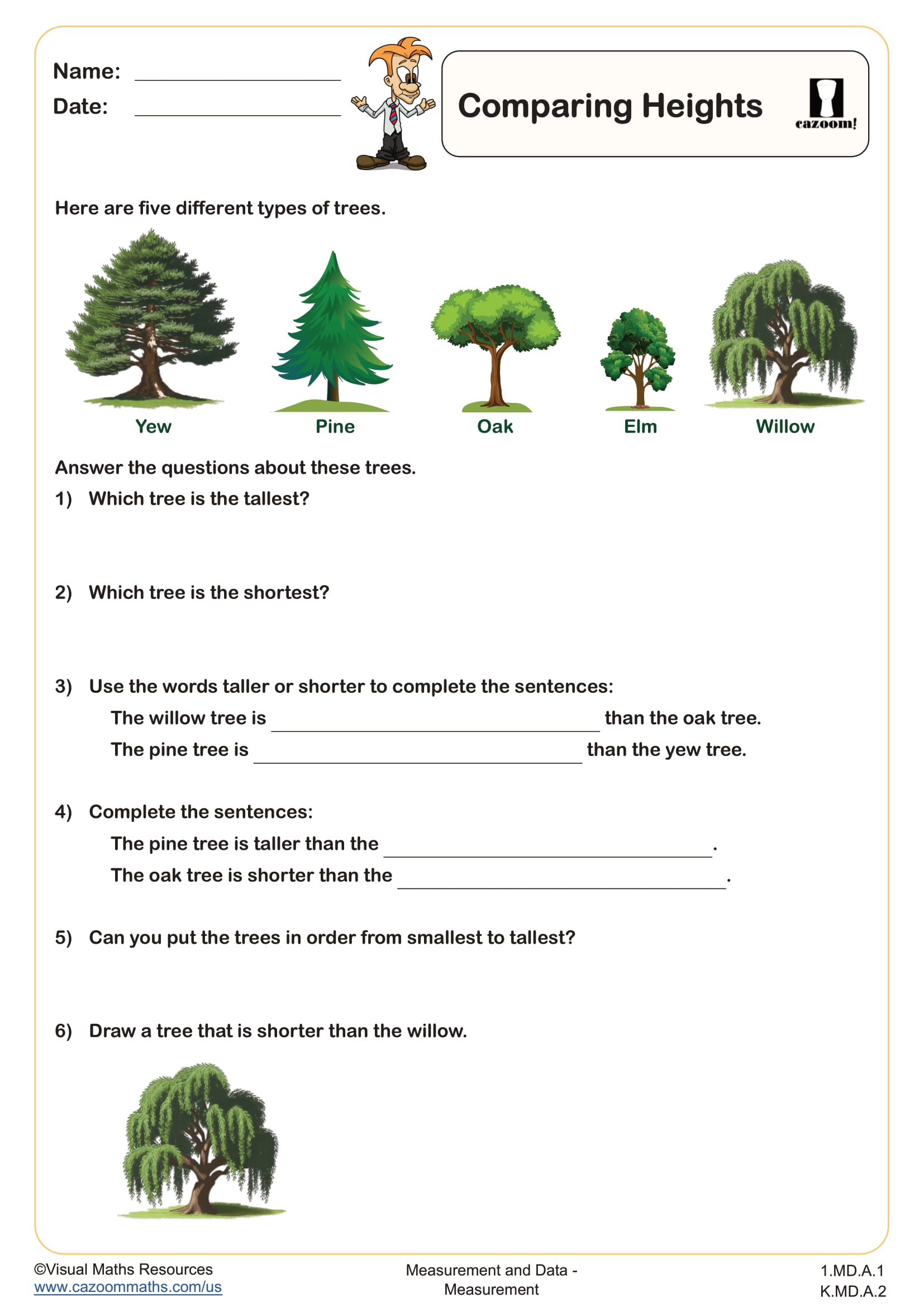
The worksheets provide visual representations where students can practice identifying which objects are taller or shorter, reinforcing the connection between comparative vocabulary and actual measurement attributes. Clear illustrations help students focus on the measurement task without getting distracted by complex scenarios or confusing layouts. The answer keys allow teachers to quickly assess whether students understand the concepts or need additional support with specific comparative terms.
Many teachers use these worksheets during math centers or small group instruction, where they can observe how students approach comparison tasks and address misconceptions immediately. The worksheets also work well for homework practice, giving parents a structured way to reinforce measurement vocabulary at home. Some teachers find that pairing students to complete worksheets together encourages mathematical discussion, as students explain their reasoning about which object is taller or shorter. The format adapts easily to intervention sessions for students who need extra practice before moving to measurement with non-standard units.