1st Grade Multiplication Worksheets
All worksheets are created by the team of experienced teachers at Cazoom Math.
What multiplication concepts should 1st graders learn?
First grade multiplication focuses on understanding equal groups and the concept of doubling rather than memorizing multiplication facts. Students work with pictorial representations to see that multiplication means combining groups of the same size. The Common Core State Standards introduce multiplication formally in 2nd grade, but 1st grade lays important groundwork through repeated addition and recognizing patterns in equal groups.
Doubling serves as the most accessible entry point because students can physically see two identical groups and count the total. Teachers often use this foundation by having students draw circles around groups of objects, then count how many total items appear when they have two groups. Students who struggle with this concept typically need more time with one-to-one correspondence and basic addition before tackling grouped quantities.
Is multiplication too advanced for 1st grade students?
Multiplication at the 1st grade level looks very different from what older students practice. Rather than memorizing times tables, 1st graders explore the conceptual foundation—understanding that three groups of two means counting 2, 4, 6. This pre-multiplication work uses visual models exclusively, allowing students to count individual objects within groups before making the cognitive leap to multiplication as a shortcut for repeated addition.
This early exposure builds number sense that makes 2nd and 3rd grade multiplication significantly easier. Students who recognize equal groups and practice skip counting in 1st grade transition more smoothly to formal multiplication algorithms. The visual nature of 1st grade multiplication also supports students who need concrete representations, preventing the abstract symbol confusion that often emerges when multiplication is introduced too quickly without foundational understanding.
How does doubling help students understand multiplication?
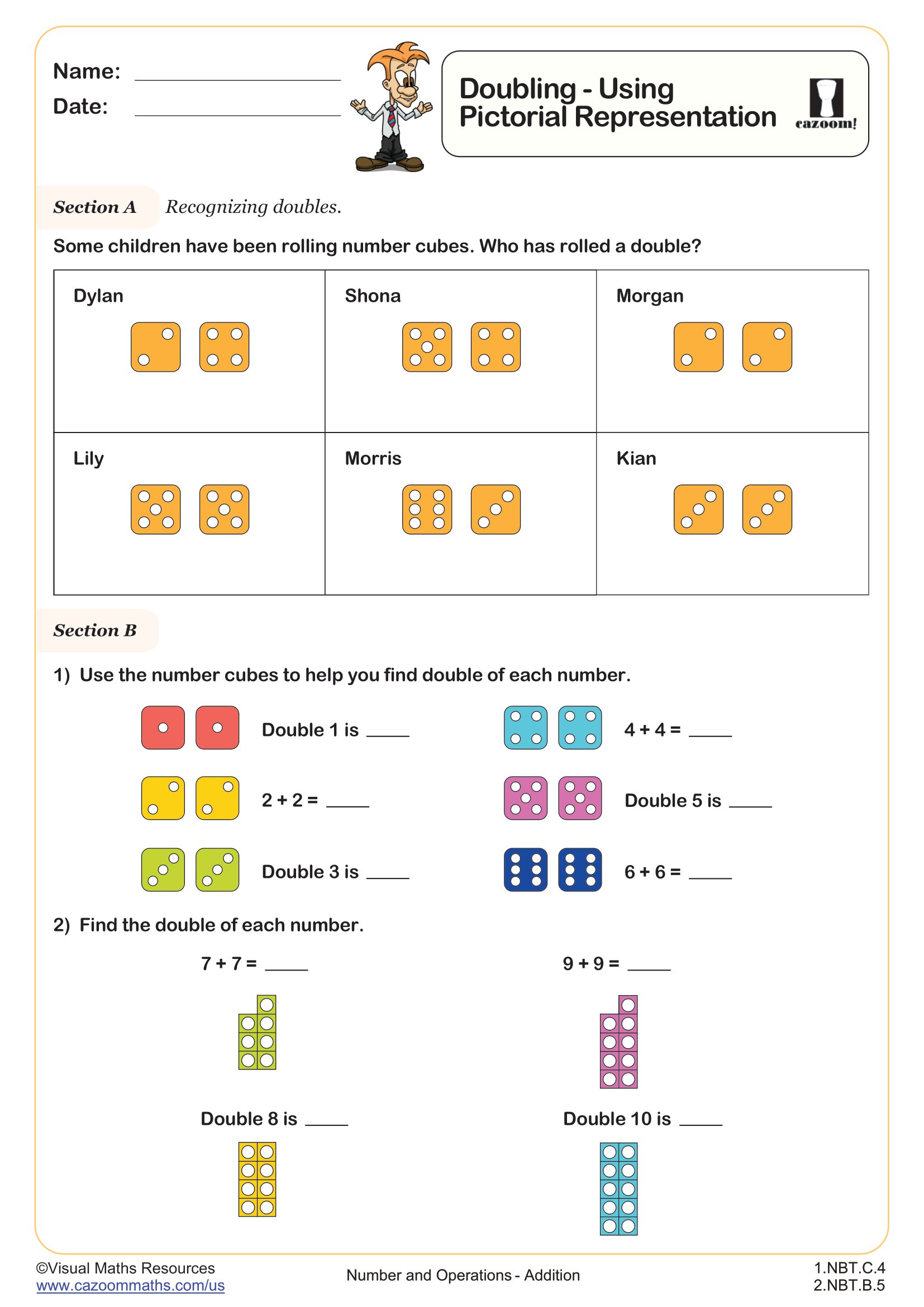
Doubling teaches multiplication through the most intuitive multiplier—two. When students see a picture with four stars, then another picture with four stars, they practice combining equal groups without the cognitive load of larger multipliers. This approach connects directly to the concept that 4 + 4 equals 8, which later translates to understanding that 2 × 4 also equals 8. Pictorial representations make the groups visible, helping students count systematically rather than randomly.
Doubling appears constantly in real-world contexts that 1st graders recognize. Students notice that two hands mean double the fingers, two dice show double the dots, and sharing equally between two people means doubling what one person gets. These connections appear in STEM fields as well—doubling is fundamental to understanding binary systems in computer science, exponential growth in biology, and symmetry in engineering. Building this foundational skill in 1st grade supports mathematical thinking across future learning.
How can teachers use these multiplication worksheets effectively?
These worksheets work best when students have access to manipulatives alongside the pictorial problems. Teachers often notice stronger understanding when students first build the groups with counters or blocks, then complete the worksheet to reinforce what they physically constructed. The visual format allows students to circle or color each group before counting the total, providing a concrete strategy for organizing their thinking. Answer keys let teachers quickly identify whether students counted accurately or need additional practice with one-to-one correspondence.
Many teachers use these worksheets during small group instruction where they can observe student strategies and address misconceptions immediately. The doubling focus makes them particularly useful for students who struggle with addition facts—doubling provides a structured pattern that helps students check their work. These sheets also work well for early finishers who need enrichment beyond basic addition, or as homework that parents can support without needing to teach complex multiplication concepts.