2nd Grade Properties of Shapes Worksheets
All worksheets are created by the team of experienced teachers at Cazoom Math.
What Are the Key Properties of Shapes Students Learn in 2nd Grade?
Second grade students focus on identifying and describing 2D shapes by their defining attributes rather than just their appearance. They learn that triangles always have three sides and three vertices, quadrilaterals have four sides, pentagons have five, and hexagons have six. Students also begin recognizing that shapes can be oriented differently and still maintain the same properties, which aligns with Common Core Standard 2.G.A.1.
A misconception teachers often address is students thinking a rotated square becomes a diamond or a different shape entirely. Students lose points on assessments when they fail to count sides and angles systematically. Teaching students to trace each side with their finger while counting helps them move beyond visual recognition to truly understanding what defines each shape category.
Which Grade Levels Study Properties of Shapes?
This collection focuses specifically on 2nd grade elementary school students, though shape properties form a progression that begins in kindergarten and extends through middle school. At the 2nd grade level, students transition from simply naming shapes to analyzing their attributes and understanding how shapes relate to one another.
The worksheets progress from basic shape identification and vocabulary building through 2D shape word searches to more advanced concepts like area calculations for regular hexagons and shape transformations using enlargements. Students who struggle with recognizing shapes in different orientations benefit from starting with the identification activities before moving to transformation concepts. This scaffolded approach mirrors how standardized tests present geometry questions, beginning with straightforward identification before testing deeper conceptual understanding.
How Do Enlargements and Column Vectors Connect to Shape Properties?
Enlargements introduce students to the concept that shapes can change size while maintaining their fundamental properties. When a triangle enlarges, it still has three sides and three vertices, but the measurements increase proportionally. Column vectors provide a mathematical way to describe these transformations by showing how far and in which direction each point moves, laying groundwork for coordinate geometry in later grades.
Architects and engineers use these transformation concepts when scaling blueprints or creating models of buildings and structures. A toy designer enlarging a prototype to life-size or a graphic designer resizing a logo both apply these same principles. Students often make the connection between enlargements and shadow puppets or projectors, where the shape's properties remain constant even as the size changes, helping them understand that geometric properties are independent of scale.
How Can Teachers Use These Worksheets Most Effectively?
The worksheets provide structured practice that moves from concrete shape recognition to abstract geometric thinking. Students benefit from manipulating physical shapes alongside worksheet completion, especially when working with enlargements and transformations. The answer keys allow for immediate feedback, helping teachers catch errors in reasoning before they become ingrained habits.
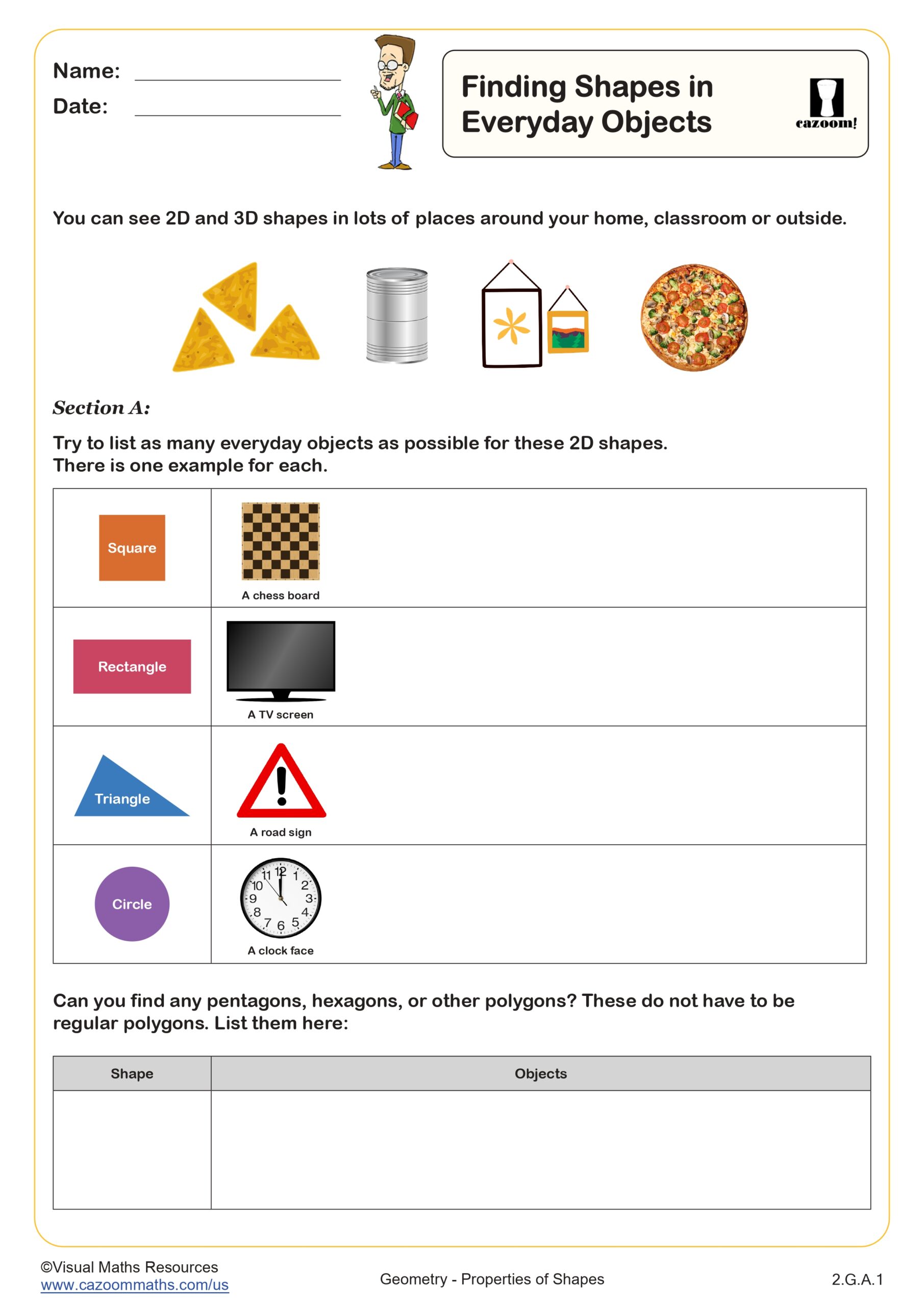
Many teachers use the 2D shape word searches as warm-up activities or fast-finisher tasks, while reserving the enlargement and area worksheets for focused instruction time. The finding shapes in everyday objects activities work particularly well as homework assignments since students can explore their own environments. Pairing students during transformation exercises encourages mathematical discussion about why shapes maintain their properties despite changes in size or position, which deepens conceptual understanding beyond procedural completion.