3rd Grade Number Bonds Over 20 Worksheets
All worksheets are created by the team of experienced teachers at Cazoom Math.
What Are Number Bonds Over 20 and Why Do Third Graders Learn Them?
Number bonds over 20 extend the foundational concept of part-part-whole relationships to larger numbers, specifically focusing on making benchmark numbers like 100 and 1000. In 3rd grade, students use these bonds to develop mental math strategies and deepen their understanding of place value. This aligns with Common Core Standard 3.NBT.A.2, which requires students to fluently add and subtract within 1000 using strategies based on place value.
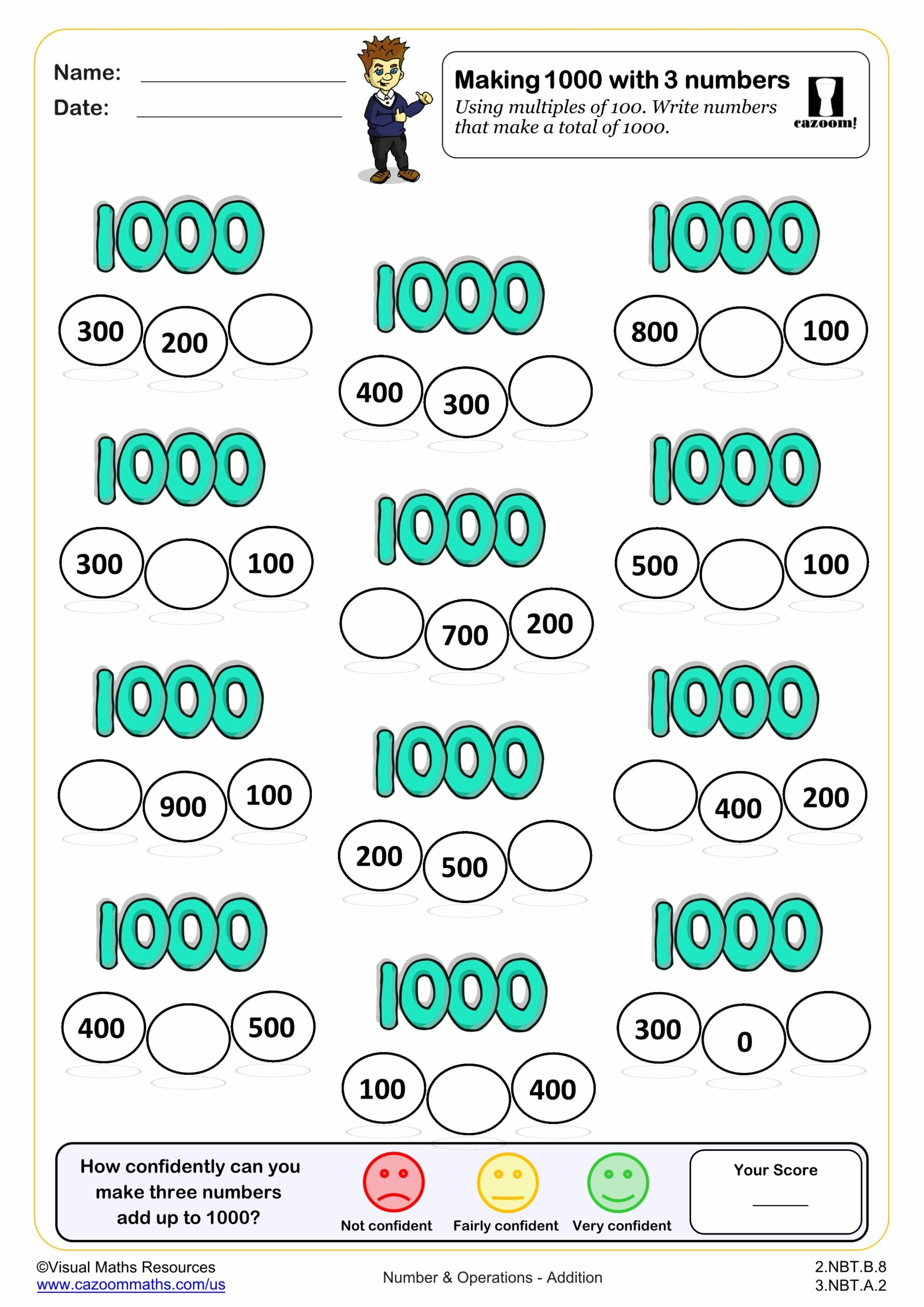
Students often lose points on assessments when they add all three numbers sequentially rather than recognizing which two numbers bond together first to make a friendly number. For example, when making 1000 with 300, 400, and 300, students who add 300 + 400 first, then add 300, work more efficiently than those who move left to right without strategic thinking. This skill directly supports multi-digit addition and prepares students for algebraic thinking where finding missing addends becomes routine.
What Should 3rd Graders Know About Number Bonds to 1000?
By 3rd grade, students should recognize that multiples of 100 bond together using the same patterns they learned with single digits. They understand that 7 + 3 = 10 means 700 + 300 = 1000, applying their earlier knowledge at a larger scale. Students should also work comfortably with three-part bonds, identifying which two numbers combine to create a benchmark number while determining the third addend. This level of place value understanding is expected on state assessments and standardized tests.
This work builds directly on 2nd grade skills where students made 100 with two-digit numbers and prepares them for 4th grade multi-digit operations. Teachers frequently notice that students who struggle with bonds to 1000 often have gaps in their understanding of bonds to 10 and 100. Mastering these larger number bonds gives students the flexibility to break apart and recombine numbers mentally, a strategy that becomes increasingly important as computational complexity increases in upper elementary grades.
How Do Multiples of 10 and 100 Work in Number Bonds?
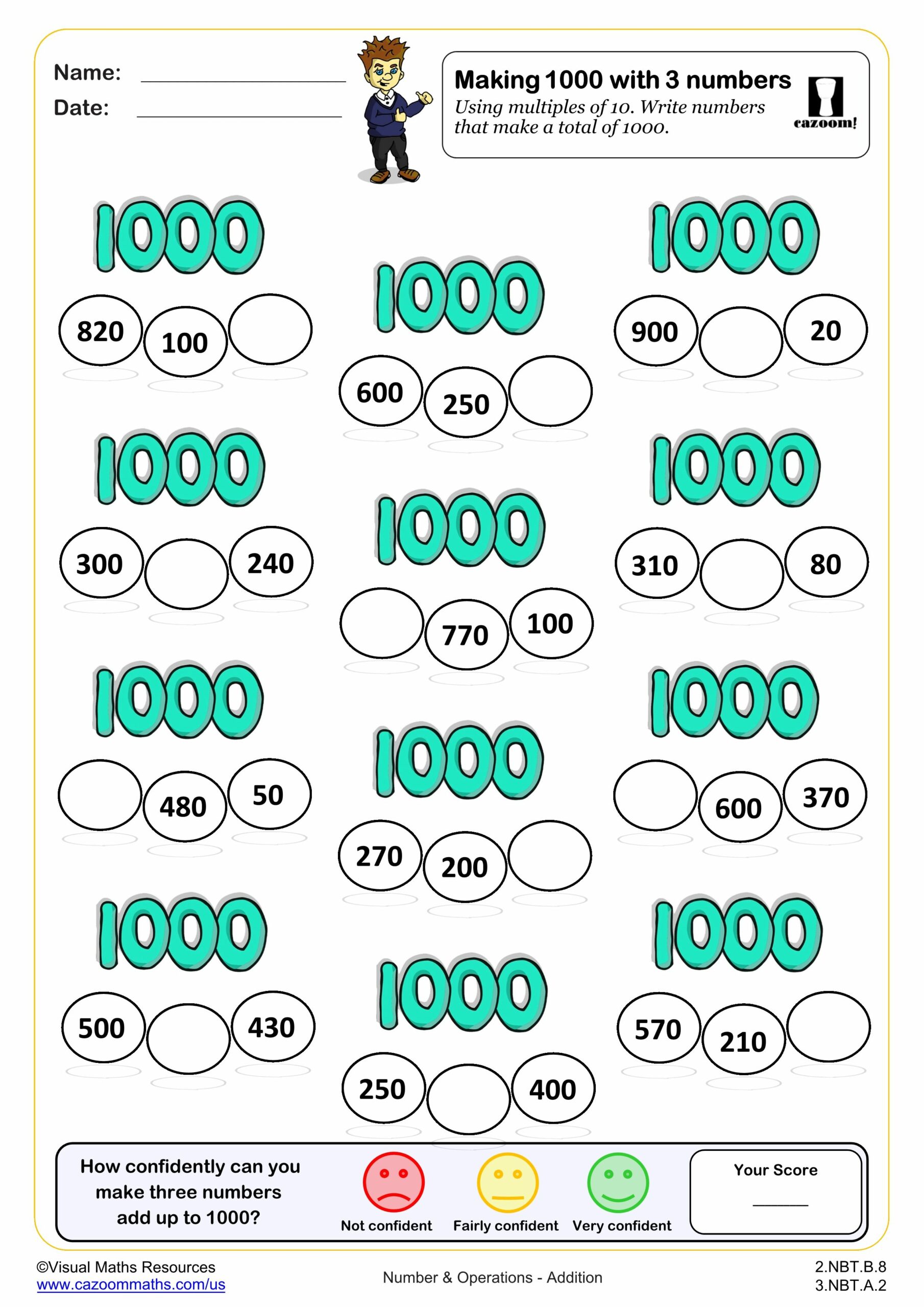
Working with multiples of 10 and 100 helps students recognize place value patterns and apply scaling strategies. When students understand that 40 + 60 = 100, they can extend this thinking to 400 + 600 = 1000 by recognizing they're working with hundreds instead of tens. The worksheets progress from using only multiples of 100 (cleaner, more visual) to multiples of 10 (requiring more careful place value tracking), building complexity gradually. Students typically make the connection between these patterns once they see several examples side by side.
This skill applies directly to real-world contexts like budgeting and estimation. When calculating costs or distances, rounding to multiples of 10 or 100 and using number bonds makes mental math practical. In STEM fields, scientists and engineers regularly estimate measurements by rounding to friendly numbers and mentally checking if totals make sense. Students who develop strong number sense with these bonds can quickly verify whether calculations are reasonable, a critical skill in any quantitative field.
How Can Teachers Use These Number Bond Worksheets Effectively?
These worksheets provide structured practice that moves students from concrete understanding to abstract application. The focus on making 1000 with three numbers challenges students to think strategically about which numbers to combine first, developing their problem-solving flexibility. The answer keys allow students to self-check during independent work or help teachers quickly identify which students need additional support with place value concepts or mental math strategies.
Many teachers use these worksheets during math centers or small group instruction to differentiate for students who need extra practice with larger numbers. They work well as warm-up activities to activate place value thinking before a lesson on multi-digit addition or as homework to reinforce classroom learning. Some teachers pair students and have them explain their thinking process to each other, which helps both students articulate their strategies and catch their own errors. The worksheets also serve as quick formative assessments to gauge whether students are ready to move from multiples of 100 to more complex addends.